Shashthi Shradh 2026: Date, Significance and Ritual Procedure
By Pt. Abhishek Sharma
A sacred observance during Pitru Paksha dedicated to ancestors who passed on Shashthi tithi
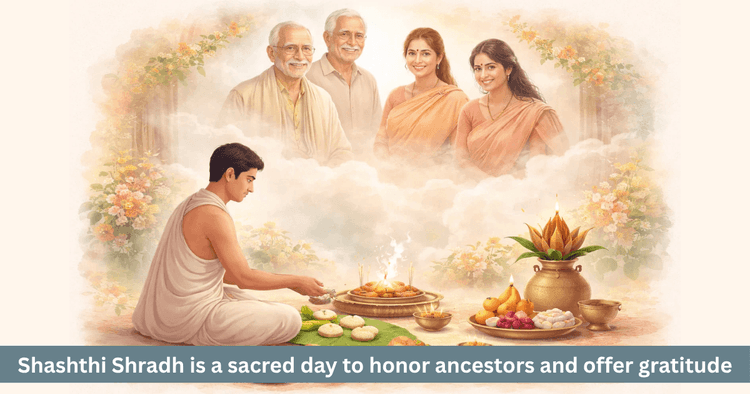
Table of Contents
Every day of Pitru Paksha carries within it a deep sense of memory, duty and gratitude. During this sacred fortnight, one does not perform ritual alone. One reconnects with lineage, with family roots and with the ancestral souls through whom one’s own existence became possible. Shashthi Shradh is one such highly significant observance. It is especially dedicated to those ancestors whose passing took place on a Shashthi tithi, the sixth lunar day. The Shradh performed on this day is understood not merely as remembrance but as a sacred occasion for offering nourishment, tarpan, pinda and reverence to the ancestors, while seeking their blessings for family welfare and continuity.
In many regions, this day is also called Chhath Shradh. Across large parts of North India it is observed with sincere devotion. If in a family any parent, grandparent, great grandparent or revered forebear passed away on a Shashthi tithi, then the Shashthi day of Pitru Paksha is considered especially appropriate for their Shradh. This day is therefore not only a ritual date. It is a living expression of reverence toward one’s lineage and one’s spiritual responsibility toward the ancestors.
When Is Shashthi Shradh 2026
In the year 2026, Pitru Paksha is observed from 26 September and continues until 10 October, ending with Sarva Pitru Amavasya. Within this sequence, Shashthi Shradh falls on Thursday, 1 October 2026. This is the day regarded as especially suitable for Shradh, tarpan and pind daan for ancestors connected to the sixth lunar day.
Main Time Windows for Shashthi Shradh 2026
In ancestral rites, timing is considered important because Shradh karma is generally held to be especially fruitful during the afternoon sacred period. The commonly observed time windows for Shashthi Shradh 2026 are as follows:
| Time Period | Approximate Time | Importance |
|---|---|---|
| Kutup Muhurat | 11:36 AM to 12:24 PM | The primary and most sacred period for Shradh |
| Rohina Muhurat | 12:24 PM to 1:12 PM | The secondary highly auspicious time |
| Aparahna Kala | 1:12 PM to 3:36 PM | A suitable broader period if the earlier windows are missed |
These timings may vary slightly according to place. Therefore it is best to confirm with a local Panchang, family priest or qualified ritual guide according to one’s own location.
What Is Shashthi Shradh
Shashthi Shradh is one of the sixteen Parvan Shradh observances associated with Pitru Paksha. The word Shashthi refers to the sixth lunar day. On this day, Shradh performed for ancestors connected with this tithi is considered especially appropriate.
This day is understood as a subtle spiritual bridge between the ancestral realm and the world of the living. The offerings of water, sesame, sacred grass, pinda and food are not seen as mere outward items. They are regarded as vehicles of remembrance, nourishment, satisfaction and lineage continuity. This is why the inner quality of shraddha, sincere reverence, is considered more important than external display.
In some families, this day is also observed for ancestors whose exact date of passing is uncertain. Yet if the date is known to have been Shashthi, then performing Shradh specifically on Shashthi Shradh is considered more scripturally appropriate and spiritually beneficial.
Who Should Perform Shradh on Shashthi
This Shradh is primarily to be performed by those whose ancestors passed away on a Shashthi tithi of any lunar month. This may apply whether the death occurred in the bright or dark fortnight.
Shradh on this day may be performed for the following:
| For Whom | Suitability |
|---|---|
| Father | If the passing occurred on Shashthi |
| Mother | If the passing occurred on Shashthi |
| Grandfather or Grandmother | If connected with Shashthi tithi |
| Great Grandparents | According to family lineage practice |
| Other Revered Ancestors | If their death is known to have occurred on this tithi |
| Ancestors with uncertain date | In some traditions, through remembrance and offering |
Some regional traditions also give special value to this day for families connected with Chhath observances, Shashthi Devi worship or specific lineage customs. If the exact tithi is not known, Shradh on Sarva Pitru Amavasya is regarded as covering all ancestors. however if the death tithi is known to be Shashthi, then Shashthi Shradh remains the more appropriate day.
The Spiritual Significance of Shashthi Shradh in Pitru Paksha
The word Shradh itself is rooted in shraddha, reverent faith. Without that inner reverence, Shradh is considered incomplete. The significance of Shashthi Shradh may be understood at several levels.
First, it is an acknowledgment of ancestral debt. No human being is self created. Each life stands upon the unseen contributions of lineage, culture, family and forebears. Shradh is the sacred act of remembering that debt with humility.
Second, it is a means of ancestral satisfaction. Through tarpan, sesame, water and pinda, the ritual expresses the wish that the ancestors be nourished and at peace. This belief is not merely symbolic. It is deeply rooted in the ritual and philosophical tradition.
Third, it is a channel for blessings. Satisfied ancestors are believed to bless the family with well being, continuity, inner peace, prosperity and harmonious family life.
Fourth, it cultivates spiritual humility. Shradh reminds the human being that life is not limited to the present moment alone. It is linked to both what came before and what will continue after.
What Is the Full Ritual Procedure of Shashthi Shradh
The ritual of Shashthi Shradh generally follows the traditional Parvan Shradh format. Minor differences may exist across regions but the common sequence is as follows.
1. Morning Bath and Purification
The day begins with an early bath. If a sacred river or pilgrimage place is available, bathing there is considered especially meritorious. Otherwise one bathes at home and wears clean garments. Purification is understood not only as bodily cleansing but also as purification of mind and intention.
2. Preparation of the Sacred Space and Materials
A clean place is prepared and one usually sits facing south, which is associated with the ancestors. The following items are commonly used:
| Material | Purpose |
|---|---|
| Kusha grass | Purity, sankalpa and tarpan |
| Black sesame | Tarpan and ancestral satisfaction |
| Water | Tarpan |
| Cooked rice | For preparing pinda |
| Barley or barley flour | For pinda or offering |
| Ghee | Purity and pinda mixture |
| Honey | Mixed into pinda |
| Flowers | Worship |
| Leaf plate or vessel | Offering arrangement |
| Food for Brahmin feeding | Completion of Shradh |
3. Sankalpa
The sankalpa is one of the most important parts of the ritual. Here the performer states name, gotra, place, tithi and the names of the ancestors being remembered. This is the moment when the direction of the rite is inwardly established.
4. Tarpan
In tarpan, water mixed with black sesame and accompanied by kusha is offered with remembrance of the ancestors. It is believed that this offering reaches them in a subtle form. During tarpan the mind should remain focused and sincere.
5. Pind Daan
Pind daan is the central part of Shradh. Rice balls are prepared from cooked rice mixed with sesame, ghee, honey and sometimes barley. Each pinda is offered in the name of a specific ancestor. These pindas are not treated merely as symbolic food but as a means of nourishment for the subtle ancestral being.
6. Feeding a Brahmin and Giving Dakshina
Feeding a worthy Brahmin is regarded as an important part of completing Shradh. This is not seen merely as charity but as a sacred extension of ancestral offering. After the meal, dakshina, cloth or some form of respectful offering may be given according to ability.
7. Offering Food to Sacred Creatures
In many traditions, food is also offered to a cow, crow, dog or other living beings. This reflects a broader spirit of compassion and the recognition of divine presence throughout life.
Is Shashthi Shradh More Fruitful at a Sacred Pilgrimage Site
Tradition considers Shradh performed at a sacred pilgrimage site to be especially meritorious. Places such as Prayag, Gaya, Kashi, Haridwar, river banks and other holy sites are often regarded as especially powerful for pinda and tarpan. The reason is not merely geographical. It is connected with the long standing spiritual discipline and ritual sanctity associated with those places.
Even so, it is important to understand that if travel to such a place is not possible, Shradh performed at home or at a nearby sacred place with sincere reverence is also meaningful. The heart of Shradh lies in purity, intent and faithful observance.
What Should Be Kept in Mind While Performing Shashthi Shradh
There are certain important observances associated with the day:
| Point of Care | Why It Matters |
|---|---|
| Do not rush the ritual | Shradh is guided by reverence |
| Avoid anger and conflict | Mental purity is important |
| Keep food sattvic | Purity supports ancestral rites |
| Stay away from intoxication and tamasic habits | The ritual atmosphere should remain spiritually clean |
| Give charity according to ability | It supports the completeness of the rite |
| Respect local and family traditions | Lineage custom carries importance |
What If the Exact Death Tithi Is Not Known
In many families, especially for earlier generations, the precise lunar date of death may no longer be known. In such cases, Sarva Pitru Amavasya is traditionally observed for all ancestors. however if family memory or lineage custom indicates some connection with Shashthi, remembrance and offering may still be made on this day. Guidance from the family priest is helpful in such situations.
How Is This Ritual Linked With Family Welfare
Ancestral rites are not viewed only as acts for the peace of the departed. They are also traditionally connected with the harmony, continuity and subtle well being of the living family. Contented ancestors are believed to bless the family line. Questions of peace in the household, lineage continuity, release from ancestral imbalance and inner stability are all traditionally connected with the proper observance of Shradh.
For this reason, Shashthi Shradh may be understood not only as a memorial rite but also as an important day of spiritual responsibility toward the family’s deeper continuity.
The Deeper Essence of This Sacred Day
Shashthi Shradh 2026 is not merely one date in the ritual calendar. It is a sacred opportunity to express humility, gratitude and acknowledgment of ancestral debt. For families who know that a revered ancestor passed away on Shashthi tithi, this day carries special significance. Bathing, sankalpa, tarpan, pind daan, feeding a Brahmin and giving in charity on this day are all held to be auspicious for ancestral satisfaction and family welfare.
That is the deeper essence of this observance. A human being is responsible not only to the present but also to the past. And when that responsibility is fulfilled with reverence, a sacred bridge is formed between lineage, memory and spiritual balance.
Frequently Asked Questions
1. When is Shashthi Shradh 2026
Shashthi Shradh 2026 falls on Thursday, 1 October 2026.
2. For whom is Shashthi Shradh performed
It is primarily performed for ancestors whose passing took place on a Shashthi tithi.
3. What is the main time for Shashthi Shradh
Kutup Muhurat and Rohina Muhurat are considered especially important, along with the broader Aparahna period.
4. Can Shashthi Shradh be performed at home
Yes. If going to a pilgrimage place is not possible, it may be performed properly at home or at a nearby sacred place.
5. What if the exact death tithi is not known
In such a case, Shradh is usually performed on Sarva Pitru Amavasya, though remembrance on Shashthi may also be done according to family custom.
Get your accurate Kundali
Generate KundaliDid you like it?
Author

Pt. Abhishek Sharma (63)
Experience: 20
Consults About: Family Planning, Career
Clients In: Punjab, Haryana, Delhi
Share this article with friends and family
About ZODIAQ
ZODIAQ is an online Vedic Astrology platform. It connects clients seeking astrological advice to experienced astrologers with deep knowledge. Our users also generate kundali and perform kundali milan for free. ZODIAQ also offers services to the Astrologers. Astrologers utilize various offerings by ZODIAQ to serve their clients effectively.
If you are a User
Consult with experienced astrologers and seek their guidance. You can also order handwritten Janm Patrika report with life prediction prepared by experienced astrologers. Generate accurate Kundali, perform Kundali Matching and check horoscope and muhurat. Utilize our online library for all the necessary astrological and spiritual information.
If you are an Astrologer
Create accurate kundali for your clients and perform Kundali Matching for up to 5 people at a time. Write comprehensive Janm Patrika report for your clients with ZODIAQ. Check client details anytime by saving it in client directory. Become more productive by tracking how many clients you guide every day.
WELCOME TO
ZODIAQ
Right Decisions at the right time with ZODIAQ
