Hindu Calendar: Shukla Paksha and Krishna Paksha Meaning and Calculation
By Pt. Suvrat Sharma
Choosing Auspicious Moments and Spiritual Insight Based on Paksha and Panchang
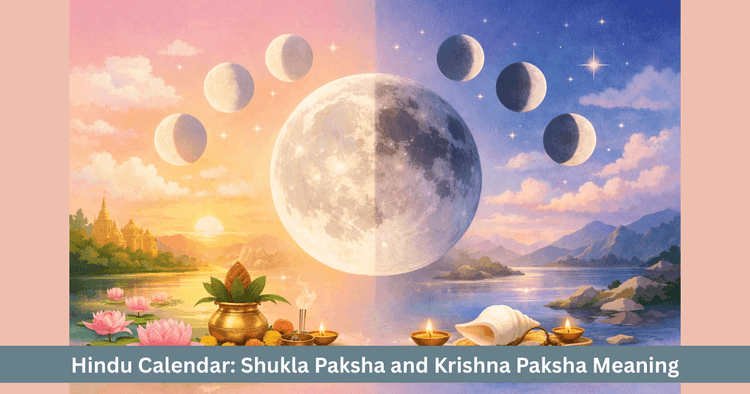
Table of Contents
In the Hindu tradition, for any festival, vow or auspicious ceremony, looking only at the date is considered incomplete. One must also consider the paksha, the lunar tithi and the condition of the Moon. The traditional panchanga is in fact a complete Hindu calendar, describing the day, tithi, nakshatra, yoga and karana along with clear information about Shukla and Krishna Paksha. When a person understands these pakshas correctly, choosing auspicious moments and aligning life with the lunar rhythm becomes easier.
How are pakshas calculated in the Hindu calendar and panchanga
To begin, it is useful to understand how a lunar month in the Hindu calendar is structured.
| Basis | Description |
|---|---|
| One lunar month | Considered to have about 30 tithis |
| Number of pakshas | 2 pakshas, each containing 15 tithis |
| Start and end of lunar cycle | From Amavasya to Purnima or from Purnima to Amavasya |
| Main pakshas | Shukla Paksha and Krishna Paksha |
The monthly panchanga, commonly referred to as the Hindu calendar, divides these 30 days into two equal parts. In one part the Moon waxes and in the other it wanes and these are known as Shukla and Krishna Paksha.
What is Krishna Paksha
On the night of Purnima, the full Moon shines with complete radiance. From the very next day Krishna Paksha begins.
- Krishna Paksha runs from the day after Purnima until Amavasya.
- It is a period of 15 tithis during which the visible disc of the Moon gradually becomes smaller each day.
- As the tithis advance, both the size and the brightness of the Moon reduce and the nights become darker.
Which tithis belong to Krishna Paksha
The tithis of Krishna Paksha are generally counted in the following sequence.
- Purnima
- Pratipada
- Dwitiya
- Tritiya
- Chaturthi
- Panchami
- Shashthi
- Saptami
- Ashtami
- Navami
- Dashami
- Ekadashi
- Dwadashi
- Trayodashi
- Chaturdashi
The next day brings Amavasya, when the Moon is not visible and a new lunar cycle begins afterwards.
Why is Krishna Paksha considered less auspicious for certain works
According to tradition, Krishna Paksha is usually avoided for certain auspicious beginnings such as marriages or major celebrations unless there is a special reason indicated by scripture or local custom.
- From an astrological viewpoint the waning Moon is seen as a phase where emotional and mental energy symbolically reduces.
- After Purnima, as the Moon’s light decreases, this is interpreted as a period of declining strength.
- The increasing darkness of the nights reinforces the idea that this time is more suitable for restraint, introspection and quieter inner work rather than for major festivities.
Still, not all good actions are prohibited. Many vows, austerities and rites related to ancestors and inner purification are considered especially beneficial during Krishna Paksha.
What is Shukla Paksha
On the night of Amavasya, the Moon is not visible or appears only as a faint trace. From the next day Shukla Paksha begins.
- The 15 days following Amavasya are called Shukla Paksha.
- During this period the Moon grows a little each day and the nights gradually become brighter.
- Shukla Paksha culminates in Purnima, when the Moon is full and shines with maximum light.
Which tithis belong to Shukla Paksha
The tithis of Shukla Paksha are usually described as follows.
- Amavasya
- Pratipada
- Dwitiya
- Tritiya
- Chaturthi
- Panchami
- Shashthi
- Saptami
- Ashtami
- Navami
- Dashami
- Ekadashi
- Dwadashi
- Trayodashi
- Chaturdashi
The following day is Purnima, seen as the peak of Shukla Paksha.
Why is Shukla Paksha regarded as auspicious and growth oriented
The steadily increasing light of the Moon in Shukla Paksha is regarded as very supportive for auspicious works.
- As the Moon waxes, it symbolically reflects an increase in mental stability, enthusiasm and creative energy.
- For this reason many important ceremonies such as marriage, house entry, new business or samskaras are usually scheduled in Shukla Paksha, unless a specific tithi or yoga suggests otherwise.
- On Purnima the Moon is at its fullest, so it is seen as a sign of abundance and completeness.
This phase is not only about outer prosperity. It also hints at inner growth and the rise of sattvic qualities.
Puranic stories related to Shukla and Krishna Paksha
Scriptures and Puranas also present beautiful stories explaining the origin of these pakshas, which help us see the waxing and waning of the Moon not only as astronomy but as lessons about life.
Story of the beginning of Krishna Paksha
According to a well known narration Daksha Prajapati had 27 daughters, who are in fact the 27 nakshatras. All of them were married to the Moon.
The difficulty arose when the Moon began to show special affection towards Rohini, one of the daughters.
- His behaviour towards the other wives became dry and neglectful.
- The remaining daughters complained to their father Daksha that the Moon did not give them equal love and respect.
- Daksha instructed the Moon to treat all his wives with equality but the Moon’s inclination towards Rohini continued.
When things did not change, Daksha became angry and cursed the Moon with kshaya roga, a wasting disease. Because of this curse the brilliance of the Moon began to diminish gradually. This waning of the Moon’s light came to be recognised as the beginning of Krishna Paksha.
Through this story tradition conveys that when someone becomes partial and imbalanced, their charm, respect and radiance slowly fade.
Story of the beginning of Shukla Paksha
Seeing his light fade and his end approaching, the Moon became deeply distressed.
- In that state he turned towards Lord Shiva and engaged in intense worship.
- Pleased with his devotion, Shiva accepted the Moon on his matted locks.
- By the grace of Shiva, the Moon’s radiance slowly returned and he was protected from complete destruction.
However the curse of Daksha could not be entirely removed, so it was modified. A new arrangement was made that the Moon’s light would decrease for 15 days and then increase for 15 days.
- The phase of decreasing light became Krishna Paksha.
- The phase of increasing light became Shukla Paksha.
This is described as the origin of Shukla Paksha. The story also suggests that when our light, enthusiasm or honour begins to fade, sincere surrender, repentance and devotion can open the way for renewal.
Understanding life’s rhythm through Shukla and Krishna Paksha
Shukla and Krishna Paksha are not only technical divisions of the calendar. They mirror the rhythm of mind and life.
- Krishna Paksha teaches that after every fullness there comes a phase when energy recedes. It is a suitable time for restraint, letting go, self observation and inward focus.
- Shukla Paksha reminds us that after the deepest darkness of Amavasya, light surely returns. It is a favourable period for new beginnings, resolutions, efforts and growth.
A person who plans important steps in tune with these lunar phases often finds a deeper harmony with nature and with the movement of the inner world.
Frequently asked questions about Shukla and Krishna Paksha
Must all auspicious works always be done only in Shukla Paksha
Most major auspicious works are indeed preferred in Shukla Paksha, yet this is not an unbreakable rule in every situation. Some specific tithis, yogas or local traditions may also treat selected days of Krishna Paksha as suitable. It is best to consider paksha, tithi and muhurat together.
Which types of activities are suitable for Krishna Paksha
Inner work such as self reflection, spiritual practice, japa, penance, rites for ancestors, release of debts or shedding harmful habits is often found to be more effective in Krishna Paksha, as this period naturally supports introversion and sobriety.
Are Shukla and Krishna Paksha the same across all places
The sequence of Shukla and Krishna Paksha is universally the same but the clock timings of tithi start and end differ by location. For precise guidance one should follow a panchanga calculated for the local region.
Does a tithi always change at sunrise
In strict calculation a tithi changes according to the movement of the Moon and may shift at any time of day or night. In practical decisions about fasts and festivals, the tithi present at sunrise is often given importance but detailed rules of the panchanga are also considered.
How can the understanding of pakshas support personal spiritual practice
If a person uses Shukla Paksha for new practices, commitments and positive expansion and uses Krishna Paksha to consciously drop unnecessary burdens and patterns, then the spiritual journey can progress in greater balance, in rhythm with the lunar cycle.
Get your accurate Kundali
Generate KundaliDid you like it?
Author

Pt. Suvrat Sharma (63)
Experience: 20
Consults About: Family Planning, Career
Clients In: Punjab, Haryana, Delhi
Share this article with friends and family
About ZODIAQ
ZODIAQ is an online Vedic Astrology platform. It connects clients seeking astrological advice to experienced astrologers with deep knowledge. Our users also generate kundali and perform kundali milan for free. ZODIAQ also offers services to the Astrologers. Astrologers utilize various offerings by ZODIAQ to serve their clients effectively.
If you are a User
Consult with experienced astrologers and seek their guidance. You can also order handwritten Janm Patrika report with life prediction prepared by experienced astrologers. Generate accurate Kundali, perform Kundali Matching and check horoscope and muhurat. Utilize our online library for all the necessary astrological and spiritual information.
If you are an Astrologer
Create accurate kundali for your clients and perform Kundali Matching for up to 5 people at a time. Write comprehensive Janm Patrika report for your clients with ZODIAQ. Check client details anytime by saving it in client directory. Become more productive by tracking how many clients you guide every day.
WELCOME TO
ZODIAQ
Right Decisions at the right time with ZODIAQ
