Surya Grahan 2026: August 12 Solar Eclipse and Its Spiritual Perspective
By Aparna Patni
Learn about the astronomical features and astrological significance of the solar eclipse during Shravan month
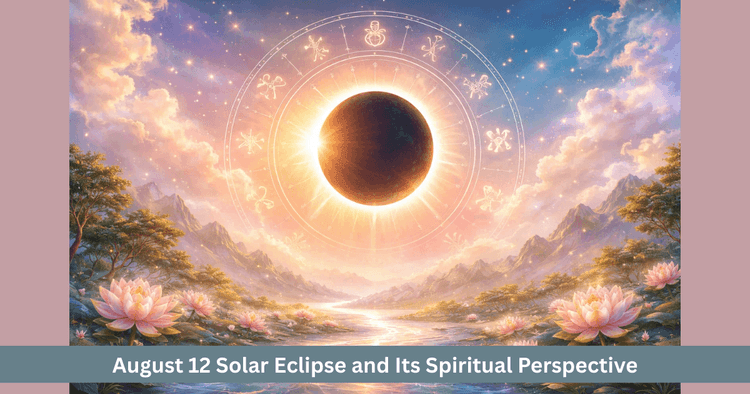
Table of Contents
The Surya Grahan of 12 August 2026 arrives during the sacred season of Shravan and is being described as a particularly striking astronomical event. Astronomers have noted that this solar eclipse will be long in duration and visually impressive in the regions where it is visible. According to the given details, the eclipse will occur in the zodiac sign Cancer and under Ashlesha nakshatra, which also gives it a place in astrological discussions, although it will not be visible from India.
Solar Eclipse 12 August 2026: Date, Timings and Zodiac Details
This solar eclipse follows a recent lunar eclipse and is regarded as one of the noteworthy celestial events of the year 2026. The start and end of the eclipse in Indian Standard Time can be summarised as follows.
| Detail | Date | Time |
|---|---|---|
| Eclipse begins | 12 August 2026 | Around 9:04 PM IST |
| Eclipse ends | 13 August 2026 | Around 4:25 AM IST |
| Zodiac sign | Cancer | Throughout the eclipse |
| Nakshatra | Ashlesha | During the main phase of the eclipse |
For India, the entire span of the eclipse lies within the night hours, when the Sun is already below the horizon. Because of this, the eclipse will not be visible from Indian locations, even though it remains an important part of the astronomical calendar for that period.
Where Will the 2026 Solar Eclipse Be Visible and What about India?
The path of this solar eclipse will cover parts of North America, sections of Europe and northern polar regions. Countries and regions such as Greenland, Iceland, Spain, Portugal and Russia are expected to witness the most impressive views of this event. In some areas the Moon will appear to cover the Sun so completely that daytime darkness or very subdued light will be experienced for a short period.
In contrast, for India the timings fall during the night. The Sun will already have set by the time the eclipse begins and it will still be below the horizon when the eclipse ends. As a result, the event will not be visible from the Indian subcontinent. From a practical and religious standpoint this also means that temple worship and daily rituals in India will continue in their normal form without interruption.
Rahu, Ketu and the Astrological View of Surya Grahan
In Vedic astrology, solar eclipses are linked with the shadow nodes Rahu and Ketu. The alignment of the Sun and Moon near these nodes is what gives rise to the eclipse condition. This is seen as a time when subtle shifts in energy take place and many traditions use such periods as reminders for self awareness and inner discipline.
Even so, in the specific case of this eclipse, its astrological influence in India is often treated with moderation because the event is not visible here. For those who choose a scientific approach, the eclipse is a natural part of the Sun Moon Earth relationship. For those with a devotional perspective, it can be viewed as a symbolic call to re examine patterns of attachment, ego and emotional intensity, especially as the eclipse occurs in Cancer and Ashlesha.
Does Sutak Apply in India for This Solar Eclipse?
According to traditional rules, the Sutak period associated with eclipses is observed only in regions where the eclipse is visible in the sky. Since the 12 August 2026 solar eclipse will not be visible from India, the Sutak restrictions do not apply for Indian locations.
This implies the following for daily life and temple worship.
- Temples may remain open with regular aarti, abhishek and darshan as usual.
- Families can continue with cooking, eating, travel and planned ceremonies without needing to halt activities because of the eclipse.
- Any additional observance, such as extra prayers or a personal vow for that night, remains a matter of individual choice rather than social obligation.
Thus, while the eclipse has symbolic and astronomical interest, it does not impose ritual limitations on routine activities in India.
What Is Considered Auspicious to Do During a Solar Eclipse?
In regions where the eclipse is visible, many traditions suggest that the eclipse period can be used for mantra recitation, meditation and quiet charity. Even though the 2026 solar eclipse will not be seen in India, the general principles that are often associated with such times can still be understood.
- If someone wishes, they may spend part of the eclipse period in silent remembrance of the divine, repeating a chosen mantra or prayer.
- After the eclipse ends, some people like to take a purifying bath and wear clean clothes before resuming normal activities, although in the Indian context for this eclipse it remains a voluntary practice.
- Acts of charity, especially giving food, clothes or helpful items to those in need, are always appropriate around the time of eclipses and other celestial events.
The essential point is that eclipses need not be a cause for fear. They can be used as quiet prompts to pause, reflect and offer something good to others.
How Can the August 12 Solar Eclipse Guide Personal Reflection?
This solar eclipse is mentioned as the last solar eclipse of 2026, to be followed by a lunar eclipse on 28 August that same year. Together, this sequence can be taken as a symbolic cycle. The solar eclipse hints at a temporary dimming of outer brightness, encouraging attention towards inner light and clarity. The subsequent lunar eclipse then subtly emphasises emotional awareness and integration.
For those inclined towards inner work, the Surya Grahan of 12 August 2026 can be a reminder to look at how energy is being used, which areas of life feel drained and where greater balance is needed. It invites a shift from worry about external shadows towards a steadier trust in the deeper light that does not depend on constant sunshine.
Frequently Asked Questions
When will the solar eclipse take place in 2026 and what are the timings in IST?
The solar eclipse of 2026 will occur on 12 August. In Indian Standard Time the eclipse is expected to begin around 9:04 PM and end around 4:25 AM on 13 August.
Will the 12 August 2026 solar eclipse be visible from India?
No, it will not be visible from India because the entire eclipse takes place during local night hours when the Sun is below the horizon.
Is Sutak observed in India for this particular eclipse?
Sutak is not observed in India for this eclipse, since traditional rules apply Sutak only in regions where the eclipse is actually visible.
Which regions of the world will see this solar eclipse?
The eclipse will be visible across parts of North America, regions of Europe and northern polar zones including Greenland, Iceland, Spain, Portugal and Russia.
Is it necessary to change daily routine because of this eclipse in India?
It is not necessary to change routine activities in India. Those who wish may add personal practices like extra prayer or charity but regular cooking, worship and ceremonies can continue as usual.
Get your accurate Kundali
Generate KundaliDid you like it?
Author

Aparna Patni (63)
Experience: 20
Consults About: Family Planning, Career
Clients In: Punjab, Haryana, Delhi
Share this article with friends and family
About ZODIAQ
ZODIAQ is an online Vedic Astrology platform. It connects clients seeking astrological advice to experienced astrologers with deep knowledge. Our users also generate kundali and perform kundali milan for free. ZODIAQ also offers services to the Astrologers. Astrologers utilize various offerings by ZODIAQ to serve their clients effectively.
If you are a User
Consult with experienced astrologers and seek their guidance. You can also order handwritten Janm Patrika report with life prediction prepared by experienced astrologers. Generate accurate Kundali, perform Kundali Matching and check horoscope and muhurat. Utilize our online library for all the necessary astrological and spiritual information.
If you are an Astrologer
Create accurate kundali for your clients and perform Kundali Matching for up to 5 people at a time. Write comprehensive Janm Patrika report for your clients with ZODIAQ. Check client details anytime by saving it in client directory. Become more productive by tracking how many clients you guide every day.
WELCOME TO
ZODIAQ
Right Decisions at the right time with ZODIAQ
