Trayodashi Shradh 2026: Date, Muhurat, Significance and Ritual Method
By Pt. Narendra Sharma
Special Shradh performed on the thirteenth day of Pitru Paksha
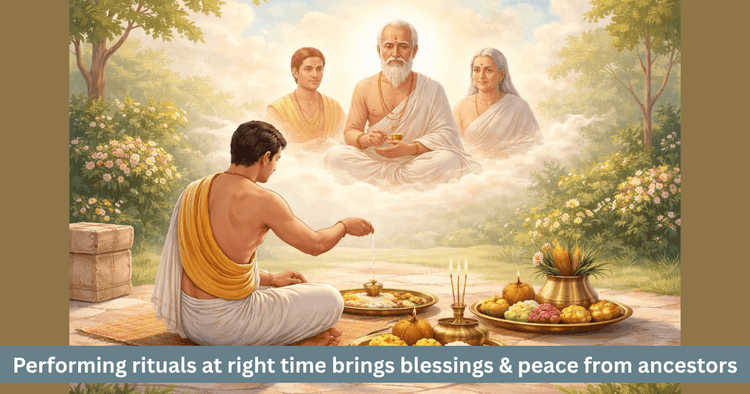
Table of Contents
The thirteenth day of Pitru Paksha is observed as Trayodashi Shradh and this day carries within it a deep feeling of remembrance, compassion and special ancestral duty. In the year 2026, Trayodashi Shradh will be observed on Thursday, October 8, 2026. On this day, Kutup Muhurat will be from 11:45 AM to 12:32 PM, Rohina Muhurat will be from 12:32 PM to 01:19 PM and Aparahna Kala will continue from 01:19 PM to 03:39 PM. Trayodashi Tithi begins on October 7, 2026 at 11:16 PM and ends on October 8, 2026 at 10:15 PM. For Shradh rites, Kutup, Rohina and Aparahna Kala are regarded as especially auspicious.
What is Trayodashi Shradh
Trayodashi Shradh is observed on the day in Pitru Paksha that corresponds to Trayodashi Tithi, meaning the thirteenth lunar day. It is performed for those ancestors who departed on Shukla Paksha Trayodashi or Krishna Paksha Trayodashi of any lunar month. Among the tithi based Shradh observances, it has its own distinct place because it comes in the later phase of Pitru Paksha, when the seriousness of remembrance becomes even deeper.
The Shradh performed on this day is not seen merely as routine observance of a calendar date. It is also understood as a renewal of the sacred bond that continues between living descendants and departed ancestors through dharma, family memory and gratitude.
For whom is Trayodashi Shradh performed
The first and primary right of Trayodashi Shradh belongs to those ancestors whose death took place on Trayodashi Tithi. Yet the importance of this day does not remain limited to them alone. Tradition also holds that this Shradh is performed for children who passed away at a young age, regardless of the month, paksha or tithi in which they died.
Because of this, Trayodashi Shradh carries a very tender dimension. For families that have suffered the loss of a child in early life, this day becomes deeply emotional. Through this Shradh, prayers are offered for the peace, well being and divine protection of that soul.
Is Trayodashi Shradh also connected with Magha Shradh
In some traditions, Trayodashi Shradh is also linked with Magha Shradh because in many years Magha Nakshatra may occur around Trayodashi. Since Magha Nakshatra is associated with the Pitru Devas, meaning the ancestral divine beings, any connection of Magha with Pitru Paksha is regarded as especially significant.
Even so, it is important to understand that Trayodashi Shradh and Magha Shradh are not founded on the same principle. Trayodashi Shradh is primarily tithi based, while Magha Shradh is regarded as nakshatra based. therefore in years when both coincide, the day gains added significance and in years when they do not, Trayodashi Shradh still remains fully valid in its own independent importance.
Date and muhurat of Trayodashi Shradh 2026
In the year 2026, Trayodashi Shradh will be observed on October 8. The principal ritual timings for this day are as follows:
| Details | Time |
|---|---|
| Date of Trayodashi Shradh | Thursday, October 8, 2026 |
| Kutup Muhurat | 11:45 AM to 12:32 PM |
| Duration (Kutup Muhurat) | 47 minutes |
| Rohina Muhurat | 12:32 PM to 01:19 PM |
| Duration (Rohina Muhurat) | 47 minutes |
| Aparahna Kala | 01:19 PM to 03:39 PM |
| Duration (Aparahna Kala) | 02 hours 20 minutes |
| Trayodashi Tithi begins | October 7, 2026 at 11:16 PM |
| Trayodashi Tithi ends | October 8, 2026 at 10:15 PM |
It is traditionally held that Kutup and Rohina Muhurat are the finest timings for Shradh. If the ritual cannot be completed in these periods, it should still be completed within Aparahna Kala.
Why are Kutup, Rohina and Aparahna Kala so important
In ancestral rites, timing is not merely a matter of convenience. It is considered part of the spiritual suitability of the ritual. Kutup Muhurat is counted among the most sacred timings for Shradh. The Rohina Muhurat that follows it is also accepted as equally auspicious.
When these two muhurats pass, Aparahna Kala still continues. In the Dharmashastra tradition, it is said that Shradh should be completed before the end of the Aparahna period. This is why these timings are repeatedly emphasized in the ritual tradition.
How should Trayodashi Shradh be performed
The ritual method of Trayodashi Shradh follows the general rules of Pitru Paksha Shradh but the sankalpa is directed specifically toward ancestors who died on Trayodashi or toward children who departed at a young age.
Morning purification
The day begins with a morning bath. Clean and sattvic clothing is worn. White or light coloured garments are generally preferred. It is considered proper to keep the mind calm, avoid anger and maintain restrained conduct before the ritual begins.
Sankalpa
The Shradh begins with Sankalpa, meaning the sacred declaration of intent. In this, the performer states their name, gotra and the names of the ancestors for whom the Shradh is being performed. If the Shradh is for a child who passed away young, this is specifically stated in the sankalpa.
Tarpan
In Tarpan, meaning the sacred water offering, water is offered using black sesame seeds and Kusha grass. While remembering the names of the ancestors, water is offered through the right hand. This act is not viewed as symbolic alone. It is regarded as a subtle means by which reverence reaches the ancestors.
Pinda Daan
Pinda Daan, meaning the offering of ritual food balls, is one of the most important parts of Shradh. Pindas are prepared with rice, sesame seeds, ghee and other sattvic ingredients and offered in the names of the ancestors. When performed for children, the offering is made with a particularly tender feeling of compassion and blessing.
Brahmin Bhojan and charity
Brahmin Bhojan, meaning feeding a worthy Brahmin, is considered essential for the completion of Shradh. A sattvic meal is served with reverence. After the meal, dakshina, cloth or other charity may be offered according to one’s capacity. Tradition holds that food and gifts offered with shraddha, meaning reverent faith, reach the ancestors in subtle form.
Food for the crow, cow and other beings
In many traditions, food is also set aside after Shradh for the crow, cow and other beings. The crow in particular is considered a messenger of the ancestral realm, so feeding it is regarded as auspicious.
Scriptural significance of Trayodashi Shradh
In Puranic understanding, Shradh is not viewed merely as a family custom. It is understood as a religious duty connected with Pitru Rin, meaning ancestral debt. According to tradition, one who performs Shradh properly receives the blessings of the ancestors. In the tradition associated with the Markandeya Purana, one finds the idea that a person who completes all Shradh rites with devotion receives health, prosperity, happiness and ultimately auspicious spiritual welfare.
This idea is not limited to worldly gain. Actions that satisfy the ancestors are also believed to bring balance within the family, calmness of mind and continuity of inherited values. For this reason, Trayodashi Shradh is understood not only as remembrance of the dead but as a sacred duty that keeps the living bond with the lineage intact.
What should be done on the day of Trayodashi Shradh
| What should be done | Why it should be done |
|---|---|
| Perform Shradh during Kutup or Rohina Muhurat | These are regarded as the finest timings for Shradh |
| Use black sesame seeds and Kusha grass in tarpan | This is scripturally accepted for ancestral offerings |
| Keep the sankalpa clear | The offering is properly directed to the intended ancestor or child |
| Prepare sattvic food | It preserves the ritual purity |
| Feed a Brahmin | It is considered necessary for the completion of Shradh |
| Offer food to the crow and cow | This is part of the traditional completion of ancestral rites |
| Keep the mind peaceful | Purity of feeling is essential in Shradh |
What should be avoided on the day of Trayodashi Shradh
| What should be avoided | Why it should be avoided |
|---|---|
| Do not extend Shradh beyond Aparahna Kala | The principal ritual period is accepted only until the afternoon |
| Do not consume onion, garlic, non vegetarian food or tamasic food | Sattvic purity is the basic rule of Shradh |
| Do not rush the ritual | Both reverence and proper sequence are important |
| Do not engage in loud argument or entertainment | This day is meant for restraint and remembrance |
| Do not use impure or unsuitable vessels | Purity and ritual care must be maintained |
Why is this day especially important for children who passed away young
The most tender and distinctive aspect of Trayodashi Shradh is that it is also regarded as valid for children who died at a young age. For such families, this day is not only a ritual date but also an opportunity for emotional peace.
When Shradh is performed for a young departed soul, the feeling is not one of fear, formality or severity. It is carried out with compassion, blessing and a prayer for divine protection. In this way, Trayodashi Shradh becomes one of the most sensitive dates within Pitru Paksha.
The inner message of Trayodashi Shradh
Trayodashi Shradh teaches that the dharma of remembrance does not depend only on age, position or social role. Whether for ancestors or for children who passed away in early life, the essence of Shradh is reverence, love and a prayer for auspicious peace.
This day also shows that when a family performs tarpan, pinda daan and charity properly, it is not only remembering the past. It is also awakening compassion, duty and spiritual humility within itself.
FAQs
When is Trayodashi Shradh 2026
Trayodashi Shradh in the year 2026 will be observed on Thursday, October 8.
For whom is Trayodashi Shradh performed
It is performed for ancestors who died on Trayodashi Tithi and for children who passed away at a young age.
Is Trayodashi Shradh also called Magha Shradh
In some traditions it may be called so when Magha Nakshatra is connected with the day but the basis of both is not always the same.
What is the most auspicious time for Trayodashi Shradh
Kutup Muhurat, Rohina Muhurat and then Aparahna Kala are regarded as the most accepted periods for Shradh.
If a child died on any tithi, can Trayodashi Shradh be performed
Yes, tradition especially recognizes this day for Shradh of children who passed away in early life.
Get your accurate Kundali
Generate KundaliDid you like it?
Author

Pt. Narendra Sharma (63)
Experience: 20
Consults About: Family Planning, Career
Clients In: Punjab, Haryana, Delhi
Share this article with friends and family
About ZODIAQ
ZODIAQ is an online Vedic Astrology platform. It connects clients seeking astrological advice to experienced astrologers with deep knowledge. Our users also generate kundali and perform kundali milan for free. ZODIAQ also offers services to the Astrologers. Astrologers utilize various offerings by ZODIAQ to serve their clients effectively.
If you are a User
Consult with experienced astrologers and seek their guidance. You can also order handwritten Janm Patrika report with life prediction prepared by experienced astrologers. Generate accurate Kundali, perform Kundali Matching and check horoscope and muhurat. Utilize our online library for all the necessary astrological and spiritual information.
If you are an Astrologer
Create accurate kundali for your clients and perform Kundali Matching for up to 5 people at a time. Write comprehensive Janm Patrika report for your clients with ZODIAQ. Check client details anytime by saving it in client directory. Become more productive by tracking how many clients you guide every day.
WELCOME TO
ZODIAQ
Right Decisions at the right time with ZODIAQ
