Tritiya Shradh 2026: Date, Significance and Complete Rituals
By Pt. Suvrat Sharma
Importance of Tritiya Shradh, Date, and Pinda Daan Rituals
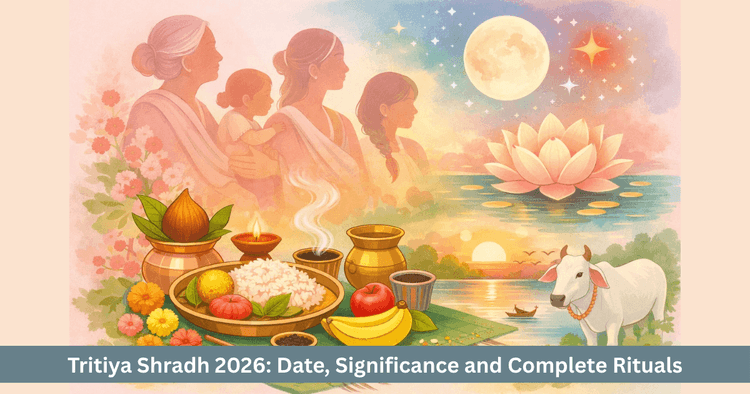
Table of Contents
Tritiya Shradh 2026 is the third day of Pitru Paksha and is especially recognised as a sacred occasion to honour the departed women of the family. On this tithi Shradh is offered for ancestors who passed away on Tritiya and also for mothers, grandmothers, sisters, aunts, daughters and daughters in law whose remembrance may have been overshadowed by the focus on male ancestors. In the year 2026 Tritiya Shradh will fall on Tuesday 29 September 2026 and on this same day Maha Bharani Nakshatra will be active during the daytime, raising the merit of ancestral rites on this date to the level traditionally associated with Gaya Shradh.
Ashwina Krishna Tritiya in 2026 will appear as the third day of Pitru Paksha. Throughout the daytime hours of this tithi Bharani Nakshatra will prevail, which is why this date is also regarded as the proper day for Maha Bharani Shradh. For North India the approximate auspicious windows are as follows. The Kutup muhurat is around 11:44 AM to 12:31 PM, Rohina muhurat from 12:31 PM to 1:17 PM and the Aparahna kala that follows, when Bharani Nakshatra is fully operative, from about 1:17 PM onwards, is considered especially favourable for Maha Bharani rites. When both Tritiya tithi and Bharani Nakshatra coincide in this afternoon period, the Shradh performed becomes particularly powerful.
Tritiya Shradh 2026 and the Maha Bharani combination
The main timings of the day can be seen together for easy planning of both Tritiya Shradh and Maha Bharani Shradh.
| Detail | Date and time |
|---|---|
| Third day of Pitru Paksha | Tuesday, 29 September 2026 |
| Lunar tithi | Ashwina Krishna Tritiya |
| Special Nakshatra | Bharani Nakshatra, Maha Bharani Shradh day |
| Kutup muhurat | Approximately 11:44 AM to 12:31 PM |
| Rohina muhurat | Approximately 12:31 PM to 1:17 PM |
| Aparahna with Bharani Nakshatra | Main period after about 1:17 PM |
Because Tritiya tithi and Bharani Nakshatra both operate in the same Aparahna window on this date, families who wish to perform Tritiya Shradh for their Tritiya tithi ancestors can also include the mantras and sankalpa of Maha Bharani Shradh in one extended ceremony. In this way a single well structured rite can offer peace to both Tritiya based ancestors and the broader lineage, with a merit comparable to Gaya Shradh.
What is Tritiya Shradh and why is it considered special
Tritiya is the third lunar day of any fortnight. During Pitru Paksha, Tritiya Shradh is the prescribed rite for all ancestors who departed on Shukla or Krishna Tritiya of any month. In common language it is sometimes called Teej Shradh, drawing from the same Sanskrit root as the Teej festivals that mark the third tithi.
Texts such as Dharmasindhu explain that within the structure of Pitru Paksha, Tritiya is particularly suited to female ancestors. On this day Shradh is recommended for
- Ancestors who departed on Tritiya tithi.
- Departed women of the family, including mothers, grandmothers, sisters, aunts, daughters in law and daughters.
- Female ancestors whose Shradh has never been individually performed, because the family focused mainly on male forefathers.
The recognition of the female line in Tritiya Shradh reflects an important spiritual insight. Women of the lineage are as integral a part of the ancestral field as the men. When their Shradh is neglected, specific forms of Pitru Dosha, ancestral imbalance, are believed to arise, often showing as challenges in the health, marriages and pregnancies of female descendants.
The name Teej also evokes the memory of Goddess Parvati, whose festival celebrates marital harmony and the bond between husband and wife. Seen in this light, Tritiya Shradh becomes a day to pray for the spiritual peace of those women who held homes and relationships together and yet may have departed with responsibilities still unfinished.
Why Tritiya Shradh in 2026 is especially powerful
In 2026, the presence of Bharani Nakshatra on Tritiya gives the day a second, very potent dimension. Bharani is traditionally associated with Lord Yama, the deity who governs the path after death. Because of this, the period of Bharani Nakshatra, especially in Pitru Paksha, is regarded as exceptionally strong for ancestral rites.
Classical teachings state that Shradh performed under Bharani Nakshatra in Pitru Paksha can carry a merit similar to that of Pind daan at Gaya. For this reason, even families whose ancestors are not directly linked with Tritiya tithi are advised to perform at least Tarpan and Pind daan on 29 September 2026. Those who could not observe Shradh properly in previous years may use this date as an opportunity for a more comprehensive rite, trusting in the Maha Bharani power to reach many ancestors at once.
Who should especially observe Tritiya Shradh 2026
Considering both Tritiya Shradh and Maha Bharani Shradh, the scope of this day becomes quite wide.
- Those whose ancestors passed away on Shukla or Krishna Tritiya.
- Families wishing to honour departed women such as mothers, grandmothers, sisters, aunts, daughters in law and daughters.
- Those whose female ancestors have not received focused Shradh in earlier years.
- Families experiencing signs of female line Pitru Dosha such as repeated obstacles in marriage, recurrent miscarriages or unexplained health challenges among daughters.
- All devotees who wish to benefit from the rare Maha Bharani alignment through general Tarpan and Pind daan, even without a specific Tritiya connection.
In this way Tritiya Shradh 2026 becomes not only a tithi based rite but also a day of honouring female ancestors and a major Bharani Nakshatra observance for the entire lineage.
Morning preparations for Tritiya Shradh
From the beginning of the day the emphasis is on purity, recollection and quiet devotion.
- The performer rises before sunrise or around dawn and bathes.
- Bathing in a river or sacred water body is ideal. At home, a few drops of Ganga jal may be added to the bathwater.
- Since the weekday is Tuesday, governed by Mars, some traditions tie a red thread, mouli, on the wrist as an auspicious sign.
- After bathing, clean, simple clothes are worn. Light or white shades are often preferred when honouring female ancestors.
The home or chosen ritual area is carefully cleaned. A peaceful space is prepared as an altar. Photographs or simple remembrance items of departed women may be placed respectfully on this altar to support concentration and gratitude.
Extended sankalpa for female ancestors
The sankalpa on Tritiya Shradh is slightly more detailed than on some other days, because it deliberately includes the women of the lineage.
- The performer states gotra, name, place and date.
- Names and relationships of departed women such as mother, grandmother, sister, aunt, daughter in law and daughter are clearly spoken.
- Even when the exact date of passing is not known, their names and relationships are included with a sincere prayer for peace and satisfaction.
Through this sankalpa it becomes clear that the heart of the day is respect and nourishment for female ancestors as well as for Tritiya tithi forefathers.
Special Tarpan procedure on Tritiya Shradh
In general Tarpan, black sesame is widely used. On Tritiya Shradh, however many traditions recommend using white sesame seeds for female ancestors.
- Water is mixed with white sesame and offered slowly from cupped hands.
- The names, gotras and relationships of female ancestors are recited while making the offering.
- When both male and female forefathers are being honoured, the sequence may begin with the standard black sesame Tarpan for male ancestors and then continue with white sesame Tarpan specifically for the women.
The inner attitude is that water and sesame together represent purity and peace and that this offering carries a gentle and soothing energy to the mothers of the lineage.
Pind daan features for women on Tritiya Shradh
In Pind daan for female ancestors, Tritiya Shradh incorporates a few meaningful symbolic touches.
- Pindas are formed from rice, barley flour, sesame, ghee and honey.
- For women who passed away while married, a small amount of turmeric and sindoor may be mixed into the pinda, symbolising honour for their role as suhagan, a wedded woman.
- Each pinda is offered with the name, gotra and relationship of the ancestor being remembered.
Where the name or date of a female ancestor is unknown, a single pinda may be dedicated to all such women collectively. The central idea is that the family consciously acknowledges those women whose love, work and sacrifice shaped the lineage.
Additional Maha Bharani Shradh observances
Families who wish to observe Maha Bharani Shradh on this day may extend the ceremony into the Aparahna period when Bharani Nakshatra is strongest.
In this section of the ritual
- Mantras related to Yama are chanted along with prayers for release and support on the path beyond.
- Pindas and offerings are made not only for Tritiya connected ancestors but for the entire family line.
- Devotees maintain the inner understanding that the Bharani energy helps loosen bindings and gently moves souls toward greater freedom.
In this way Tritiya Shradh and Maha Bharani Shradh become two interlinked parts of a single, carefully structured day of ancestral worship.
Brahmin feeding and honouring female ancestors
For the satisfaction of female ancestors, many traditions advise inviting a Brahmin woman or girl, along with the Brahmin priest, to share in the Shradh meal when possible. This expresses the intention that the offerings reach the feminine side of the ancestral line through an appropriate living representative.
The meal itself is kept light and sattvic, typically including rice, dal, curd, vegetables, roti and a sweet dish such as halwa or kheer. Very heavy, hot or overly spiced items are avoided on this day. After the meal, suitable gifts of cloth, food grains, fruits or other useful items are given as daan.
Conduct guidelines for Tritiya Shradh
Practices to adopt
- Make sure that the names of women being honoured are included clearly in the sankalpa, even if exact dates are forgotten.
- Decorate the altar with garlands of white or light coloured flowers, such as jasmine or champa.
- Keep a ghee lamp burning in the shrine area for much of the day to maintain a serene atmosphere.
- Maintain a mood of calm remembrance and gratitude, rather than sinking into prolonged grief.
Things to avoid
- Eating before Brahmin feeding and before food has been offered to cow or crow.
- Preparing or consuming very spicy, fried or tamasic foods.
- Beginning the rites without bathing and without wearing clean clothing.
- Leaving out the names of female relatives through hesitation or social habit, since active remembrance strengthens the spiritual connection.
These simple rules help ensure that Tritiya Shradh becomes a living expression of respect and not just a formal duty.
Common questions about Tritiya Shradh 2026
On which date and weekday will Tritiya Shradh be observed in 2026?
In 2026 Tritiya Shradh will fall on Tuesday 29 September. It will be the third day of Pitru Paksha and Bharani Nakshatra will also be active on this date.
For which ancestors is Tritiya Shradh especially intended?
It is meant for ancestors who died on Tritiya tithi and for female ancestors such as mothers, grandmothers, sisters, aunts, daughters in law and daughters, particularly when their Shradh has not been given due attention earlier.
Can Tritiya Shradh and Maha Bharani Shradh be performed together?
Yes. In one ceremony the priest may first perform rites specifically for Tritiya tithi ancestors, then extend the sankalpa to include all forefathers under Bharani Nakshatra and conduct a broader Tarpan and Pind daan sequence.
Why is white sesame used for female ancestors in Tarpan?
Many traditions associate white sesame with purity, gentleness and peace, so it is chosen for offerings to female ancestors, while black sesame remains the norm for general Tarpan.
What should be done if the exact death date of a female ancestor is not known?
In such cases her name, relationship and gotra can still be spoken in the Tritiya Shradh sankalpa and a dedicated pinda and Tarpan may be offered for all unknown date female ancestors collectively, which aligns perfectly with the spirit of this day.
Get your accurate Kundali
Generate KundaliDid you like it?
Author
Pt. Suvrat Sharma (63)
Experience: 20
Consults About: Family Planning, Career
Clients In: Punjab, Haryana, Delhi
Share this article with friends and family
About ZODIAQ
ZODIAQ is an online Vedic Astrology platform. It connects clients seeking astrological advice to experienced astrologers with deep knowledge. Our users also generate kundali and perform kundali milan for free. ZODIAQ also offers services to the Astrologers. Astrologers utilize various offerings by ZODIAQ to serve their clients effectively.
If you are a User
Consult with experienced astrologers and seek their guidance. You can also order handwritten Janm Patrika report with life prediction prepared by experienced astrologers. Generate accurate Kundali, perform Kundali Matching and check horoscope and muhurat. Utilize our online library for all the necessary astrological and spiritual information.
If you are an Astrologer
Create accurate kundali for your clients and perform Kundali Matching for up to 5 people at a time. Write comprehensive Janm Patrika report for your clients with ZODIAQ. Check client details anytime by saving it in client directory. Become more productive by tracking how many clients you guide every day.
WELCOME TO
ZODIAQ
Right Decisions at the right time with ZODIAQ
