Vaisakhi 2026: Date, Mesha Sankranti Timing and Auspicious Period
By Pt. Nilesh Sharma
Festival’s Spiritual and Historical Significance with Sun’s Entry into Aries
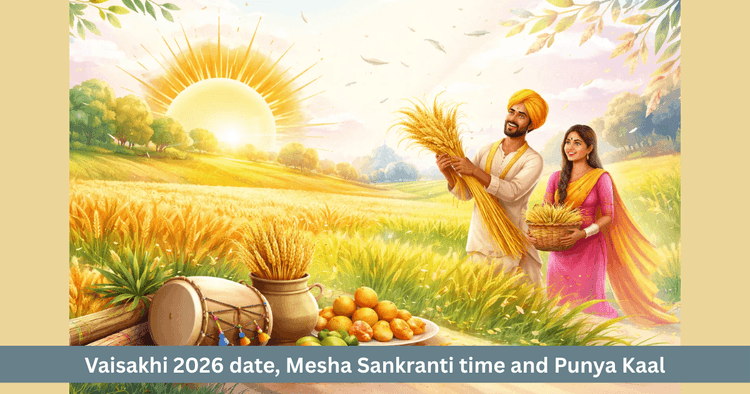
Table of Contents
The name Vaisakhi instantly brings many images together. Fields ready for harvest, hymns in Gurudwaras and the Sun signalling the start of a new yearly cycle. Vaisakhi 2026 will carry the same blend of energy where Mesha Sankranti marks the opening of a solar year and the festival itself reminds of courage, gratitude and shared spiritual identity.
In 2026 Vaisakhi will be celebrated on the day when the Sun reaches Aries and a new solar cycle begins. This movement of the Sun is treated not only as an astronomical shift but as a moment to renew decisions, intentions and inner radiance. For farmers it expresses gratitude for the rabi crop and for the Sikh community it recalls a decisive spiritual turning point known as the founding of the Khalsa.
Vaisakhi 2026 date, Mesha Sankranti time and Punya Kaal
Understanding the timing of Vaisakhi in 2026 helps in planning sacred bathing, charity and Sun worship.
| Detail | Date | Weekday | Time or note |
|---|---|---|---|
| Vaisakhi festival day | 13 April 2026 | Monday | Widely kept as Vaisakhi |
| Sun enters Aries | 13 April 2026 | Monday | Around 08:47 PM, Mesha Sankranti moment |
| Punya Kaal day | 14 April 2026 | Tuesday | Sunrise hours honoured as auspicious |
| Spirit of Punya Kaal | 14 April 2026 | Tuesday | Favourable for bathing, charity and Surya worship |
In 2026 the Sun moves from Pisces into Aries on 13 April 2026 at about 08:47 PM. Since the Sankranti takes place in the evening, the main Punya Kaal is observed on the following morning, that is 14 April 2026 during sunrise hours. This is regarded as the most suitable time for charity, holy bathing and offerings to the Sun.
How is Vaisakhi connected with Mesha Sankranti
The astrological foundation of Vaisakhi lies in Mesha Sankranti. Whenever the Sun enters Aries, Vaisakhi is celebrated around that date.
- Aries is the exaltation sign of the Sun.
- The movement of the Sun into Aries is treated as the start of the solar year.
- Many regional calendars accept this Sankranti as the New Year marker.
In this sense Vaisakhi 2026 is not only an agricultural or cultural festival but also a sign of entering a new solar phase. Intentions, efforts and good deeds undertaken at this time subtly influence the tone of the coming months.
Main timing summary for Vaisakhi 2026
The key points of Vaisakhi 2026 can be viewed briefly in the table given below.
| Event | Date | Time or description |
|---|---|---|
| Vaisakhi celebration | 13 April 2026 | Monday, main festive day |
| Sun enters Aries | 13 April 2026 | Around 08:47 PM, Mesha Sankranti |
| Punya Kaal observance | 14 April 2026 | Morning around sunrise, for bathing and charity |
| Solar New Year feel | 13 and 14 April 2026 | Marking the new solar cycle |
Thus one day carries the Vaisakhi celebrations and the next morning carries the main Punya Kaal and together they complete the sense of a new beginning.
The historic Vaisakhi and the birth of the Khalsa
One of the most defining events linked to Vaisakhi took place in 1699 at Anandpur Sahib. On that sacred day the tenth Sikh Guru, Guru Gobind Singh, gathered a large assembly of devotees and presented a call that tested courage and devotion.
The Guru asked for five volunteers ready to offer their heads for dharma. Silence and inner questions filled the gathering, yet one by one five men stepped forward. Rather than being sacrificed they were initiated into a new spiritual brotherhood called Khalsa, representing purity, fearlessness and readiness to stand for justice.
These five came to be known as the Panj Pyare, the five beloved ones. From that Vaisakhi onward the festival was no longer only about harvest. It became a declaration of spiritual bravery, collective identity and protection of the weak. Vaisakhi began to stand for a life where faith, justice and service are held together.
What is the spiritual meaning of Vaisakhi 2026
The inner spirit of Vaisakhi rests on a balance of two core themes.
- The first is gratitude, expressed for harvest, resources and all forms of material support that life provides.
- The second is courage and righteousness, reflected in the Khalsa tradition that joins prosperity with responsibility and moral strength.
On this day a person may joyfully honour successes and abundance, yet the festival gently asks how that abundance is being used. Accumulation alone is incomplete without service, charity and readiness to stand for what is right.
Astrological significance of Vaisakhi and the Sun in Aries
Vaisakhi coincides with the time when the Sun enters Mesha Rashi or Aries.
- In Aries the Sun’s qualities of energy, leadership and self confidence are intensified.
- It becomes a supportive phase for new beginnings, whether in work, study or personal directions.
- Ego sensitivity can also become stronger, which makes humility and balanced decisions important.
If a person uses this period to define clear goals, let go of certain fears or hesitations and step forward with responsibility, the transit may act as a positive force in that life.
How is Vaisakhi 2026 observed
The outward form of Vaisakhi varies among communities, yet a shared thread of devotion, gratitude and celebration runs through them.
In the Sikh tradition
- Visiting Gurudwaras in the morning for kirtan and prayer gatherings
- Listening to passages from Guru Granth Sahib and participating in Akhand Path programmes
- Taking part in Nagar Kirtan processions that combine hymns with public service
- Serving and sharing in Langar, where all receive food equally as a living lesson in humility and oneness
In Hindu and regional customs
- Bathing at sunrise in a river or lake or at home with clean or sanctified water
- Offering water and prayers to the Sun with devotion
- Giving charity in the form of food, clothes or money to those in need
- Starting new accounting books or business records for the fresh year
- Celebrating at home with traditional dishes, music and local forms of dance
In Punjab and nearby regions fields shine golden with ripe wheat. Dances such as Bhangra and Gidda express joy, strength and thanks for prosperity and are woven naturally into the Vaisakhi spirit.
Symbolism of harvest and the deeper lesson
The harvest at Vaisakhi is more than an economic event. It serves as a living symbol.
- Seeds that were sown with patience and effort months earlier now stand as full crops.
- Vaisakhi reminds that disciplined work and steady endurance are the soil in which results mature.
- Every completed cycle prepares the ground for the next beginning.
The festival points to a truth that work gains depth when joined with faith and perseverance. Quick gains may appear, yet it is sustained, value based effort that strengthens a life.
Related New Year festivals across India
Around the time of Vaisakhi many regions welcome the New Year under different names, though the spirit remains connected.
- In Kerala the festival appears as Vishu, with auspicious darshan and arrangements known as Vishu Kani.
- In Tamil Nadu it is Puthandu, marking the Tamil New Year in homes and social life.
- In West Bengal it becomes Pohela Boishakh, the Bengali New Year for both business and family.
- In Punjab and adjoining areas it is Baisakhi, uniting agricultural and spiritual meanings.
Across these traditions the inner essence is one of renewal, gratitude and inner strength, even as cultural forms differ.
Deep personal reflection for Vaisakhi 2026
Vaisakhi 2026 is not only a festive mark on the calendar. It quietly raises questions for every individual.
Some of the reflections it invites are these.
- Which new beginning is one truly ready to embrace now.
- Which old fear, hesitation or limiting pattern is ready to be left behind.
- In which area of life is it time to act with courage, fairness and dignity rather than with convenience alone.
The courage of the Khalsa, the gratitude of the farmer and the strength of the exalted Sun come together on this day as one message. Light is meant to grow not only in the sky but also in character. Vaisakhi reminds that the real New Year begins when change enters thinking, values and daily choices, not only when dates move forward.
Frequently asked questions about Vaisakhi 2026
When will Vaisakhi 2026 be celebrated
Vaisakhi 2026 will be celebrated on Monday 13 April 2026, close to the time when the Sun is about to complete its shift into Aries and begin a new solar cycle.
What is the exact time of the Sun’s entry into Aries in 2026
The Sun will move from Pisces into Aries on 13 April 2026 at around 08:47 PM and this is regarded as the key Mesha Sankranti moment for that year.
On which day and at what time will Punya Kaal be observed for Vaisakhi 2026
Since the Sankranti occurs in the evening, the Punya Kaal is honoured on 14 April 2026 during the morning hours around sunrise, as the best time for holy bathing, charity and Sun offerings.
Is Vaisakhi meant only for farmers and the Sikh community
No, while Vaisakhi holds special meaning for Punjab and Sikh history, it is also valuable more widely as a time for solar New Year observances, gratitude for harvest, charity and fresh personal resolutions.
What is the most important personal lesson to draw from Vaisakhi 2026
The central lesson is that a new year begins not just with a change of date but with releasing old fears, setting new aims, deepening gratitude and choosing to stand for dharma with courage and clarity. Vaisakhi points to this inner renewal.
Get your accurate Kundali
Generate KundaliDid you like it?
Author

Pt. Nilesh Sharma (63)
Experience: 20
Consults About: Family Planning, Career
Clients In: Punjab, Haryana, Delhi
Share this article with friends and family
About ZODIAQ
ZODIAQ is an online Vedic Astrology platform. It connects clients seeking astrological advice to experienced astrologers with deep knowledge. Our users also generate kundali and perform kundali milan for free. ZODIAQ also offers services to the Astrologers. Astrologers utilize various offerings by ZODIAQ to serve their clients effectively.
If you are a User
Consult with experienced astrologers and seek their guidance. You can also order handwritten Janm Patrika report with life prediction prepared by experienced astrologers. Generate accurate Kundali, perform Kundali Matching and check horoscope and muhurat. Utilize our online library for all the necessary astrological and spiritual information.
If you are an Astrologer
Create accurate kundali for your clients and perform Kundali Matching for up to 5 people at a time. Write comprehensive Janm Patrika report for your clients with ZODIAQ. Check client details anytime by saving it in client directory. Become more productive by tracking how many clients you guide every day.
WELCOME TO
ZODIAQ
Right Decisions at the right time with ZODIAQ
