Vyasa Puja 2026: Date, Guru Glory and Detailed Worship Procedure
By Aparna Patni
Significance of Worshiping Guru and Veda Vyasa on Ashadha Purnima
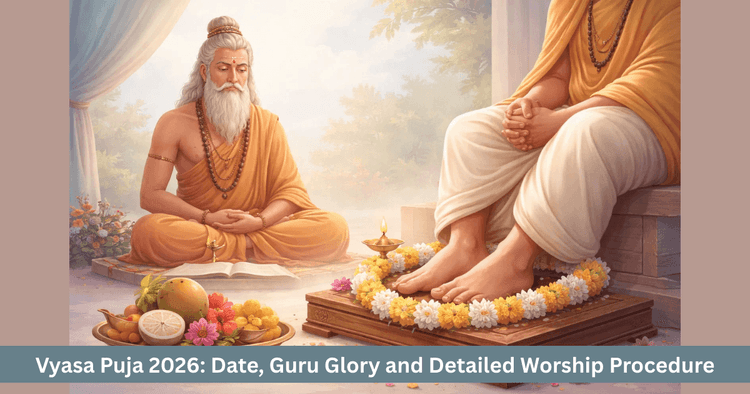
Table of Contents
The full moon of Ashadha, observed as Vyasa Puja, is regarded as a very sacred occasion for honouring the Guru principle and the Vedic tradition. This day is not only a festival but also a time to awaken respect for the Guru and to accept inner guidance with humility. In the year 2026 Vyasa Puja will be celebrated on Ashadha Purnima, on 29 July 2026, when seekers offer gratitude at the feet of Veda Vyasa, the lineage of teachers and their own personal Guru.
Vyasa Puja 2026: Date and Key Information
| Detail | Year 2026 |
|---|---|
| Date of Vyasa Puja | 29 July 2026 |
| Weekday | Thursday |
| Lunar month and tithi | Ashadha Shukla Purnima |
| Names of the day | Vyasa Purnima, Guru Purnima |
On this day devotees customarily take an early bath, wear clean clothes, prepare a pure atmosphere and worship Veda Vyasa and their Guru with a calm mind. Many aspirants also treat this date as a Guru Purnima fast, spending the entire day in restraint, satsanga and service.
What Is Vyasa Puja and Why Is It Called Vyasa Purnima?
Ashadha Shukla Purnima is known as Vyasa Purnima because it is remembered as the appearance day of Veda Vyasa. In remembrance of this, worship of the Guru lineage, the Vedic stream and the tradition of teacher and disciple is offered in the form of Vyasa Puja. This worship does not remain limited to Veda Vyasa alone. Through him it becomes a way to express gratitude to the entire Guru tradition.
Veda Vyasa is regarded as the primordial preceptor of humanity who divided the Vedas, composed the Mahabharata and preserved dharma and wisdom through many Puranas. For this reason the worship on Ashadha Purnima is called Vyasa Puja and the day itself is called Vyasa Purnima. In later times the same date also became well known as Guru Purnima because the Guru is honoured on this day as a visible form of the Supreme.
Who Was Maharishi Veda Vyasa?
Maharishi Veda Vyasa is honoured as the first great teacher of the Vedic scriptures and the arranger of the Vedas. Traditional accounts describe that he appeared on Ashadha Purnima and gave systematic form to the vast body of Vedic knowledge. His original name is given as Krishna Dvaipayana Vyasa, indicating his dark complexion and island like place of birth.
Veda Vyasa was born to Maharishi Parashara and Devi Satyavati. Satyavati later became the matriarch of the Kuru lineage from which both Kauravas and Pandavas descended. Veda Vyasa divided the four Vedas, composed many Puranas and through the Mahabharata brought deep teachings of dharma, ethics and devotion within the reach of ordinary people. For this monumental work he came to be known as Veda Vyasa, the one who arranged and expanded the Vedas.
How Are Vyasa Puja and Guru Purnima Connected?
Ashadha Purnima is also celebrated as Guru Purnima. The basis of this connection is the understanding that Veda Vyasa represents the foundation of the entire Guru lineage. The honour offered to Veda Vyasa naturally extends to every true Guru who carries the stream of knowledge forward.
The tradition rests on the thought that without the Guru, the flow of knowledge remains incomplete. Scriptures repeatedly suggest that real direction in a disciple’s life arises through the grace and guidance of the Guru. On the day of Vyasa Puja, by remembering Maharishi Veda Vyasa, every seeker offers thanks to the guides who have appeared in life, whether as a formal initiator, as a spiritual mentor or as a teacher who offered right direction at a crucial turn.
Meaning of the Guru Shloka and the Greatness of the Teacher
On Vyasa Puja the well known Sanskrit verse is often recited.
“Guru Brahma, Guru Vishnu, Guru Devo Maheshwara
Guru Sakshat Param Brahma, Tasmai Shri Gurave Namah.”
In this shloka the Guru is praised as being Brahma, Vishnu and Maheshwara. Brahma represents the beginning of creation, Vishnu preservation and order and Mahesh the power of ending and transformation. To say that the Guru is these three in one means that the Guru gives new direction to the disciple’s life, maintains him on the right path and brings an end to inner ignorance. The final part of the verse states that the Guru is the direct manifestation of the Supreme and therefore is worthy of deep reverence.
Which Acharya Groups Are Honoured in Vyasa Puja?
Vyasa Puja does not focus on a single teacher. It honours the entire Guru lineage. According to traditional method three groups of acharyas are remembered, known as Krishna Panchakam, Vyasa Panchakam and Shankaracharya Panchakam. Each of these panchakas consists of five acharyas.
Through Krishna Panchakam devotees bow to Lord Krishna and the teacher tradition associated with him. Vyasa Panchakam recalls Veda Vyasa and connected acharyas. Shankaracharya Panchakam honours Adi Shankaracharya and the teachers of the monastic seats founded by him. In this way the aspirant acknowledges that the stream of knowledge has flowed through many great ones before reaching the present disciple.
Why Are Vyasa Puja and Guru Puja Considered So Important?
Within the Hindu tradition Vyasa Purnima, with its observance of Vyasa Puja and Guru Puja, is held to be very auspicious. The day reminds everyone that scriptures by themselves are not sufficient unless a Guru shows how to live their teachings. It is the Guru who can gently place the disciple on the path of truth and liberation.
It is also believed that spiritual practice without guidance can often become tiring or confusing, whereas practice performed under the Guru’s instructions makes the mind stable and quietly joyful. On Vyasa Puja it is therefore considered important to bow at the Guru’s feet, remember his words and renew one’s commitment to the directions already received.
Step by Step Method of Vyasa Puja and Guru Puja
According to traditional practice, purity, devotion and orderly procedure are the three pillars of Vyasa Puja. The essential worship can be carried out in a simple form at home.
Vyasa Puja 2026: Stepwise Method
| Step | Point of worship |
|---|---|
| 1 | Rise early, clean the house, bathe and wear fresh clothes |
| 2 | Spread a clean white cloth at the altar to prepare the Vyasa seat |
| 3 | Draw twelve lines on the cloth in north south and east west directions using fragrant powder |
| 4 | Mentally invoke Veda Vyasa, Brahma, the supreme power, Guru and the lineage of acharyas on the seat |
| 5 | Take the vow of performing Vyasa Puja by reciting the sankalpa mantra |
| 6 | Perform shodashopchar worship of Veda Vyasa and the Guru |
| 7 | At the end bow to parents and the initiator Guru and seek their blessings |
Tradition of Sankalpa and Invocation
During Vyasa Puja the worshipper holds the feeling that today’s ritual is a living promise to honour the Guru lineage throughout life. A traditional form of sankalpa is spoken as follows.
“Guruparampara Siddhyartham Vyas Pujam Karishye”
The meaning is that the worship of Veda Vyasa and the Gurus is being undertaken for the continuation and fulfilment of the Guru tradition.
After this, one meditates upon Brahma, the supreme power, Veda Vyasa, Shukadeva, Gaudapadacharya, Govindasvami and Shankaracharya on the Vyasa seat and offers them a seat, water for the feet, water for the hands, fragrant substances, flowers, incense, lamp and food.
What Is Shodashopchar Puja?
In Vyasa Puja the method of shodashopchar puja is commonly followed. Shodasha means sixteen and upachara refers to the services offered in worship. These include offering a seat, washing the feet, offering water for hands and sipping, ritual bath, clothes, sacred thread, sandal paste, flowers, incense, lamp, food, betel and finally prostration and prayers.
Through these steps the devotee treats Veda Vyasa and the Guru as a living divine presence. A symbolic seat, bathing, clothing, fragrance and food are all offered with reverence. This gradually dissolves ego and strengthens the inner mood of service.
Why Are Parents and the Initiating Guru Honoured?
A distinct feature of Vyasa Puja is that after completing the ritual, the devotee bows to parents and to the initiatory Guru. Parents are revered as the first teachers who impart the earliest values of life. The Guru of initiation opens the door to spiritual understanding.
By seeking their blessings on this day the aspirant acknowledges that without these two supports, life’s path would remain incomplete. If possible, offering a small gift such as cloth, fruits or a few loving words to parents and Guru on Vyasa Purnima is considered very auspicious.
Importance of Scriptural Study and Inner Resolve
Another aspect of Vyasa Puja is the encouragement to study the works composed or arranged by Veda Vyasa. On this day one may read a few passages from the Mahabharata, the Bhagavad Gita or any text connected with Vyasa and reflect quietly on its meaning.
This practice reminds the seeker that sacred books are meant to guide life rather than simply decorate a shelf. A resolve made on Vyasa Puja 2026 to keep regular study and to apply even a small portion of the teachings in daily conduct can lend depth and steadiness to spiritual effort throughout the year.
Inner Inspiration from Vyasa Puja 2026
Vyasa Puja 2026 offers a gentle reminder that connection with knowledge, the Guru and tradition brings stability and meaning to life. Material achievements may be many, yet without right guidance they rarely give lasting contentment. The combined grace of Guru and scripture points towards a way of living that maintains inner peace.
On this day it is helpful to sit quietly for a while and remember those who have shown the right path, the books that have lit up the mind and the occasions when timely guidance changed the direction of life. Gratitude and resolve formed in the peaceful atmosphere of Vyasa Puja deepen spiritual practice and provide a fresh inner foundation for the days ahead.
Frequently Asked Questions
When will Vyasa Puja 2026 be celebrated and on which full moon does it fall?
Vyasa Puja 2026 will be celebrated on Thursday, 29 July 2026, on the full moon of the bright half of Ashadha.
Are Vyasa Puja and Guru Purnima observed on the same day?
Yes, on Ashadha Purnima both the birth of Veda Vyasa is honoured through Vyasa Puja and the Guru principle is worshipped as Guru Purnima.
Why is Maharishi Veda Vyasa called the primordial Guru?
He divided the Vedas, composed the Mahabharata and compiled many Puranas, thereby giving organised form to dharma and knowledge for the benefit of humanity.
Which main steps are important in the method of Vyasa Puja?
An early bath, preparation of the Vyasa seat, reciting the sankalpa, invoking the lineage of teachers, performing shodashopchar worship, bowing to parents and Guru and reading texts of Veda Vyasa are central elements.
What inner resolve can a seeker take on Vyasa Puja 2026?
A seeker may inwardly pledge to respect the Guru’s words, maintain regular study and practice and use whatever knowledge is received for righteousness and the welfare of others.
Get your accurate Kundali
Generate KundaliDid you like it?
Author

Aparna Patni (63)
Experience: 20
Consults About: Family Planning, Career
Clients In: Punjab, Haryana, Delhi
Share this article with friends and family
About ZODIAQ
ZODIAQ is an online Vedic Astrology platform. It connects clients seeking astrological advice to experienced astrologers with deep knowledge. Our users also generate kundali and perform kundali milan for free. ZODIAQ also offers services to the Astrologers. Astrologers utilize various offerings by ZODIAQ to serve their clients effectively.
If you are a User
Consult with experienced astrologers and seek their guidance. You can also order handwritten Janm Patrika report with life prediction prepared by experienced astrologers. Generate accurate Kundali, perform Kundali Matching and check horoscope and muhurat. Utilize our online library for all the necessary astrological and spiritual information.
If you are an Astrologer
Create accurate kundali for your clients and perform Kundali Matching for up to 5 people at a time. Write comprehensive Janm Patrika report for your clients with ZODIAQ. Check client details anytime by saving it in client directory. Become more productive by tracking how many clients you guide every day.
WELCOME TO
ZODIAQ
Right Decisions at the right time with ZODIAQ
