Yogini Ekadashi 2026: Date, Significance, Vrat Katha and Proper Observance
By Pt. Narendra Sharma
Importance and Observance of Yogini Ekadashi
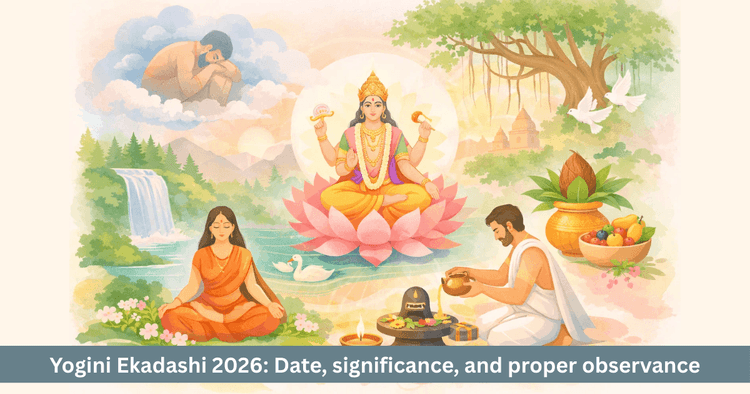
Table of Contents
In Vedic tradition among the twenty four Ekadashi that come in a year Yogini Ekadashi is regarded as a highly powerful and result giving date. This Ekadashi is connected not only with relief from sins and diseases but also with happiness, prosperity and inner purification in life. For those devotees who observe the Yogini Ekadashi fast with discipline this day can support both spiritual growth and practical well being.
Yogini Ekadashi 2026 date and timings
Yogini Ekadashi falls every year in the Krishna Paksha of the month of Ashadha. In the Gregorian calendar it usually falls in the months of June or July, when the atmosphere of the coming Chaturmas gradually begins to form and the energy of spiritual practice becomes stronger.
The key timings for Yogini Ekadashi in 2026 are as follows.
| Yogini Ekadashi 2026 | Details |
|---|---|
| Date | Friday, 10 July 2026 |
| Ekadashi starts | 10 July 2026, 08:16 in the morning |
| Ekadashi ends | 11 July 2026, 05:22 in the morning |
| Parana period | 11 July, 02:03 in the afternoon to 04:42 pm |
For the vow holder it is important to maintain resolve, chanting and discipline from the beginning of the Ekadashi tithi until the appropriate time of breaking the fast. Parana should always be done after Ekadashi has ended and within Dwadashi during the auspicious period.
What is Yogini Ekadashi
Yogini Ekadashi according to the Vedic lunar calendar is one of the Ekadashi that fall on the eleventh tithi of each fortnight. Every lunar month has two Ekadashi. The first is in Shukla Paksha when the Moon is waxing. The second is in Krishna Paksha when the Moon is waning.
Yogini Ekadashi is the Ekadashi that comes in Krishna Paksha of the month of Ashadha. In terms of the lunar cycle this Ekadashi appears when the Moon is decreasing and a subtle inward movement grows in nature. In the Gregorian year this time usually arrives around the middle of June or July.
It is also noteworthy that Yogini Ekadashi comes after Nirjala Ekadashi. Nirjala Ekadashi is observed in the month of Jyeshtha during Shukla Paksha and is famous because of its strict waterless fasting. Yogini Ekadashi follows in this sequence as a date that is described as supporting the devotee in cleansing sins, releasing diseases and preparing for the path of liberation.
Religious and spiritual importance of Yogini Ekadashi
On Yogini Ekadashi Lord Vishnu is worshipped especially under the names Shri Hari and Narayan. The core feeling of this fast is that the devotee steps out of attachment, disease, negative karma and inner restlessness and seeks shelter at the feet of the Lord.
It is believed that those who observe the Yogini Ekadashi fast with faith, discipline and purity of conduct receive immense merit. Traditional descriptions state that the merit of this fast is equivalent to feeding eighty eight thousand Brahmins. This comparison is not only about number but also hints that this Ekadashi multiplies the fruits of charity, service and surrender.
Padma Purana mentions that those who follow the Yogini Ekadashi rituals sincerely begin to see meaningful changes in their lives. Old sins, health problems, mental burdens and negative tendencies may gradually lessen and the person can feel lighter, more balanced and more peaceful from within.
Yogini Ekadashi vrat katha: meaning and message
Two main stories are connected with Yogini Ekadashi. One is related to Yudhishthira, the eldest of the Pandavas and the other to Hem Mali, the gardener of Kubera, the Lord of Wealth. Both stories help explain that this fast not only frees from karmic reactions but also invites a change in thinking and lifestyle.
Teaching of Yogini Ekadashi to Yudhishthira
According to the narrative, King Yudhishthira once asked Lord Krishna about the importance of Yogini Ekadashi. Lord Krishna, who is regarded as an avatar of Lord Vishnu on earth, then described the greatness of this Ekadashi that falls in the dark fortnight of Ashadha.
Lord Krishna explained that this Ekadashi has the power to carry those who are drowning in the ocean of material existence to the safe shore of spiritual welfare. It is said to destroy the reactions of sinful deeds and to guide the devotee towards final liberation. Within the three worlds this Ekadashi is described as the essence among many holy fasting days.
Through this teaching one understands that Yogini Ekadashi is not just a ritual fast but a special day of practice that can shift the direction of life through discipline, chanting and deep reflection.
Story of Hem Mali and King Kubera
The second story is associated with King Kubera, the Lord of Wealth and his gardener Hem Mali. Kubera used to offer flowers to Lord Shiva every day. The responsibility of bringing these flowers from the sacred lake Mansarovar belonged to Hem Mali.
One day Hem Mali collected the flowers but became overly absorbed in the company of his beautiful wife and neglected to deliver them on time to the king’s court. When Kubera learned of his negligence, he became extremely angry. In his anger he cursed Hem Mali to suffer from the terrible disease of leprosy and separated him from his wife.
Driven out from the palace Hem Mali wandered in forests for many years in great suffering. After a long time he reached the ashram of Rishi Markandeya. There he narrated his painful story and acknowledged his mistake. Out of compassion the sage advised him to observe the Yogini Ekadashi fast with full sincerity.
Hem Mali followed the vow with determination and prayed for forgiveness to Lord Vishnu. As a result of the power of this Ekadashi and the Lord’s grace his sins were washed away, his leprosy disappeared and he was reunited with his beloved wife.
This story conveys that Yogini Ekadashi can not only release a person from the results of past actions but can also guide a wandering life back into right direction, improving health, relationships and inner balance.
Main procedure of Yogini Ekadashi fast
In Yogini Ekadashi both outer discipline and inner feeling are important. The fast is not completed by hunger alone but by combining restraint, devotion and remembrance of the Lord.
Preparations and rules from Dashami
All the observances of Yogini Ekadashi begin from the Dashami tithi, one day before Ekadashi.
On Dashami the observer is expected to take only one simple sattvic meal before sunset. Hot spices, very salty items, tamasic food and meat are avoided. The aim is to prepare the body and mind so that on Ekadashi the system is light and able to focus on worship and chanting.
From the night of Dashami it is helpful to withdraw the mind gradually from unnecessary talk and distraction so that Ekadashi can be spent in a state of greater awareness.
Rules on the day of Ekadashi
On Ekadashi the vrat holder should wake up early, preferably during Brahma Muhurta and take a purifying bath. Some people use water mixed with sesame for bathing, which symbolises deeper cleansing. After the bath one wears clean clothes and takes a resolve to observe the fast before the image of the Lord.
In worship the devotee installs an image or picture of Lord Vishnu or a Shaligrama and offers lamp, incense, flowers, tulsi leaves and naivedya. Throughout the day one maintains restraint in eating. Many follow a waterless fast. Some take only fruits, milk or very light sattvic food once. The form of the fast should be chosen according to health and capacity but the inner resolve needs to remain steady.
Staying awake at night is considered very auspicious on Yogini Ekadashi. It is said that the observer should avoid sleep and spend the night in the remembrance of the Lord through chanting, listening to stories or quiet meditation. Even if one cannot remain fully awake, one should avoid wasting the time in idle activity and keep the mind oriented towards devotion.
Worship, mantra chanting and listening to the story
On Yogini Ekadashi, reciting the Vishnu Sahasranama is considered highly auspicious. Those who are unable to recite the full thousand names may chant simple mantras like “Om Namo Narayanaya” or “Om Namo Bhagavate Vasudevaya” with faith. Along with mantra chanting it is important to read or hear the story of Yogini Ekadashi at least once during the day.
At the end of the worship the aarti of Lord Vishnu is performed and prasada is distributed. Prasada should be clean, sattvic and prepared with reverence. Through the entire day of fasting, chanting and listening to the katha the devotee is encouraged to release inner negativity such as anger and resentment and move towards peace and devotion.
Method of breaking the fast
The fast of Yogini Ekadashi is completed only with Parana, the ritual breaking of the fast. Parana means ending the fast at the correct time by first offering food to the Lord, then to guests or Brahmins and finally taking food oneself.
In 2026 the suitable Parana time for Yogini Ekadashi is on 11 July between 02:03 and 04:42 in the afternoon. Ideally the devotee offers naivedya to Lord Vishnu at this time, feeds a Brahmin or a needy person and then takes a simple meal. Parana should be done within Dwadashi and unnecessary delay is to be avoided.
Importance of charity and service on Yogini Ekadashi
Charity, service and helping those in need on Yogini Ekadashi are considered very meritorious. It is especially auspicious to donate food, clothes and money according to one’s capacity. Traditionally feeding Brahmins, supporting the poor, serving cows and helping the distressed are recommended on this day.
When fasting is combined with giving, the devotee’s focus shifts from self centred gain to the welfare of others. This deepens the spiritual effect of the fast and harmonises personal upliftment with social responsibility.
Why do we fast on Yogini Ekadashi
The fast of Yogini Ekadashi holds a special place in the Hindu tradition for several reasons.
Relief from health problems and diseases
According to scriptural belief, the Yogini Ekadashi fast is particularly linked with relief from illnesses and physical suffering. The story of Hem Mali clearly shows that when a person sincerely repents and turns towards the Lord through this fast even severe diseases like leprosy can be removed by grace.
During this fast, sattvic diet, restraint, prayer and quiet reflection also give the body and mind a chance to reset. Mental stress may reduce and the inner state can become calmer, which naturally supports better health.
Freedom from sins and inner purification
Yogini Ekadashi is described as a date that helps in destroying sins and protecting from the reactions of negative deeds. When a person consciously follows the fast with sincere repentance, this Ekadashi can help in reducing the weight of past actions.
The observance is meant not only as an outer practice but as an opportunity to recognise and let go of inner faults like anger, jealousy, selfishness and resentment. This is why Yogini Ekadashi is seen as a strong support for inner purification.
Strengthening devotion and faith in Lord Vishnu
Another deep aspect of Yogini Ekadashi is that it strengthens devotion to Lord Vishnu. When a person dedicates a full day to remembrance, chanting and discipline for the sake of the Lord, faith and surrender begin to settle more firmly in the heart.
Tradition holds that Lord Vishnu listens to the wishes of those who approach him with pure intention through vrata, japa and service. Yogini Ekadashi is therefore considered favourable for seeking peace, prosperity and a balanced life under the shelter of the Lord.
Common questions about Yogini Ekadashi
How many times does Yogini Ekadashi occur in a year
Yogini Ekadashi occurs only once in a year. It is observed in the month of Ashadha during Krishna Paksha, which usually falls in June or July.
Is waterless fasting compulsory on Yogini Ekadashi
Waterless fasting is not compulsory. The form of the fast should be suited to the health and age of the devotee. Some may remain completely without water, some may take fruits and water and those who are not able to fast strictly can still follow a simple sattvic diet with sincere remembrance.
Which mantras are considered auspicious on Yogini Ekadashi
Reciting the Vishnu Sahasranama is regarded as very auspicious on this day. If that is not possible, one may chant “Om Namo Narayanaya” or “Om Namo Bhagavate Vasudevaya” with focus and devotion.
Is Yogini Ekadashi only for relief from diseases
Yogini Ekadashi is not limited to relief from disease. It is also connected with the destruction of sins, inner cleansing, improvement in relationships, mental lightness and preparation for the path of liberation. The story of Hem Mali shows that the fast transforms the entire direction of life.
How can one receive maximum benefit from Yogini Ekadashi fast
To receive the best results, the fast should not be treated as a mere formality. From Dashami onward one should adopt sattvic conduct and on Ekadashi focus on restraint, chanting, listening to the katha, charity and remembrance of the Lord. When repentance, gratitude and a genuine wish to improve are combined with the observance, Yogini Ekadashi can bring deep and positive change in life.
Get your accurate Kundali
Generate KundaliDid you like it?
Author
Pt. Narendra Sharma (63)
Experience: 20
Consults About: Family Planning, Career
Clients In: Punjab, Haryana, Delhi
Share this article with friends and family
About ZODIAQ
ZODIAQ is an online Vedic Astrology platform. It connects clients seeking astrological advice to experienced astrologers with deep knowledge. Our users also generate kundali and perform kundali milan for free. ZODIAQ also offers services to the Astrologers. Astrologers utilize various offerings by ZODIAQ to serve their clients effectively.
If you are a User
Consult with experienced astrologers and seek their guidance. You can also order handwritten Janm Patrika report with life prediction prepared by experienced astrologers. Generate accurate Kundali, perform Kundali Matching and check horoscope and muhurat. Utilize our online library for all the necessary astrological and spiritual information.
If you are an Astrologer
Create accurate kundali for your clients and perform Kundali Matching for up to 5 people at a time. Write comprehensive Janm Patrika report for your clients with ZODIAQ. Check client details anytime by saving it in client directory. Become more productive by tracking how many clients you guide every day.
WELCOME TO
ZODIAQ
Right Decisions at the right time with ZODIAQ
