Akshaya Tritiya and the Blessing of Everlasting Merit
By Pt. Amitabh Sharma
Righteous Acts on Akshaya Tritiya Yield Everlasting Merit and Auspicious New Beginnings
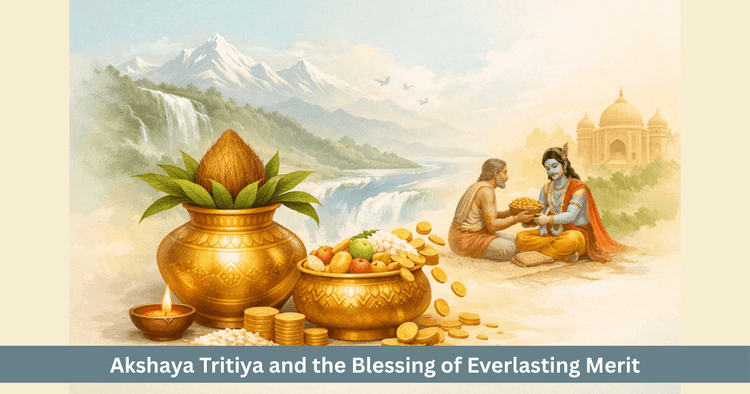
Table of Contents
In Indian tradition Akshaya Tritiya is regarded as one of the most auspicious and beneficial days of the year. It is believed that righteous actions performed on this date, such as charity, mantra japa, worship and the beginning of new ventures, become akshaya, meaning that their subtle fruits do not come to an end. For this reason people consider it an ideal day for starting important work, making investments, giving in charity and deepening spiritual practice. Many sacred events are linked to this tithi. The descent of the sacred river Ganga to Earth, the bestowal of the Akshaya Patra upon Draupadi by Lord Krishna and the end of Sudama’s poverty are all remembered in connection with Akshaya Tritiya. Through these stories the day becomes a symbol of grace and abundance on both material and spiritual levels.
Date of Akshaya Tritiya and Its Auspicious Alignment
Akshaya Tritiya falls in the lunar month of Vaishakha, on the third day of the bright fortnight, known as Vaishakh Shukla Tritiya. On this day both the Sun and the Moon are regarded as occupying highly auspicious positions, which is why many traditions refer to this tithi as a sarva siddhi or sarvartha siddhi day. The core features can be seen in this table.
| Aspect | Description |
|---|---|
| Tithi | Third day of the bright half of Vaishakha |
| Special belief | Meritorious actions gain results that are never exhausted |
| Astrological note | Highly auspicious positions of Sun and Moon, in many lineages a separate muhurt is not considered essential |
| Recommended acts | Charity, purchase of gold, japa, homa, marriage, new business or investment, beginnings related to dharma and service |
| Central themes | Prosperity, service, devotion, divine grace and steadily increasing merit |
Many families treat this date as naturally favourable and therefore do not always search for additional muhurts for ordinary auspicious tasks. Even so, it is wise to retain sincerity, discrimination and awareness of one’s individual astrological situation.
Descent of Ganga and Akshaya Tritiya
According to popular belief Ganga, the sacred river, descended to Earth on Akshaya Tritiya. Ganga is honoured as the destroyer of sins, the giver of life and the one who sanctifies all three worlds. From this story it is understood that the day is especially suitable for inner and outer purification, because Ganga symbolises not only water but also holiness and grace. By bathing, giving in charity and engaging in japa on this date a seeker can release the heaviness of the past and step forward with new spiritual resolve. For this reason many devotees bathe in rivers, lakes or available sacred water on Akshaya Tritiya and offer worship to Lord Vishnu, Goddess Lakshmi and Ganga Devi.
Draupadi’s Akshaya Patra and the Secret of Service
Among the stories related to Akshaya Tritiya, a well known incident from the Mahabharata period is often recalled. During the exile of the Pandavas and their wife Draupadi, a revered sage once sent word that he would take his meal with them. By that time the family had already eaten and the cooking vessels had been set aside, seemingly empty. Draupadi became worried. She knew that honouring a guest is a sacred duty, yet no food remained in the pots. In that moment of distress she turned inward and prayed to Lord Krishna. Krishna immediately arrived at their dwelling and smilingly said that he was very hungry and asked whether there was anything to eat. Draupadi, filled with humility, explained that nothing was left. When Krishna looked into one of the pots he noticed a single dry grain of rice sticking to it. He lifted that one grain and ate it joyfully. The story narrates that at that very moment the pot became an Akshaya Patra, a vessel whose contents never run out. When the sage arrived with around four hundred companions, Draupadi began to serve them from that same pot. The more she took out, the more appeared within. Every guest ate to satisfaction, yet the vessel did not become empty. From this account we learn that by the Lord’s grace even limited resources can become ever flowing, that an offering made with genuine faith and a spirit of service can produce results far beyond its apparent size and that sometimes a single act of true surrender can bring a major turning point in life. Even today, when a person is unusually generous and constantly helps others, people may affectionately call that person an akshaya patra, meaning a source that is always ready to give.
The Story of Sudama and Krishna’s Friendship
Akshaya Tritiya is also associated with the story of Lord Krishna and his childhood friend Sudama. Sudama was a very poor Brahmin, yet inwardly rich in purity and love. One day his wife, feeling the weight of their poverty, suggested that he visit Krishna in Dwaraka. She reminded him that Krishna was a king and also his close friend, so it would be natural to seek help from him. Sudama agreed but insisted that he could not go to a friend empty handed. There was almost nothing in the house, so his wife lovingly gathered three handfuls of puffed rice and tied them in a cloth as his simple gift. When Sudama reached Dwaraka, Krishna welcomed him with great honour, washed his feet and embraced him warmly. The flow of friendship and love between them was so strong that Sudama forgot both his poverty and the purpose of his visit. He could not bring himself to ask for anything. As he prepared to take leave, Krishna gently asked whether he had brought something as a gift and said that he knew Sudama’s wife must have sent something for him. With hesitation Sudama offered the small bundle of puffed rice. Krishna accepted it with delight, ate one handful and then a second. The story goes on to say that as he was about to take a third handful, his consort Rukmini came and gently stopped him, as if to indicate that the blessing was already complete. Sudama returned home without having spoken of his need. For him the meeting with his friend felt like wealth in itself. Yet when he reached his village he saw that his humble hut had been transformed and now shone with wealth, comfort and prosperity. His poverty had quietly dissolved. This narrative shows that in sincere devotion and friendship there is often more urge to give than to demand, that the Lord values even a small offering when it is filled with love and that at times grace flows without any explicit request, simply in response to deep affection. Because of such associations many people buy gold or other enduring items on Akshaya Tritiya and exchange gifts, believing that what is gained or given on this day will steadily grow.
Charity, Gold and New Ventures on Akshaya Tritiya
In many households it is believed that on Akshaya Tritiya, if gold is purchased, a gift is offered or the foundation of a new undertaking is laid, that effort will grow with time and bear good fruit. For this reason people often choose this date to acquire gold, silver or other precious metals, to plan property related projects and to start new businesses or long term investments. At the same time the finest use of Akshaya Tritiya lies in charity and service. By feeding the hungry, helping with clothing, education or medical care, a seeker can build a store of enduring merit. When humility and compassion are present, giving no longer remains a transaction but becomes a form of spiritual practice.
Spiritual Message of Akshaya Tritiya
These stories remind us that everything in the material world is impermanent. The body will one day return to the earth, yet the soul is akshaya, free from decay. Akshaya Tritiya helps seekers understand that along with outer prosperity inner growth is essential. When devotion becomes deep, not only spiritual strength but sometimes even material support arises naturally. Human life lasts for a limited number of years, while the cycle of creation is without a clear beginning or end and the soul continues its journey within that vastness. The day also invites reflection that the Sun, Moon, clouds, rain, trees and birds have been following their rhythms for ages. A few decades from now the present generation will have changed, yet creation will continue its movement. Within this continuity what remains truly akshaya is the light of the Self and the relationship with the Divine.
Common Questions
Why is Akshaya Tritiya regarded as especially auspicious?
Because actions such as charity, japa, worship and auspicious beginnings carried out on this day are believed to yield results that are never exhausted. With the Sun and Moon in highly favourable positions, the tithi is regarded as a day of natural fulfilment and many people choose it for important undertakings.
What is the main lesson of the Akshaya Patra story?
The story of Draupadi and Krishna shows that through divine grace limited resources can become ever flowing. A small offering, when joined with faith and surrender, can bring vast and lasting blessings, especially when it arises from a spirit of service.
How is the Sudama story connected to Akshaya Tritiya?
Sudama’s visit to Krishna suggests that even the simplest gift, when filled with pure love, is deeply valued by the Lord. The belief that gifts and investments made on this day will grow is related to this idea that grace responds more to inner feeling than to outer value.
Which practices are considered best on Akshaya Tritiya?
Sacred bath, charity, purchase of gold or long lasting assets, mantra japa, homa, helping those in need, starting new virtuous work or a business and worship of Lord Vishnu and Goddess Lakshmi are all regarded as appropriate. In every act, sincerity and moderation remain important.
What is the deeper spiritual message of Akshaya Tritiya?
The festival reminds us that worldly objects are perishable, whereas the soul and its bond with the Divine are enduring. Merit earned through devotion, service and goodwill becomes the most reliable form of wealth and guides the path ahead with steady light.
Get your accurate Kundali
Generate KundaliDid you like it?
Author
Pt. Amitabh Sharma (56 Years)
Experience: 20
Consults About: Family Planning, Career
Clients In: Punjab, Haryana, Delhi
Share this article with friends and family
About ZODIAQ
ZODIAQ is an online Vedic Astrology platform. It connects clients seeking astrological advice to experienced astrologers with deep knowledge. Our users also generate kundali and perform kundali milan for free. ZODIAQ also offers services to the Astrologers. Astrologers utilize various offerings by ZODIAQ to serve their clients effectively.
If you are a User
Consult with experienced astrologers and seek their guidance. You can also order handwritten Janm Patrika report with life prediction prepared by experienced astrologers. Generate accurate Kundali, perform Kundali Matching and check horoscope and muhurat. Utilize our online library for all the necessary astrological and spiritual information.
If you are an Astrologer
Create accurate kundali for your clients and perform Kundali Matching for up to 5 people at a time. Write comprehensive Janm Patrika report for your clients with ZODIAQ. Check client details anytime by saving it in client directory. Become more productive by tracking how many clients you guide every day.
WELCOME TO
ZODIAQ
Right Decisions at the right time with ZODIAQ
