Why Chaitra Navratri Is Celebrated
By Pt. Narendra Sharma
Beginning of Chaitra Month and Welcoming the Divine Energy of Maa Durga
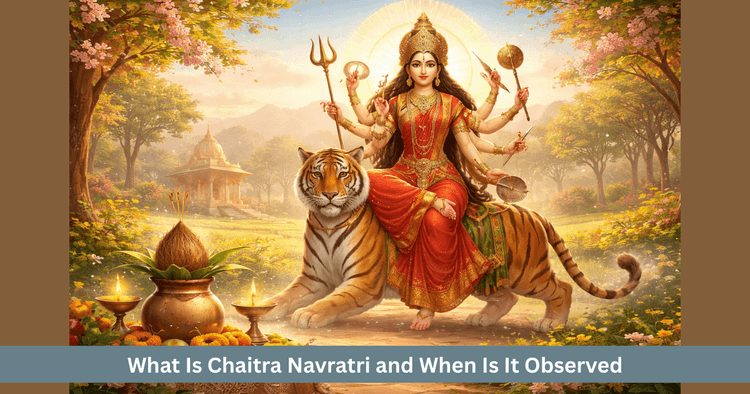
Table of Contents
In the Hindu calendar the month of Chaitra is regarded as the beginning of the year. From the very first day of the bright fortnight of this month a nine day festival known as Chaitra Navratri begins. It is not seen merely as a period of fasting and ritual but as an opportunity to welcome the new year, to align with the renewal of nature and to invite the divine energy of Maa Durga into one’s life. Chaitra Navratri usually falls in March or April when the season of spring has firmly set in.
These nine days are viewed as a time of strength, devotion and disciplined practice. Each day is dedicated to the worship of a particular form of Goddess Durga. The atmosphere in temples and homes fills with hymns, bells and the glow of lamps, creating a distinct spiritual vibration. Many families treat this occasion as their new year and resolve to reorder their homes, minds and lifestyles with fresh clarity and purpose.
What Is Chaitra Navratri and When Is It Observed
The very name Chaitra Navratri explains its timing and nature. Chaitra is the first month of the lunar Hindu calendar and Navratri literally means nine nights. This festival is observed from the first to the ninth lunar day of the bright fortnight of Chaitra. In several regions of India it is accepted as the formal beginning of the year. Spring, the appearance of new crops, tender leaves and fragrant flowers together form the natural backdrop of this observance.
During these nine days devotees try to keep their body, mind and surroundings pure. Homes are thoroughly cleaned and decorated in preparation. On the first day many perform kalash sthapana or the installation of a sacred pot, considering it an invitation to the divine presence. In different areas this Navratri is also referred to as Chaitra Navrat, Vasantik Navratri or Ram Navami Navratri, because the birth festival of Shri Rama also falls within this period on the ninth day.
Connection Between Chaitra Navratri and the New Year
Since ancient times the month of Chaitra has been accepted as the start of the Hindu New Year. Because of this, Chaitra Navratri is not only a festival devoted to the Goddess but also a celebration of the new era of the year. With the change of year a person naturally reflects on life and makes fresh resolutions regarding conduct and direction. Many choose this time to initiate new businesses, new studies or long term plans.
Nature itself enters a new phase during this period. In the fields new crops sway, mango blossoms appear in the orchards, trees are covered in fresh leaves and gentle sunlight spreads warmth. Chaitra Navratri brings the message that just as the outer world renews itself, the inner world of thoughts and attitudes should also be refreshed. For this reason it is seen as a festival of new beginnings, new direction and new energy.
Story Behind Chaitra Navratri and the Battle with Mahishasura
To understand the greatness of Chaitra Navratri it is helpful to recall the story of Mahishasura’s defeat. According to the Puranas, a demon named Mahishasura performed severe austerities and obtained a boon from Lord Brahma that he would not be killed in battle by any god or man. Inflated by this blessing he spread terror across the three worlds. Deities, sages and human beings all suffered under his cruelty.
To find relief from this injustice the gods gathered and discussed a solution. The combined radiance of all the gods came together in a single blinding light. From this divine radiance Maa Durga is said to have manifested. The gods offered their own weapons and powers to her. Armed with the trishul, chakra, shankha, khadga and gada, the Goddess set out to confront Mahishasura.
It is described that the battle between the Goddess and Mahishasura lasted for nine nights and nine days. Each day the Goddess used different aspects of her power to weaken and destroy the demon’s strength. On the tenth day Mahishasura was finally slain and righteousness prevailed. In remembrance of this victory of dharma over adharma, the nine days of Navratri are regarded as sacred to the nine forms of Maa Durga.
Nine Forms of Durga and Their Significance
During the nine nights of Navratri devotees revere the nine forms of Durga, each form nurturing a specific quality in the practitioner such as strength, restraint, knowledge or fulfilment.
These forms can be understood through the following table.
| Form | Day | Main quality |
|---|---|---|
| Shailaputri | First day | Stability, patience, foundation |
| Brahmacharini | Second day | Austerity, restraint, devotion |
| Chandraghanta | Third day | Courage, protection, peace |
| Kushmanda | Fourth day | Creative power, light, joy |
| Skandamata | Fifth day | Motherly love, care, compassion |
| Katyayani | Sixth day | Justice, valour, firmness |
| Kalaratri | Seventh day | Destruction of fear, removal of darkness |
| Mahagauri | Eighth day | Purity, gentleness, forgiveness |
| Siddhidatri | Ninth day | Perfection, spiritual success, grace |
Each day the devotee contemplates the special quality belonging to that form and tries to cultivate it inwardly. In this way the nine days of worship help to shape a balanced and mature personality.
Relationship of Chaitra Navratri with Ram Navami
The ninth day of Chaitra Navratri holds special importance because it is also celebrated as Ram Navami. Tradition states that on this tithi Lord Rama took birth in the royal family of Ayodhya. Rama is revered as the seventh avatar of Lord Vishnu and as the embodiment of righteousness, discipline, sacrifice and ideal conduct.
In this sense the nine days of Chaitra Navratri are significant on two levels. On one side they belong to the worship of Goddess Durga and her power, on the other they culminate in the celebration of an ideal human life in the form of Rama. Many families honour both aspects together by worshipping the Goddess during the first eight days and celebrating Rama’s birth on the ninth. This combination teaches that a complete life needs both strength and moral discipline.
How Chaitra Navratri Is Celebrated
The outward forms of Chaitra Navratri vary from region to region, yet the underlying essence remains same. Some days before the festival people thoroughly clean their homes. The household shrine, kitchen and living spaces are especially kept pure and orderly. On the first day many install a sacred pot and sow barley or other seeds in clay, seeing the sprouts as a sign of prosperity and growth.
Many devotees observe fasts throughout these nine days. Some abstain completely from grains and eat only fruits, while others take one controlled meal with restricted ingredients. Common fasting items include sendha namak salt, buckwheat flour, water chestnut flour, sago, potatoes and fox nuts. Dishes such as sago khichdi, buckwheat pooris, potato curry and fox nut kheer are often prepared as offerings and later distributed as prasad.
During Navratri daily worship of the Goddess is carried out in the morning and evening with aarti, hymns and recitation of texts such as the Durga Saptashati or other praises of the Goddess. In many localities collective night long devotional singing and gatherings take place. Devotees usually refrain from intoxicants, meat and harsh behaviour so that the atmosphere of practice remains pure. Acts of charity like feeding the poor, offering clothes or supporting religious activities are considered especially meritorious at this time.
Spiritual Importance and Benefits of Chaitra Navratri
Chaitra Navratri is also a period of self discipline and inward refinement. Through controlled eating and simple sattvic diet the body receives rest from heavy foods and digestion becomes lighter. Repetition of mantras and regular recitation calm the restless mind. Reflecting on the various forms of the Goddess gradually reduces fear, insecurity and negative tendencies.
The austerity and practice undertaken in these nine days provide a mental foundation for the rest of the year. Those who observe Navratri with sincerity often notice an increase in willpower, patience, discrimination and determination. The festival teaches that no matter how powerful evil or confusion may appear, in the end steadfastness, courage and devotion prevail.
Life Guidance Offered by Chaitra Navratri
If Chaitra Navratri is viewed not only as tradition but as a guide to living, many deep lessons emerge. The story of Mahishasura shows that pride and injustice ultimately lead to destruction, whereas strength joined with restraint and wisdom brings lasting victory. The nine forms emphasise that sometimes gentleness is needed, sometimes firm decisions are necessary, sometimes nurturing love is required and sometimes fearless confrontation of darkness.
The fasts of Navratri are not limited to food alone. They can be seen as an invitation to minimise anger, greed, jealousy and attachment during these days. A person who lives these nine days with awareness and discipline lays a stable base within, upon which the rest of the year’s efforts can stand firmly.
Common Questions
What is the main difference between Chaitra Navratri and Sharadiya Navratri?
Chaitra Navratri begins in the month of Chaitra during the spring season, while Sharadiya Navratri starts in the month of Ashwin in the autumn. Chaitra Navratri is closely connected with the start of the new year and with Ram Navami on the ninth day, whereas Sharadiya Navratri culminates in Vijayadashami or Dussehra. In both, the Goddess is worshipped, yet the surrounding climate, agricultural context and outer celebrations differ somewhat.
What deeper intention lies behind worshipping the nine forms of Durga over nine days?
The worship of nine forms encourages the devotee to focus each day on developing a particular quality. On the day of Shailaputri the focus is on stability and grounding, on the day of Brahmacharini on discipline and devotion, on the day of Kalaratri on overcoming fear and on the day of Mahagauri on purification and softness. Through this gradual practice the inner personality gains balance and maturity.
What benefits arise from fasting during Chaitra Navratri and what care should be taken?
Fasting can give the digestive system a break and bring a sense of physical lightness and freshness. On the mental level it trains a person to restrain impulses and to be more mindful of habits. While fasting it is important to avoid showiness and instead emphasise simplicity, adequate water and fruit intake, proper rest and a calm attitude. Avoiding anger and conflict helps preserve the subtle benefits of the practice.
What spiritual message is conveyed by celebrating Ram Navami within Chaitra Navratri?
The celebration of Ram Navami within Chaitra Navratri suggests that true spiritual life needs both strength and moral integrity. The nine days of worship deepen connection with the power of the Goddess, while the birth of Rama reminds one of the value of righteousness, truthfulness and dutiful living. Together they present a complete picture of inner power guided by noble conduct.
If someone cannot fast for all nine days, can they still meaningfully observe Chaitra Navratri?
The essence of Navratri lies more in sincerity, purity and conscious effort than in the strict length of the fast. A person who, due to health or circumstances, cannot fast for all days can still participate by observing fasts on selected days, by keeping a daily period for prayer, mantra recitation or reading and by maintaining a gentle, sattvic routine. What matters most is a respectful attitude toward Maa Durga and a genuine intention to improve oneself.
Get your accurate Kundali
Generate KundaliDid you like it?
Author

Pt. Narendra Sharma (63)
Experience: 20
Consults About: Family Planning, Career
Clients In: Punjab, Haryana, Delhi
Share this article with friends and family
About ZODIAQ
ZODIAQ is an online Vedic Astrology platform. It connects clients seeking astrological advice to experienced astrologers with deep knowledge. Our users also generate kundali and perform kundali milan for free. ZODIAQ also offers services to the Astrologers. Astrologers utilize various offerings by ZODIAQ to serve their clients effectively.
If you are a User
Consult with experienced astrologers and seek their guidance. You can also order handwritten Janm Patrika report with life prediction prepared by experienced astrologers. Generate accurate Kundali, perform Kundali Matching and check horoscope and muhurat. Utilize our online library for all the necessary astrological and spiritual information.
If you are an Astrologer
Create accurate kundali for your clients and perform Kundali Matching for up to 5 people at a time. Write comprehensive Janm Patrika report for your clients with ZODIAQ. Check client details anytime by saving it in client directory. Become more productive by tracking how many clients you guide every day.
WELCOME TO
ZODIAQ
Right Decisions at the right time with ZODIAQ
