Chaitra Purnima Vrat: Story and Grace of Shri Satyanarayana
By Pt. Sanjeev Sharma
Significance of Vrat, Worship, and Satyanarayana Story on Chaitra Purnima
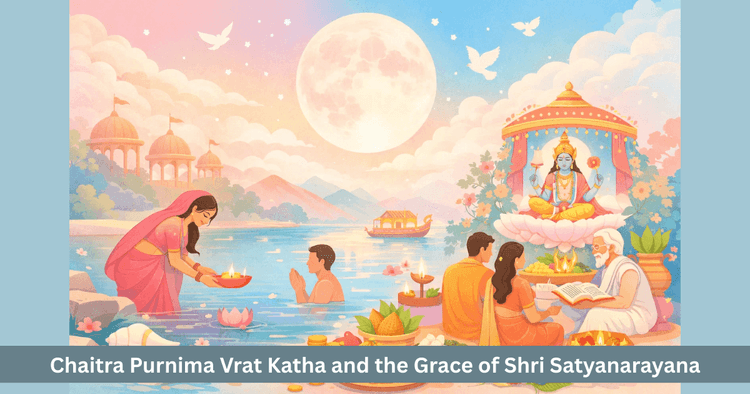
Table of Contents
Within the Hindu tradition the full moon is considered a very pure and uplifting time, as the mind, body and environment all receive the gentle sattvic influence of the moon. Among all full moons, Chaitra Purnima holds a special place. It is the full moon of the month of Chaitra and in many traditions is seen as the first full moon of the year. On this day fasting, sacred bathing, charity and especially the worship and story of Shri Satyanarayana Bhagavan are given great importance.
According to the Indian lunar calendar each month ends with a full moon but the full moon of Chaitra is considered especially auspicious. It is believed that those who observe a vrata on this day and worship Satyanarayana with devotion gradually experience improvement in their undertakings, support in financial matters and greater inner peace. Bathing in sacred rivers, giving charity, reciting divine names and honouring learned Brahmins on this date are said to weaken negative tendencies and strengthen noble resolutions.
Importance of Chaitra Purnima Vrat and Satyanarayana Puja
The Chaitra Purnima fast is regarded as more fruitful than an ordinary full moon observance because the classic tradition prescribes Satyanarayana Puja and Katha on this day. The true meaning of vrata is not only to abstain from food but also to bring thoughts, speech and actions under conscious discipline. In this vrata one cultivates the feeling that Lord Satyanarayana is personally present in the home and that every act is being done before him.
The main aspects of Chaitra Purnima Vrat can be summarised as follows.
| Topic | Description |
|---|---|
| Tithi | Full moon of the month of Chaitra |
| Presiding deity | Shri Satyanarayana, a form of Lord Vishnu |
| Principal observances | Fasting, ritual bath, Satyanarayana Puja and listening to the Katha |
| Purpose | Fulfilment of righteous desires, reduction of sin, family harmony and progress toward liberation |
| Eligible practitioners | Women and men, householders, traders, rulers and the poor alike |
During Satyanarayana Puja, a clean and central place in the house is prepared. On an adorned altar an image or symbol of the Lord and a sanctified water pot are placed. The deity is worshipped with bathing rites, sandal paste, rice, flowers, fruits and offerings of food. At the end the Katha is recited or heard and prasadam is distributed among family and guests.
The Poor Brahmin and Lord Vishnu’s Guidance
The Chaitra Purnima Katha begins with the story of a poor Brahmin living in the town of Kashipur. He was so destitute that he sustained himself through begging. One day, as he went from place to place for alms, Lord Vishnu himself appeared before him in the form of an aged Brahmin.
Addressing him with affection, the Lord said,
“O noble one, Shri Satyanarayana Bhagavan is the giver of cherished results. If you undertake his vrata and worship him, you will be freed from many forms of suffering.”
He further explained that fasting does not mean merely avoiding food. During upavasa one should hold the clear awareness that Satyanarayana is present nearby, watching over and blessing. For this reason both inner and outer purity, devotion in worship and attentive listening to the sacred story are essential.
Through this opening scene the Katha teaches that Chaitra Purnima Vrat is meant to awaken a living sense of divine presence rather than to be a mechanical ritual.
Equal Access to Satyanarayana Vrat for All
One of the key messages of the Satyanarayana Katha is that every human being has equal access to the fruits of this vrata. It is not confined to any single caste, social class or level of wealth. To convey this clearly, the narrative includes episodes from the lives of many different people.
Some of the main figures and their social positions are listed below.
| Character | Social position |
|---|---|
| Poor Brahmin | Lives solely on alms |
| Woodcutter | Earns livelihood through collecting wood from forests |
| King Ulkamukha | A ruler endowed with royal power and resources |
| Sādhu Vaishya | A merchant whose faith is initially incomplete |
| Lilavati and Kalavati | Wife and daughter of the merchant |
| King Tungadhvaja | Another king whose mind is coloured by pride |
| Cowherds | Community of gopas who worship Satyanarayana in the forest |
Through these examples the Katha makes it clear that this vrata is a path open to the poor and the rich, householders and ascetics, rulers and workers, women and men, all on the basis of faith and sincerity.
Fruit of Faith for the Woodcutter, Poor Brahmin and Cowherds
In the Katha, several simple people hear about the greatness of Satyanarayana Vrat and respond without delay.
The poor Brahmin, the humble woodcutter who lives by selling wood and the cowherds dwelling in the forest all come to know that this vrata brings happiness, good fortune and prosperity. Without overthinking they immediately resolve to observe it with devotion and humility.
They perform the vrata, worship Satyanarayana, listen carefully to the story and honour the prasadam. Over time their lives become more stable and peaceful and at the end of their journey they are said to attain eligibility for liberation. This shows that sincere, unpretentious practice can uplift both worldly circumstances and inner awareness.
The Sādhu Vaishya, Incomplete Faith and Difficult Trials
A central section of the Katha concerns the Sādhu Vaishya and his family. He first hears of the Satyanarayana Vrat from King Ulkamukha but his faith is not firm. He resolves internally that he will perform the vrata only after the birth of a child.
In due course a beautiful daughter is born to him. His wife Lilavati reminds him of the vow, yet he postpones again, saying that he will undertake the worship at the time of the girl’s marriage.
Eventually the daughter Kalavati is married but the merchant still does not fulfil his pledge. Soon after, he sets out on a trading journey with his son in law, leaving the vrata incomplete. During this journey he is falsely accused of theft and King Chandraketu imprisons both him and his son in law. Meanwhile, thieves break into his house, leaving Lilavati and Kalavati with nothing. They are forced to survive through begging.
Through this, the story illustrates that postponing righteous commitments and practising with half hearted faith can lead to avoidable troubles and imbalance.
Lilavati, Kalavati and the Lord’s Mercy
In the midst of hardship, one day Kalavati sees Satyanarayana Puja being performed at a house. She receives a little prasadam there and brings it home for her mother. Seeing the blessed food and reflecting on their suffering, a deep sense of devotion awakens in Lilavati.
The next day she observes the Satyanarayana Vrat with full sincerity. She worships the Lord and prays earnestly for the safe return of her husband and son in law and for the removal of the misfortune surrounding the family.
The Katha narrates that Lord Hari becomes pleased with her devotion. In a dream he instructs King Chandraketu that the two prisoners are innocent and must be released. The king frees them with respect and even restores wealth and goods before sending them home.
On returning, the merchant realises the consequences of his neglect and vows to observe Satyanarayana Vrat every Purnima and Sankranti. He lives out his remaining years in gratitude and finally, after enjoying his rightful share of worldly comfort, attains liberation by the Lord’s grace. This episode underlines that even after mistakes, sincere repentance and steady practice can restore harmony.
King Tungadhvaja, Pride and Return from Calamity
Another important episode concerns King Tungadhvaja. Once he entered a forest where a group of cowherds were worshipping Satyanarayana. Filled with pride, he neither approached the place of worship, nor bowed from a distance, nor accepted prasadam from them.
This attitude of disrespect toward the Lord and his devotees brought serious consequences. The king gradually lost his sons, his wealth, his grain and even his horses and elephants. Misfortune overtook his household.
After some time he understood that the root of his suffering was his arrogance and disregard for Satyanarayana. Filled with remorse, he returned to the forest, called the cowherds and humbly requested them to teach him the procedure of the vrata.
He then performed Satyanarayana Puja with sincerity, accepted the prasadam and shed his pride. As a result the calamities lifted. His wealth, family and resources were restored. The king felt deep joy and dedicated his life and possessions to serving dharma and honouring the Lord.
Guidance Offered by Chaitra Purnima Vrat Katha
The Chaitra Purnima Katha is more than a sequence of miracles. It is a layered guide for living. From the poor Brahmin to King Tungadhvaja, each character’s journey carries a lesson.
- Incomplete faith leads to incomplete results.
- A vrata is not a test of endurance alone but a practice of truthfulness, purity and humility.
- Respect for prasadam, Katha and divine names is as important as any big ritual or sacrifice.
- Pride, procrastination and neglect of one’s word invite disturbance, while honest correction and renewed sincerity reopen the way to grace.
Those who listen to this Katha on Chaitra Purnima while performing Satyanarayana Puja do not merely gather merit. They also cultivate humility, gratitude and a deeper attraction toward righteous living.
Common Questions
What is considered the main benefit of observing Satyanarayana Vrat on Chaitra Purnima?
The vrata is said to support the fulfilment of wholesome desires, strengthen family bonds, stabilise finances and calm the mind. The Katha shows that people from many walks of life gained relief from difficulties and a more balanced life after embracing this practice.
Is this vrata reserved only for Brahmins or a particular group?
No. The Katha explicitly includes the poor, the wealthy, kings, traders, Brahmins, cowherds, women and men, indicating that Satyanarayana Vrat is open to all. Eligibility rests on faith and sincerity rather than caste or status.
Can the merit of the vrata be offered for someone else’s wellbeing?
The episode of Lilavati demonstrates that she performed the vrata and prayed for the release and safe return of her husband and son in law. This shows that one may dedicate the merit of the observance for the protection and upliftment of loved ones.
What happens when faith is weak or the vow is repeatedly postponed?
The Sādhu Vaishya’s story illustrates that delaying a vow and practising without full conviction can invite unnecessary hardship. Yet when he later observed the vrata with true remorse and devotion, conditions improved, which encourages honest self correction.
What practical lesson arises from the story of King Tungadhvaja?
By ignoring the worship and refusing prasadam, he expressed subtle contempt for devotion and paid a heavy price. Later, through humble participation in the vrata, his fortunes were restored. The lesson is to avoid disrespect toward sacred acts and to cultivate humility before divine grace.
Get your accurate Kundali
Generate KundaliDid you like it?
Author
Pt. Sanjeev Sharma (63)
Experience: 20
Consults About: Family Planning, Career
Clients In: Punjab, Haryana, Delhi
Share this article with friends and family
About ZODIAQ
ZODIAQ is an online Vedic Astrology platform. It connects clients seeking astrological advice to experienced astrologers with deep knowledge. Our users also generate kundali and perform kundali milan for free. ZODIAQ also offers services to the Astrologers. Astrologers utilize various offerings by ZODIAQ to serve their clients effectively.
If you are a User
Consult with experienced astrologers and seek their guidance. You can also order handwritten Janm Patrika report with life prediction prepared by experienced astrologers. Generate accurate Kundali, perform Kundali Matching and check horoscope and muhurat. Utilize our online library for all the necessary astrological and spiritual information.
If you are an Astrologer
Create accurate kundali for your clients and perform Kundali Matching for up to 5 people at a time. Write comprehensive Janm Patrika report for your clients with ZODIAQ. Check client details anytime by saving it in client directory. Become more productive by tracking how many clients you guide every day.
WELCOME TO
ZODIAQ
Right Decisions at the right time with ZODIAQ
