Gajanan Sankashti Chaturthi and Its Sacred Story
By Pt. Nilesh Sharma
Gajanan Sankashti Chaturthi is Powerful for Ganesh Worship and Obstacle Removal
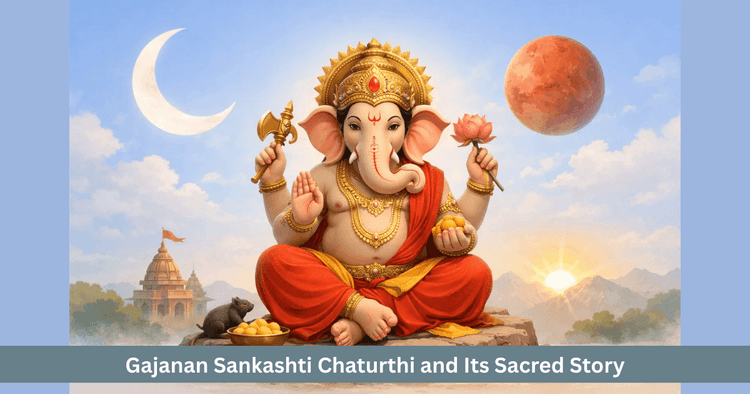
Table of Contents
In the Sanatana tradition Sankashti Chaturthi is regarded as a very sacred and powerful date. It is observed every month on the fourth tithi of the Krishna Paksha. When this Chaturthi falls on a Tuesday it is called Angaraki Sankashti Chaturthi and its spiritual potency is believed to increase even more. On this day the observance is dedicated to Lord Ganesha, worshipped as the remover of obstacles and the destroyer of distress. In the form of Gajanan Sankashti Chaturthi, devotees worship Ganesha specifically in the aspect known as Gajanan, the elephant faced Lord who grants relief from difficulties and bestows peace, success and inner steadiness.
The Chaturthi tithi itself is dear to Ganesha. From a jyotish perspective this day connects the energies of Moon and Mars and is seen as helpful for purifying both the mind and courage. Sankashti Chaturthi, especially when it falls as Angaraki, is considered highly effective for resolving crises, seeking justice, coming out of debts and restoring mental balance through sincere vrata and worship.
What Is Gajanan Sankashti Chaturthi
The word Sankashti is formed from sankat, meaning difficulty or obstacle and a sense of removal. Sankashti Chaturthi is thus the day on which Ganesha is especially worshipped as Sankat Nashak, the remover of troubles. When his Gajanan form is invoked on this tithi, the devotee prays not only for freedom from outer problems but also from inner confusion, fear and ignorance.
The key features of this observance can be summarised as follows.
| Aspect | Description |
|---|---|
| Date | Fourth tithi of the Krishna Paksha each month, especially when it falls on a Tuesday as Angaraki Sankashti |
| Presiding deity | Lord Ganesha in his Gajanan form |
| Main benefits | Removal of obstacles and troubles, protection from dishonour, strengthening of intellect and courage |
| Recommended practices | Fasting, worship after Moonrise, chanting of Ganesha mantras, offering laddus or modakas as naivedya |
| Special names | Sankashti Chaturthi, Angaraki Sankashti, Gajanan Sankashti |
On this day many devotees observe a disciplined fast and perform Ganesha puja after sighting the Moon in the evening. In several traditions specific names and forms of Ganesha are remembered month by month and on Gajanan Sankashti the focus is on the elephant faced form.
Birth Story of Lord Ganesha
The Puranas describe that at the beginning of creation, when different deities were entrusted with various cosmic functions, Brahma, Vishnu and Mahesh together saw the need for a deity who could represent intelligence, strength and discrimination and who would be worshipped first in all auspicious undertakings.
From this vision arose the story of Lord Ganesha’s manifestation through the tapas of Mata Parvati. One day, before bathing, Parvati was applying fragrant paste to her body. From that paste she lovingly fashioned the figure of a young boy and, using her yogic power, infused it with life. She instructed the boy to guard the doorway and told him that until she finished her bath no one, whoever it might be, should be allowed to enter. The child accepted her command as absolute and began to stand watch at the entrance.
How the Incident between Shiva and Ganesha Took Place
After some time Lord Shiva arrived and proceeded to enter. The boy, obeying his mother’s order, stopped him and firmly stated that no one could go inside until Parvati came out. Not recognising the child and feeling challenged at his own door, Shiva perceived this as a form of disrespect. Other deities and attendants tried to persuade the boy but he remained unwavering in his duty to his mother.
Eventually Shiva’s displeasure intensified and a confrontation arose. In the course of this conflict Shiva, in his fierce aspect, severed the child’s head with his weapon. The lifeless body fell at the doorway. Shortly thereafter Parvati emerged from her bath and saw her created son lying dead. Overcome with sorrow and anger, she began to lament and her grief shook the worlds.
The Elephant Head and the Gajanan Form of Ganesha
Seeing the gravity of the situation, the devas approached Lord Vishnu for help. Vishnu advised that a head should be brought from the first living being found sleeping with its head toward the north. The gods searched and found an elephant in that posture. Accepting this as part of divine arrangement, they brought the elephant’s head, which was then placed upon the child’s body.
Lord Shiva restored the boy to life and declared that from that day he would be known as the Ish of the ganas, that is, Ganesha. Shiva further granted that Ganesha would be honoured as the first deity to be worshipped in every auspicious undertaking. With the elephant head he also came to be called Gajanan, the one with the elephant face. From this pivotal event Ganesha became revered as Vighnaharta, the remover of obstacles and as the deity presiding over the proper beginning of all sacred rituals and efforts.
Why the Day Came to Be Known as Sankashti Chaturthi
When this series of events unfolded, the gods realised that a great crisis had been resolved. Destruction and disorder were near, as Parvati’s grief and anger could have shaken the cosmic balance, yet harmony was restored through Ganesha’s revival and elevation. Because a deep sankat or crisis, had been removed and because the tithi was Chaturthi, the day became associated with the idea of Sankashti Chaturthi.
On this tithi devotees remember the moment when Ganesha received his role as Vighnaharta and pray that similarly the obstacles in their own lives may be cleared. In this way, the observance is linked both to a specific mythic event and to an ongoing inner process of removing blockages.
The Story of Shri Krishna and the Sankashti Vrat
Another story that highlights the greatness of Sankashti Chaturthi is connected with Shri Krishna. It is said that on one occasion Krishna was falsely accused in connection with the theft of a precious jewel. This undeserved blame hurt his honour and caused distress. Seeking guidance, he approached Devarshi Narada and asked for a way to remove the stain of that accusation.
Narada advised him to observe the vrata of Sankashti Chaturthi with full faith. He explained that by performing this vow properly one can be freed from fault, infamy and obstacles and truth is allowed to shine forth. Krishna followed Narada’s instruction and kept the vrata of Sankashti Chaturthi. As a result the false charges fell away and he was recognised as free from blame. This narrative conveys that the Sankashti vrata is not only for worldly problems but also for clearing dishonour, wrong accusations and karmic obstructions.
Symbolic Meaning of the Gajanan Form
The Gajanan form of Ganesha is not only the outcome of an ancient event but also a rich symbol. The large head of the elephant represents expansive intelligence and strong memory. The small eyes point toward deep concentration and subtle perception, teaching that a seeker should learn to look carefully and inwardly. The large ears suggest that one should listen more and speak less so that discrimination remains awake.
His ample belly teaches the art of digesting both pleasant and difficult experiences of life without losing balance. His short legs and long trunk together indicate steadiness combined with flexibility. In this way the Gajanan form reminds the devotee that true removal of obstacles requires not only outer worship but also the cultivation of these inner qualities.
Benefits of Observing Sankashti Chaturthi
For a sincere practitioner, the vrata of Sankashti Chaturthi, especially on Gajanan Sankashti, offers support on many levels.
- Old debts, legal entanglements and repeating outer obstacles are believed to move gradually toward resolution
- Inner fear, confusion and negativity reduce, while self confidence increases
- Students, business people and those starting new ventures often experience clarity and support through this observance
- Families seeking harmony, stability and blessings for children find this vrata especially meaningful
Above all, the devotee’s mind slowly learns to focus less on the obstacle and more on the way forward. When remembrance of Ganesha and contemplation of the Gajanan form remain alive in the heart, courage and clear thinking become stronger and one is better able to turn challenges into opportunities.
Common Questions
On which date is Gajanan Sankashti Chaturthi observed?
Sankashti Chaturthi is observed every month on the fourth tithi of the Krishna Paksha. When this Chaturthi falls on a Tuesday it is called Angaraki Sankashti Chaturthi and on such a day special worship is offered to Ganesha in his Gajanan aspect.
Why is Lord Ganesha called Gajanan?
Because his body is that of a human child, while his head is that of an elephant. This elephant face makes him Gajanan, symbolising great intellect, patience and strength.
How is the Sankashti Chaturthi vrata usually observed?
One takes a morning bath and resolves to keep the vrata, then follows a controlled or complete fast during the day. In the evening, after sighting the Moon, Ganesha puja is performed with mantra chanting and offerings, after which the fast is traditionally broken.
What lesson does the story of Shri Krishna and the Sankashti vrata convey?
It shows that when faced with false accusations or dishonour, the Sankashti vrat strengthens inner resolve and invites divine grace so that truth can emerge and circumstances can gradually turn in a favourable direction.
What benefits arise from meditating on the Gajanan form of Ganesha?
Meditation on Gajanan steadies the mind, sharpens intellect and nurtures patience in the face of difficulties. It supports better decision making and helps the devotee develop the capacity to transform obstacles into steps on the spiritual and practical path.
Get your accurate Kundali
Generate KundaliDid you like it?
Author

Pt. Nilesh Sharma (63)
Experience: 20
Consults About: Family Planning, Career
Clients In: Punjab, Haryana, Delhi
Share this article with friends and family
About ZODIAQ
ZODIAQ is an online Vedic Astrology platform. It connects clients seeking astrological advice to experienced astrologers with deep knowledge. Our users also generate kundali and perform kundali milan for free. ZODIAQ also offers services to the Astrologers. Astrologers utilize various offerings by ZODIAQ to serve their clients effectively.
If you are a User
Consult with experienced astrologers and seek their guidance. You can also order handwritten Janm Patrika report with life prediction prepared by experienced astrologers. Generate accurate Kundali, perform Kundali Matching and check horoscope and muhurat. Utilize our online library for all the necessary astrological and spiritual information.
If you are an Astrologer
Create accurate kundali for your clients and perform Kundali Matching for up to 5 people at a time. Write comprehensive Janm Patrika report for your clients with ZODIAQ. Check client details anytime by saving it in client directory. Become more productive by tracking how many clients you guide every day.
WELCOME TO
ZODIAQ
Right Decisions at the right time with ZODIAQ
