Gangaur Festival: Tradition and the Story of Kacchi Gangaur
By Pt. Sanjeev Sharma
Gangaur Festival in Rajasthan: Marital Harmony and Traditional Rituals
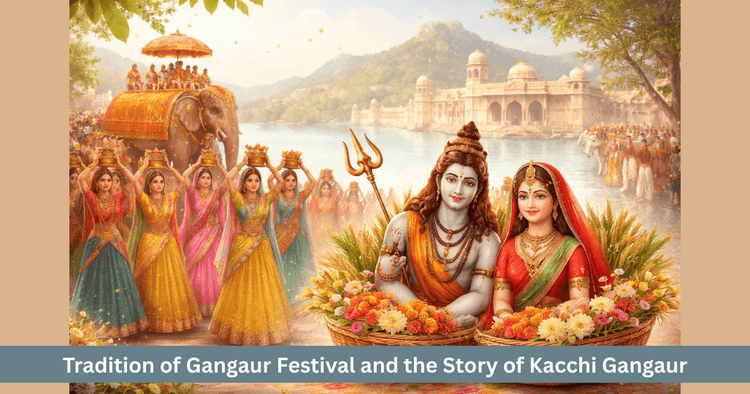
Table of Contents
Within the living traditions of Rajasthan the festival of Gangaur holds a very special place. It is regarded as a celebration of marital harmony, auspiciousness, prosperity and the grace of Lord Shiva and Goddess Parvati upon family life. In the cities of lakes, processions of Gangaur, rituals of Sinjara and the worship offered by married women become the focus of attention. Among these customs there exists a particularly interesting history related to “Kacchi Gangaur” or “Choti Gangaur” which is worth understanding in detail.
Historical references indicate that around a century and a quarter ago, near the year 1889, during the custodianship of Maharana Fateh Singh of Mewar, a proposal was made to organise a social fair on the days of Sheetla Saptami and Sheetla Ashtami according to the Hindu calendar. This fair was conceived as a gathering for the people of the city. From that time onward the public tradition of Kacchi Gangaur slowly took shape and since then this festival has been observed every year with deep devotion.
What Is Kacchi Gangaur and When Is It Celebrated
In general the Gangaur festival is observed in the month of Chaitra, yet the specific form known as Kacchi or Choti Gangaur is closely associated with the days of Sheetla Saptami and Ashtami. In the old quarters of the city this custom evolved as a folk celebration where women and young girls dress beautifully and carry the Gangaur idols in procession before immersing them in water.
The term Kacchi Gangaur is also related to the manner of its construction. The idols are made from delicate and fine clay. Because of this fragile material they came to be called “kacchi” meaning unbaked or tender. In contrast, in some other places Gangaur images are made from wood or metal for long term use but the tradition described here relates specifically to clay idols of Gangaur which are freshly prepared each year.
Beginning of Kacchi Gangaur in the Time of Maharana Fateh Singh
During the late nineteenth century Maharana Fateh Singh ruled in Mewar. At that time the thought arose of creating an event where the people of the city could gather on Sheetla Saptami and Ashtami for both religious and social celebration. Under this idea a social fair was organised in the city of lakes and was later linked with the observance of Kacchi Gangaur.
The responsibility of organising this first Kacchi Gangaur festival was entrusted to Panna Lal Gaud, an artisan working within the royal palace. He was skilled in traditional arts and often played an important role in religious works of the royal household. From this initial royal initiative the custom gradually became firmly rooted among the residents of the old city and today that area is recognised for this distinctive celebration.
Role of Panna Lal Gaud and the First Gangaur Idols
At the time of the first Kacchi Gangaur celebration Panna Lal Gaud was given the task of creating a pair of idols. In this pair one figure represented the male aspect and the other the feminine aspect. The male side was consecrated as Lord Shiva and the feminine side as Goddess Parvati often addressed as Gangaur. This pair became the central icon of worship for the festival.
The intention behind this unique pair was not limited to artistic beauty but extended to symbolising marital love, harmony and the purity of household life. From that very first effort the tradition has been honoured by the townspeople with great respect. The idols of Gangaur are viewed not as mere figures of clay but as symbolic embodiments of Shiva and Parvati together.
Hereditary Continuation of the Craft of Making Gangaur
A particularly noteworthy aspect of this tradition is that for nearly one hundred and twenty five years the delicate craft and responsibility of making these Gangaur idols has remained within the same family to whom it was originally given. After Panna Lal Gaud, his son carried forward the work. Subsequent generations have regarded it as both a duty and a privilege.
At present this lineage is represented by Devendra Kumar Gaud, the great grandson of Panna Lal Gaud. Devendra Kumar feels deep pride in this inherited art and duty. For him the making of Gangaur is not only a craft of the hands but also the fruit of inner devotion and generations of practice. He also believes that in future his son will continue this family tradition so that the cultural heritage of Gangaur remains protected.
How Kacchi Gangaur Idols Are Prepared
The making of Kacchi or Choti Gangaur is a sensitive and time consuming process. Very fine and suitable clay is chosen for the work. A special feature is that preparations begin almost half a year in advance, soon after Diwali, because a clay idol takes a long time to lose all moisture and become fully dry.
In the first stage the clay is kneaded and the basic form of the idols is shaped. The proportion between male and female figures, the expression of the faces, the positioning of ornaments and the posture are decided at this time. After shaping, the idols are dried slowly in the shade so that no cracks appear and the structure remains sound. When the figures have lost all dampness, the work of painting begins, usually after the festival of Holi.
Colours are chosen with both tradition and aesthetics in mind. Auspicious shades such as red, yellow, green and golden are commonly applied to the garments and jewellery of Gangaur. Gentle expressions are painted on the faces, with devotion in the eyes and a soft smile on the lips. After this detailed process the Kacchi Gangaur idols are ready to be installed for the festival.
Feelings of Devendra Kumar Gaud and Changing Public Interest
Devendra Kumar Gaud experiences deep satisfaction in maintaining this ancestral craft and responsibility. According to him, the art of making Gangaur is not merely a technical skill but an offering of the heart shaped by generations. He has also observed that during certain periods in the past the enthusiasm and interest of people in this tradition had somewhat declined.
however over roughly the last decade the attraction toward Kacchi Gangaur has grown again. Devendra Kumar believes that administrative support, positive discussion among the public and a renewed sense of devotion in individuals have all contributed to this revival. Once more, residents of the old city are actively participating with decorations, processions and worship during the days of Gangaur.
Main Rituals on the Day of Kacchi Gangaur
On the day of Kacchi Gangaur the atmosphere of the town becomes both joyful and devotional. From morning onwards the idols of Gangaur are dressed in beautiful clothing, with skirts, veils, turbans, crowns and artificial ornaments. Along with the idols, items associated with married life such as bangles, vermilion, bindis and henna are also given importance.
Married women and unmarried girls adorn themselves in traditional attire. They carry the Gangaur idols upon their heads. This sight in the streets and at the lakeside is very graceful and attractive. In the form of a procession, the idols are taken through the main routes of the city. The sound of devotional songs, drums and folk music fills the surroundings and the whole area seems absorbed in celebration.
Immersion of Gangaur and the Emotional Farewell
After worship and the procession, the Kacchi Gangaur idols are brought to the nearby lake or reservoir. There, final aarti, prayers and blessings are offered before they are immersed in the water. As the clay idols are created for just that one year of worship, their immersion is understood as a natural part of the festival’s cycle.
At this moment a gentle emotion appears in the eyes of many women, because they see Gangaur not only as a clay form but as a companion of Maa Gauri and a guardian of their married life. With the immersion they silently place a wish in their hearts that the festival will return the next year and that the grace of Shiva and Parvati will continue upon their homes.
Cultural Message of the Gangaur Tradition
The entire story and custom of Kacchi Gangaur shows how a small initiative can grow into a strong cultural identity over time. What began as a social fair in the days of Maharana Fateh Singh has become an integral part of the soul of the city of lakes. From Panna Lal Gaud to Devendra Kumar Gaud, the generations that have cared for this heritage demonstrate that when faith and folk art come together, traditions remain vibrant.
The Gangaur festival honours married life, auspiciousness, motherhood and household responsibilities. The clay idols of Kacchi Gangaur remind people every year that forms may change but when respect, love and devotion are deep, culture stays stable and enriched.
Common Questions
Why is this form of the festival called Kacchi or Choti Gangaur?
It is called Kacchi Gangaur mainly because the idols are made from delicate clay which is not meant to be preserved permanently. Fresh idols are created each year and immersed after the celebrations. For this reason they are referred to as kacchi or small Gangaur, in contrast to more permanent wooden or metal forms.
What was the special role of Panna Lal Gaud and who continues the tradition today?
For the very first Kacchi Gangaur, the responsibility of crafting the idols and managing the arrangements was given to palace artisan Panna Lal Gaud. He created the initial pair of idols representing Shiva and Parvati. Today this hereditary tradition is continued by his great grandson, Devendra Kumar Gaud.
When and how are the Kacchi Gangaur idols prepared during the year?
Work on the Kacchi Gangaur idols begins soon after Diwali because clay requires many months to dry fully. The forms are shaped from clay, slowly dried in shade and kept safe. After Holi, when all moisture has left, colours are applied and the idols are decorated with painted garments and ornaments in readiness for the festival.
What special activities do women perform on the day of Kacchi Gangaur?
On this day women and girls wear traditional clothes, adorn themselves with jewellery and participate in the procession carrying the Gangaur idols on their heads. They sing devotional and festive songs, offer prayers and finally take the idols to the lake or reservoir where they perform aarti and immersion.
What broader message does this tradition give to society?
The tradition of Kacchi Gangaur conveys that preserving marital harmony, family affection and cultural heritage is a shared responsibility of the community. When one family maintains the craft across generations and the whole town comes together to celebrate, it becomes clear that society and tradition support each other, keeping folk art and faith alive.
Get your accurate Kundali
Generate KundaliDid you like it?
Author
Pt. Sanjeev Sharma (63)
Experience: 20
Consults About: Family Planning, Career
Clients In: Punjab, Haryana, Delhi
Share this article with friends and family
About ZODIAQ
ZODIAQ is an online Vedic Astrology platform. It connects clients seeking astrological advice to experienced astrologers with deep knowledge. Our users also generate kundali and perform kundali milan for free. ZODIAQ also offers services to the Astrologers. Astrologers utilize various offerings by ZODIAQ to serve their clients effectively.
If you are a User
Consult with experienced astrologers and seek their guidance. You can also order handwritten Janm Patrika report with life prediction prepared by experienced astrologers. Generate accurate Kundali, perform Kundali Matching and check horoscope and muhurat. Utilize our online library for all the necessary astrological and spiritual information.
If you are an Astrologer
Create accurate kundali for your clients and perform Kundali Matching for up to 5 people at a time. Write comprehensive Janm Patrika report for your clients with ZODIAQ. Check client details anytime by saving it in client directory. Become more productive by tracking how many clients you guide every day.
WELCOME TO
ZODIAQ
Right Decisions at the right time with ZODIAQ
