Gudi Padwa: Very Detailed Significance, History and Traditions
By Pt. Amitabh Sharma
Arrival of Spring and Celebration of the New Year Explained in Detail
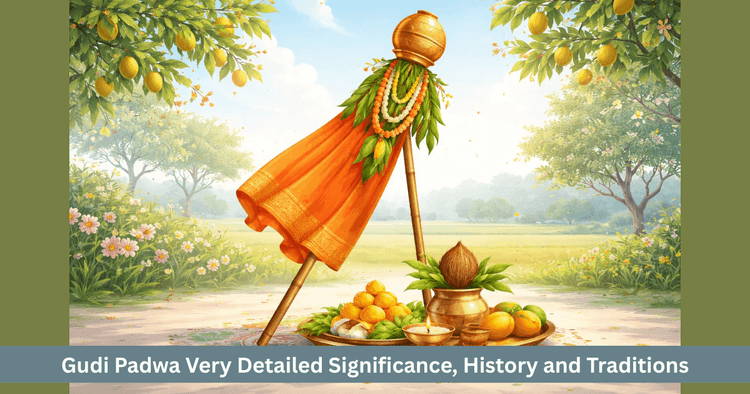
Table of Contents
In Indian culture the arrival of spring is not seen as just a change of season, it is understood as the beginning of a new cycle of life. After the cold winter winds subside, when the air becomes gentle, tender leaves appear on trees, mango blossoms fill the breeze with fragrance and fresh green crops shimmer in the fields, the heart naturally feels uplifted. In this atmosphere of renewal and joy the festival of Gudi Padwa is celebrated. It is observed with deep reverence and happiness as the New Year by the Marathi and Konkan communities of western India.
Gudi Padwa falls on the first day of the bright fortnight of the month of Chaitra, known as Chaitra Shukla Pratipada. According to the lunar Hindu calendar this day marks the beginning of a new year. As per the commonly used Gregorian calendar it usually occurs between the last week of March and the first week of April. For Marathi and Konkani Hindus this is not merely a change of date but an opportunity to refresh life with new resolutions, new efforts and renewed hope. In Maharashtra, Goa and parts of Karnataka, Gudi Padwa appears in every household through Gudi flags, rangoli designs, traditional dishes and family gatherings. In many regions of southern India the same day is known as Ugadi, which shows how widespread and deep rooted this festival truly is.
Detailed Worship Procedure and Auspicious Beginning on Gudi Padwa
From early morning on Gudi Padwa the atmosphere of the home turns devotional and festive. Tradition recommends waking during Brahma Muhurta and taking a cleansing bath with oil massage using sesame or herbal oils. After this people wear fresh traditional clothes, with many women choosing the nine yard saree and men wearing dhoti or kurta. The house is purified by sprinkling a mixture of Ganga water and sacred cow byproducts at the entrance and in the courtyard so that negative vibrations are dissolved and a positive spiritual energy is invited.
At the main doorway a colourful rangoli is drawn. Designs often include auspicious symbols such as kalash, swastik, lamps, mango leaves, images of the rising sun and moon. Through rangoli the household symbolically invites Goddess Lakshmi. Along with this, preparations for Gudi Dwaja, the central emblem of the festival, begin near the entrance or on a balcony visible from outside.
To prepare the Gudi, a bamboo pole of about four to six feet is usually chosen. At the top of this pole a clean new cloth of a bright colour such as yellow, saffron or green is tied. This cloth represents joy, enthusiasm and prosperity. Over this cloth an inverted copper or silver pot is carefully placed as a kalash. Around the mouth of the kalash are tied fresh mango leaves, tender neem leaves, a garland of sugar crystals, jaggery pieces and flowers. In some households special sweet garlands are also added. In this manner the complete Gudi flag is decorated and made ready.
During worship the Gudi is tied on the right side of the entrance at a height so that it is visible from a distance. First, the family offers prayers in the home shrine to Lord Vishnu, Lord Brahma and Lord Shiva, then comes to the Gudi and offers vermilion, rice, flowers, incense, lamp and naivedya. Many families especially remember Lord Brahma on this day, because one belief holds that this is the day when he once again created the universe after a great dissolution.
After the rituals the entire family stands before the Gudi with joined palms and prays for wellbeing in the new year. Old conflicts and resentments are consciously left behind and there is an inner resolve to live with harmony and goodwill. After the puja a special mixture of neem, jaggery, sometimes tamarind, black pepper and other ingredients is eaten. This blend of bitter and sweet is taken as a symbolic teaching about the balanced acceptance of pleasure and pain in life. Throughout the day relatives and friends visit, sweets are shared and warm greetings for the new year are exchanged.
Ancient Historical Background of Gudi Padwa and Related Narratives
The history of Gudi Padwa is not confined to a single region or era. It carries many layers of ancient, regional and royal traditions. According to several scholars of Maharashtra, the origins of Gudi Padwa can be traced back to the time of Yadava rulers, when it was primarily celebrated as the beginning of a new agricultural cycle after harvest. This is the period when the rabi crop is gathered and preparations begin for the next sowing. Naturally, for agrarian communities this became a joyful time marked by rituals of gratitude and hope.
One widely held historical belief is that Gudi Padwa came to be observed more prominently during the reign of Chhatrapati Shivaji Maharaj. It is said that when Shivaji Maharaj won several forts and territories, strengthening the foundations of Swarajya, the people hoisted Gudi flags on their homes to honour his victories. The fluttering Gudi was seen as a symbol of valour, freedom and self respect. For this reason even today raising the Gudi high is associated with success, dignity and the power to rise above challenges.
Another historical reference connects Gudi Padwa to the beginning of the Shalivahana Shaka era. According to tradition, Emperor Shalivahana defeated invading forces and established a new calendar era to commemorate this triumph. The Gudi flag then became an emblem of that victory and of a new period of stability. From this perspective Gudi Padwa stands not only for personal renewal but also for collective pride and social resilience.
Mythological Beliefs Associated with Gudi Padwa
Alongside historical narratives Gudi Padwa is also interwoven with several mythological beliefs. Texts such as Brahma Purana describe this day as the moment when Lord Brahma restarted the process of creation and set the wheel of time into motion after a great deluge. Because of this, the day is seen as the birthday of the universe in a symbolic sense and as an especially powerful time to start anything new.
Another cherished belief links Gudi Padwa to the return of Lord Rama to Ayodhya after defeating Ravana. It is described that the people of Ayodhya decorated the city with flowers and flags and joyfully welcomed their king by raising victory banners. Over time, in the cultural soil of Maharashtra, that idea of a victory flag took the form of the Gudi. Therefore Gudi Padwa also carries the message of the triumph of righteousness and the ultimate success of truth over falsehood.
In some traditions the Gudi is called the flag of Brahma or Brahma Dhwaja, representing higher knowledge, awakening and spiritual awareness. Thus the festival does not only celebrate external achievement but also calls attention to the inner journey of consciousness.
Symbolic Meaning of Each Element of Gudi Dwaja
The Gudi Dwaja holds within itself a complete spiritual teaching. The tall bamboo pole can be seen as the backbone of human life, signifying stability, patience and steadfastness. Around it the bright cloth wraps like the many colours of experience, joys and celebrations that give life its flavour. The copper or silver kalash at the top represents purity, prosperity and fertility, indicating that when life rests on a strong foundation, abundance naturally flows.
The fresh mango leaves denote perpetual growth and ever renewing vitality. The bitter neem leaves stand for protection from disease and purification of body and mind. Jaggery and other sweets woven into the Gudi express the sweetness one must cultivate in thoughts, words and relationships. When family members later drink the water associated with the kalash or partake of offerings tied to the Gudi, it is considered an act of inwardly absorbing all these auspicious qualities.
Raising the Gudi high outside the house conveys the message that the household stands under the banner of righteousness, courage and divine grace. It is as if the home declares to the world and to itself that positive values will always be kept at the forefront.
Gudi Padwa as a Symbol of New Beginnings in Life
Recognising Gudi Padwa as the Marathi New Year means acknowledging that this day offers a fresh lens through which to view life. Many people consciously choose this day to end old quarrels, forgive past hurts and open a new chapter in their relationships. It is common to plan the commencement of important activities such as launching a business, deciding on house construction, initiating educational plans or fixing auspicious ceremonies after Gudi Padwa.
From a spiritual standpoint the day is suited for taking personal vows related to discipline, healthier living, regular prayer or study of sacred texts. Families often perform special worship to Lord Vishnu and Goddess Lakshmi with the intention that the coming year should be marked by financial stability and inner contentment. In this way the festival balances material aspirations with spiritual growth.
Family, Community and Social Harmony on Gudi Padwa
One of the most beautiful aspects of Gudi Padwa is the way it weaves families and communities together. Visiting relatives and neighbours, offering them sweets and exchanging blessings for the new year are a natural part of the celebration. In many places community groups organise processions where decorated Gudi flags, traditional music, folk dances and devotional singing can be seen together. Women dressed in traditional attire play drums and dance in synchrony, adding vibrancy to the streets.
In rural regions farmers visit their fields to offer prayers to Mother Earth and seek blessings for the new cropping cycle. Children learn from elders about the meaning of the Gudi, about ancestral customs and stories of courage and faith. Through these activities Gudi Padwa becomes a living classroom of culture, teaching unity, gratitude and shared joy.
Traditional Foods of Gudi Padwa and Their Inner Message
Like every Indian festival, Gudi Padwa is incomplete without its special food. A distinctive feature is the mixture of neem and jaggery eaten in the morning. In some households ingredients such as tamarind, black pepper or fenugreek seeds are also added. The bitter taste of neem is associated with cleansing the body and warding off illness, while the sweetness of jaggery reflects the pleasant experiences of life. Taking them together symbolises the understanding that both pleasant and unpleasant events contribute to growth and must be accepted gracefully.
In Maharashtrian homes puran poli holds an honoured place on this day. Made with cooked chickpeas, jaggery and fragrant spices stuffed inside a soft wheat flatbread fried with ghee, it becomes a food that carries affection and warmth. Along with puran poli dishes such as shrikhand, sheera, aloo bhaji, katachi amti and various snacks are prepared. Eating together at one table reinforces bonds of love and nurtures the feeling that prosperity is best enjoyed when shared.
How Gudi Padwa Brings Prosperity and Inner Balance
When all these dimensions of Gudi Padwa are considered together, it becomes clear that the festival is more than a cultural routine. The raised Gudi reminds a person to keep self respect, courage and faith high even amidst difficulties. The neem jaggery mixture teaches that wisdom lies in accepting both success and failure as parts of a larger journey. Family gatherings and community celebrations show that real happiness often grows in togetherness, not in isolation.
Those who observe the day with sincerity, perform worship with focus, practise charity and attempt to cultivate noble thoughts gradually experience a shift within themselves. Over time habits become more disciplined, the mind gains steadiness and a quiet confidence arises. In this way Gudi Padwa serves as a gateway to inner transformation alongside outer celebration.
Common Questions
On which date is Gudi Padwa celebrated and why is this day considered especially auspicious?
Gudi Padwa is celebrated every year on the first day of the bright fortnight of the month of Chaitra, which is recognised in the lunar Hindu calendar as the opening day of the new year. This same period also marks the onset of spring, the beginning of a new agricultural cycle and, according to several traditional beliefs, the moment when creation and time were set into motion again by Lord Brahma. For Marathi and Konkani communities it therefore becomes a natural point to start afresh with new intentions, which is why the day is regarded as highly auspicious and beneficial for important beginnings.
What is the special significance of bamboo, kalash, mango leaves and neem leaves in the structure of the Gudi Dwaja?
Each element used in the Gudi carries its own deep symbolic meaning. The tall bamboo pole represents strength and steadiness, suggesting that a firm character is needed to support the responsibilities of life. The copper or silver kalash fixed on top signals purity, prosperity and the potential for growth, just as a filled pot signifies fullness. The green mango leaves tied around the kalash indicate renewal and continuous development, while the bitter neem leaves stand for protection from illness, removal of inner impurities and shielding from negative influences. When these components come together they create a visual reminder that stability, purity, growth and protection are all essential for a balanced and successful life.
How is Gudi Padwa connected with Chhatrapati Shivaji Maharaj and the Shalivahana Shaka era?
In the historical memory of Maharashtra, Gudi Padwa is intertwined with stories of valour and self rule. It is believed that during the time of Chhatrapati Shivaji Maharaj, people began hoisting Gudi flags to celebrate his victories over oppressive forces and to honour the establishment of Swarajya. The sight of a Gudi thus came to symbolise not only religious joy but also pride in freedom and just leadership. Another tradition links the festival to the start of the Shalivahana Shaka era, when Emperor Shalivahana defeated invading armies and ushered in a period marked by a new calendar. Remembering these events on Gudi Padwa strengthens the feeling that the festival honours courage and righteous rule alongside spiritual renewal.
What inner message lies behind the custom of eating a special mixture of neem and jaggery on Gudi Padwa morning?
The neem and jaggery mixture taken on Gudi Padwa is a simple yet profound symbolic practice. Neem with its pronounced bitterness points to the difficult, challenging or painful experiences that inevitably arise in life, while jaggery with its sweetness represents joys, successes and comforts. When both are chewed together, it conveys the understanding that wisdom does not come from chasing pleasure alone or resisting discomfort but from accepting both with maturity. This small ritual encourages people to keep emotional balance through the ups and downs of the year ahead and to remember that every experience has something to teach.
In what ways can celebrating Gudi Padwa positively influence the life of an individual and family?
When Gudi Padwa is celebrated with awareness rather than as a mere formality, it can gently reshape attitudes and habits. The act of raising the Gudi inspires self respect and a commitment to uphold high values. Shared worship and time spent with family nurture emotional closeness and mutual understanding. Engaging in charity and acts of service on this day softens the ego and brings a sense of inner contentment. New year resolutions taken on Gudi Padwa help people to move away from lethargy and to move towards clearly defined goals. Over time these influences can lead to greater emotional stability, improved relationships and a more harmonious and purposeful lifestyle for the entire household.
Get your accurate Kundali
Generate KundaliDid you like it?
Author
Pt. Amitabh Sharma (56 Years)
Experience: 20
Consults About: Family Planning, Career
Clients In: Punjab, Haryana, Delhi
Share this article with friends and family
About ZODIAQ
ZODIAQ is an online Vedic Astrology platform. It connects clients seeking astrological advice to experienced astrologers with deep knowledge. Our users also generate kundali and perform kundali milan for free. ZODIAQ also offers services to the Astrologers. Astrologers utilize various offerings by ZODIAQ to serve their clients effectively.
If you are a User
Consult with experienced astrologers and seek their guidance. You can also order handwritten Janm Patrika report with life prediction prepared by experienced astrologers. Generate accurate Kundali, perform Kundali Matching and check horoscope and muhurat. Utilize our online library for all the necessary astrological and spiritual information.
If you are an Astrologer
Create accurate kundali for your clients and perform Kundali Matching for up to 5 people at a time. Write comprehensive Janm Patrika report for your clients with ZODIAQ. Check client details anytime by saving it in client directory. Become more productive by tracking how many clients you guide every day.
WELCOME TO
ZODIAQ
Right Decisions at the right time with ZODIAQ
