Hanuman Janmotsav: Birth Story and Significance of Chaitra Purnima
By Aparna Patni
Spiritual Importance of Hanuman Worship, Vrat, and Devotion on Chaitra Purnima
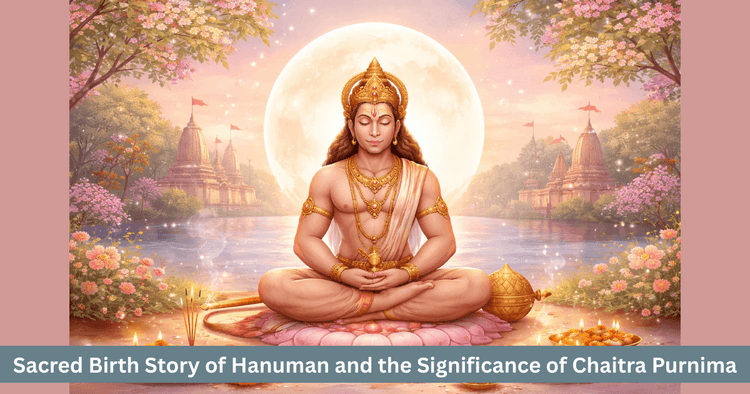
Table of Contents
In the Hindu tradition, Hanuman is revered as a unique synthesis of strength, unwavering devotion and sharp, discerning intellect. The festival of Hanuman Janmotsav is celebrated with deep reverence on the full moon of the month of Chaitra. This sacred date is accepted as the day of his appearance and devotees remember him as an ideal of service, courage and steadfast dedication to Rama.
The Chaitra full moon is itself considered highly auspicious. On this day, fasting, recitation, worship of Hanuman, reading of Sundarakanda and chanting of the Hanuman Chalisa are performed to purify the mind and seek his grace. Many traditions hold the combination of a Tuesday with the Chaitra full moon as especially powerful, so Hanuman Janmotsav becomes a day of strong inspiration for devotees.
When and How Is Hanuman Janmotsav Celebrated
Hanuman Janmotsav is generally observed on the full moon of the month of Chaitra. Some regions follow slightly different dates, yet Chaitra Purnima remains widely accepted. The belief is that on this very day, through the blessing of Vayu and the grace of a divine offering, Hanuman took birth from the womb of Mother Anjana.
On this day devotees bathe in the morning and wear clean, simple clothing. In temples, special Hanuman worship is arranged in the morning and evening with incense, lamps, arati, recitations of Rama’s name and distribution of prasadam. Many observe a fast, spending the day in reciting the Hanuman Chalisa and Sundarakanda with focused devotion.
The date and main practices may be viewed in this table.
| Aspect | Description |
|---|---|
| Name of festival | Hanuman Janmotsav |
| Tithi | Full moon of Chaitra month |
| Related weekday | Tuesday is given special importance in many traditions |
| Main practices | Hanuman Chalisa, Sundarakanda, Hanuman mantras, arati |
| Nature of fast | Full fast or fruit based, with simple sattvic food if needed |
| Principal fruits | Freedom from fear, inner strength, removal of obstacles, deepening of Rama bhakti |
Anjana and Kesari and the Beginning of the Birth Story
The story of Hanuman’s birth begins with Mother Anjana and the monkey chieftain Kesari. In ancient times, Anjana was an apsara known for beauty and artistic grace in the celestial realms. By an unfortunate incident she offended a sage. The sage felt hurt and, in anger, cursed her to be born on earth in the form of a monkey woman.
Realising her mistake, Anjana humbly sought forgiveness. The sage softened and declared that although the curse would take effect, there would be a clear path to release. When a son would be born to her as an amsa avatara of Lord Shiva, she would be freed from the curse. This assurance gave Anjana a new spiritual goal and direction.
On earth, in her monkey form, Anjana married Kesari, a noble monkey chief. Even while living in the vanara lineage, she retained a deep aspiration for tapasya and for the birth of a divine son who would serve dharma and grant her liberation.
Tapas in the Himalayas and Waiting for Shiva’s Grace
With the clear resolve to gain a Shiva born son and freedom from the curse, Anjana undertook severe austerities in the Himalayan ranges. Day after day she worshipped Lord Shiva, recited his mantras and immersed herself in meditation. Her intention was focused and unselfish. She prayed for a child who would be an expression of Shiva’s power and who would serve the cause of righteousness.
Around the same time, in Ayodhya, King Dasharatha was troubled by the absence of heirs. Seeking divine help, he performed a special sacrifice for progeny. When the ritual concluded, Agni appeared and presented a divine kheer to the king. This sacred food was shared by his three queens, leading to the births of Rama, Bharata and Shatrughna.
A portion of this divine kheer would, through a subtle connection, also become the means for Anjana to receive the seed of a radiant child, thus linking the story of Rama’s appearance with that of Hanuman.
Role of Vayu and the Descent of Pavanputra Hanuman
According to the traditional account, a part of the sacrificial kheer was carried by Vayu, the wind god, to Anjana. Vayu, the deity of prana and movement, ensured that she too received a share of the divine food as a blessing.
When Anjana reverently accepted and consumed this kheer, a luminous presence was established in her womb. In due course, the full moon of the Chaitra month arrived. Many narratives mention that this day was also a Tuesday, adding further auspiciousness. On this sacred day Anjana gave birth to a radiant son who later became renowned as Hanuman.
Because his birth was mediated by the grace of Vayu, he is honoured as Pavanputra, son of the wind god and, as the son of Anjana, he is also called Anjanisut. As a partial manifestation of Shiva, Hanuman is seen as the embodiment of strength, clear intelligence, fearlessness and deep devotion.
Childhood Deeds and Boons from the Devas
The childhood of Hanuman is portrayed as full of extraordinary acts and playful exploits. From an early age he displayed remarkable strength and curiosity. A well known episode describes how he saw the rising red sun in the sky and mistook it for a delicious fruit. In childlike enthusiasm he leaped into the sky, seeking to grasp and eat it.
As he approached the sun, the world fell into darkness. The gods became anxious. Indra, king of the gods, struck Hanuman with his thunderbolt to restrain him. Hit by the weapon, Hanuman fell and lost consciousness. Seeing his son injured, Vayu was overcome with sorrow and anger and withdrew the flow of air from the worlds. Without air, life itself began to falter and the three realms came into distress.
Then Brahma and the other gods came together. To pacify Vayu and bless Hanuman, they conferred powerful boons. Hanuman received immortality, immense strength, keen intellect, mastery of knowledge, heroic courage and victory over negative forces. Thus he became protected and empowered by the collective blessings of the devas. Vayu was calmed and the movement of air resumed, restoring balance to the universe.
Learning from the Sun and Walking the Path of Rama Bhakti
Tradition states that in his youth Hanuman accepted Surya, the sun god, as his teacher. Since Surya is always in motion across the sky, it was not easy for a disciple to study with him. Yet, by his speed, dedication and focus, Hanuman kept pace with Surya and studied the Vedas, scriptures and codes of conduct. Impressed by his humility and service, Surya blessed him fully.
During the age described in the Ramayana, Hanuman’s life became inseparably linked with Lord Rama. He was not merely a servant but the supreme devotee and fearless messenger of Rama. His loyalty, sharp judgement and bravery made him an indispensable figure in the unfolding of the Ramayana.
Key Roles of Hanuman in the Ramayana
Without Hanuman’s efforts, the search for Sita and the victory over Ravana would not have advanced as swiftly. Some of his main contributions can be viewed in this table.
| Deed | Brief description |
|---|---|
| Finding Mother Sita | Crossing the ocean to Lanka, discovering Sita in Ashoka Vatika and delivering Rama’s message |
| Burning Lanka | After being captured and having his tail set on fire, using it to ignite the city of Lanka |
| Bringing Sanjivani | Lifting and carrying the mountain with life restoring herbs to save Lakshmana |
| Support in building Rama Setu | Assisting the vanara army in constructing the bridge over the ocean |
| Role as messenger and warrior | Serving as Rama’s envoy, strategist, encourager and unshakable ally |
Through these acts Hanuman is remembered as Rama’s devotee, servant, messenger, warrior and ideal disciple.
Spiritual Significance of Hanuman Janmotsav
Hanuman Janmotsav is not only a festival but also an opportunity to awaken courage, fearlessness, spirit of service and pure devotion.
Typical observances on this day include
- Studying and reciting the Hanuman Chalisa with attention
- Reading and listening to Sundarakanda
- Chanting Rama’s name and singing devotional songs
- Offering lamps, sindoor, sacred cloth and prasadam in Hanuman temples
- Keeping a fast with focus on simplicity and sattvic conduct
Devotees believe that by Hanuman’s grace, fear, hesitation and negativity are reduced. Life gains inner strength, patience and steady effort.
Hanuman’s Grace and Direction for a Seeker’s Life
It is widely held that Hanuman is Chiranjivi, ever present in subtle form even in the current age. The belief is that wherever the story of Rama is narrated with sincerity, Hanuman is present, listening and rejoicing.
His way of devotion leaves no space for pride. He sees himself always as the servant of Rama and acts with complete selflessness. This attitude is an ideal for seekers. When a person embraces service, honesty and dharmic living, along with loyalty to the chosen deity, qualities reflecting Hanuman’s nature begin to awaken within.
Hanuman Janmotsav reminds devotees that true strength is wholesome only when joined with humility. Not strength alone but the union of intelligence, compassion and devotion makes life truly aligned with the spirit of Hanuman.
Common Questions
On which date is Hanuman Janmotsav celebrated and what is its basis?
Hanuman Janmotsav is primarily observed on the full moon of Chaitra month. The birth narrative says that on this day, through Vayu’s help and a share of divine kheer, Hanuman was born to Anjana. Many follow the understanding that the coincidence of a Tuesday with this full moon is especially auspicious.
Why is Hanuman called Pavanputra and Anjanisut?
A portion of the sacrificial kheer reached Anjana through Vayu, leading to Hanuman’s birth. This connection makes him the son of Vayu, hence Pavanputra and as the child of Anjana he is Anjanisut. These names reflect his divine origin and special favour from the wind god.
What is the inner meaning of the story in which he tries to swallow the sun?
The episode highlights Hanuman’s exceptional power and innocent curiosity. Seeing the sun as a fruit shows his childlike simplicity. The later bestowal of boons by the gods indicates that his power was then sanctified, regulated and dedicated to the welfare of the world.
Which main forms of worship are practised on Hanuman Janmotsav?
Devotees fast, recite the Hanuman Chalisa, read Sundarakanda and chant mantras in praise of Hanuman. Temples perform special abhisheka, adorn the deity with sacred cloth and sindoor, offer lamps and distribute prasadam. The aim is to receive blessings for courage and steadfast devotion to Rama.
How can devotion to Hanuman transform a seeker’s life?
Devotion to Hanuman nurtures courage, discipline, loyalty and readiness to serve. Fear, laziness and despair lose their hold. Even in difficulty, a person learns to remain patient and to act according to dharma. Through his remembrance, self confidence, mental stability and trust in the Lord grow deeper.
Get your accurate Kundali
Generate KundaliDid you like it?
Author

Aparna Patni (63)
Experience: 20
Consults About: Family Planning, Career
Clients In: Punjab, Haryana, Delhi
Share this article with friends and family
About ZODIAQ
ZODIAQ is an online Vedic Astrology platform. It connects clients seeking astrological advice to experienced astrologers with deep knowledge. Our users also generate kundali and perform kundali milan for free. ZODIAQ also offers services to the Astrologers. Astrologers utilize various offerings by ZODIAQ to serve their clients effectively.
If you are a User
Consult with experienced astrologers and seek their guidance. You can also order handwritten Janm Patrika report with life prediction prepared by experienced astrologers. Generate accurate Kundali, perform Kundali Matching and check horoscope and muhurat. Utilize our online library for all the necessary astrological and spiritual information.
If you are an Astrologer
Create accurate kundali for your clients and perform Kundali Matching for up to 5 people at a time. Write comprehensive Janm Patrika report for your clients with ZODIAQ. Check client details anytime by saving it in client directory. Become more productive by tracking how many clients you guide every day.
WELCOME TO
ZODIAQ
Right Decisions at the right time with ZODIAQ
