Kamada Ekadashi Vrat: Significance and Traditional Story
By Pt. Narendra Sharma
Kamada Ekadashi Vrat in Chaitra for Sin Removal and Auspicious Rewards
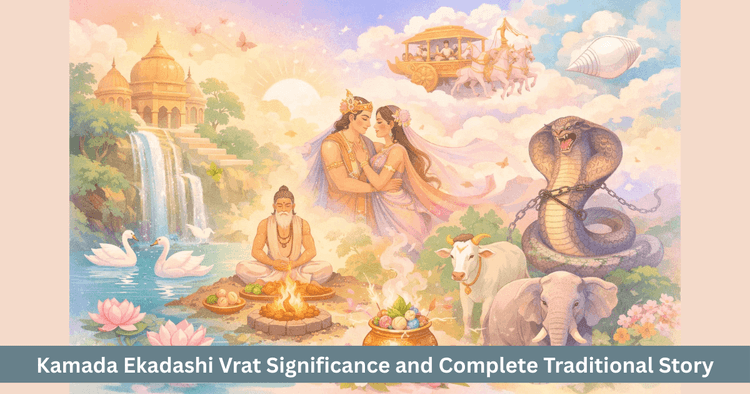
Table of Contents
Among the twenty four Ekadashi fasts observed through the year, Kamada Ekadashi is especially honoured as a destroyer of sins and a fulfiller of pure wishes. This vrata is considered very beneficial for those who wish to lighten the burden of negative actions and invite divine grace for a fresh, righteous beginning in life. The scriptures state that observing Kamada Ekadashi and listening to its sacred story grants merit comparable to that of performing a Vajapeya yajna.
According to the Hindu calendar, Kamada Ekadashi falls on the eleventh day of the bright fortnight of the month of Chaitra. This period comes close to the early part of the new year, when the influence of the sun brings new light and energy into nature. For this reason the vrata is also seen as an opportunity to bring new purity and direction into one’s own life.
When Is Kamada Ekadashi and Why Is It Observed
Kamada Ekadashi is observed on Chaitra Shukla Ekadashi. Like other Ekadashi days, it is dedicated to the worship of Lord Vishnu. It holds a special place because its traditional story describes in detail the release from states such as demonic and pisacha forms and from the weight of heavy sin.
The date and key aspects can be summarised as follows.
| Detail | Information |
|---|---|
| Tithi | Chaitra Shukla Ekadashi |
| Dedicated to | Lord Vishnu, Shri Vasudeva |
| Special fruit | Merit equal to a Vajapeya sacrifice |
| Benefit | Freedom from demonic, pisacha states and grave sins |
The very name Kamada suggests that this vrata fulfils worthy desires. Here the deeper meaning of desire is not merely worldly gain but the longing to free the soul from sinful bondage and to move more firmly toward the path of dharma.
Scriptural Background of Kamada Ekadashi
The story of Kamada Ekadashi appears in the Padma Purana. It begins with a question by King Dilip. The king asked the sage Vashishtha which Ekadashi falls in the bright fortnight of the month of Chaitra and what its name is. In response Vashishtha explained that the Ekadashi of this fortnight is known as Kamada Ekadashi.
Vashishtha said that this Ekadashi is supremely meritorious. For sins it acts like a forest fire for dry wood, burning them away as a blaze consumes fuel. He then narrated an ancient story set in a city of Nagas and associated with celestial beings.
City of Nagpur, King Pundarika and the Gandharva Couple
Long ago there was a beautiful city named Nagpur. It was filled with palaces of gold and everywhere one could see splendour and prosperity. The city was ruled by the serpent king Pundarika. Powerful Nagas such as Karkotaka also resided there.
Nagpur was not only a dwelling place of Nagas. In that city Gandharvas, Kinnaras and Apsaras also moved about. Music, dance and fine arts were held in high regard. Among the residents was a graceful Apsara named Lalita. With her lived a Gandharva named Lalita as well. The two stayed together as husband and wife and were deeply attached to one another.
In Lalita’s heart the form of her husband was constantly present and in the heart of Lalita the image of his wife never left. Each felt incomplete without the other. This intense affection later became the cause of a great difficulty for Lalita.
Court Assembly and the Curse upon the Gandharva
One day serpent king Pundarika was seated in his royal court enjoying music and entertainment. Gandharva Lalita had been appointed to sing before the king. His performance began in the assembly, yet his beloved wife was not by his side on that occasion.
While singing, memories of Lalita suddenly arose very strongly in Lalita’s mind. The pull of attachment became so strong that his attention drifted away from the music. His feet stopped moving in rhythm, his tongue faltered and mistakes began to appear in the song. Among those present, the Naga Karkotaka noticed the change and understood that Lalita’s mind was no longer focused on his duty.
Karkotaka informed King Pundarika that the Gandharva, instead of concentrating on his performance, had become absorbed in thoughts of his wife, which caused flaws in his singing. Hearing this, the king’s anger flared. His eyes turned red with fury.
In that state of anger, Pundarika cursed Lalita.
“Foolish Gandharva. You allowed yourself to fall under the sway of sensual thoughts while singing before me. Therefore become a Rakshasa.”
As soon as the curse was spoken, Lalita lost his radiant Gandharva form and turned into a terrifying Rakshasa. His face became horrible, his eyes fierce and his entire appearance inspired fear at first sight. He now had to suffer the consequences of his uncontrolled attachment.
Lalita’s Sorrow and Journey to the Sage’s Hermitage
Seeing her husband transformed into such a dreadful figure, the heart of Apsara Lalita was shaken. She felt broken within. She wondered what could be done, where she could go and who might show a way to free her husband from this painful state. In deep sorrow she began to follow her now demonic husband through dense forests.
As they wandered, she saw a hermitage in the middle of a thick forest. There sat a peaceful and radiant sage. His face reflected compassion, calm and freedom from hostility toward any creature. Lalita approached him gently, bowed with respect and stood before him.
The sage was kind. Seeing the distressed woman, he asked with affection,
“O auspicious one, who are you and from where have you come. Tell me truthfully the cause of your sorrow.”
Lalita’s Prayer and the Sage’s Instruction
With humility, Lalita replied,
“Great sage, my name is Lalita. I am the daughter of a Gandharva named Veeradhanva. I was married to the Gandharva Lalita. My husband has fallen into this Rakshasa state due to his own faults and the curse of the king. To see him in such a condition gives me great pain. O noble one, please tell me what my duty is at this time. Kindly instruct me in a meritorious act by which my husband may be freed from this demonic state.”
The sage listened and said,
“Good lady, the bright fortnight of this month of Chaitra now brings the tithi of Kamada Ekadashi. This Ekadashi is known for removing all sins and is highly auspicious. You should observe this vrata properly. Then offer the merit gained from it to your husband. Through the power of that merit his curse will be removed within a moment and his Rakshasa form will disappear.”
Hearing these words, hope arose in Lalita’s heart. She felt that a clear path to her husband’s release had been revealed. She resolved inwardly to undertake the Kamada Ekadashi fast with full dedication.
Lalita Observes the Kamada Ekadashi Vrat and Her Husband’s Deliverance
Narrating to King Dilip, Vashishtha said that Lalita observed the Kamada Ekadashi with full devotion as advised by the sage. She fasted on the Ekadashi day, worshipped Shri Vasudeva and maintained purity of body, speech and mind as far as she could throughout the day.
When the twelfth day arrived, Lalita stood before the sage in the hermitage, in front of the form of Shri Vasudeva and made this sincere declaration.
“O Lord, the merit that has arisen from my observance of Kamada Ekadashi, I now dedicate entirely to my husband. May this merit remove his Rakshasa condition.”
Vashishtha explained that as soon as she spoke these words, the sins of Lalita were destroyed. His demonic form vanished and he once again assumed his original Gandharva body. He appeared not only as before but even more brilliant and beautiful than earlier.
Seeing her husband restored, Lalita’s joy knew no bounds. The two of them, glowing with renewed splendour, ascended into a celestial vehicle. Their appearance shone even more radiantly due to the grace of Kamada Ekadashi.
Vashishtha told King Dilip that anyone who observes Kamada Ekadashi with sincerity can be freed from even severe sins, from states like Rakshasa and pisacha. The glory of this vrata is such that merely reading or hearing its story is said to grant the fruit of a Vajapeya yajna.
Inner Messages of Kamada Ekadashi
The story of Kamada Ekadashi is not only about the removal of sin. It also carries deep inner messages. Lalita’s fall into Rakshasa form arose from allowing desire and attachment to override duty and self control. Even in the royal court, where full attention was expected, he allowed his mind to be swept away. This shows how unrestrained passion can overshadow even great talent.
On the other hand, Lalita’s dedication, patience and readiness to undertake a vrata for her husband show that true love involves discipline and dharma. By performing the fast and offering its merit for his welfare, she demonstrates that the fruits of virtuous deeds can help uplift loved ones as well.
Kamada Ekadashi teaches that even when a person has gone astray through ignorance or weakness, a path of return remains open through sincere prayer, disciplined fasting and devotion. It reassures that divine grace responds when effort and humility come together.
Common Questions
Who can observe the Kamada Ekadashi fast and are there any main restrictions?
Men and women of different ages who are physically able may keep this fast. Those whose health does not permit a full fast can take fruits or a single light sattvic meal and still observe the vrata. It is recommended to avoid intoxicants, meat, tamasic foods and false speech on this day.
Can the Kamada Ekadashi fast be kept for someone else’s benefit?
In the story, Lalita observed the fast for the deliverance of her husband and offered the merit to him. This shows that the vrata may be undertaken with the welfare of loved ones in mind. The purity of conduct and sincerity of intention are key to its effectiveness.
Why is Kamada Ekadashi described as so powerful in destroying sin?
Vashishtha compared it to a forest fire for the fuel of sin. The story includes release from states such as Rakshasa and pisacha and from major wrongs. Hence, Kamada Ekadashi is regarded as especially effective for repentance, purification and turning away from harmful tendencies.
What is the most special feature of this vrata?
Its unique feature is that it can function not only for personal upliftment but also for the upliftment of others when the merit is consciously offered. Lalita’s example shows that selfless dedication of punya can bring about tangible transformation.
Is there benefit in only reading or hearing the Kamada Ekadashi story without fasting?
The Padma Purana states that reciting and listening to this story also yields the fruit of a Vajapeya sacrifice. Those unable to fast can still benefit by attentively hearing or reading the katha, allowing it to deepen their aversion to sin and attraction toward dharma. The story works as a gentle guide for inner awareness.
Get your accurate Kundali
Generate KundaliDid you like it?
Author
Pt. Narendra Sharma (63)
Experience: 20
Consults About: Family Planning, Career
Clients In: Punjab, Haryana, Delhi
Share this article with friends and family
About ZODIAQ
ZODIAQ is an online Vedic Astrology platform. It connects clients seeking astrological advice to experienced astrologers with deep knowledge. Our users also generate kundali and perform kundali milan for free. ZODIAQ also offers services to the Astrologers. Astrologers utilize various offerings by ZODIAQ to serve their clients effectively.
If you are a User
Consult with experienced astrologers and seek their guidance. You can also order handwritten Janm Patrika report with life prediction prepared by experienced astrologers. Generate accurate Kundali, perform Kundali Matching and check horoscope and muhurat. Utilize our online library for all the necessary astrological and spiritual information.
If you are an Astrologer
Create accurate kundali for your clients and perform Kundali Matching for up to 5 people at a time. Write comprehensive Janm Patrika report for your clients with ZODIAQ. Check client details anytime by saving it in client directory. Become more productive by tracking how many clients you guide every day.
WELCOME TO
ZODIAQ
Right Decisions at the right time with ZODIAQ
