Lakshmi Panchami Vrat: Significance and Story
By Pt. Suvrat Sharma
Worship and Vrat of Maa Lakshmi in Chaitra for Prosperity and Wellbeing
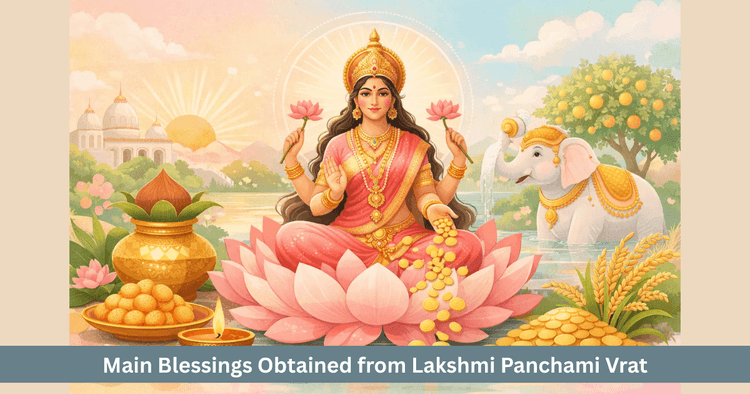
Table of Contents
The fifth day of the bright fortnight of the month of Chaitra, known as Lakshmi Panchami, is regarded as very auspicious. On this day two important streams of worship are recognised. During Navratri, devotees honour Maa Kushmanda and on the same date a special observance called Lakshmi Panchami is offered to Mahalakshmi, the presiding deity of wealth and abundance. This tithi is also called Shri Panchami and is considered highly favourable for prosperity and overall wellbeing.
It is believed that if the fast and worship of Lakshmi Panchami are carried out with devotion, correct method and inner restraint, then by the grace of Maa Lakshmi poverty begins to recede from life. A person gradually gains wealth, provisions, useful resources and honour. Traditional belief also states that the one who observes this vrat properly on this day becomes eligible to reside in the realm of Lakshmi along with twenty one generations of the family line.
Main Blessings Obtained from Lakshmi Panchami Vrat
The observance of Lakshmi Panchami is not limited to financial gain. Through this vrat women receive blessings of marital happiness, harmonious relationships, children and long lasting prosperity in the household. Where there are repeated obstacles in finances, frequent losses or hindrances in profession and business, this vrat is considered especially supportive.
The key benefits of this vrat can be understood through the table below.
| Blessing | Description |
|---|---|
| Freedom from poverty | Gradual reduction of financial lack and economic stress |
| Material prosperity | Greater stability and growth in business, job and transactions |
| Growth of marital fortune | Improved harmony and steadiness between husband and wife |
| Joy of children | Auspicious for women desiring progeny |
| Welfare of the lineage | Fruit of residence in Lakshmi’s realm along with twenty one generations |
Besides these, Lakshmi Panchami is also held to reduce subtle disturbances and emotional burdens in the home. Feelings of anxiety, insecurity and deep scarcity begin to loosen their hold over time.
How to Observe the Lakshmi Panchami Vrat
On Lakshmi Panchami it is considered auspicious to bathe early in the morning and wear clean clothes, preferably in soft yellow or pink hues. In the home shrine or another clean place a red or yellow cloth is spread and an image or idol of Shri Lakshmi is placed upon it. Where possible, a kalash is also installed, filled with water, betel nut, rice and decorated with mango or ashoka leaves.
Thereafter incense, lamp, rice, flowers, vermilion, turmeric, roli, milk, curd, ghee, honey and jaggery are offered to Maa Lakshmi according to capacity. The atmosphere is kept pure through the sound of conch, bells and mantra recitation. Reciting Shri Suktam, Kanakadhara Stotra or other hymns of Lakshmi, where available, is considered beneficial. Throughout the day one should attempt to maintain a sattvic diet, measured speech and calm behaviour.
Those who are able may observe a full fast, refraining from grains and taking only fruits, milk, dried nuts or one light sattvic meal. Those who cannot keep a strict fast can still gain benefit by avoiding heavy or tamasic foods and by keeping the mind engaged in devotion and gratitude toward the Goddess.
Traditional Story of Shri Lakshmi Panchami Vrat
The Shri Lakshmi Panchami vrat katha helps to explain why this particular date became so strongly linked with the worship of Lakshmi. According to the narrative there came a time when Maa Lakshmi became displeased with the gods. Due to their negligence or disorder she withdrew her presence and entered the ocean of milk, Kshira Sagara, in a subtle, hidden form.
With Lakshmi’s departure, the entire realm of the gods experienced the effect of poverty and lack. The deities became deprived of Shri, the principle of beauty and prosperity. Where there had once been splendour, radiance and refined joy, there now appeared dullness, scarcity and dissatisfaction. The gods realised that without Lakshmi, even their divine status felt incomplete.
In this situation Indra, the king of the gods, assumed responsibility for finding a solution. He recognised that unless they collectively worked to please Maa Lakshmi again, their distress would not end. Inspired by this realisation he decided to undertake strict penance and observe a dedicated vrat for Lakshmi with proper rituals and discipline.
Gods Observing the Lakshmi Panchami Fast
Indra chose a pure Panchami tithi and began a vow of restraint, recitation and worship devoted to Lakshmi. According to the story, this was the bright fifth day of Chaitra. Clothed in clean garments, with a steady mind and control over the senses, he focused fully on the remembrance of Maa Lakshmi. He kept rules of the fast, avoided tamasic food and allowed no indulgence in distracting habits, remaining centred in devotion.
Seeing his example, other gods were inspired to join the observance. They too began worshipping Maa Lakshmi. The asuras also noticed this and, knowing very well the importance of wealth and resources, they too started to venerate her. Thus, from both sides, gods and asuras together called upon Lakshmi with intensity.
Through the combined effect of their fasting, worship and earnest practice, Maa Lakshmi became deeply pleased. She accepted the prayers of her devotees and emerged again from the ocean of milk. With her reappearance, radiance, beauty and prosperity returned to the divine realm.
Marriage of Lakshmi with Shri Hari Vishnu and Importance of the Date
The story further narrates that after the completion of the vrat, Maa Lakshmi chose Shri Hari Vishnu as her eternal consort. Their marriage was performed according to divine rites. With this sacred union, the gods once again felt blessed by the grace of Lakshmi. Order, balance and abundance were restored in their world.
It is held that this auspicious event occurred on the bright Panchami of the month of Chaitra. For this reason the date came to be honoured as Lakshmi Panchami. According to this belief, anyone who worships Maa Lakshmi with devotion and observes a vrat on this day becomes a recipient of her special blessings just as the gods once were. Therefore the date is not only a remembrance of the story but a living opportunity for practice.
Precautions and Conduct on the Day of Lakshmi Panchami
Certain simple yet important guidelines are given for Lakshmi Panchami, which, if followed, make the vrat more pure and effective. It is advised not to consume onion or garlic in food on this day, as these are considered tamasic. Where possible, one may also reduce very spicy and heavily fried items.
On the level of behaviour one is encouraged to stay away from anger, hostility, jealousy, irritation, hatred and dishonesty. Lakshmi is said to favour cleanliness, simplicity, truth and affection. This is therefore a suitable time to cultivate humility, cooperation, honesty and balance in one’s nature. If a person performs only outer worship yet remains full of bitterness, deceit or excessive greed, the full fruit of the vrat is difficult to obtain.
Transformations Brought by Lakshmi Panchami in Daily Life
Those who observe Lakshmi Panchami regularly over several years with sincerity often notice that their anxiety around money gradually reduces. Sudden losses tend to decrease, unnecessary expenses come under control and opportunities for useful earnings start to appear more frequently. This shift arises not only from the worship itself but from the discipline that the vrat introduces into daily life.
For women this vrat is particularly associated with marital good fortune and the wellbeing of children. A peaceful home, cooperation between husband and wife and a stable environment for the family are all seen as expressions of Lakshmi’s grace. When the observer of the vrat also consciously develops qualities such as generosity, diligence and honesty in thought and action, the influence of Lakshmi Panchami becomes even deeper.
Common Questions
How is Lakshmi Panchami different from a general Lakshmi puja?
Lakshmi puja can be performed on several dates, such as Kartik Amavasya and other holy days, whereas Lakshmi Panchami is specifically linked to Chaitra Shukla Panchami. Its special significance lies in the belief that on this date Lakshmi reappeared from the ocean of milk and was united in marriage with Shri Hari Vishnu. For this reason it is emphasised as a fast as well as a worship day.
Is it necessary to keep a strict fast on Lakshmi Panchami or is worship alone sufficient?
Keeping a fast on Lakshmi Panchami is considered very auspicious, yet not everyone has the same physical capacity. Those who cannot undertake a full fast may still benefit by avoiding tamasic foods, maintaining moderation and offering sincere worship, praise and gratitude to Maa Lakshmi. Here the purity of heart and intention is more important than the external hardness of the vrat.
What special benefits are mentioned for women who observe this vrat?
For women, Lakshmi Panchami is said to support marital happiness, long life for the husband, the joy of children and financial steadiness in the home. It is auspicious for both married and unmarried women, as it symbolises protection of existing marital bonds as well as the wish for a blessed future partnership and prosperity.
Can the Lakshmi Panchami vrat help resolve obstacles in job or business?
Both the story and tradition suggest that when Maa Lakshmi is pleased, many types of obstacles in economic affairs begin to ease. If a person is already working sincerely and also uses observances like Lakshmi Panchami to invite positive energy and blessing, opportunities for employment, promotion, business growth and stable transactions can increase.
Which mental attitudes should be avoided and which encouraged on Lakshmi Panchami?
On this day it is especially recommended to avoid anger, jealousy, resentment, hatred and dishonesty, as these make the mind heavy and disturbed. In their place one should cultivate gratitude, contentment, hard work, charity, honesty and cooperation. These qualities create the inner atmosphere in which Maa Lakshmi’s grace is more likely to flow.
Get your accurate Kundali
Generate KundaliDid you like it?
Author
Pt. Suvrat Sharma (63)
Experience: 20
Consults About: Family Planning, Career
Clients In: Punjab, Haryana, Delhi
Share this article with friends and family
About ZODIAQ
ZODIAQ is an online Vedic Astrology platform. It connects clients seeking astrological advice to experienced astrologers with deep knowledge. Our users also generate kundali and perform kundali milan for free. ZODIAQ also offers services to the Astrologers. Astrologers utilize various offerings by ZODIAQ to serve their clients effectively.
If you are a User
Consult with experienced astrologers and seek their guidance. You can also order handwritten Janm Patrika report with life prediction prepared by experienced astrologers. Generate accurate Kundali, perform Kundali Matching and check horoscope and muhurat. Utilize our online library for all the necessary astrological and spiritual information.
If you are an Astrologer
Create accurate kundali for your clients and perform Kundali Matching for up to 5 people at a time. Write comprehensive Janm Patrika report for your clients with ZODIAQ. Check client details anytime by saving it in client directory. Become more productive by tracking how many clients you guide every day.
WELCOME TO
ZODIAQ
Right Decisions at the right time with ZODIAQ
