Mohini Ekadashi Vrat Katha and the Secret of Freedom from Sin
By Pt. Suvrat Sharma
Mohini Ekadashi Fast Removes Sins and Brings Mental Peace and Spiritual Liberation
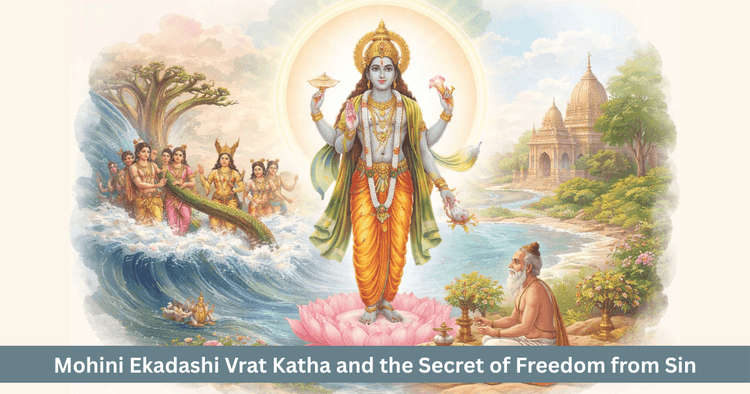
Table of Contents
In the month of Vaishakh, the Ekadashi of the bright fortnight is known as Mohini Ekadashi. This sacred observance is specially dedicated to Lord Vishnu and is described as a powerful means for the removal of delusion, sins and suffering. From the jyotish perspective this period is considered favourable for purification of the mind, for stabilising the heart and for gradually untangling the knots of past karma. When a devotee observes the Mohini Ekadashi vrata with proper method, it is said to help in the destruction of sins, relief from sorrow and release from the net of attachment.
When and How Is Mohini Ekadashi Observed
The scriptures clearly state that the Ekadashi of Vaishakh Shukla Paksha is called Mohini Ekadashi. The vrata is kept from sunrise on Ekadashi until the appropriate time on Dwadashi and is regarded as especially auspicious for the worship of Lord Vishnu.
The main features of Mohini Ekadashi can be understood in brief through this table.
| Aspect | Description |
|---|---|
| Tithi | Ekadashi of the bright fortnight of the month of Vaishakh |
| Presiding deity | Lord Vishnu |
| Principal result | Destruction of sins, freedom from sorrow, release from delusion |
| Mode of worship | Name chanting, fasting, listening to the katha and offering oneself to the Lord |
| Special glory | Listening to or reading the katha gives merit like the gift of many cows |
In the Vaishnava tradition this day is honoured with morning bath, clean clothing, remembrance of Vishnu’s names and a vrata resolve, followed by a day of restraint, awareness and devotion.
What Did Yudhishthira Ask about Mohini Ekadashi
In one sacred dialogue, Dharmaraj Yudhishthira asked Lord Shri Krishna about the Ekadashi of Vaishakh Shukla Paksha. He wished to know its name, the story associated with it and the proper method of observing the vrata. With humility he requested that all these aspects be explained in detail so that people could follow them correctly.
Lord Krishna replied that this is the same katha which the sage Vashishtha had once related to Shri Ram. In such exchanges it becomes clear that the glory of the Ekadashi vrata is not limited to ordinary people, it offers guidance even for kings and incarnations.
Shri Ram’s Question and Sage Vashishtha’s Answer
At one time Lord Shri Ram respectfully asked his preceptor Sage Vashishtha to show him such a vrata by which all sins and sorrows could be destroyed. He shared that he had endured deep pain in the separation from Sita and therefore wished to know a practice that could purify the heart and lighten the burden of grief.
Vashishtha, pleased with Ram’s gentle enquiry, told him that this question was truly excellent. He praised Ram’s pure intellect and inner holiness, adding that even the remembrance of Ram’s name purifies a person, yet, for the welfare of the world, this teaching still needed to be explained. Vashishtha then revealed that the Ekadashi that comes in Vaishakh Shukla Paksha is called Mohini Ekadashi. He said that by observing this vrata a person can become free from sins and sorrows and can be released from the web of attachment. With this he began to narrate the story of Mohini Ekadashi and asked Ram to listen with full attention.
City of Bhadravati, King Dyutiman and the Merchant Dhanpal
According to the story told by Sage Vashishtha, on the banks of the Saraswati river there once stood a beautiful city named Bhadravati. In that city a Chandravamsha king named Dyutiman ruled. Under his protection the people were content and the city prospered. In the same city lived a wealthy merchant named Dhanpal, who was very pious, charitable and devoted to Vishnu.
Using his wealth in noble ways, Dhanpal built many food establishments, water sheds, wells, ponds and dharmashalas. He arranged water, food and rest for travellers. Along the roads he planted trees such as mango, jamun and neem to provide shade and fruits. In this way he was not only rich but also abundant in service and generosity.
The Five Sons of Dhanpal and the Fall of Dhritabuddhi
Dhanpal had five sons. Their names were Sumana, Sadbuddhi, Medhavi, Sukriti and Dhritabuddhi. True to their names the first four were endowed with good qualities but the fifth son, Dhritabuddhi, lived in the opposite way suggested by his name.
Dhritabuddhi became deeply immersed in sinful habits and misconduct. He did not honour ancestors, nor did he respect religious duties. He moved in the company of courtesans and corrupt companions, played gambling, engaged in relations with other men’s wives and indulged in intoxicants and meat. Through such behaviour he steadily destroyed the wealth earned by his righteous father. Dhanpal, who himself was devoted to dharma and charity, became very distressed by his son’s path.
Expulsion from Home and Descent into Crime
When matters grew unbearable Dhanpal finally expelled Dhritabuddhi from the house. After leaving home, Dhritabuddhi sold his ornaments and clothes and lived for some time on what he received. When his wealth was exhausted and his resources ended, the so called friends, courtesans and corrupt associates also abandoned him.
Now he became tormented by hunger and thirst. Seeing no support he turned to theft. Once he was caught stealing but, recognising him as the son of a respected merchant, people released him with a warning. When he was caught stealing again, King Dyutiman ordered that he be put in prison, where he suffered many hardships. After the term of his punishment, when he was released from jail, the king also ordered him to leave the city.
Life in the Forest, Violence and the Way of a Hunter
Forced to leave the city, Dhritabuddhi went into the forest. There he began to kill wild animals and birds for food. Gradually he sank deeper into violence and eventually became a full time hunter. With bow and arrows he roamed about, killing creatures and feeding on them. His life thus continued in a state filled with sin, cruelty and ignorance.
Even so, deep within, the weight of his karma and the unrest of his soul began to trouble him. Hunger and thirst were visible on the surface but the inner fatigue and the feeling of meaninglessness also weakened him from inside.
Awakening of Good Sense in the Ashram of Sage Kaudinya
One day, suffering greatly from hunger and thirst, he wandered in search of food and came near the ashram of the sage Kaudinya. It was the month of Vaishakh and the sage was returning from a bath in the Ganges. Drops of water from his wet garments fell on Dhritabuddhi’s body. It is believed that contact with the holy and the company of saints can prepare the ground for inner change. In that very moment a little good sense awakened in him.
He went to Kaudinya Muni, folded his hands and in a humble voice admitted that he had committed countless sins in his life and had been involved in many wrong actions. He begged for a simple way to become free from his sins, a method that required no wealth and could be followed by an ordinary person. Pleased by his sincere and distressed words, Kaudinya Muni looked on him with compassion.
The Sage’s Instruction and the Mohini Ekadashi Vrat
Sage Kaudinya advised him to observe the vrata of Mohini Ekadashi falling on Vaishakh Shukla Paksha. He explained that fasting on this Ekadashi destroys all sins and brings purity into one’s life. He described it as a vrata that frees one from the net of delusion and removes suffering.
Hearing the sage’s instruction, Dhritabuddhi became very happy. He observed the Mohini Ekadashi vrata exactly as taught, with fasting, restraint, remembrance of the Lord and heartfelt prayer. Through the day he remained engaged in devotion and when the vrata was completed he felt a new sense of inner peace and lightness.
Fruit of the Vrat and Attainment of Vishnuloka
Sage Vashishtha told Shri Ram that by the power of the Mohini Ekadashi vrata all of Dhritabuddhi’s sins were destroyed. The burden of violence, vice and a life of disgrace lifted from him. In the end that soul attained Vishnuloka, riding upon Garuda.
Thus the vrata was not merely a single day of discipline but became the turning point of an entire life. Vashishtha added that through this vow all forms of delusion are destroyed and that in this world there is no vrata superior to Mohini Ekadashi. He also stated that the merit gained by listening to or reading the glory of this Ekadashi is described as equal to the donation of a thousand cows.
Inner Lessons Offered by Mohini Ekadashi
The story of Mohini Ekadashi offers deep lessons for the spiritual seeker. It shows that
- Habits of sin and misconduct gradually drive a person away from family, society and self respect
- Even when wealth, pleasures and friends abandon someone, a spark of good sense can still arise and change the course of life
- Association with saints, sages and true teachers is the most accessible way to redirect one’s destiny
- A vrata that looks simple from outside can, when practised with humility and repentance, lighten the weight of heavy karmas
- Real safety and peace lie in taking shelter of the Lord, moving beyond blind attachment and ignorance
Mohini Ekadashi reminds us that no person falls so low that they cannot rise again. A sincere question, an honest desire to change and one well observed vrata can become the beginning of release from long standing karmic burdens.
Common Questions
On which date is Mohini Ekadashi observed and what is its main result?
Mohini Ekadashi is observed on the Ekadashi of Vaishakh Shukla Paksha. Its main result is described as the destruction of sins, freedom from sorrow and release from the net of delusion.
How is the story of Dhritabuddhi connected with Mohini Ekadashi?
Dhritabuddhi, the son of a merchant, had fallen into many sinful actions, addictions and violence. On the instruction of Sage Kaudinya he observed the Mohini Ekadashi vrata, through which his sins were destroyed and he finally attained Vishnuloka.
What remedy did Sage Kaudinya give to Dhritabuddhi?
Seeing his repentance, Sage Kaudinya told him to fast on Mohini Ekadashi in Vaishakh Shukla. He explained that this Ekadashi is capable of destroying all sins and is a simple, accessible path for ordinary people.
What merit is said to arise from listening to or reading the Mohini Ekadashi katha?
Scriptural descriptions state that one who listens to or reads the katha of Mohini Ekadashi with faith obtains great merit, comparable to the result of making a gift of a thousand cows.
What message comes from the questions of Shri Ram and Yudhishthira?
Shri Ram asked about a path for release from sorrow and sin and Yudhishthira asked about the name, story and method of the vrata. Their questions show that however elevated one’s position may be, humble enquiry into dharma and vrata is always the true beginning of inner wisdom.
Get your accurate Kundali
Generate KundaliDid you like it?
Author
Pt. Suvrat Sharma (63)
Experience: 20
Consults About: Family Planning, Career
Clients In: Punjab, Haryana, Delhi
Share this article with friends and family
About ZODIAQ
ZODIAQ is an online Vedic Astrology platform. It connects clients seeking astrological advice to experienced astrologers with deep knowledge. Our users also generate kundali and perform kundali milan for free. ZODIAQ also offers services to the Astrologers. Astrologers utilize various offerings by ZODIAQ to serve their clients effectively.
If you are a User
Consult with experienced astrologers and seek their guidance. You can also order handwritten Janm Patrika report with life prediction prepared by experienced astrologers. Generate accurate Kundali, perform Kundali Matching and check horoscope and muhurat. Utilize our online library for all the necessary astrological and spiritual information.
If you are an Astrologer
Create accurate kundali for your clients and perform Kundali Matching for up to 5 people at a time. Write comprehensive Janm Patrika report for your clients with ZODIAQ. Check client details anytime by saving it in client directory. Become more productive by tracking how many clients you guide every day.
WELCOME TO
ZODIAQ
Right Decisions at the right time with ZODIAQ
