Panguni Uthiram Festival: Divine Marriages and Ancient Heritage
By Pt. Nilesh Sharma
Significance of Divine Couples’ Marriages and Celebration in Tamil Tradition
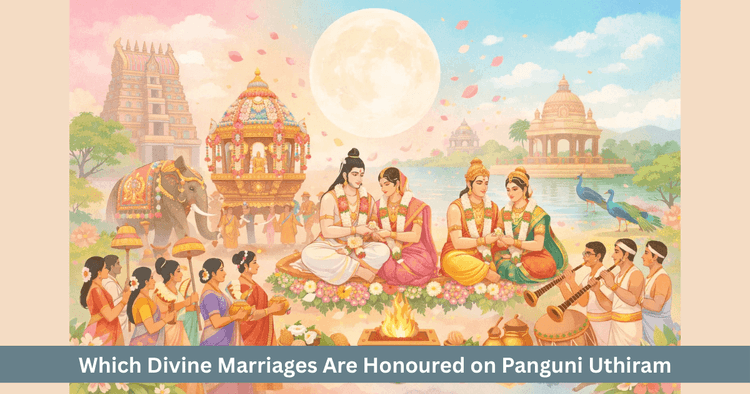
Table of Contents
In Tamil spiritual tradition Panguni Uthiram is regarded as a sacred day that commemorates the marriages of several divine couples with deep reverence and joy. The festival does not remain confined to temple walls but lives as a vibrant expression of collective memory, culture and devotion among Tamil people.
In the Tamil calendar Panguni Uthiram falls on the full moon day of the last month Panguni, usually between mid March and mid April. On this day the Uttara Phalguni star is in prominence, considered highly auspicious for marriage. In many temples of Tamil Nadu the festival extends over ten days, with the grand divine wedding being celebrated on the final day.
Which Divine Marriages Are Honoured on Panguni Uthiram
Panguni Uthiram symbolises the sacred union of divine couples. The remembrance of these celestial weddings offers guidance to devotees about harmony, mutual respect and spiritual depth within married life.
The main divine unions traditionally connected with this day are these.
| Divine couple | Main temple association |
|---|---|
| Shiva and Parvati | Kalyanotsavam in many ancient Shiva temples of South India |
| Murugan and Valli | Sacred marriage celebrated in Murugan shrines across Tamil Nadu |
| Murugan and Deivayanai | Marriage of Murugan with Devasena, daughter of the gods |
| Rangamannar and Andal | Wedding of Andal with Sri Ranganatha in Vaishnava temples |
| Rama and Sita | Remembrance of Rama and Sita’s union in certain Rama temples |
Through these celebrations, marriage is viewed not only as a social relationship but as a spiritual commitment grounded in dharma, reverence and mutual dedication.
Panguni Uthiram in Tamil Sangam Literature
The roots of Panguni Uthiram reach far back into Tamil history. Tamil Sangam literature, dated roughly around the third century of the common era, records references to this festival.
In the Sangam work Agananuru there is a description of Panguni Uthiram festivities in Uraiyur, the ancient Chola capital. The festival is referred to as “Panguni Muyukkam”, indicating the joyful mood, community gatherings and festive ambience within the city. People came together in large numbers, cooking special dishes, sharing them and filling the streets with a sense of celebration.
Another Sangam anthology, Purananuru, also refers to Panguni Uthiram. These mentions show that the festival was woven into the social and cultural life of early Tamil regions rather than being limited to temple rituals alone.
The Moving Story of Poombavai and Panguni Uthiram
One of the most touching narratives linked with Panguni Uthiram is the story of Poombavai. Around the seventh century a wealthy merchant named Sivanesa Chettiar lived in Mylapore, in present day Chennai. He wished to marry his daughter Poombavai to the renowned Shaivite saint Thirugnana Sambandar, one of the Nayanmars.
Fate took a tragic turn when Poombavai was bitten by a snake and passed away. In his grief, Sivanesa Chettiar preserved her bones in a sacred kalasam or urn, holding on to a faint hope for divine intervention.
Some years later, when Thirugnana Sambandar arrived at Thiruvotriyur near Chennai and heard the account of Poombavai, he came to Mylapore. Sivanesa Chettiar offered him the urn containing her remains.
Sambandar then stood in the famous Kapaleeswarar temple of Mylapore and sang heartfelt hymns to Lord Kapaleeswarar, praying for Poombavai’s life to be restored. These verses are known as “Poombavai Pathigam”, included in the Shaivite devotional canon called “Thevaram”.
In one of the verses, Sambandar gently questions Poombavai, asking whether it was right for her to leave this world without witnessing the glory of the Panguni Uthiram festival in the streets of Mylapore. In this way the festival is tied to the visual beauty, processions and devotional atmosphere of that region.
Kapaleeswarar Temple, Mylapore and Present Day Festivities
Even today Panguni Uthiram is among the grandest festivals of the Kapaleeswarar temple in Mylapore, Chennai. The celebrations include the divine wedding of Kapaleeswarar and the Goddess, chariot processions, flag hoisting and many days of elaborate rituals and processions.
For a long time the episode of Poombavai’s revival was also ritualised during the festival, with devotional singing of the pathigam and a symbolic re enactment of Sambandar’s miracle. Through this, devotees experience both the power of devotion and the enduring cultural importance of Panguni Uthiram.
The seventh century Nayanmar Thirunavukkarasar also describes Panguni Uthiram celebrations at Thiruvarur in his Thevaram hymns. Later, in the twelfth century, Sekkizhar mentions the festival at Thiruvarur and inscriptions from the time of Kulothunga Chola provide additional details about the ten day Panguni Uthiram celebration there.
Thiruvotriyur, Thiruvarur and Inscriptions of Rajadhiraja Chola
In the Thevaram hymns of Thirunavukkarasar, the Panguni Uthiram celebrations of Thiruvotriyur near Chennai are described vividly, with the entire region lit up by lamps and alive with festive processions.
A twelfth century epigraphic record from the Thiruvotriyur temple notes the presence of Chola king Rajadhiraja Chola II during Panguni Uthiram. The inscription also mentions Chaturanana Pandita, who maintained a math there and Vagishwara Pandita, who taught the Soma Siddhanta, a branch within the Kapalika Shaiva system. During this occasion, those gathered also listened to the story of the Shaivite poet Sundarar.
Such accounts show that Panguni Uthiram served as a time not only for ritual worship but also for philosophical dialogue, recitation of devotional poetry and shared spiritual reflection.
Panguni Uthiram under the Chola, Pandya and Chera Dynasties
The eighteenth century Tamil treatise Iraiyanaar Kalaviyal notes that the Panguni Uthiram festival in Uraiyur was one of the grandest celebrations of the three main Tamil dynasties, Chera, Chola and Pandya. This indicates that the festival enjoyed royal patronage and wide social participation.
Inscriptions from many different eras speak of Panguni Uthiram. During the Vijayanagara period, numerous stone records across Tamil regions describe in detail the dates, rituals, offerings and temple services connected with the festival.
One of the earliest known records is a tenth century inscription from Srirangam, dating to the reign of Parantaka Chola. It outlines the ceremonies and daily offerings for the nine day Panguni Uthiram festival. Even today Srirangam is renowned for its celebrations on this occasion and the divine wedding hall in the temple is called the “Panguni Uthira Mandapam”, bearing witness to this long heritage.
A seventeenth century Tamil work, Mookudarpallu, also refers to the grand Panguni festival at the Koodal Azhagar Vishnu temple in Madurai.
Special Offerings and Food Traditions on Panguni Uthiram
Panguni Uthiram is equally notable for its traditional naivedya offerings. Temples across Tamil Nadu prepare specific dishes that reflect the festive and devotional mood of the day.
Some of the best known offerings are listed below.
| Offering | Distinct feature |
|---|---|
| Appam | Sweet rice and jaggery preparation, popular in both Shaiva and Vaishnava temples |
| Paruppu Pongam | Thick dish made with lentils and rice, often flavoured with ghee and jaggery |
| Vadai | Fried savoury cakes made from lentils, offered during major utsavams |
| Payasam | Sweet pudding made with milk and grains such as rice or vermicelli |
| Paal Maangai | In Madurai, a special preparation of tender mango cooked in milk |
These offerings are later shared as prasadam, strengthening bonds among families and communities. Through such sharing, Panguni Uthiram becomes a festival of devotion, nourishment and togetherness.
A Festival Shining Unbroken for Two Millennia
Perhaps the most remarkable feature of Panguni Uthiram is that it has been celebrated for nearly two thousand years with undiminished enthusiasm. References in Sangam poetry, medieval Thevaram hymns, Sekkizhar’s compositions, Chola and Vijayanagara inscriptions and modern Tamil writings together confirm an unbroken line of observance.
In contemporary Tamil Nadu, temples continue to mark Panguni Uthiram with grand processions, divine weddings, vows, offerings and community gatherings. In Murugan temples, rituals such as carrying kavadi, performing abhishekam and offering special vows are common. In Shiva and Vishnu temples, the day is marked by ceremonial weddings of the deities, richly decorated processional images and large congregations of devotees.
Thus Panguni Uthiram remains a living festival, carrying historical depth, devotional fervour and a sense of shared identity among Tamil devotees across generations.
Common Questions
On which tithi and star is Panguni Uthiram celebrated?
Panguni Uthiram is observed on the full moon day of the Tamil month Panguni. On this day the Uttara Phalguni star is prevalent, which is traditionally considered very auspicious for marriage, hence its association with divine weddings.
Which divine marriages are especially linked with Panguni Uthiram?
The day is associated with the unions of Shiva and Parvati, Murugan with Valli and Deivayanai andal with Sri Ranganatha or Rangamannar and in some traditions Rama with Sita. These unions symbolise ideal devotion and dharmic companionship.
How does the story of Poombavai connect to Panguni Uthiram?
In the Kapaleeswarar temple tradition, Thirugnana Sambandar’s hymns for reviving Poombavai include a verse asking how she could leave without witnessing the Panguni Uthiram festival of Mylapore. This shows the festival’s importance in local devotional life even in that period.
What information about Panguni Uthiram is found in inscriptions?
Inscriptions from Srirangam, Thiruvotriyur and other temples record multi day Panguni Uthiram celebrations, divine weddings, lamp offerings, royal attendance and endowments for rituals. They document the festival under Chola, Pandya and Vijayanagara rule.
How is Panguni Uthiram celebrated in present times?
Today the festival features special pujas, abhishekam, divine weddings, chariot processions, vows and devotional singing in Shiva, Vishnu and Murugan temples. Devotees offer preparations like appam, paruppu pongam, vadai, payasam and, in Madurai, paal maangai, while temple streets glow with lights and floral decoration.
Get your accurate Kundali
Generate KundaliDid you like it?
Author
Pt. Nilesh Sharma (63)
Experience: 20
Consults About: Family Planning, Career
Clients In: Punjab, Haryana, Delhi
Share this article with friends and family
About ZODIAQ
ZODIAQ is an online Vedic Astrology platform. It connects clients seeking astrological advice to experienced astrologers with deep knowledge. Our users also generate kundali and perform kundali milan for free. ZODIAQ also offers services to the Astrologers. Astrologers utilize various offerings by ZODIAQ to serve their clients effectively.
If you are a User
Consult with experienced astrologers and seek their guidance. You can also order handwritten Janm Patrika report with life prediction prepared by experienced astrologers. Generate accurate Kundali, perform Kundali Matching and check horoscope and muhurat. Utilize our online library for all the necessary astrological and spiritual information.
If you are an Astrologer
Create accurate kundali for your clients and perform Kundali Matching for up to 5 people at a time. Write comprehensive Janm Patrika report for your clients with ZODIAQ. Check client details anytime by saving it in client directory. Become more productive by tracking how many clients you guide every day.
WELCOME TO
ZODIAQ
Right Decisions at the right time with ZODIAQ
