Spiritual Significance of Parashurama Dwadashi and the Jamadagnya Vrat
By Aparna Patni
Parashurama Dwadashi Strengthens Courage, Detachment, and Commitment to Dharma
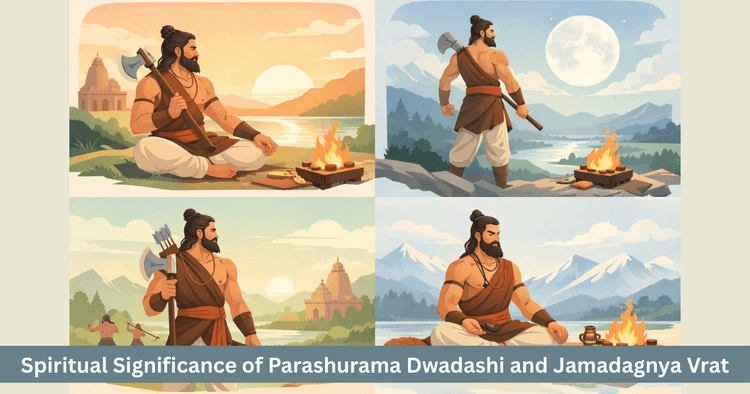
Table of Contents
In the bright fortnight of Vaishakh, the twelfth tithi is revered as Parashurama Dwadashi. This sacred date is devoted to Bhagavan Parashurama, the sixth incarnation of Lord Vishnu. The vrata of Parashurama Dwadashi is observed on the day following Mohini Ekadashi. At times, due to the alignment of tithis, Mohini Ekadashi and Parashurama Dwadashi may fall on the same calendar day, in which case devotees maintain their resolves with appropriate care. For those who observe this vrata with discipline and devotion, the day is regarded as a support for the weakening of negative karma, the awakening of courage, the protection of dharma and an aspiration toward liberation.
Vaishakh Shukla Dwadashi by its nature carries a fiery, protective energy that strengthens the qualities linked with righteous action. Through fasting, mantra chanting and night vigil from sunrise of Dwadashi until the following sunrise, the practitioner seeks to awaken detachment, bravery and adherence to dharma within.
What Is Parashurama Dwadashi and When Is It Kept
In traditional descriptions the Parashurama Dwadashi vrata is also known as Parashurama Dwadashi Vrat and Jamadagnya Parashurama Vrat. It is kept on the Dwadashi tithi of the bright fortnight in the month of Vaishakh. The deity honoured is the same Parashurama who is recognised as the sixth avatar of Vishnu and who was born in the lineage of sage Jamadagni and mother Renuka.
The key aspects can be seen clearly in this table.
| Aspect | Description |
|---|---|
| Tithi | Dwadashi of Vaishakh Shukla Paksha |
| Related observance | Comes after Mohini Ekadashi, sometimes both vratas coincide on one day |
| Presiding deity | Bhagavan Parashurama, sixth incarnation of Vishnu |
| Central intention | Protection of dharma, removal of adharma, strengthening of courage, restraint and aspiration for moksha |
| Practice pattern | Strict fasting, night vigil, chanting of Vishnu names and Parashurama worship |
Those who take up Parashurama vrata over many years often keep this Dwadashi vow every Vaishakh, using it as a steady anchor for their inner commitment.
Form of Bhagavan Parashurama and Purpose of the Avatar
Bhagavan Parashurama is honoured as the sixth avatar of Vishnu. As the son of sage Jamadagni and mother Renuka, he is known as Jamadagnya Parashurama. His life is connected with both Treta Yuga and Dvapara Yuga. Parashurama is counted among the Chiranjivi, the long lived beings whose presence is said to continue across ages.
Tradition holds that he performed intense austerities to please Lord Shiva. Pleased with his tapas, Shiva granted him the parashu, a divine axe, from which he came to be known as Parashurama, “Rama with the axe”. Shiva not only gave him this weapon but also taught him ancient martial disciplines such as Kalaripayattu and many subtleties of warfare. In this way Parashurama is seen not only as a punisher of adharmic warriors but also as a master teacher of martial knowledge and righteous combat.
Role of Parashurama in the Ramayana and Mahabharata
Parashurama appears in both of the great epics, the Ramayana and the Mahabharata. In the Ramayana he arrives in Mithila at the time of Sita’s swayamvara, when the bow of Shiva has been broken by Lord Ram. There he tests Ram, recognises his radiance and dignity and departs in satisfaction, acknowledging Ram’s true stature.
In the Mahabharata he is remembered as the guru of mighty warriors such as Bhishma, Drona and Karna. Subtle techniques of warfare, the use of celestial weapons and the boundaries of righteous conflict are all linked to his instruction. The weapon known as Bhargavastra is described as a divine astra granted to him by Lord Shiva. From this perspective Parashurama Dwadashi becomes not only a day of fasting but also a day to remember Parashurama as a teacher and upholder of the laws of dharma in the field of battle.
How Is the Parashurama Dwadashi Vrat Observed
The vrata of Parashurama Dwadashi is understood to begin with sunrise. After bathing in the early morning, the devotee wears clean clothes, remembers Lord Vishnu and Parashurama and makes a solemn resolve to observe the fast. Through the day the practitioner maintains a strict fast or a carefully regulated diet. Many devotees take only water or limited fruits as they are able.
During the worship an image or picture of Parashurama is placed at the altar. Lamps, incense, flowers and offerings of food are presented with devotion. In some regions there is a tradition of placing the image of Parashurama within a water filled pot, which symbolises peace, stability and purification of emotions. A night vigil is also practised. As far as possible the devotee stays awake during the night, engaged in remembrance of Vishnu, recitation of praises to Parashurama and listening to his katha.
Which Mantras and Stotras Are Favourable on This Day
On Parashurama Dwadashi it is considered auspicious to chant both the names of Vishnu and the praises of Parashurama. In particular, the recitation of Shri Vishnu Sahasranama Stotra is highly recommended. Devotees who undertake the sahasranama on this day nourish inner detachment, reverence and steadiness.
While remembering Parashurama, the practitioner focuses on his zeal for justice, his discipline and his commitment to protecting dharma. The vrata is generally brought to completion by parana, the ritual breaking of the fast, after sunrise on the following day or at the designated time given in the calendar.
Inner Fruits and Spiritual Message of Parashurama Dwadashi
According to traditional understanding, the vrata of Parashurama Dwadashi helps in several ways.
- It reduces tendencies toward fear, laziness and passive acceptance of injustice
- It strengthens the courage to protect dharma, to oppose wrongdoing and to stand with truth
- It inspires individuals and families to walk on a path of responsibility and right conduct
- It plants the seeds of the tapas, restraint and detachment needed for genuine movement toward liberation
It is also believed that those who observe Parashurama Dwadashi regularly with sincerity see their worthy desires gradually supported and they gain clarity and firmness in the important decisions of their lives.
Common Questions
In which month and on which tithi is Parashurama Dwadashi observed?
Parashurama Dwadashi is observed in the month of Vaishakh on the Dwadashi tithi of the bright fortnight. It comes immediately after Mohini Ekadashi and in some years both vratas can fall on the same calendar day.
Why is this vrata called Jamadagnya Parashurama Vrat?
Because Parashurama is the son of sage Jamadagni and mother Renuka and is therefore known as Jamadagnya Parashurama. For this reason one of the established names of the observance is Jamadagnya Parashurama Vrat.
What key practices are recommended on Parashurama Dwadashi?
It is advised to bathe early, take a firm vow of fasting, worship Parashurama and Vishnu, recite sacred texts such as Vishnu Sahasranama and, if possible, keep a night vigil with continued remembrance and chanting.
How is Parashurama connected to the Ramayana and Mahabharata?
In the Ramayana he appears at Sita’s swayamvara and recognises the greatness of Lord Ram. In the Mahabharata he is revered as the teacher of Bhishma, Drona and Karna, imparting to them the disciplines of warfare and the use of divine weapons.
What spiritual lesson does the Parashurama Dwadashi vrata offer to a seeker?
The vrata teaches that along with nonviolence, the courage and resolve to protect dharma are also essential. By honouring Parashurama, a seeker is encouraged to cultivate inner discipline, a sense of duty and a balanced readiness to oppose injustice when necessary.
Get your accurate Kundali
Generate KundaliDid you like it?
Author

Aparna Patni (63)
Experience: 20
Consults About: Family Planning, Career
Clients In: Punjab, Haryana, Delhi
Share this article with friends and family
About ZODIAQ
ZODIAQ is an online Vedic Astrology platform. It connects clients seeking astrological advice to experienced astrologers with deep knowledge. Our users also generate kundali and perform kundali milan for free. ZODIAQ also offers services to the Astrologers. Astrologers utilize various offerings by ZODIAQ to serve their clients effectively.
If you are a User
Consult with experienced astrologers and seek their guidance. You can also order handwritten Janm Patrika report with life prediction prepared by experienced astrologers. Generate accurate Kundali, perform Kundali Matching and check horoscope and muhurat. Utilize our online library for all the necessary astrological and spiritual information.
If you are an Astrologer
Create accurate kundali for your clients and perform Kundali Matching for up to 5 people at a time. Write comprehensive Janm Patrika report for your clients with ZODIAQ. Check client details anytime by saving it in client directory. Become more productive by tracking how many clients you guide every day.
WELCOME TO
ZODIAQ
Right Decisions at the right time with ZODIAQ
