Ram Navami: Victory of Dharma and Sacred Story
By Pt. Amitabh Sharma
Significance of Lord Rama’s Birth and Religious Celebration on Chaitra Shukla Navami
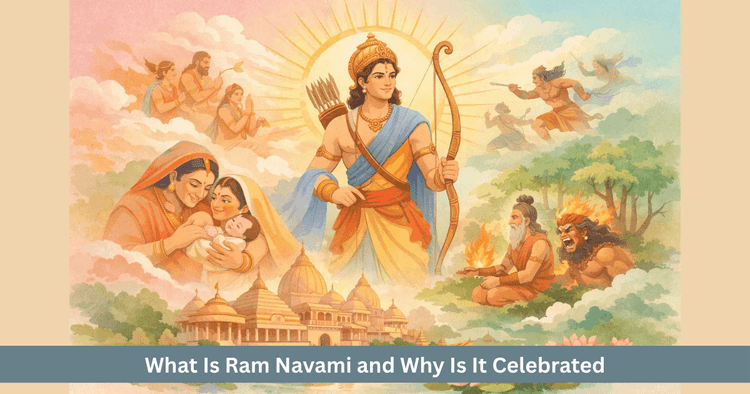
Table of Contents
In Indian spiritual tradition Ram Navami is regarded not only as a festival but as a sacred day that recalls the appearance of Maryada Purushottam Shri Ram and the restoration of dharma. On this day devotees celebrate the birth of Lord Rama in Ayodhya as the seventh incarnation of Lord Vishnu. In Treta Yuga, when adharma had reached a dangerous height and gods, sages and saintly people were oppressed by demonic forces, the Supreme chose to descend as Rama.
According to the Hindu lunar calendar, Chaitra Shukla Navami is observed as Ram Navami. On this very day Shri Ram took birth in the royal family of Ayodhya. The month of Chaitra itself is considered highly auspicious and favourable for spiritual practices, so fasting, recitation and remembrance of Rama on this Navami are considered especially powerful.
What Is Ram Navami and Why Is It Celebrated
Ram Navami is the sacred day when Lord Vishnu incarnated on earth as Shri Ram for the protection of dharma and the destruction of adharma. The purpose of his birth is described as the defeat of the demon king Ravana and the re establishment of righteousness, while also showing humanity an ideal path of life. On this day people worship the child form of Shri Ram, celebrate his birth on decorated altars, sing hymns and listen to the narration of his story.
The date has great religious as well as spiritual importance. The story of Ram Navami inspires a person to stand with righteousness in every situation, to speak truth and to live with restraint, even when personal sacrifices are required. The entire life of Shri Ram appears as an example of an ideal human being.
Ayodhya, King Dasharatha and the Desire for a Son
The birth story of Shri Ram begins with the city of Ayodhya and its king Dasharatha. King Dasharatha belonged to the Solar dynasty and was known as a righteous, caring and just ruler. There was no scarcity of prosperity in his kingdom, yet he carried deep sorrow because he had no children.
The king had three queens, Kausalya, Kaikeyi and Sumitra. The palace was full of splendour but the absence of an heir left a constant pain in the king’s heart. Over time his concern grew about who would take charge of the kingdom after him and how the lineage of the Suryavansha would continue.
Finally King Dasharatha decided to perform a great sacrifice to obtain a son. He invited the sage Rishyasringa, who was renowned for his austerity and mastery of Vedic rituals. Rishyasringa advised him to perform the Putrakameshti Yajna, a special sacrifice focused on the blessing of children.
Putrakameshti Yajna and the Appearance of Shri Ram
Under the guidance of Rishyasringa, extensive arrangements were made for the Putrakameshti Yajna. Throughout the sacrifice the king and queens worshipped with sincere intention. At the completion of the ritual, a divine being emerged from the sacrificial fire holding a golden vessel filled with sanctified sweet rice. He offered it to King Dasharatha with the instruction to distribute it among his queens.
The king respectfully divided this sacred preparation among his three queens.
Its result appeared in this way.
| Queen | Child |
|---|---|
| Kausalya | Shri Ram |
| Kaikeyi | Bharata |
| Sumitra | Lakshmana and Shatrughna |
In due course, on Chaitra Shukla Navami at the auspicious hour of noon, Shri Ram was born from the womb of Queen Kausalya. Queen Kaikeyi gave birth to Bharata and from Queen Sumitra were born Lakshmana and Shatrughna. Waves of happiness spread throughout Ayodhya. The city was filled with showering flowers, music, dance and devotional singing.
Joy in Ayodhya at the Birth of Rama
The joy that filled Ayodhya at the birth of Shri Ram is difficult to capture in words. People were delighted that an ideal prince had arrived to guide and protect them. Lamps illuminated the streets, sweets were distributed in every home and special worship was offered in temples.
With the birth of the four princes the Solar dynasty was once again firmly established. The gods and sages also rejoiced inwardly, knowing that this divine incarnation would later end the tyranny of Ravana and re establish dharma. Thus Ram Navami holds a central place in the story of that era.
Background of the Ram Navami Story and Ravana’s Cruelty
The broader Ram Navami story becomes even more meaningful when seen in its cosmic background. In Treta Yuga the demon king Ravana created fear and chaos across the three worlds by misusing boons and powers gained through austerities. He was highly learned in scripture and a devotee of Lord Shiva, yet pride and desire led him into grave unrighteousness.
Gradually he began to use his strength in harmful ways.
Some aspects of his conduct can be summarised as follows.
| Action | Effect |
|---|---|
| Breaking the sacrificial rituals of sages | Fear and disruption in spiritual practice |
| Insulting holy people | Creating insecurity among those who followed dharma |
| Disrespecting gods | Disturbing the celestial order |
| Violating the honour of women | Abducting the wives of sages and celestial beings |
As his oppression grew, the gods, sages and other divine beings went to Lord Vishnu seeking protection. They prayed that he descend personally to end Ravana and restore balance. This appeal became the immediate cause of the incarnation of Lord Vishnu as Shri Ram.
Exile, Abduction of Sita and the End of Ravana
In the life of Shri Ram, Ram Navami marks only the beginning. The later events show the continuous struggle to uphold dharma. When Queen Kaikeyi demanded two boons from King Dasharatha, she asked that Shri Ram be sent to fourteen years of exile and that her son Bharata be given the throne.
The king was heartbroken but bound by the promise he had once given. Out of respect for his father’s word and his stepmother’s wish, Shri Ram accepted exile without resistance. His wife Sita and brother Lakshmana also chose to go with him to the forest. Here Shri Ram showed that for him truth and promise were higher than royal comfort.
During the exile, the three of them protected sages, destroyed harmful demons and maintained discipline and virtue in the simplicity of forest life. One day the demon king Ravana, using a deceptive plan, abducted Sita and took her to his kingdom of Lanka. This event turned Shri Ram’s journey decisively toward a final battle between dharma and adharma.
Shri Ram then joined hands with Hanuman, the Vanara army, Sugriva, Jambavan and many other allies to search for Sita. Hanuman leapt across the ocean, found Sita in Ashoka Vatika, gave her Rama’s message and caused great damage in Lanka before returning. Eventually a bridge was built across the sea and Shri Ram marched to Lanka. After a fierce war he defeated Ravana and freed Sita with full honour.
Thus Shri Ram not only brought his consort back but also liberated gods, sages and countless beings from the terror of Ravana. In the context of Ram Navami, the defeat of Ravana represents the ultimate victory of dharma over adharma.
Ideal Qualities of Shri Ram and Human Inspiration
The Ram Navami story is rich not only in divine events but also in ideal human qualities. Shri Ram is called Maryada Purushottam because in every situation he upheld the highest standards of conduct. A few of his prominent qualities may be seen as follows.
| Quality | Expression |
|---|---|
| Truthfulness | Accepting exile to uphold his father’s promise |
| Patience | Remaining composed through exile, separation and war |
| Sense of justice | Showing fairness even toward enemies |
| Compassion | Granting refuge to Vibhishana who surrendered to him |
| Humility | Remaining simple and approachable despite being a divine incarnation |
The story teaches that however challenging the circumstances, one should not abandon truth, compassion and dharma. The life of Shri Ram conveys that character is greater than power and that real strength lies in integrity.
How Ram Navami Is Celebrated
On Ram Navami devotees begin the day with a ritual bath, then take a vow to fast and worship according to their ability. In many homes and temples images of Shri Ram, Lakshmana, Bharata, Shatrughna and Sita are beautifully decorated. At noon, the believed time of Rama’s birth, the moment is marked with conch blowing, ringing of bells and joyful chanting.
Devotees read from the Ramayana or from the Ramcharitmanas, especially the sections describing the birth of Rama. Many observe a vrat on this day, living on fruits or light sattvic food and dedicating the mind to devotion. In the evening, bhajan kirtan, Ram naam chanting and processions or tableaux depicting scenes from the life of Rama are also organised.
Spiritual Lessons from the Ram Navami Story
The Ram Navami story carries many spiritual and practical lessons. From the birth of Rama through the defeat of Ravana and return to Ayodhya, each stage offers guidance for daily life. Some key teachings are these.
| Teaching | Meaning |
|---|---|
| Steadfast dharma | Remaining aligned with dharma even in hardship |
| Spirit of sacrifice | Accepting exile in place of clinging to royal comfort |
| Forgiveness and compassion | Accepting Vibhishana as a devotee despite his family ties |
| Devotion and service | The selfless loyalty of Hanuman, Lakshmana and Bharata |
| Balanced leadership | Combining authority with kindness, justice and humility |
The festival reminds that Rama is not merely a character in an epic but a living ideal. When a person brings even a fraction of Rama’s restraint, humility and sense of duty into personal conduct, the celebration of Ram Navami becomes truly meaningful.
Common Questions
On which date does Ram Navami fall and what is its astrological significance?
Ram Navami is observed on the ninth day of the bright fortnight of the month of Chaitra. This period is close to the beginning of the new year in many traditional calendars and to the sun’s movement in the northern direction, so it is seen as a particularly auspicious time for new resolutions and spiritual growth.
Why did King Dasharatha perform the Putrakameshti Yajna and what was its result?
King Dasharatha remained without children for many years despite having three queens. Concerned for the future of his dynasty, he followed the advice of Rishyasringa and performed the Putrakameshti Yajna for progeny. From the sanctified offering of that sacrifice, Kausalya received Shri Ram, Kaikeyi received Bharata and Sumitra received Lakshmana and Shatrughna.
If Ravana was learned and a devotee of Shiva, why did he meet destruction?
Ravana’s knowledge and devotion became clouded by pride and desire. He misused his powers to disturb sacrifices, insult holy people, oppose the gods and violate the honour of women. These actions brought about his fall and made it necessary for the Lord to incarnate as Rama to end his rule.
How should one observe fast and worship on Ram Navami?
On Ram Navami it is recommended to bathe, wear clean light coloured clothes and then worship Shri Ram with lamps, incense, flowers and simple offerings. Reading or listening to the story of Rama’s birth is helpful. Many followers keep a fast, taking fruits or light sattvic food and spending the day in recitation of Rama’s name, singing bhajans and attending satsang.
What practical guidance for daily life can be taken from the Ram Navami story?
The story shows that truth, dharma and loyalty to one’s word are the true pillars of life. Even when given power, one should remain humble and fair. In difficulties, instead of escape, one should respond with courage and faith. Placing the welfare of family, society and dharma above personal preference, as Shri Ram did, becomes the hallmark of a truly noble life.
Get your accurate Kundali
Generate KundaliDid you like it?
Author
Pt. Amitabh Sharma (56 Years)
Experience: 20
Consults About: Family Planning, Career
Clients In: Punjab, Haryana, Delhi
Share this article with friends and family
About ZODIAQ
ZODIAQ is an online Vedic Astrology platform. It connects clients seeking astrological advice to experienced astrologers with deep knowledge. Our users also generate kundali and perform kundali milan for free. ZODIAQ also offers services to the Astrologers. Astrologers utilize various offerings by ZODIAQ to serve their clients effectively.
If you are a User
Consult with experienced astrologers and seek their guidance. You can also order handwritten Janm Patrika report with life prediction prepared by experienced astrologers. Generate accurate Kundali, perform Kundali Matching and check horoscope and muhurat. Utilize our online library for all the necessary astrological and spiritual information.
If you are an Astrologer
Create accurate kundali for your clients and perform Kundali Matching for up to 5 people at a time. Write comprehensive Janm Patrika report for your clients with ZODIAQ. Check client details anytime by saving it in client directory. Become more productive by tracking how many clients you guide every day.
WELCOME TO
ZODIAQ
Right Decisions at the right time with ZODIAQ
