Rohini Vrat Katha and the Deeper Law of Karma
By Pt. Narendra Sharma
Rohini Vrat Promotes Health, Family Harmony, and Auspicious Future Karma
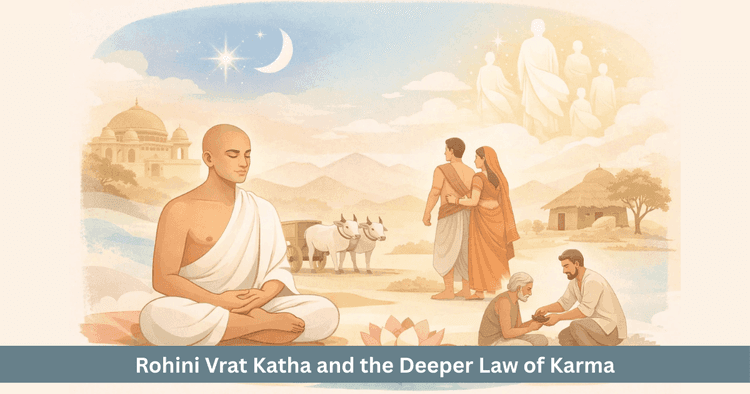
Table of Contents
In Jain tradition Rohini Vrat is regarded as a highly auspicious and beneficial observance. It is especially kept with the intention of gaining good fortune, health, family harmony, reduction of past karmas and relief from suffering across many births. When observed with faith, restraint and the spirit of nonviolence, Rohini Vrat is believed to bring inner peace and stability and to support auspicious results in future lives as well. The Rohini Vrat Katha linked with this vrata is not only a traditional story but also a profound teaching on the law of karma and its long term consequences.
What Is the Background of the Rohini Vrat Story
The traditional account begins in ancient times in a city called Champapuri. In this city, King Madhava ruled along with his queen Lakshmipati. Both were devoted to dharma, compassionate and sincerely concerned for the welfare of their subjects. They had eight children in all, seven sons and one daughter. The daughter was named Rohini. Rohini was virtuous, graceful and very dear to her parents. As she grew into youth, the king’s natural concern about her marriage also increased. One day King Madhava asked a nimittajnani, a seer skilled in reading omens and subtle indications, about the future husband of his daughter. After contemplation the seer replied that Rohini would marry Ashok, the prince of Hastinapur. Hearing this, the king and queen were filled with joy. In due course preparations were made for Rohini’s swayamvara in full royal splendour.
Rohini and Ashok’s Swayamvara and Marriage
On the day of the swayamvara many princes and warriors from different regions gathered in Champapuri. The city was decorated, the halls were adorned and the atmosphere became festive. In the assembly Rohini, guided by her inner understanding and destiny, chose the prince of Hastinapur, Ashok and placed the garland around his neck. Thus, in the presence of sacred fire, deities and assembled guests, the marriage of Rohini and Ashok was completed. Both Champapuri and Hastinapur were pleased with this alliance. The newly married couple began their life together in happiness. Until this point the narrative appears to be a simple royal story but as it unfolds it reveals deeper layers concerning karma and previous births.
Arrival of Muni Shri Charan and the Opening of the Karmic Secret
At a later time a radiant Muni, known as Shri Charan Muni, arrived in the forest near Hastinapur. His austerity, renunciation and spiritual power had become widely known. Hearing of his presence, King Ashok, along with his relatives and his queen, went to take his darshan. All bowed respectfully, listened to his teachings on dharma and felt many of their doubts being dissolved. The calm depth of the Muni’s presence and the serenity in his words impressed everyone. Observing this peace, a thought arose in the king’s mind. He humbly asked why his queen appeared so calm, composed and inwardly deep, as if she carried some old impressions or dispassion from previous lives. In response to this sincere question Shri Charan Muni began to narrate a subtle karmic story connected with the same city, though in a different time and a different birth.
The Story of Vastupal, Dhanmitra and Durgandha
Shri Charan Muni explained that in earlier times the same city had been ruled by a king named Vastupal. He had a close friend called Dhanmitra. In Dhanmitra’s house a daughter was born who, due to particular conditions, emitted a foul smell from her body. She was therefore named Durgandha. This was not only a physical difficulty but also a cause of social hardship. Dhanmitra constantly worried about his daughter’s future, wondering who would accept her and how she would live a dignified life. The pressure of social opinion, his own emotional pain and the visible condition of his daughter together made the situation very heavy. Under this burden Dhanmitra decided to arrange her marriage with Shrishen, the son of his friend King Vastupal. To secure this alliance he also used the attraction of wealth and royal connection. The marriage took place but the smell from Durgandha’s body made life uncomfortable for Shrishen. Within a month he felt unable to continue in the relationship and separated from her. This event was deeply hurtful for Durgandha. Yet behind this visible suffering there was not only the present situation but also the working out of past karma, which was explained next in the story.
Coming of Muni Amritsen and Revelation of the Previous Birth
At another time a great ascetic named Muni Amritsen arrived in the city while travelling. Hearing of his spiritual stature, Dhanmitra went to pay respect to him along with his daughter Durgandha. They bowed and Dhanmitra described the pain and difficulties of his daughter’s life, asking whether there was a deeper spiritual cause and if any remedy was possible. Muni Amritsen entered a contemplative state and perceived the chain of Durgandha’s former births. He then narrated a further story. Long ago, near Girnar Parvat, there was a city ruled by King Bhupal. His queen’s name was Sindhumati. One day King Bhupal went for forest recreation with his queen. While they were moving about in the forest they encountered a venerable Muni. The king requested his queen to return home and arrange pure, sattvic food for the ascetic, since offering proper alms to a monk is considered a great meritorious act. Outwardly Queen Sindhumati agreed but inwardly she was displeased. Driven by anger, irritation and pride, she did not prepare an appropriate meal. Instead she offered the Muni a bitter gourd like fruit, described as kadvi tumbhi, a harsh and unsuitable food for an ascetic in delicate health. This food caused intense suffering to the Muni’s body. Severe pain arose and as a result of this ordeal his life came to an end.
Long Journey of Suffering from Harm Done to a Saint
When King Bhupal came to know that due to Queen Sindhumati’s anger and disrespect the Muni had been given such a painful meal that it led to his death, he was deeply shaken. From the standpoint of dharma this was a serious act of violence and disrespect. To uphold righteousness he expelled the queen from his kingdom. After this, Queen Sindhumati’s body developed a severe disease resembling leprosy. Isolated from society, weighed down by illness and remorse, she lived a life filled with misery. At the end of that life she fell into hellish states of suffering. After enduring many torments there, she was born in an animal womb and in a later birth the same soul took birth in Dhanmitra’s house as the girl named Durgandha. Thus the foul odour and humiliation that Durgandha experienced were in fact the karmic result of Queen Sindhumati’s earlier deed, when she had caused great pain to a saint by offering a cruel and inappropriate meal. By narrating this, Muni Amritsen helped Dhanmitra understand that the root of his daughter’s suffering lay in old karmas and that relief would require a path of vrat, repentance, restraint and service to ascetics.
Reason for Present Calmness and Inner Composure
After narrating this chain of events, Shri Charan Muni indicated to King Ashok that the queen’s present calmness and depth were also connected with such past journeys of joy, suffering and gradual purification. When a soul passes through many births, experiencing both intense pain and the results of its own actions, a natural seriousness and inner maturity arise. Through the Rohini Vrat Katha it becomes clear that the conditions we see now, whether honour or dishonour, health or disease, comfort or hardship, are not only the outcomes of present circumstances but often belong to a long sequence of karmic causes. Understanding this principle makes the Jain doctrine of karma more vivid and also clarifies why Rohini Vrat carries such importance as a support for karmic lightening.
Spiritual Guidance Offered by Rohini Vrat
The Rohini Vrat story offers several layers of guidance to a spiritual seeker.
- Present suffering does not always arise from present causes alone, many times it is linked to actions of previous births
- Respect, humility and nonviolence toward saints, monks and spiritual teachers are of utmost importance
- Small acts of anger, pride or disrespect towards the virtuous can create heavy karmic bondage with far reaching consequences
- Through vrata, restraint, repentance, compassion and service to ascetics, the intensity of karmic results can slowly be reduced
- And by accepting life situations with wisdom, patience and commitment to dharma, inner peace gradually becomes possible
When a devotee observes Rohini Vrat while remembering this katha, awareness of karma and responsibility becomes stronger. The vrata then is not a mere outer formality but a conscious practice that refines thoughts, speech and conduct and encourages a humbler and more careful way of living.
Common Questions
To which tradition does Rohini Vrat belong and what is its main purpose?
Rohini Vrat is mainly associated with the Jain tradition. Its primary purpose is to support reduction of karmic burden, increase auspiciousness and wellbeing in the family and gradually free the soul from layers of suffering through restraint and devotion.
How are King Madhava of Champapuri and Rohini connected to this story?
King Madhava’s daughter Rohini marries Prince Ashok of Hastinapur. Later, Ashok’s question to Muni Shri Charan about his calm natured queen becomes the doorway through which the deeper story of Durgandha, Sindhumati and karmic results is revealed. This is why the narrative is remembered as the Rohini Vrat Katha.
Why does Durgandha’s life show so much pain and humiliation?
Durgandha is actually the rebirth of Queen Sindhumati, who in a previous life gave a painful, bitter meal to a saint, leading to his death. As the karmic consequence of this, she went through disease, hellish suffering, animal birth and finally a human life marked by foul odour and rejection.
Why is the act of giving bitter tumbhi to a saint considered such a grave sin?
Because it arose from anger, pride and disrespect toward an ascetic who should have been honoured. Causing severe harm and even death to a saint through such deceitful offering constitutes a serious form of violence, which in Jain understanding leads to heavy karmic bondage and prolonged suffering.
Why is it recommended to recall this katha while observing Rohini Vrat?
Remembering the katha deepens understanding of karma, restraint, nonviolence and reverence for holy beings. It helps ensure that the vrata is practised with awareness and sincerity, turning it into a means for genuine inner transformation rather than a mere ritual.
Get your accurate Kundali
Generate KundaliDid you like it?
Author

Pt. Narendra Sharma (63)
Experience: 20
Consults About: Family Planning, Career
Clients In: Punjab, Haryana, Delhi
Share this article with friends and family
About ZODIAQ
ZODIAQ is an online Vedic Astrology platform. It connects clients seeking astrological advice to experienced astrologers with deep knowledge. Our users also generate kundali and perform kundali milan for free. ZODIAQ also offers services to the Astrologers. Astrologers utilize various offerings by ZODIAQ to serve their clients effectively.
If you are a User
Consult with experienced astrologers and seek their guidance. You can also order handwritten Janm Patrika report with life prediction prepared by experienced astrologers. Generate accurate Kundali, perform Kundali Matching and check horoscope and muhurat. Utilize our online library for all the necessary astrological and spiritual information.
If you are an Astrologer
Create accurate kundali for your clients and perform Kundali Matching for up to 5 people at a time. Write comprehensive Janm Patrika report for your clients with ZODIAQ. Check client details anytime by saving it in client directory. Become more productive by tracking how many clients you guide every day.
WELCOME TO
ZODIAQ
Right Decisions at the right time with ZODIAQ
