Sita Navami: Celebrating the Birth of an Ideal of Virtue
By Pt. Sanjeev Sharma
Sita Navami Honors Mata Sita’s Virtue, Courage, and Righteousness
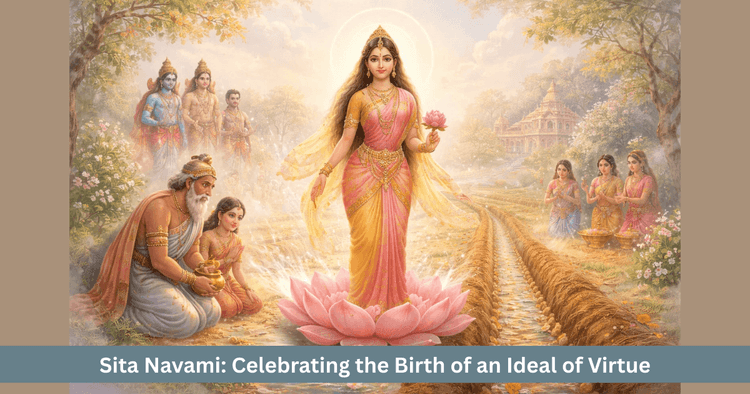
Table of Contents
In the Indian tradition Sita Navami is honoured as the sacred day on which Janakanandini, the princess of Janakpur and the consort of Lord Shri Ram, Mata Sita, appeared on earth. In Hindu dharma she is regarded as an embodiment of strength, endurance, sacrifice and perfect decorum. This date is not only a birthday celebration but also a collective reaffirmation of the ideal womanly qualities of courage and righteousness.
According to the Hindu lunar calendar, Sita Navami is observed every year in the month of Vaishakh, on the Navami tithi of the Shukla Paksha. This fortnight, known as Shukla Paksha, is the waxing phase of the Moon and is therefore associated with growth, hope and auspicious beginnings. Usually this falls during the months of April or May in the Gregorian calendar and many families treat it as a very special devotional day within the home.
Date of Sita Navami and Its Subtle Significance
The Navami tithi of Shukla Paksha is associated with a heightened presence of the divine feminine, so Sita Navami is regarded as a day where gentle strength and dharma walk together.
The key points related to Sita Navami can be seen in this table.
| Aspect | Description |
|---|---|
| Tithi | Vaishakh Shukla Navami |
| Other names | Janakanandini Jayanti, Janaki Navami |
| Presiding form | Mata Sita, manifestation of Lakshmi, consort of Shri Ram |
| Central themes | Womanly dignity, sacrifice, courage, compassion, fidelity to dharma |
| Main observances | Fasting, kirtan, Ramayana recitation, charity, vows for respect toward women |
In many places Sita Navami is also seen as a day to strengthen the culture of honour for women and to renew harmony and mutual respect within the family, so it becomes a time for living values and not only for ritual.
What Is the Birth Story of Mata Sita
According to the Ramayana the birth of Mata Sita did not occur in the usual human way. The story describes that the king of Mithila, Raja Janak, was once ploughing the land in preparation for a yagna, a sacred ritual. This tilling was meant not for agriculture but for sanctifying the sacrificial field.
As Janak moved forward with the plough, he saw before him a container or cradle emerging from the earth and inside lay a radiant baby girl. The king was astonished by this sight. With deep reverence he lifted the child, understanding her to be a special gift from the divine. His queen, Rani Sunayana, lovingly accepted the child as their daughter.
Because she arose from the earth, Mata Sita is called Bhumija, daughter of the earth and Dharani sutā, child of the soil. She is not regarded as having been born from a human womb but from the womb of the earth itself and thus is revered as supremely pure and as a direct expression of the strength and sanctity of the earth. For this reason Sita Navami naturally carries an added message of respect for land, nature and the environment.
Sita as Lakshmi and Her Bond with Nature
In Vaishnava understanding Mata Sita is regarded as an incarnation of Shri Lakshmi, who descended in the form of Sita when Lord Vishnu took birth as Ram. The simplicity and naturalness of her birth story, together with her emergence from the ground itself, present her as especially united with prakriti, the living environment.
Traditional narration mentions Sita’s tenderness toward trees, flowers and living beings. One remembered incident describes her compassion toward an injured bird, because of which she is seen as a true embodiment of kindness and empathy. From this angle Sita Navami becomes not only the remembrance of a divine birth but also a celebration of compassion, sensitivity and love for nature.
How Is Sita Navami Observed
In many parts of India, especially in Ayodhya and in regions of Nepal associated with the Ramayana, Sita Navami is observed with great devotion. Fasts, bhajans, kirtan and scriptural readings make the day vibrant with devotion.
What Are the Main Rituals of Sita Navami
On Sita Navami devotees bathe early, wear clean clothes and perform joint worship of Shri Ram and Mata Sita. Many women observe a vrata, often refraining from grains and keeping to fruits or simple sattvic food. Throughout the day
- repetition of Ram’s name
- hymns in praise of Sita
- and evening aarti
become the main expressions of devotion. The vrata is often kept for harmony in marriage, wellbeing of the family and the growth of noble qualities in children.
Temple Celebrations on Sita Navami
In temples preparations for Sita Navami begin in advance. The sanctum and pillars are decorated with garlands and lights, lamps are lit and in some places special yajnas are conducted. Devotees visit the temple to offer
- water and sacred pots
- flowers
- and food offerings
to Sita and Ram. During the evening aarti crowds increase significantly, so many families plan their visit in advance to join the worship with calm attention.
Reading of Sita’s Life and Story Circles
A central feature of Sita Navami is Ramayana recitation and focused reflection on Sita’s character. In temples, halls and community spaces, story circles are formed where episodes such as
- the birth of Sita
- life in Ayodhya
- the forest exile
- the time in Ashoka Vatika
- and the agni pariksha
are narrated. Storytellers and scholars use these episodes to highlight patience, dignity and fidelity to dharma. For younger listeners these gatherings are especially meaningful, as they offer a simple way to understand tradition and values.
Cultural Programs and Dramatic Performances
In many places Sita Navami is also marked by Ramayana themed dramas and cultural performances. Children and youth dress as
- Shri Ram
- Mata Sita
- Lakshman
- and other characters
and enact scenes from the epic. This nurtures confidence in the children and deepens their connection to their heritage. For those watching, these events are not only enjoyable but also act as a living lesson in ideals and conduct.
Satsang and Spiritual Discourses
Many devotees choose to spend Sita Navami in satsang, discourses and Ramayana readings. Learned teachers recite portions of the text and explain their meanings. Often the talks focus on themes like
- respect for women
- trust within marriage
- and steadiness in times of trial.
Inspirational guidance for the younger generation is also shared so that Sita Navami becomes a day of practical spiritual insight, not just ritual observance.
Charity and Service in the Spirit of Sita
Sita Navami is also regarded as a day of kindness, courage and compassion. The humility and service seen in Sita’s life inspire devotees to reflect this in their actions. On this day many people engage in
- feeding the hungry
- giving clothes
- or offering financial help
to those in need. Such giving is understood as an offering in Sita’s honour and as a way to invite contentment and wellbeing into one’s own home.
Inner Impact of the Sita Navami Date
During the Shukla Paksha, as the Moon grows brighter, Navami is seen as a time particularly receptive to the awakening of inner strength. On Sita Navami it is believed that
- meditation
- japa
- and heartfelt resolutions
receive special support. Those who turn inward on this day with sincere prayer and contemplation often find a deeper sense of calm, strength and balance emerging.
Spiritually, many hold that prayers made on Sita Navami, especially for
- peace and stability in marriage
- wellbeing of children
- and honour for women
carry lasting positive effects and subtly shape the atmosphere of the home.
Relevance of Sita Navami in the Present Time
In a period when society is seeking equity and sensitivity, the message of Sita Navami becomes especially important. Younger generations increasingly wish to understand the meaning behind festivals rather than only perform them. Sita Navami offers a clear reminder that honouring women, standing with truth and living with integrity should be part of daily life, not only part of ancient stories.
Many families now use this day to
- show appreciation for daughters
- acknowledge the contributions of women
- and encourage open, respectful dialogue within the home. Through digital media people share messages, inspiring quotes and images connected with Sita Navami. Online satsangs, live aarti broadcasts and virtual gatherings help those living far apart to share a sense of belonging and devotion.
Guiding Message for Everyday Life
Sita Navami gently reminds us that, like Mata Sita, it is possible to
- remain firm in love
- hold patience in adversity
- and walk on the path of dharma without compromise.
The day encourages families and communities to express respect for women not only in words but also in actions, so that future generations may draw strength from Sita’s example of dignity and resilience and bring that balance into their own lives.
Common Questions
When is Sita Navami observed each year?
Sita Navami is observed every year in the month of Vaishakh on the Navami tithi of the Shukla Paksha according to the Hindu calendar. It usually falls in April or May of the Gregorian calendar.
What is the main birth episode of Mata Sita?
The Ramayana narrates that while King Janak was ploughing the land to prepare a field for yagna, he discovered a radiant baby girl emerging from the earth in a vessel. He accepted her as his daughter and she later became revered as Mata Sita.
What are the main rituals performed on Sita Navami?
Devotees keep fasts, worship Ram and Sita together, sing bhajans, recite the Ramayana, participate in aarti and engage in acts of charity. Temples organise special decorations, yajnas and storytelling sessions.
What is considered the central spiritual message of Sita Navami?
The main message lies in honouring women, valuing patience, sacrifice and compassion and remaining true to dharma. Through Sita’s life the day teaches that even in difficulty one should not abandon truth and moral integrity.
How can Sita Navami be made meaningful in today’s context?
Sita Navami can be made deeply relevant by using it as a day to affirm respect for women, encourage awareness of equal dignity, support service projects, study the Ramayana and foster honest family conversations, so that the festival becomes a channel for real inner and social change.
Get your accurate Kundali
Generate KundaliDid you like it?
Author

Pt. Sanjeev Sharma (63)
Experience: 20
Consults About: Family Planning, Career
Clients In: Punjab, Haryana, Delhi
Share this article with friends and family
About ZODIAQ
ZODIAQ is an online Vedic Astrology platform. It connects clients seeking astrological advice to experienced astrologers with deep knowledge. Our users also generate kundali and perform kundali milan for free. ZODIAQ also offers services to the Astrologers. Astrologers utilize various offerings by ZODIAQ to serve their clients effectively.
If you are a User
Consult with experienced astrologers and seek their guidance. You can also order handwritten Janm Patrika report with life prediction prepared by experienced astrologers. Generate accurate Kundali, perform Kundali Matching and check horoscope and muhurat. Utilize our online library for all the necessary astrological and spiritual information.
If you are an Astrologer
Create accurate kundali for your clients and perform Kundali Matching for up to 5 people at a time. Write comprehensive Janm Patrika report for your clients with ZODIAQ. Check client details anytime by saving it in client directory. Become more productive by tracking how many clients you guide every day.
WELCOME TO
ZODIAQ
Right Decisions at the right time with ZODIAQ
