Story of Swarochisha Manu and the Spiritual Meaning of the Second Manvantara
By Pt. Suvrat Sharma
Role of Manu and the Cosmic Cycles of Creation in Vedic Time
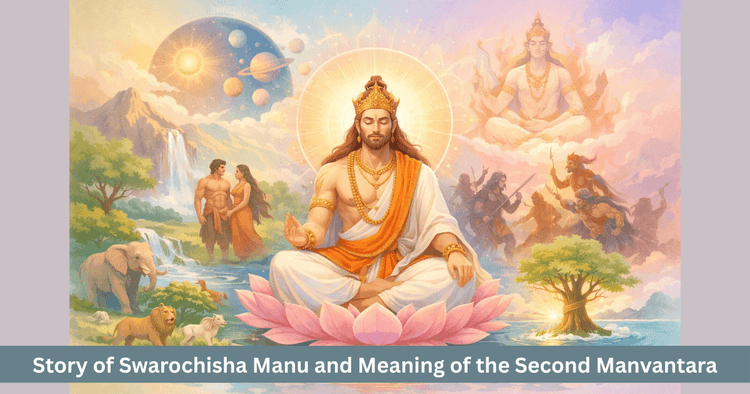
Table of Contents
In Vedic time reckoning, time is not understood only through years, yugas and kalpas but also through larger and more subtle cycles. One of these is the Manvantara, an era presided over by a particular Manu. In each Manvantara, the Manu functions as the progenitor of humanity and as the giver of laws and dharmic guidelines. A single day of Brahma, called a Kalpa, contains fourteen such Manus.
Among these fourteen, the second Manu is known as Swarochisha Manu. After Swayambhuva Manu, the first Manu, Swarochisha took charge during the second Manvantara. His story is not merely about a single figure but points toward the cyclic movement of creation, the re establishment of dharma and the unfolding of spiritual light.
Who Is Swarochisha Manu and How Was He Born
According to the Puranas, Swarochisha Manu was born from the radiance of Agni, the fire god. The name itself means “self luminous” or “shining by one’s own light”. This origin associates him with purity, brilliance and a naturally radiant consciousness.
When the era of the first Manu, Swayambhuva, came to an end, the responsibility of guiding beings and shaping order in creation passed to Swarochisha Manu. During the second Manvantara he established dharma, social structures and spiritual disciplines suitable for that cosmic phase.
What Was Special about the Second Manvantara
Each Manvantara has its own configuration of deities, Indra, Saptarishis and other divine assistants. This reflects the idea that in each major cycle, leadership and spiritual guardianship are renewed. In the time of Swarochisha Manu, this arrangement was distinct from other eras.
The main features of the second Manvantara can be summarised as follows.
| Aspect | Description for the second Manvantara |
|---|---|
| Manu | Swarochisha Manu |
| Origin | Born from the splendour of Agni |
| Indra | Named Rochana or Vipashchit in various accounts |
| Presiding gods | Deva groups known as **Tushitas** and **Paravatas** |
| Saptarishis | A set of seven sages appointed specifically for this era |
| Vishnu’s role | A particular manifestation appeared to uphold balance and protect dharma |
These details together suggest that creation is periodically reorganised, with divine governance, wisdom traditions and sage lineages appearing anew in each Manvantara.
Symbolic Meaning of Swarochisha Manu
The name Swarochisha itself carries deep symbolic value. Being born from fire, he represents purity, transformation and illumination. In Vedic thought, Agni is not only a physical element but also the deity who carries offerings to the higher realms and connects the visible with the invisible.
Swarochisha Manu therefore embodies inner light, clarity and connection with the divine. His Manvantara marks a phase where, after the initial establishment of creation under Swayambhuva order and dharma were further clarified and systematised.
Every Manu defines law codes and ethical patterns appropriate for the beings of that particular era. The norms established by Swarochisha Manu are seen as refined principles guiding the second phase of cosmic evolution.
What Is the Role of Manu in Hindu Thought
In Sanatana Dharma, Manu is not only a historical individual but also a cosmic archetype. The word shares its root with “man,” indicating mind and reflective capacity. Manu is seen as the primordial human, the initiator of thought and the basic organiser of society.
From Manu, terms like “manusha” and “man” gain their association with human identity. In the Puranas, each Manu is portrayed as the one who gives dharma, discipline and social frameworks suited to that Manvantara.
As the second Manu, Swarochisha symbolises the refinement of law and morality after the foundational work of Swayambhuva Manu. His role suggests that in the evolution of creation there comes a stage when initial structures are reviewed, polished and adapted for the next spans of time.
What Lessons Arise from the Story of Swarochisha Manu
From the name and origin of Swarochisha several spiritual insights can be drawn.
- Creation moves in cycles, not in a straight line. Each Manvantara marks a new beginning with fresh leadership and renewed guidance.
- A Manu born from fire reminds seekers that true guidance springs from inner luminosity and self awareness.
- Just as fire purifies metal and makes it more valuable, spiritual discipline purifies mind and life so that they can reflect higher values.
- The rules of dharma are not rigidly identical in every age. They are re articulated according to the needs, capacity and consciousness of beings at that time and each Manu carries out this work for his era.
The memory of Swarochisha Manu encourages a person to treat each new phase of life as a kind of “inner Manvantara” in which past habits are refined and new, clearer principles are consciously adopted.
Our Present Time and the Place of Swarochisha Manu
Traditional reckoning holds that we are now living in the seventh Manvantara, presided over by Vaivasvata Manu. Before him, six Manus have already completed their eras, named in order as Swayambhuva, Swarochisha, Auttami, Tamasa, Raivata and Chakshusha.
During the first Manvantara, the seed of creation was planted. In the second, under Swarochisha Manu order and discipline were further defined. Later Manvantaras then carried the long story of cosmic development forward step by step.
The purpose of these narratives is not only to present vast spans of time but also to show that consciousness, society and understanding of dharma deepen with each cycle. The early Manus, including Swarochisha, stand as markers of the initial stages of this unfolding.
Ongoing Journey toward Dharma and Light
Although brief in scriptural mentions, the story of Swarochisha Manu leaves a strong impression. A Manu born of fire, radiant in nature and engaged in establishing dharma, indicates that outer order rests on inner light.
Whenever a new responsibility or life stage appears, viewing it as a new “Manvantara” and kindling one’s own clarity and discipline can be seen as following the spirit of his example.
In this sense, Swarochisha Manu is not only a figure of a distant cosmic past but also a symbol of self luminous discernment within each seeker, guiding the path whenever it is consciously invoked.
Common Questions
Where does Swarochisha Manu stand in the sequence of Manus and what era does he belong to?
Swarochisha Manu is the second among the fourteen Manus of a Kalpa. He presides over the second Manvantara, which follows the era of Swayambhuva Manu and forms a distinct period within a single day of Brahma.
What does the name Swarochisha mean and what does it imply?
The name means “shining by one’s own radiance.” His birth from Agni suggests a nature that is bright, pure and inwardly illumined. Symbolically it points to self generated light and awakened conscience.
Which deities, Indra and sages are associated with the second Manvantara?
In this Manvantara the main gods are groups called Tushitas and Paravatas and Indra is named Rochana or Vipashchit. The Saptarishis for this era form a distinct set, including sages such as Dattatreya, Atri, Chyavana, Stambha, Prana, Kashyapa and Brihaspati according to certain accounts.
Why is Manu described as the progenitor and guide of humanity?
Manu is linked with the root “man,” indicating mind and reflective capacity. He is portrayed as the primordial human who lays down dharma, social regulation and ethical frameworks. Each Manu shapes the fundamental guidelines by which human society develops in that Manvantara.
What practical insight can a seeker draw from the story of Swarochisha Manu?
The story encourages ongoing refinement. At each new phase one should examine old patterns in the fire of discernment, retain what is pure and let go of what obstructs growth. Without inner light and self discipline, external structures lack stability. This balance of order and inner clarity is the core teaching represented by Swarochisha Manu.
Get your accurate Kundali
Generate KundaliDid you like it?
Author
Pt. Suvrat Sharma (63)
Experience: 20
Consults About: Family Planning, Career
Clients In: Punjab, Haryana, Delhi
Share this article with friends and family
About ZODIAQ
ZODIAQ is an online Vedic Astrology platform. It connects clients seeking astrological advice to experienced astrologers with deep knowledge. Our users also generate kundali and perform kundali milan for free. ZODIAQ also offers services to the Astrologers. Astrologers utilize various offerings by ZODIAQ to serve their clients effectively.
If you are a User
Consult with experienced astrologers and seek their guidance. You can also order handwritten Janm Patrika report with life prediction prepared by experienced astrologers. Generate accurate Kundali, perform Kundali Matching and check horoscope and muhurat. Utilize our online library for all the necessary astrological and spiritual information.
If you are an Astrologer
Create accurate kundali for your clients and perform Kundali Matching for up to 5 people at a time. Write comprehensive Janm Patrika report for your clients with ZODIAQ. Check client details anytime by saving it in client directory. Become more productive by tracking how many clients you guide every day.
WELCOME TO
ZODIAQ
Right Decisions at the right time with ZODIAQ
