Vaisakhi and the Birth of the Khalsa
By Pt. Sanjeev Sharma
Vaisakhi Marks the Birth of the Khalsa and Highlights Courage, Discipline, and Dharma
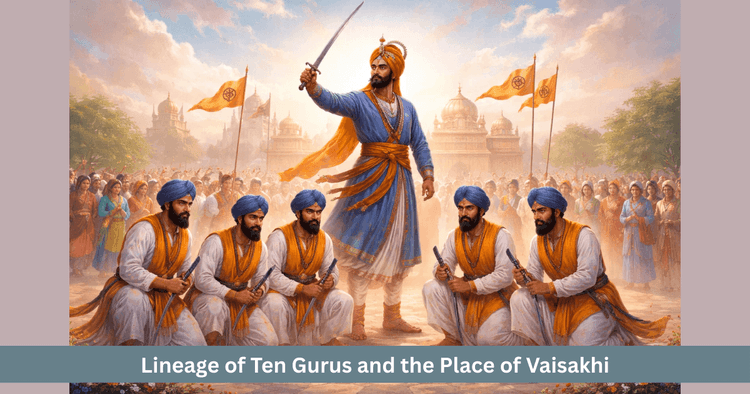
Table of Contents
Vaisakhi is not only a harvest celebration. It is also the sacred remembrance of the birth of the Khalsa Panth. On Vaisakhi in 1699, Guru Gobind Rai, at Anandpur Sahib, initiated an event that reshaped Sikh history and gave a new form to the very idea of dharma. On that day the Guru awakened ordinary people as saint soldiers, showing them how to live as fearless, disciplined and God connected human beings.
Sikh Dharma is the spiritual path given so that souls may learn, grow and serve while living in this temporary physical world. Flowing from the light of Nanak through ten Gurus, this path teaches that life is an opportunity to express the highest virtues through courage, wisdom and service.
Lineage of Ten Gurus and the Place of Vaisakhi
Without understanding the Guru lineage, the meaning of Vaisakhi and Khalsa remains incomplete. Step by step
- Guru Nanak Dev Ji spread the light of the Divine Name throughout the world
- Guru Angad Dev Ji embodied complete obedience and loyalty to the Guru
- Guru Amar Das Ji established langar, seating rich and poor together to teach equality
- Guru Ram Das Ji is remembered for a heart so compassionate that his flowing tears seem to hold an ocean of kindness
- Guru Arjun Dev Ji compiled the sacred words of Gurbani, giving humanity an immeasurable treasure
- Guru Hargobind Ji expressed the balance of spiritual and temporal power, establishing the tradition of miri and piri
- Guru Har Rai Ji showed gentle love and friendship toward nature and all living beings
- Guru Har Krishan Ji comforted the suffering and is remembered for curing the pain of the sick with his kindness
- Guru Teg Bahadur Ji offered his head to protect freedom of conscience and truth
- Guru Gobind Rai brought together joy, martial skill and fearlessness and ultimately created the Khalsa Panth
Through this lineage we are reminded that the human being is essentially spirit, who has taken birth by the grace of the Infinite in order to live a noble life.
Historical Background of Vaisakhi 1699
During the time of Guru Gobind Rai, the rulers of the land were harsh and unjust toward ordinary people. Religious and political oppression created an atmosphere of deep fear and darkness. In this setting, Guru Teg Bahadur Ji gave his own head to defend religious freedom.
Against this background there arose a need for unshakable and fearless people who would stand firmly in dharma and also protect others. On Vaisakhi of 1699, Guru Gobind Rai responded to that need by founding the Khalsa Panth.
Vaisakhi itself is linked with spring, the season of renewal. On that Vaisakhi in 1699, a vast sangat gathered at Anandpur Sahib. Farmers, traders, wandering yogis, singers, soldiers, mothers and children from many backgrounds and communities came together.
The Call of Guru Gobind Rai and the Demand for Heads
On that day Guru Gobind Rai appeared before the congregation from an elevated place. His presence was radiant and composed. People felt naturally uplifted in his company.
Yet on this occasion he combined his boundless love with a very intense test. He drew his sword and, in a powerful voice, called out
“Is there any Sikh who will give the gift of his head?”
At the first call people were astonished. Again the Guru roared, “Who will offer a head to the Guru?” A third time his call rang out. The force of his voice shook the listeners to their very core.
Between fear and devotion, the minds of the sangat trembled. Then one man stood up. His name was Daya. Fear did not rule over his eyes. Instead, devotion shone in them. With folded hands he came forward and said
“Guru Ji, my head is yours.”
Guru Gobind Rai took him into the tent and removed his head. For many, this was beyond understanding. Awe, shock and reverence all arose together in the hearts of the people.
How the Five Beloved Ones Appeared
The Guru then emerged with his sword, now stained with blood and cried out again
“Give me another head!”
Confusion spread through the gathering. Still, one more man stepped forward. His name was Dharam Chand. He also asked to offer his head. The Guru took him inside and did as before.
Many in the crowd began to leave in fear. Some felt that what they witnessed was too frightening and incomprehensible. Those who followed only their reasoning mind stepped back. Those whose hearts were deeply in love with the Guru sensed a divine test unfolding.
Three more men came forward. Their names were Himmat, Mokam and Sahib. Each of them said
“My head is yours and has always belonged to you.”
In this way five men offered their heads without hesitation. They were
- Bhai Daya Singh
- Bhai Dharam Singh
- Bhai Himmat Singh
- Bhai Mokam Singh
- Bhai Sahib Singh
They came to be known as the Panj Pyare, the Five Beloved Ones. After taking their heads, the Guru was preparing to bring them into a new form of life.
Preparation of Amrit and the Flow of Bani
Next, a large iron bowl was brought and filled with water. Guru Gobind Rai placed his double edged sword into the bowl and began to stir. As he stirred, sacred Bani flowed from his lips.
He recited, in a warm and resonant voice, “Ik ongkar, satinām, karta purakh, nirbhao, nirvair, akaal murat, ajooni, saibhang, gurprasad, jap, aad sach, jugad sach, hai bhi sach, Nanak hosi bhi sach”, the opening of Jap Ji Sahib. This Bani establishes the mind in higher awareness and protects it from deep sorrow.
Then he recited Jaap Sahib, beginning “Chakr chihn ar baran jaat ar paat nahin joat roop har aap”, which brings dignity and contemplation on the qualities of the Divine.
After that he chanted Tav Prasad Savaiye, beginning “Sravag sudh samuh sidhan ke dekh firiou ghar jog jati ke”, to reduce pride and confusion and to increase love and balance.
He then recited Chaupai Sahib, beginning “Humree karo hath de rachha, pooran hoee chit ki ichha”, a powerful prayer for protection, victory and freedom from fear.
At the end he read Anand Sahib, beginning “Anand bhia mere mai satgur mai paia”, which fills the mind with a stable sense of joy.
Through these Banis, the water in the bowl was transformed into Amrit, charged with spiritual strength, grace and bliss.
Guru Ji’s wife came forward and added sweet ingredients to the bowl. She did this so that those who drank the Amrit would not only be powerful but also gentle and sweet. The union of strength and sweetness became a hallmark of the Khalsa identity.
Rebirth as Khalsa and the First Amrit Ceremony
Now came the moment to grant a new birth. Guru Ji first called Daya. He sprinkled Amrit upon the top of his head, the tenth gate and upon his mouth, eyes and body and then gave him to drink.
The Guru proclaimed
“Waheguru Ji Ka Khalsa, Waheguru Ji Ki Fateh.”
Daya rose as if filled with new life and roared in response
“Waheguru Ji Ka Khalsa, Waheguru Ji Ki Fateh.”
In the same way, one by one, the Guru gave Amrit to all five. Each time the Guru’s call and the reply of the Panj Pyare filled the air. After this process they were reborn at a higher level of consciousness as Khalsa.
Khalsa means pure. They became human beings who had gone beyond fear of death, rooted in Truth and shining with the light of the Divine.
Guru Gobind Rai dressed them in the beautiful bana of the saint soldier, with kesh, kangha, kara, kachhera and kirpan, the outer form of a disciplined and protective life. The Five Beloved Ones now stood not merely as disciples but as living reflections of the Guru.
How the Guru Took Amrit from the Khalsa
The deepest message of this event appeared when Guru Gobind Rai himself stood before the Five Beloved Ones. He bowed on one knee and humbly requested that they now give him Amrit.
The Panj Pyare asked
“O Guru Ji, what do you offer in order to receive Amrit?”
Guru Gobind Rai replied
“O great Khalsa, I would sacrifice my parents and my children for your sake.”
Hearing this truth, they agreed to administer Amrit to him. They sprinkled the nectar upon him and gave it to him to drink, just as he had done for them. From that moment Guru Gobind Rai became known to the world as Guru Gobind Singh.
In this act, the Guru did not keep Khalsa beneath him but united himself with the Khalsa. He declared that the Khalsa is his treasure, his very life and the source of his honour.
Meaning of Khalsa and Guidance for the Seeker
On that day thousands of men and women came forward to receive Amrit. Men were blessed with the name Singh and women with the name Kaur and stepped into a life of higher discipline and courage.
Khalsa is one who
- Rises beyond fear of death and remains steady in Truth
- Acts with high ideals while keeping a humble mind
- Walks in the Guru’s teachings to remove inner darkness
- Maintains outer discipline and inner light through Bana and Bani
Guru Gobind Singh did not only give Amrit but also a disciplined way of living so that this blessing would remain stable.
One can “offer the head” in daily life by surrendering all thoughts and actions to the Guru’s guidance. To think light filled thoughts, to see light in others and to dedicate one’s actions to service are practical ways to walk in the spirit of Khalsa.
Common Questions
Where and how was the Khalsa Panth formed on Vaisakhi 1699?
On Vaisakhi 1699 at Anandpur Sahib, before a vast sangat, Guru Gobind Rai called for volunteers to offer their heads, transformed five devoted Sikhs through Amrit into Khalsa and thus formally established the Khalsa Panth.
Who were the Panj Pyare and what are their names?
The Panj Pyare were the five beloved Sikhs who fearlessly stepped forward to offer their heads. Their names are Bhai Daya Singh, Bhai Dharam Singh, Bhai Himmat Singh, Bhai Mokam Singh and Bhai Sahib Singh.
Which main Banis did Guru Ji recite while preparing Amrit?
While preparing Amrit, Guru Gobind Rai recited Jap Ji Sahib, Jaap Sahib, Tav Prasad Savaiye, Chaupai Sahib and Anand Sahib, thus infusing the Amrit with protection, strength, clarity and joy.
Why did Guru Gobind Rai receive Amrit from the Panj Pyare and become Guru Gobind Singh?
By receiving Amrit from the Panj Pyare, Guru Ji showed oneness with the Khalsa, allowing the same discipline to apply to Guru and disciple alike. From that sacred moment he became known as Guru Gobind Singh.
How can the spirit of Khalsa be lived in the present time?
The spirit of Khalsa is lived by rising above fear, standing for justice and compassion, keeping disciplined conduct, practising Bani and Simran and dedicating one’s abilities to serve others in humility.
Get your accurate Kundali
Generate KundaliDid you like it?
Author

Pt. Sanjeev Sharma (63)
Experience: 20
Consults About: Family Planning, Career
Clients In: Punjab, Haryana, Delhi
Share this article with friends and family
About ZODIAQ
ZODIAQ is an online Vedic Astrology platform. It connects clients seeking astrological advice to experienced astrologers with deep knowledge. Our users also generate kundali and perform kundali milan for free. ZODIAQ also offers services to the Astrologers. Astrologers utilize various offerings by ZODIAQ to serve their clients effectively.
If you are a User
Consult with experienced astrologers and seek their guidance. You can also order handwritten Janm Patrika report with life prediction prepared by experienced astrologers. Generate accurate Kundali, perform Kundali Matching and check horoscope and muhurat. Utilize our online library for all the necessary astrological and spiritual information.
If you are an Astrologer
Create accurate kundali for your clients and perform Kundali Matching for up to 5 people at a time. Write comprehensive Janm Patrika report for your clients with ZODIAQ. Check client details anytime by saving it in client directory. Become more productive by tracking how many clients you guide every day.
WELCOME TO
ZODIAQ
Right Decisions at the right time with ZODIAQ
