Vaishakh Amavasya Vrat Katha and the Power of Ancestor Worship
By Pt. Abhishek Sharma
Vaishakh Amavasya is an Auspicious Fast for Ancestor Peace and Spiritual Merit
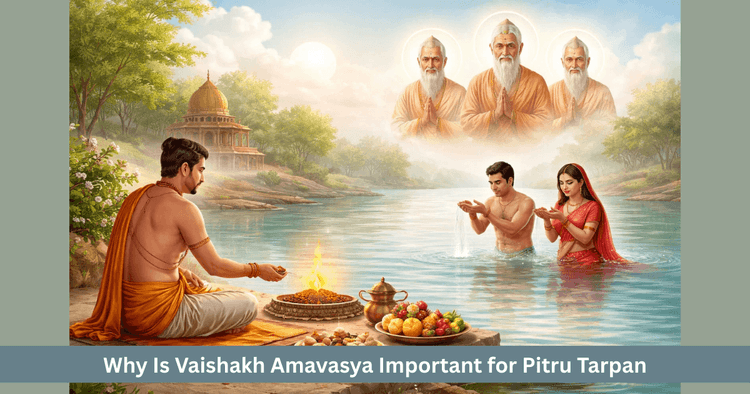
Table of Contents
In the Hindu tradition, Vaishakh Amavasya is regarded as a highly auspicious day for bringing peace to the ancestors, reducing ancestral afflictions and gaining special merit. The month of Vaishakha itself is considered dear to Lord Vishnu, so the new moon of this month carries multiplied spiritual potency. Acts of bathing, charity, tarpan and pind daan performed on this date invite blessings, inner relief and the grace of one’s lineage.
Scriptural teachings describe Vaishakha as a month in which virtuous acts bear results many times greater than usual. In the Skanda Purana, Narada is said to have described the greatness of this month before King Ambarisha, explaining that Vaishakh Amavasya in particular is a most favourable time for pitru shanti, the pacification of ancestors.
Why Is Vaishakh Amavasya Important for Pitru Tarpan
Vaishakh Amavasya is specially dedicated to ancestral rites. Tradition recommends that on this day devotees
- Bathe at sacred riverbanks
- Offer tarpan with sesame seeds, water and kusha grass
- Perform pind daan and shraddha
- And give charity in the name of their forefathers
The key ideas can be seen in this table.
| Aspect | Description |
|---|---|
| Special date | New moon of the month of Vaishakha |
| Primary focus | Peace of ancestors, removal of pitru dosha, gaining ancestral blessings |
| Main observances | Sacred bath, tarpan, pind daan, charity, fasting and listening to the vrata story |
| Presiding deities | Lord Vishnu and the Pitru devatas |
| Fruit of the day | Believed to yield many times the usual merit |
It is believed that one who observes a fast on Vaishakh Amavasya and listens with faith to the Vaishakh Amavasya Vrat Katha can please the ancestors and receive their support in overcoming many forms of suffering.
Link between Vaishakh Amavasya and Pitru Dosha
Vaishakh Amavasya is considered especially effective for addressing pitru dosha, that is, imbalances related to ancestral karma. When a birth chart shows combinations suggesting pitru dosha or when a person repeatedly faces blocks and burdens that seem to arise from neglected family duties, this date is seen as an important opportunity.
On this day, performing shraddha, tarpan and pind daan at a holy river or any sanctified place becomes an inner practice of gratitude and atonement, not just an external ritual. The Vaishakh Amavasya Vrat Katha illustrates this principle through the life of a devout Brahmin named Dharm Varn.
Background of the Brahmin Dharm Varn
Long ago there lived a deeply religious and devout Brahmin called Dharm Varn. His name truly reflected his nature. He
- Repeated the Divine Name
- Observed fasts
- Welcomed and served sages and seers
- And delighted in receiving spiritual knowledge from them
His greatest joy lay in devotional practices, satsanga and remembrance of the Lord. One day, in the midst of this life of worship, a saintly soul shared with him a teaching that changed the direction of his life.
Greatness of Vishnu Nama Japa in Kali Yuga
This pious person explained to Dharm Varn that in Kali Yuga, no pious act equals the repetition of the holy names of Lord Vishnu. In other ages, the fruits achieved through great yajnas, homas and strict rituals can, in this age, be attained simply by sincere Hari Nama smaran, the remembrance of the Divine Name.
This teaching entered Dharm Varn’s heart very deeply. He felt that if the Lord’s name carries such power, then life’s central focus should be that remembrance. He resolved to make this insight the guiding rule of his existence.
From that time onwards he engaged day and night in Hari Nama japa. Gradually, worldly bonds and household duties began to feel like unnecessary ties and he leaned strongly toward renunciation. Eventually he left worldly life and set out on the path of a wandering ascetic.
What Dharm Varn Saw in Pitru Loka
Immersed in Hari Nama, Dharm Varn’s awareness rose to subtler realms. At one point he reached Pitru Loka, the realm of ancestors. What he saw there deeply disturbed him.
He found his own ancestors in states of suffering and discomfort. They did not appear satisfied or peaceful. For a sensitive and religious person this was a painful sight.
Dharm Varn respectfully approached them and asked why they were undergoing such hardship. He wanted to understand how this condition had arisen, especially when he himself was absorbed in devotion and spiritual pursuit.
The Ancestors’ Answer and the Need for Pind Daan
The ancestors told Dharm Varn that their suffering was linked to his actions. Hearing this filled him with remorse and he asked them to explain more clearly.
They explained that because Dharm Varn had become a renunciate, there was now no one left in the family to perform pind daan and shraddha for them. For the souls in Pitru Loka, regular shraddha and offerings made from the earthly plane are a significant source of contentment and upliftment.
When a descendant living as a householder fulfils these duties, the ancestors receive peace. With Dharm Varn’s departure into sanyasa, this channel of offering had been cut off and so his forefathers were experiencing dissatisfaction and pain.
The Ancestors’ Condition and the Remedy of Vaishakh Amavasya
The ancestors made their condition clear. They told Dharm Varn that their suffering would end only if he returned to householder life. He was to marry again, raise a family and, on the Vaishakh Amavasya tithi, perform proper pind daan and tarpan for them.
They asked him to take a firm vow that he would undertake these responsibilities. Dharm Varn promised that he would do whatever was required to free them from their misery, even if that meant giving up his ascetic state and re entering family life.
In this way the story shows that genuine spirituality includes not only personal liberation but also responsibility toward one’s lineage and ancestors.
Dharm Varn Returns from Renunciation to Householder Life
Seeing the suffering of his ancestors softened Dharm Varn’s heart. He decided to leave the life of a wandering monk and take up grihastha ashrama once more. This was not an easy decision, because he had already turned away from worldly ties.
Yet he realised that true dharma does not allow a person to run away from rightful duties. He returned to the earthly realm, resumed social and family life and arranged marriage and household responsibilities according to tradition.
Gradually his family reached a stage where he could properly perform ancestral rites. He organised his life so that devotion and duty remained in balance.
Pind Daan on Vaishakh Amavasya and the Ancestors’ Liberation
When the appropriate time arrived, Dharm Varn deliberately chose the new moon of Vaishakh as the day for his offerings. The scriptures esteem this date as particularly powerful for ancestral peace.
On that day he
- Bathed in a sacred place
- Took a vow of fasting
- Performed pind daan and tarpan with mantras
- And gave charity in the name of his forefathers
Because these acts were done with proper procedure and heartfelt devotion, the effect in Pitru Loka was profound. His ancestors were released from their distress and attained the peace and satisfaction they had long awaited.
Thus Dharm Varn not only fulfilled his responsibilities but also showed that a complete spiritual life honours both devotion to God and duties toward the family line.
Inner Lessons of Vaishakh Amavasya Vrat for the Seeker
This vrat katha offers important guidance for spiritual seekers.
- Personal practice alone is not enough, duties toward ancestors and family must also be recognised
- Renunciation should not become an excuse for avoiding responsibility
- Ancestral rites such as shraddha and pind daan are expressions of gratitude and instruments of balance
- Observances on Vaishakh Amavasya may help to soften the effects of pitru dosha
For those who repeatedly encounter obstacles, unexplained burdens or feelings of ancestral heaviness, this story suggests that sincere worship and offerings on Vaishakh Amavasya can open a path toward healing and harmony.
Common Questions
Why is Vaishakh Amavasya regarded as especially important?
It is viewed as a highly favourable day for ancestral peace, removal of pitru dosha and receiving the grace of Lord Vishnu. Bathing, charity, pind daan and tarpan on this date are believed to bring multiplied spiritual merit.
Which key practices are recommended on Vaishakh Amavasya?
Sacred bathing, offering tarpan with sesame and water, performing pind daan, giving charity to worthy recipients, observing a fast and listening to or reciting the Vaishakh Amavasya Vrat Katha are the main observances. Sincerity and purity of intent are essential.
Why were the ancestors of Dharm Varn in distress?
After Dharm Varn took sanyasa, no one remained in the family to perform regular pind daan and shraddha for them. Because of this break in offerings they experienced dissatisfaction and pain in Pitru Loka.
How did Dharm Varn finally free his ancestors from suffering?
He accepted the request of his forefathers, returned to householder life, raised a family and then, on Vaishakh Amavasya, carried out proper pind daan, tarpan and charity. Through these rites they attained peace and release from their suffering.
What guidance does this story offer to those troubled by pitru dosha?
The story suggests that for relief from pitru dosha one should sincerely perform ancestral worship, shraddha, tarpan and pind daan on special days such as Vaishakh Amavasya, while also cultivating gratitude and a responsible attitude toward one’s lineage.
Get your accurate Kundali
Generate KundaliDid you like it?
Author

Pt. Abhishek Sharma (63)
Experience: 20
Consults About: Family Planning, Career
Clients In: Punjab, Haryana, Delhi
Share this article with friends and family
About ZODIAQ
ZODIAQ is an online Vedic Astrology platform. It connects clients seeking astrological advice to experienced astrologers with deep knowledge. Our users also generate kundali and perform kundali milan for free. ZODIAQ also offers services to the Astrologers. Astrologers utilize various offerings by ZODIAQ to serve their clients effectively.
If you are a User
Consult with experienced astrologers and seek their guidance. You can also order handwritten Janm Patrika report with life prediction prepared by experienced astrologers. Generate accurate Kundali, perform Kundali Matching and check horoscope and muhurat. Utilize our online library for all the necessary astrological and spiritual information.
If you are an Astrologer
Create accurate kundali for your clients and perform Kundali Matching for up to 5 people at a time. Write comprehensive Janm Patrika report for your clients with ZODIAQ. Check client details anytime by saving it in client directory. Become more productive by tracking how many clients you guide every day.
WELCOME TO
ZODIAQ
Right Decisions at the right time with ZODIAQ
