Vikata Sankashti and the Story of the Ten-Handed Lion-Riding Ganapati
By Pt. Amitabh Sharma
Significance of Vikata Sankashti in Ganapati Worship and Obstacle Removal
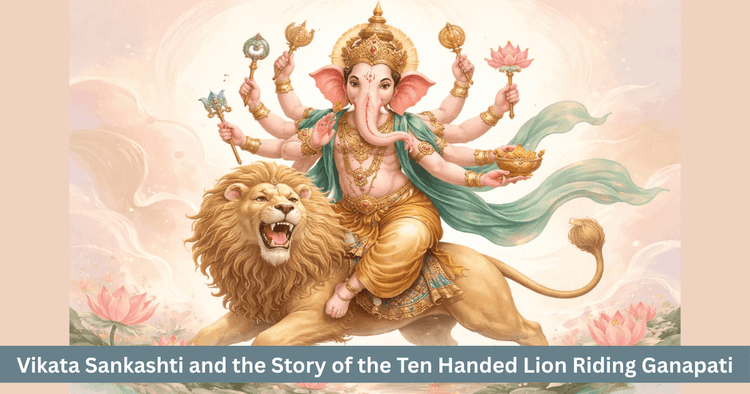
Table of Contents
Within the tradition of Ganesha worship, Sankashti Chaturthi is regarded as a powerful day for removing obstacles and fulfilling sincere wishes. Among the various Sankashti observances, Vikata Sankashti holds a distinct place. On this day devotees worship Ganesha in the Vikata Maha Ganapati form, seeking strength, clarity and inner steadiness in the face of difficulties.
Vikata Sankashti Chaturthi falls in the Krishna Paksha of the month of Vaishakha. On this day, devotees keep a fast, listen to the special vrata katha and worship Ganesha in his Vikata form. The belief is that with focused devotion, many forms of crisis, especially those related to intellect, communication and hesitation, begin to loosen their grip.
When and Why Is Vikata Sankashti Observed
According to the Hindu lunar calendar, Vikata Sankashti is observed on the fourth tithi of the waning moon in Vaishakha, the Krishna Chaturthi. It is a specific Sankashti day dedicated to the Vikata form of Ganesha. The word Vikata carries the sense of cutting through difficulty and dispersing heavy obstacles.
On this day, devotees undertake a vrata, abstain from regular food, worship Ganesha and break the fast only after sighting the moon and offering arghya. Many see this date as particularly supportive for easing mental confusion, financial challenges and planetary imbalances, especially those connected with Mercury.
The main features of this observance can be summarised in the table below.
| Aspect | Description |
|---|---|
| Name of observance | Vikata Sankashti Chaturthi |
| Month and fortnight | Vaishakha, Krishna Paksha |
| Tithi | Chaturthi of the waning moon |
| Presiding form | Vikata Maha Ganapati, ten armed lion riding Ganesha |
| Principal fruits | Relief from obstacles, easing of Mercury related issues, mental clarity, spiritual support |
What Is the Form of Vikata Ganapati
Vikata Ganapati is counted among the thirty two classical forms of Ganesha and is considered somewhat fierce in expression. In this form he is described as having ten hands and riding a lion.
The ten arms symbolise the capacity to protect and guide devotees in many areas of life simultaneously. The lion as a vehicle stands for courage, royal authority brought under control and victory over arrogance. Worship of this form is undertaken with the faith that hidden negative influences and inner fears gradually lose their force.
Devotees associate the Vikata form with
- Removal of subtle negative energies and unseen obstacles
- Growth of courage, confidence and decisiveness
- Support for clear thinking and harmonious communication
Scriptural Background of Vikata Sankashti
Among the stories linked with Sankashti observances, the episode of Chandra and Ganesha is especially well known. One narrative tells that Chandra, the moon god, once mocked the outer appearance of Ganesha in his role as remover of obstacles. Offended by this disrespect, Ganesha cursed him so that those who saw the moon on a certain day and then spoke carelessly or lied would encounter misfortune.
Even when Chandra sought forgiveness, the curse was not completely withdrawn, only softened. Days such as Vikata Sankashti are remembered as points when the effect of that curse is reduced and cosmic balance is symbolically restored.
Another stream of tradition recalls how Shiva formally declared Ganesha to be the foremost among the gods to be worshipped. From that time onward it became customary to offer worship to Ganesha before beginning any other deity’s puja or any major undertaking. In this regard, Vikata Sankashti is not only a fasting day but also a remembrance of Ganesha’s honoured status as the remover of obstacles.
Astrological and Spiritual Importance of Vikata Sankashti
From an astrological viewpoint, Vikata Sankashti is considered especially helpful for managing challenges linked with Mercury (Budha), the planet associated with intellect, speech, writing, analysis and trade. Those who experience confusion in decision making, communication blocks, lack of focus in study or erratic thinking in business often turn to this vrata for support.
It is traditionally believed that
- Students, researchers and writers may pray for improved memory, clarity and articulation by observing this fast
- Professionals facing obstacles in presentations, negotiations or written communication may find gradual relief
- Seekers desiring inner calm and better energy balance can use the vrata as a framework for self discipline
Because this tithi falls during the waning phase of the moon, it also carries a sense of contraction of ego and of quiet self observation. Spiritual practice on this day is thought to help gently melt stress, disorder and negativity held within the mind.
Core Thread of the Vikata Sankashti Vrata Katha
One significant vrata story is set in Kailasa, involving Lord Shiva and Goddess Parvati. Once they sat together to play a game of dice, known as chauras. To ensure fairness, Shiva created a boy and appointed him as the referee, asking him to declare the correct winner each time.
The game began. Three times in succession Parvati actually won, yet the boy declared Shiva as the victor each time. Feeling hurt and seeing this as partiality, Parvati became angry and cursed the boy to live in a swamp, enduring a life of suffering.
The boy cried out in pain and begged for forgiveness. Parvati’s heart softened. She instructed him to wait for the arrival of Naga maidens and to learn from them the procedure of the Vikata Sankashti vrata. She told him that by observing the vrata properly for twenty one days, he would be able to free himself from the curse.
The boy followed her instruction, kept the Vikata Sankashti fast with full sincerity and performed the prescribed worship. In time, the weight of the curse lifted and he emerged from the swamp into a peaceful and stable state. The story indicates that
- Even suffering created by poor judgement or bias can be eased through sincere practice and atonement
- Vikata Sankashti offers a framework for patience, trust and gradual transformation in difficult circumstances
Ganesha’s Birth Story and Its Link with Vikata Sankashti
Another popular narrative often recited with Sankashti vratas is the birth story of Ganesha. It is sometimes included with Vikata Sankashti observances as a second vrata katha.
Goddess Parvati created a boy from the turmeric paste used on her body and named him Vinayaka. She asked him to guard the entrance to her bathing chamber and not to let anyone enter while she was there.
During this time Lord Shiva came and attempted to go inside. Vinayaka, obeying his mother’s command, blocked his way. The situation escalated. In a moment of intense anger, Shiva severed Vinayaka’s head. When Parvati learned of this, she was overcome with grief and fury and threatened to destroy the world.
To restore balance, Shiva sent his attendants into the forest with the instruction to bring the head of the first living being they encountered. They found a young elephant. Its head was brought back and placed on Vinayaka’s body. With this, the boy received a new life and form as Lord Ganesha.
In some accounts it is said that Shiva himself observed a Ganesha related fast to calm Parvati and to honour the new form of their son. The spirit of such observances extends into vrata traditions like Vikata Sankashti, which are also linked with family harmony and the happiness of mothers and children.
Benefits Attributed to Vikata Sankashti Vrat
Traditional teachings describe Vikata Sankashti Vrat as bringing a range of benefits when observed with sincerity. Among them are
- Gradual weakening of negative influences and unseen obstacles in life
- Opportunity for the cleansing of karmic debts from past and present actions
- Blessings related to motherhood, fertility and protection of children for women
- Support for wisdom, intelligence and steady concentration for students and professionals
- Improvement in marital harmony, trust and mutual respect between spouses
- Strengthening of will power and practical insight to address financial and worldly challenges
The overarching belief is that Ganesha, as Vighnaharta, gently clears the path of those who align their efforts with faith and correct intention.
How to Perform Vikata Sankashti Vrat Puja
The worship procedure for Vikata Sankashti combines simplicity with discipline. It may be understood in a sequence of steps.
- Wake before sunrise, clean the house and bathe.
- Wear clean clothes, preferably in white, yellow or red shades.
- Take a vrata resolve to fast for the day. Those unable to keep a full fast may take fruits, milk, coconut water and light sattvic items.
- Clean the puja space and place a low seat or platform, covering it with a red cloth.
- Install an idol or picture of Lord Ganesha, especially if available in a form suitable for Sankashti worship.
- Perform Panchamrit abhisheka, bathing the idol with milk, curd, ghee, sugar and honey, then rinse with clean water.
- Offer fresh clothes or a cloth, sandal paste, kumkum, akshata, durva grass, flowers and fragrance.
- Present til, jaggery, bananas, modaks and boondi laddus as naivedya, along with a ghee lamp and incense.
- Sing or recite the Ganesh arati with focused devotion.
- Read or listen to the Vikata Sankashti Vrata Katha, including the story of the cursed boy and, if desired, the birth story of Ganesha.
- Chant Ganesha mantras such as
- “Om Gam Ganapataye Namo Namah” 108 times
- “Om Vakratundaya Namah” 11 times
- Recite the hymn beginning “Vakratunda Mahakaya Surya Koti Sama Prabha” and the Ganapati Atharvashirsha if familiar.
- Maintain celibacy and restraint in speech and conduct through the day as far as possible.
- In the evening, at moonrise, offer arghya to Chandra Deva with water, remembering Ganesha and praying for removal of obstacles.
- Break the fast after this, share prasadam and offer food or donations to the needy, to cows and, where appropriate, to learned persons.
Avoiding anger, harsh speech, deceit and indulgence is considered part of the vrata discipline.
Special Ganapati Mantra Practice on Vikata Sankashti
For those inclined toward mantra practice, Vikata Sankashti is a valuable occasion. Commonly used mantras include
- “Om Gam Ganapataye Namo Namah” for general obstacle removal and guidance
- “Om Vakratundaya Namah” to invoke the form that straightens crooked paths
- “Om Shreem Hreem Kleem Gloum Gam Ganapataye Vara Varada Sarva Janam Me Vashamanaya Svaha” for strengthening health and balanced influence
The inner aim is not to control others but to bring one’s own mind out of confusion and instability and into a state of balanced clarity.
Guidance Offered by Vikata Sankashti for Daily Life
Vikata Sankashti reminds seekers that many obstacles arise not only from outer events but also from inner patterns of confusion, unexamined bias and lack of discipline. Through worship of Vikata Ganapati, a devotee may resolve to
- Pause and reflect carefully before making decisions
- Speak with greater clarity, honesty and humility
- Recognise old habits and gently work to refine them
In this way, the vrata becomes more than a single day of fasting. It grows into a step toward ongoing self discipline, mental clarity and spiritual growth, held under the protective grace of Ganesha.
Common Questions
On which month and tithi does Vikata Sankashti fall?
Vikata Sankashti occurs on the Krishna Paksha Chaturthi of Vaishakha month. It is a specific Sankashti dedicated to the Vikata Maha Ganapati form of Lord Ganesha.
How is the Vikata form of Ganesha different from other forms?
In the Vikata form, Ganesha is described with ten arms and riding a lion. This expression emphasises courage, fierce protection and destruction of deep seated negativities, whereas other forms may have different mounts and arm counts.
Is Vikata Sankashti especially related to Mercury related difficulties?
Tradition associates this day with relief from issues linked to Mercury, such as confusion, communication blocks and study problems. The deeper intent remains overall purification of intellect and removal of obstacles through Ganesha’s grace.
Can women also observe Vikata Sankashti Vrat?
Yes. The vrata is suitable for both men and women. It is often recommended for women seeking blessings for motherhood, protection of children and harmony in marriage.
What should be avoided while observing this vrata?
One should avoid grains, heavy or tamasic food, intoxicants and unnecessary talking. Anger, harsh words, falsehood and any kind of deceit are to be left aside. A simple sattvic diet with fruits, milk and similar items supports the spirit of the vrata.
Get your accurate Kundali
Generate KundaliDid you like it?
Author
Pt. Amitabh Sharma (56 Years)
Experience: 20
Consults About: Family Planning, Career
Clients In: Punjab, Haryana, Delhi
Share this article with friends and family
About ZODIAQ
ZODIAQ is an online Vedic Astrology platform. It connects clients seeking astrological advice to experienced astrologers with deep knowledge. Our users also generate kundali and perform kundali milan for free. ZODIAQ also offers services to the Astrologers. Astrologers utilize various offerings by ZODIAQ to serve their clients effectively.
If you are a User
Consult with experienced astrologers and seek their guidance. You can also order handwritten Janm Patrika report with life prediction prepared by experienced astrologers. Generate accurate Kundali, perform Kundali Matching and check horoscope and muhurat. Utilize our online library for all the necessary astrological and spiritual information.
If you are an Astrologer
Create accurate kundali for your clients and perform Kundali Matching for up to 5 people at a time. Write comprehensive Janm Patrika report for your clients with ZODIAQ. Check client details anytime by saving it in client directory. Become more productive by tracking how many clients you guide every day.
WELCOME TO
ZODIAQ
Right Decisions at the right time with ZODIAQ
