Vishu and the Auspicious New Year of Kerala
By Pt. Suvrat Sharma
Vishu Marks the Zodiacal New Year with Sun’s Entry into Mesha and Auspicious Beginnings
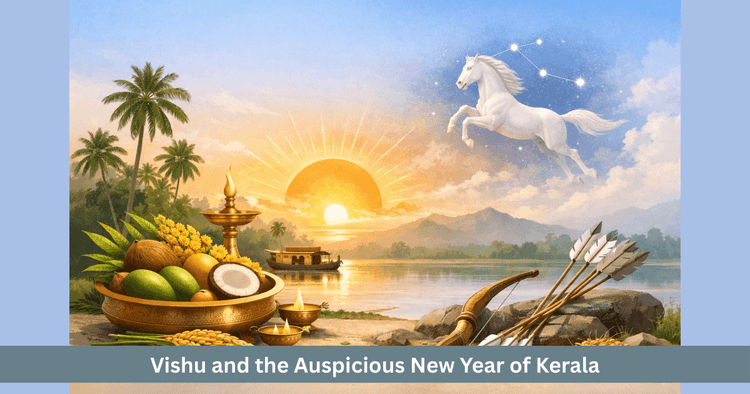
Table of Contents
In Indian tradition every important beginning is treated with great care. The belief is that if the first step is right, the rest of the journey becomes more balanced and successful. With this understanding, when the Sun enters Sidereal Mesha rashi, in the region of Ashwini nakshatra, the people of Kerala celebrate the start of the zodiacal New Year as Vishu. This day is regarded as the opening of a new cycle and as a foundation for the months to come.
On Vishu it is believed that what one sees on opening the eyes at dawn indicates the tone of the year ahead. Because of this, early morning on Vishu is treated as a sacred and reflective time. Through this day people frame an inner resolve for prosperity, clarity and auspiciousness throughout the year.
Astrological Basis of Vishu and the New Year
In Kerala, Vishu is observed as the zodiac based New Year, linked specifically to the Sun’s entry into sidereal Aries, that is, the Ashwini nakshatra zone. It is different from the solar New Year, which is defined by the Sun crossing the equator and moving northward.
The following table helps clarify this distinction.
| Aspect | Description |
|---|---|
| Type of New Year | Zodiac based astrological New Year |
| Solar transit | Sun enters Sidereal Mesha rashi in Ashwini nakshatra |
| Status in Kerala | Marked as the beginning of the year through Vishu |
| Related festivals | Similar spirit seen in Ugadi, Gudi Padwa, Bihu and Baisakhi in other regions |
| Common confusion | Often mistaken for the moving solar New Year, while the zodiacal New Year remains fixed |
In ancient times the solar and zodiacal New Year occurred around the same period. Gradually, due to astronomical shifts, the solar New Year has moved, while the zodiacal New Year has remained constant, which explains the difference seen today.
How Is Vishu Related to Other New Year Festivals
Not only Kerala but many parts of India celebrate New Year festivals in this same seasonal window. Names differ while the underlying mood remains similar. The focus everywhere is on beginning the year with light, gratitude and righteous intent.
Some well known observances connected to this period are
- Ugadi in Andhra Pradesh and Karnataka
- Gudi Padwa in Maharashtra
- Bihu in Assam
- Baisakhi in Punjab
Each festival honours the start of a new cycle, the harvest, fresh resolutions and thankfulness for divine grace. Vishu is the expression of this same spirit in Kerala.
What Is Vishukkani and Why Is It So Auspicious
The heart of Vishu is the sacred arrangement called Vishukkani. In Malayalam, kani means “that which is seen first”. Thus Vishukkani is “that which is seen first on Vishu”.
The belief is that if the first sight of the year is filled with auspicious symbols and divine presence, the mind will carry that impression throughout the year. This is not only a matter of belief but also a subtle spiritual and psychological practice that shapes inner attitudes and expectations.
Usually the mother or grandmother of the household prepares this arrangement in the puja room on the previous night. After completing it, she rests there, so that she herself may first behold the sacred sight during the Brahma muhurta, roughly between 4 and 6 a.m.
How Is the Vishukkani Arrangement Prepared
Vishukkani is created like a carefully composed sacred tableau, in which every object has symbolic meaning.
The main components include
- An image or deity form of Lord Vishnu
- Flowers, fruits and vegetables
- Akshat, a mixture of rice and turmeric
- A vessel called uruli, often made of panchaloham
- A polished kindi, the spouted water vessel
- The long handled val kannadi, a special mirror
- Two lamps made from halves of a coconut shell
- Gold coins and gold coloured fruits and items
- A spiritual text such as the Bhagavad Gita
All of this is arranged so that in one glance the viewer experiences light, abundance, knowledge, wealth and divine presence.
Symbolism of Akshat, Uruli and Panchaloham
In Vishukkani the vessel known as uruli plays a central role. It is filled with akshat, a mixture of rice and turmeric. The rice is used in two forms, husked and unhusked, suggesting a prayer for protection and fullness at both visible and subtle levels of life.
The uruli is traditionally made of panchaloham, a blend of five metals. This combination symbolises the five great elements of nature, namely earth, water, fire, air and space. In this way the vessel itself becomes a small representation of the universe.
Into this uruli the kindi is placed. A neatly folded starched cloth is inserted fan like into the kindi and within this cloth the val kannadi, the special mirror, is set. This combination creates a powerful symbolic link between the Divine, the seeker and the universe.
Vishu Lamps and the Message of Light
Two special lamps are also placed in the uruli. They are made from halves of a coconut shell, filled with oil and lit with cloth wicks. The cloth is folded in such a way that the lower part remains anchored in the oil while the upper part stands upright to burn steadily.
Lighting these lamps is much more than decoration. It is a clear reminder that the darkness of ignorance can only be removed by the light of knowledge.
When the lamps are lit, it is understood that the Divine is being welcomed into the home. At the same time, there is a quiet inner promise to keep the mind bright and aware, so that choices during the coming year remain balanced and dharmic.
Gold, Kanikkonna and the Sign of Prosperity
The colour gold is prominent in Vishukkani. Gold coins, brass vessels, turmeric coloured akshat and golden fruits and vegetables all stand for prosperity and radiance.
Especially important is the flower called Kanikkonna, a golden yellow blossom associated with Sri Krishna. It blooms when the Sun is astrologically in a position of exalted strength around this season. Because of this, the flower symbolises the Sun, brilliance and Lord Vishnu as Kala Purusha, the Lord of Time.
Bananas, jackfruit and golden cucumber are also commonly included. Together they express a prayer that the coming year will be rich in food, resources, feelings and wisdom.
Spiritual Texts, Mirror and Inner Reflection
A sacred book, often the Bhagavad Gita, forms an essential part of Vishukkani. It stands both as pramanam, the valid means of knowledge and as a symbol of the timeless wisdom of the Rishis. This indicates that outward prosperity must be supported by inner understanding and spiritual study.
The val kannadi or special mirror, carries a double meaning. It reflects and multiplies the brightness of the entire arrangement. At the same time it shows the viewer’s own face, gently teaching that God is not distant or separate but is the very consciousness within.
The mirror also suggests that as the mind becomes clearer and purer, it can reflect this inner truth more accurately. Thus on Vishu there is special value in resolving to keep the mind free from jealousy, resentment and negativity.
The Morning Practice of Vishu and Brahma Muhurta
The woman who prepares the Vishukkani spends the night in the puja room. Waking in the Brahma muhurta, she first lights the lamps, then sits quietly and takes in the sacred sight. This is her first darshan and meditation of the day.
After this she goes to each family member, wakes them and gently leads them to the shrine, often covering their eyes with her hands or a cloth. At the right moment she removes the covering so that their first sight of the year is the Vishukkani.
For children especially, this practice plants a deep memory that their year began with the vision of God, light and plenty. This memory can silently guide their attitudes for a long time.
Why Vishukkani Is Shared Beyond the Puja Room
Vishukkani is not restricted to those who can walk to the shrine. It is carried to the elderly or sick family members who are unable to move easily. It is also taken to the cowshed so that the cows, central to traditional household life, may also share in the auspiciousness.
In this way, when the arrangement is taken outdoors, birds, trees and the environment too become silent participants. The message is that the blessings of the New Year are meant not only for human beings but for all of nature.
Vishukkaineettam and the Spirit of Sharing
Another important aspect of Vishu is Vishukkaineettam, the distribution of gifts or money. Elders give wealth to children and younger members of the family. It is not merely financial support but a living symbol that whatever wealth, knowledge or position one has is meant to be shared.
Many well off families also extend this giving beyond the household, reaching neighbours or those in need. In this way Vishu becomes a festival of goodwill for the wider community, not only a private celebration.
Guidance for the Rest of the Year from Vishu
The vision of Vishukkani should not remain only a pleasant visual memory. It can become a guiding inner resolve for the entire year.
- The fruits and food indicate the importance of maintaining a balanced and sattvic diet
- The lamps and light remind us to keep knowledge and discrimination awake
- The coins suggest that wealth is to be used with responsibility and generosity
- The scriptures and mirror teach that real progress comes through self reflection and study
In this sense, Vishu tells us that a good beginning at New Year is not enough by itself. The joy and clarity of the first sight must be allowed to flow into our thoughts, choices and acts of service throughout the year.
Common Questions
What type of New Year does Vishu represent?
Vishu marks the zodiac based astrological New Year when the Sun enters Sidereal Mesha rashi in Ashwini nakshatra. It is different from the shifting solar New Year, which depends on the equatorial crossing.
Which items are considered essential in the Vishukkani?
The Vishukkani usually includes an image or form of Lord Vishnu, flowers, fruits, golden coloured items, akshat in an uruli, a kindi, val kannadi, lamps, gold coins and a spiritual text like the Bhagavad Gita.
Why are people led to the puja room with their eyes covered on Vishu morning?
Their eyes are covered so that the first sight of the year falls directly on the Vishukkani. This leaves a strong positive impression on the mind and supports an auspicious and spiritually oriented attitude for the year.
Why is the Kanikkonna flower so important in Vishu?
Kanikkonna is a yellow flower that blooms when the Sun is at a powerful astrological position around Vishu. It symbolises the Sun’s energy and Lord Vishnu as Kala Purusha and therefore holds a place of honour in the Vishukkani.
What is the spiritual message of Vishukkaineettam?
Through Vishukkaineettam elders share part of their material and emotional wealth with the next generation and with society. It teaches that prosperity, knowledge and respect are meant to be distributed in a spirit of service rather than held only for oneself.
Get your accurate Kundali
Generate KundaliDid you like it?
Author
Pt. Suvrat Sharma (63)
Experience: 20
Consults About: Family Planning, Career
Clients In: Punjab, Haryana, Delhi
Share this article with friends and family
About ZODIAQ
ZODIAQ is an online Vedic Astrology platform. It connects clients seeking astrological advice to experienced astrologers with deep knowledge. Our users also generate kundali and perform kundali milan for free. ZODIAQ also offers services to the Astrologers. Astrologers utilize various offerings by ZODIAQ to serve their clients effectively.
If you are a User
Consult with experienced astrologers and seek their guidance. You can also order handwritten Janm Patrika report with life prediction prepared by experienced astrologers. Generate accurate Kundali, perform Kundali Matching and check horoscope and muhurat. Utilize our online library for all the necessary astrological and spiritual information.
If you are an Astrologer
Create accurate kundali for your clients and perform Kundali Matching for up to 5 people at a time. Write comprehensive Janm Patrika report for your clients with ZODIAQ. Check client details anytime by saving it in client directory. Become more productive by tracking how many clients you guide every day.
WELCOME TO
ZODIAQ
Right Decisions at the right time with ZODIAQ
