Yamuna Chhath Vrat: Significance and Sin-Removing Story
By Aparna Patni
Worship of Maa Yamuna and Vrat in Kartik for Health, Prosperity, and Sin Removal
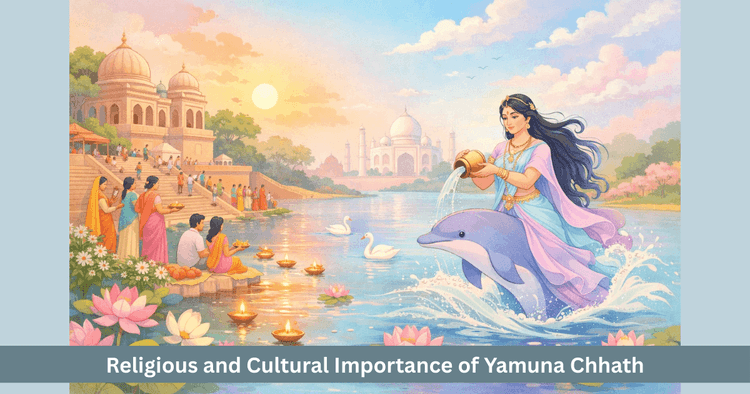
Table of Contents
In Indian tradition rivers are not seen as mere sources of water but as life giving forces and as forms of the Divine Mother. Among these sacred rivers Maa Yamuna holds a very special place. In her honour devotees observe an important festival known as Yamuna Chhath or Yamuna Shashthi. This observance is regarded as a bridge between faith, nature and culture. Through fasting, bathing and worship on this day devotees seek freedom from sin, good health and prosperity by the grace of Yamuna.
Yamuna Chhath is usually observed on the sixth day of the bright fortnight of Kartik or on a particular Shashthi date as recognised in regional traditions. On this day early morning river bath, disciplined conduct through the day and evening worship are considered especially significant. Where the Yamuna flows, the sight of families and communities bathing and praying together on the riverbank is deeply moving. In places far from the river, people worship symbolically while remembering Yamuna in their hearts.
Religious and Cultural Importance of Yamuna Chhath
The speciality of Yamuna Chhath is that it is not restricted to personal worship alone. It also expresses the connection between family, community and the natural world. People of all ages sit together on the riverbank to offer prayers. This strengthens feelings of unity within the family and fosters a sense of collective responsibility within society.
Through Yamuna Chhath, attention is drawn to the purity and value of water. By honouring a life giving river like Yamuna, one is reminded that water is not only useful for physical needs but also plays a role in spiritual cleansing. In this way the festival points towards care for water resources, river cleanliness and environmental harmony.
Sin Removing Story of Yamuna Chhath
The main Yamuna Chhath story is related to Yamaraj, the lord of death and his sister Yamuna. It is described that once Yamaraj came to visit his sister. This was a meeting filled with the affection of brother and sister. Yamuna welcomed her brother with deep love.
She received Yamaraj in her home, offering him fresh fruits, sweets and various dishes. With full respect and devotion she served his feet and attended to his comfort. Yamaraj was delighted by this heartfelt hospitality and the purity of her feelings. He sensed that the holiness of Yamuna flowed not only in her waters but also in her inner nature.
Smiling, Yamaraj asked Yamuna an important question. He wanted to know what benefit living beings obtain by bathing in her sacred waters. Through this question he sought to highlight the spiritual significance of the river.
Yamuna replied with humility that whoever bathes in her river with faith becomes free from sin and finds a path towards moksha or liberation. Here moksha may be understood not only as freedom after death but also as release from guilt, negative tendencies and the burden of past actions in this very life.
Yamaraj accepted her words and added that he had indeed heard that bathing in Yamuna removes sin. Yet he suggested that in order to make the merit even stronger, a specific vrat should be established. He said that when people on earth observe a particular fast, worship Yamuna and bathe in her waters on a chosen day, the destruction of sin and the upliftment of life would become more powerful.
Yamuna readily agreed to this proposal of her brother. From that agreement a special vow known as Yamuna Chhath vrat came into being. On this day devotees worship Yamuna with devotion, take ritual baths and resolve to move beyond their wrongdoings and inner darkness. In this way the fast is not just about bathing but about a spiritual discipline born from love between brother and sister.
How to Perform the Yamuna Chhath Puja
The Yamuna Chhath puja vidhi is simple yet filled with devotion. Where the Yamuna is accessible, direct bathing and worship on the bank carry deep meaning. In other places the same steps may be followed symbolically.
The main steps can be seen in this table.
| Step | Practice | Inner meaning |
|---|---|---|
| 1 | Morning bath and vow | Physical purification and resolve for freedom from sin |
| 2 | Remembrance of Shri Krishna and Yamuna | Devotion, surrender and gratitude |
| 3 | Evening worship and recitation of Yamuna Ashtaka | Praise, contemplation and inner cleansing |
| 4 | Aarti and offering of fruits | Thankfulness and shared joy |
| 5 | Charity and feeding Brahmins | Merit, service and social balance |
Looking at these steps in a little more detail is helpful.
In the morning, where possible, devotees take a dip in the Yamuna. While bathing they silently resolve to let go of wrong tendencies, negativity and harmful habits and to move towards a clean and honest life. Where the river is not physically present, one may bathe in clean water at home while mentally invoking Yamuna and praying for purification.
After the bath, a vow of fasting and restraint is taken according to capacity. In many households people remain on light fruits or water until afternoon. Through the day they remember Shri Krishna and Maa Yamuna by singing hymns, repeating the divine name or reading simple prayers.
In the evening, at home or at a clean spot, a small altar is prepared with an image of Yamuna, a symbol of the river or a kalash filled with water. Incense, lamp, flowers and simple offerings are presented in worship. At this time devotees often recite the Yamuna Ashtaka, a hymn describing the virtues, grace and sanctifying power of Maa Yamuna.
At the end of the ritual an aarti is performed and fruits are offered as bhog. These are then shared as prasad among family members and others present. Finally, according to means, some form of charity is given and where possible Brahmins or needy people are served food.
Message of Purity in Daily Life from Yamuna Chhath
Yamuna Chhath is not limited to the idea of washing off sins. It invites a person to embrace purity and balance in everyday living. When one touches the sacred waters of the river, it is a reminder that true change comes when the mind and heart are also cleansed of anger, greed and harshness.
For the practitioner who uses this day to honestly observe personal behaviour and to let go of anger, greed, jealousy and hurtful speech, Yamuna Chhath becomes an important step in self improvement. In this way the festival inspires both the cleansing of the river’s flow and the purification of the inner current of life.
Common Questions
On which date is Yamuna Chhath celebrated and does the date remain same in all regions?
Yamuna Chhath is generally observed on Kartik Shukla Shashthi or on a particular Shashthi as per local tradition. In some regions it is connected with the dates of the Chhath festival. The exact date is determined according to regional custom and the Hindu calendar, so it is usually fixed in consultation with local priests or panchang.
What lesson does the dialogue between Yamaraj and Yamuna give to a seeker?
Their conversation shows that the results of actions and the possibility of purification are both real. Bathing and fasting are outer acts whose true purpose is to support an inner change. When even the lord of death acknowledges Yamuna’s waters as liberating, it signals to the seeker that sincere effort to transform oneself while alive is essential.
Is it necessary to bathe only in Yamuna on this day to gain benefit?
Where the physical Yamuna is available, it is ideal to bathe and worship on her banks. however those who cannot reach the river due to distance or circumstances may still benefit by bathing in clean water, remembering Yamuna with faith and reciting Yamuna Ashtaka or another hymn. In such cases devotion and sincerity carry greater weight than geographical proximity.
Is fasting compulsory on Yamuna Chhath or is worship alone sufficient?
Fasting is an important aspect of this observance as it trains the senses and mind. Yet situations differ from person to person. Those who can keep a full fast may remain on fruits or light food for the day. Those unable to fast strictly can still observe a simple sattvic diet, avoid tamasic items and focus on bathing, worship and prayer to gain spiritual benefit.
How is Yamuna Chhath connected with environment and water conservation?
When people worship a river, they implicitly accept responsibility for its wellbeing. Festivals like Yamuna Chhath remind us that the water we call holy and life giving must be kept clean and protected. If this reverence translates into efforts for river cleanliness, saving water and reducing pollution, the social fruits of the vrat become truly meaningful.
Get your accurate Kundali
Generate KundaliDid you like it?
Author
Aparna Patni (63)
Experience: 20
Consults About: Family Planning, Career
Clients In: Punjab, Haryana, Delhi
Share this article with friends and family
About ZODIAQ
ZODIAQ is an online Vedic Astrology platform. It connects clients seeking astrological advice to experienced astrologers with deep knowledge. Our users also generate kundali and perform kundali milan for free. ZODIAQ also offers services to the Astrologers. Astrologers utilize various offerings by ZODIAQ to serve their clients effectively.
If you are a User
Consult with experienced astrologers and seek their guidance. You can also order handwritten Janm Patrika report with life prediction prepared by experienced astrologers. Generate accurate Kundali, perform Kundali Matching and check horoscope and muhurat. Utilize our online library for all the necessary astrological and spiritual information.
If you are an Astrologer
Create accurate kundali for your clients and perform Kundali Matching for up to 5 people at a time. Write comprehensive Janm Patrika report for your clients with ZODIAQ. Check client details anytime by saving it in client directory. Become more productive by tracking how many clients you guide every day.
WELCOME TO
ZODIAQ
Right Decisions at the right time with ZODIAQ
