Budha Pradosh Vrat January 2027: How to Observe?
By Pt. Nilesh Sharma
Shiva's dance of bliss at dusk, the grace of Mercury and a fast that awakens discernment
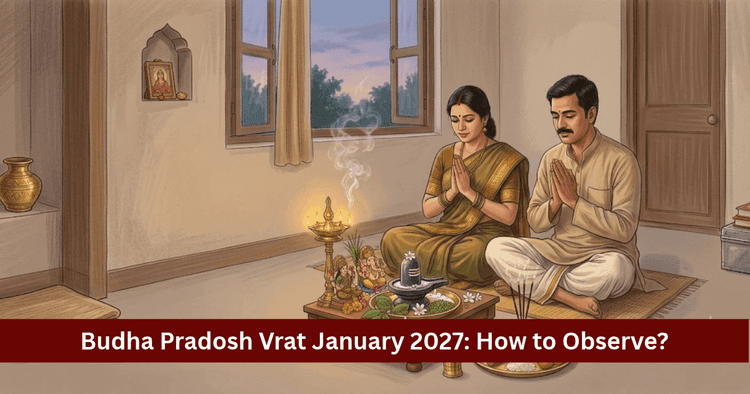
Table of Contents
When Mahadev Dances in the Glow of Dusk
The moment where day meets night, when the sun is setting and a soft redness spreads across the sky, is regarded as deeply sacred in the Sanatan tradition. This twilight period is called Pradosh. It is believed that during the Pradosh period of the Trayodashi tithi, Lord Shiva performs the Ananda Tandava (dance of bliss) on Mount Kailash and all the gods gather there to sing his praises. That is why worship of Shiva at this time is considered especially fruitful.
When the Pradosh Vrat falls on a Wednesday, it is called Budha Pradosh or Saumya Pradosh. In 2027, the Budha Pradosh Vrat will be observed on Wednesday, 20 January, on Paush Shukla Trayodashi. Along with the grace of Lord Shiva, this fast is considered special for the favourable results linked to Mercury, that is, progress in intelligence, speech, education and business.
| Detail | Information |
|---|---|
| Name of the fast | Budha Pradosh Vrat (Saumya Pradosh) |
| Date | 20 January 2027 |
| Day | Wednesday |
| Hindu month | Paush |
| Paksha (fortnight) | Shukla Paksha (waxing fortnight) |
| Tithi (lunar day) | Trayodashi (thirteenth lunar day) |
| Pradosh Puja Muhurat (Delhi) | Approximately 5:50 in the evening to 8:25 at night |
| Sunrise in Delhi | Approximately 7:15 in the morning |
| Sunset in Delhi | Approximately 5:50 in the evening |
| Rahu Kaal (Delhi) | Approximately 12:30 to 1:50 in the afternoon |
| Position of the Sun | Capricorn (Makar) |
| Deities worshipped | Lord Shiva and Mata Parvati |
The main worship of the Pradosh Vrat is performed only during the Pradosh period around sunset. The exact Pradosh time changes from city to city with sunset, so check your local Panchang. Dwadashi tithi will continue for some time in the morning of this day, so Vaishnava devotees breaking their Ekadashi fast should do so before Dwadashi ends.
Main Rituals at a Glance
- Morning bath and taking the vow before Lord Shiva
- Fasting or taking only fruits through the day
- A second bath and clean clothes before sunset
- Abhishek (ritual bathing) of the Shivalinga with panchamrit during the Pradosh period
- Offering bel leaves, dhatura, white flowers, sandalwood and akshat (unbroken rice)
- Worship of Nandi ji
- Reading the Budha Pradosh story and performing the Shiva aarti
- Donating green items and moong
What Is Pradosh Vrat?
Pradosh Vrat comes twice every month, once on the Trayodashi of the waxing fortnight and once on the Trayodashi of the waning fortnight. So there are about 24 Pradosh fasts in a year. This fast is very dear to Lord Shiva and its glory is described in many texts including the Skanda Purana.
The name of the Pradosh fast changes with the weekday on which it falls and each weekday's Pradosh is believed to bring its own special result.
| Weekday | Name of the Pradosh | Believed result |
|---|---|---|
| Sunday | Ravi Pradosh | Health, long life and fame |
| Monday | Som Pradosh | Fulfilment of wishes and peace of mind |
| Tuesday | Bhaum Pradosh | Freedom from disease and debt |
| Wednesday | Budha or Saumya Pradosh | Intelligence, education and success in work |
| Thursday | Guru Pradosh | Victory over enemies and grace of the ancestors |
| Friday | Shukra Pradosh | Good fortune and marital happiness |
| Saturday | Shani Pradosh | Blessing of children and calming of Saturn |
Budha Pradosh is also called Saumya Pradosh because astrology regards Mercury as a saumya, that is, gentle and benefic planet. The nature of this fast too is considered calm, full of wisdom and helpful in making tasks easier.
Why Is the Pradosh Period So Sacred?
Several Puranic episodes are linked with the sanctity of the Pradosh period. The most famous is the churning of the ocean. When the terrible Halahala poison emerged from the churning, its flames began to burn the three worlds. Then, at the prayer of all the gods, Lord Shiva drank the poison and held it in his throat, becoming Neelkantha, the blue throated one. By tradition this event is linked with the Pradosh period of Trayodashi, when the gods praised Shiva in gratitude and Shiva, pleased, performed the Ananda Tandava between the horns of Nandi.
The Story of the Moon
A beautiful story of the Moon is also linked with the Pradosh Vrat. Prajapati Daksha married his 27 daughters to the Moon. These 27 daughters are the 27 nakshatras. Of them all, the Moon loved Rohini the most and neglected his other wives. The grieving daughters complained to their father. Daksha counselled the Moon many times but when he did not listen, Daksha cursed him with a wasting disease.
Because of the curse, the Moon's radiance began to fade. He then performed severe penance to Lord Shiva at Prabhas. Pleased, Shiva gave him a way out of the curse, by which the Moon wanes for 15 days and waxes for 15 days. Shiva placed the Moon on his head and became known as Chandrashekhara. It is believed that this grace too was granted during the Pradosh period. That is why the Pradosh Vrat is also regarded as a fast for freedom from illness and for rising out of life's darkness.
The Story of Budha Pradosh Vrat
A folk story is popular in connection with Budha Pradosh. A man had recently married. Some time later his wife went to her parents' home. One day the man went to his in laws' house to bring his wife back. It was a Wednesday. His in laws advised him that taking a wife home on a Wednesday was not considered auspicious and asked him to stay one more day. But the man did not listen and set off with his wife that same day.
On the way the wife became thirsty. The husband went to fetch water. When he returned, he saw his wife laughing and talking with a man who looked exactly like him, down to the same clothes. The two argued and the matter reached the king. Even the wife could not tell which one was her real husband.
Frightened, the man began to remember Lord Shiva. He prayed, "O Bholenath, I made a mistake in not listening to my elders. Protect me. I will keep the Budha Pradosh fast." As soon as his sincere prayer was heard, the other man vanished. The husband and wife returned home safely and began to keep the Budha Pradosh fast regularly.
The Message of the Story
The story shows that decisions taken in pride and haste create confusion. Confusion is a matter of the intellect and the significator of the intellect is Mercury. When the intellect is confused and cannot tell truth from untruth, taking refuge in Shiva restores discernment. The Budha Pradosh fast is a fast for protecting this discernment.
The Puja Vidhi of Budha Pradosh Vrat
- Wake before sunrise, bathe and wear clean clothes. Since it is Wednesday, green clothes are considered auspicious.
- Take the vow of the fast before Lord Shiva, holding water, akshat and flowers.
- Fast through the day. Those who cannot keep a full fast may take fruits and milk.
- About an hour before sunset, bathe again and prepare for the worship.
- Clean the place of worship and sit facing the north east.
- Perform the abhishek of the Shivalinga first with water, then with milk, curd, honey, ghee and Ganga water.
- Offer sandalwood, bhasma (sacred ash), akshat, bel leaves, dhatura, aak flowers and white flowers on the Shivalinga.
- Offer a red chunari and items of adornment to Mata Parvati.
- Worship Nandi ji. By tradition, devotees whisper their wishes into Nandi's ear.
- Chant "Om Namah Shivaya" 108 times.
- Read or listen to the Budha Pradosh story and recite the Shiva Chalisa.
- Perform the Shiva aarti with a ghee lamp.
- After the worship, take prasad and break the fast or break it the next day according to your tradition.
Items for the Worship
| Item | Significance |
|---|---|
| Bel leaves | Most dear to Shiva, the three leaflets symbolise the Trinity |
| Dhatura and aak flowers | Dear to Shiva's form of renunciation |
| Panchamrit | Abhishek with milk, curd, honey, ghee and sugar |
| Bhasma | A symbol of impermanence and renunciation |
| Sandalwood | A symbol of coolness and peace |
| Green moong | To please Mercury |
| Ghee lamp | For the aarti and for light |
Main Mantras for Budha Pradosh
| Mantra | Meaning | Purpose | Count |
|---|---|---|---|
| Om Namah Shivaya | Salutations to Lord Shiva | Grace of Shiva and purification of the mind | 108 times |
| Om Tryambakam Yajamahe Sugandhim Pushtivardhanam, Urvarukamiva Bandhanan Mrityor Mukshiya Mamritat | We worship the three eyed Lord who is fragrant and nourishes all. May he free us from death as a ripe cucumber is freed from its vine and not from immortality | Mahamrityunjaya mantra, freedom from illness and fear | 108 times |
| Om Braam Breem Braum Sah Budhaya Namah | The seed mantra of Mercury, invoking his energy | Intelligence and speech | 108 times |
| Om Gam Ganapataye Namah | Salutations to Lord Ganapati | Grace of Ganesha, the presiding deity of Mercury | 21 times |
The Astrological Significance of Budha Pradosh
In Vedic astrology, Mercury signifies intelligence, logic, speech, education, mathematics, writing, business, communication, the skin and the nervous system. Mercury rules Gemini and Virgo and is exalted in Virgo. When Mercury is weak in the horoscope, afflicted by malefic planets or combust, a person may face difficulty in making decisions, hesitation in speaking, trouble concentrating on studies, losses in business or skin problems.
It is believed that keeping the Pradosh fast on a Wednesday pleases Mercury along with bringing the grace of Lord Shiva. Shiva is regarded as the original source of knowledge. He is the Adi Guru (first teacher) and, as Dakshinamurti, gives knowledge through silence alone. So worship of Shiva on Budha Pradosh is considered especially helpful for problems related to the intellect.
In 2027, Budha Pradosh falls on Paush Shukla Trayodashi. On Shukla Trayodashi the Moon is nearing fullness and shines brightly in the sky during the Pradosh period. A growing Moon in the sky during the worship of Chandrashekhara Shiva makes this fast even more beautiful. The Sun is now in Capricorn and by tradition the holy period of Uttarayan is under way.
Remedies for Problems Linked to Mercury
| Problem | Remedy on Budha Pradosh |
|---|---|
| Difficulty concentrating on studies | Offer milk on the Shivalinga and chant "Om Namah Shivaya" |
| Speech problems or hesitation in speaking | Chant the seed mantra of Mercury 108 times |
| Losses in business | Donate green moong and green clothes |
| Skin troubles | Offer water and bel leaves on the Shivalinga and chant the Mahamrityunjaya mantra |
| Confusion in decisions | Read the Budha Pradosh story and offer durva grass to Ganesha |
| Mahadasha or Antardasha of Mercury | Feed green fodder to a cow |
Benefits of the Budha Pradosh Fast
- Growth in intelligence, memory and concentration
- The belief in success in studies and examinations for students
- Sweetness of speech and skill in communication
- Progress in work related to business and writing
- Freedom from confusion and mental tangles
- Happiness and peace in the family through the grace of Lord Shiva and Mata Parvati
Dos and Donts
| Do | Do not |
|---|---|
| Perform the main worship only during the Pradosh period | Do not begin the worship during Rahu Kaal |
| Wear green clothes and donate green items | Do not offer Tulsi, turmeric or ketaki flowers on the Shivalinga |
| Place bel leaves with the smooth side facing the Shivalinga | Do not offer torn or damaged bel leaves |
| Worship Nandi ji | Do not walk fully around the Shivalinga, only halfway |
| Donate books to students | Avoid lies, harsh words and arguments |
While walking around the Shivalinga, one does not cross the jaladhari, the channel through which the abhishek water flows. That is why the tradition is to walk halfway around the Shivalinga and then turn back.
When the Light of Discernment Awakens by Shiva's Grace
Budha Pradosh Vrat is not just a day of fasting but a chance to purify the intellect and awaken discernment. In the very twilight when Mahadev dances in bliss, the devotee's mind too can grow light and settle at Shiva's feet. On the evening of Wednesday, 20 January 2027, when the waxing Moon shines in the sky, every bel leaf and every chant of "Om Namah Shivaya" can remove the confusion of life and show the right path. Where there is Shiva's grace, the intellect never wanders.
FAQ
When is Budha Pradosh Vrat in January 2027?
The Budha Pradosh Vrat of January 2027 falls on Wednesday, 20 January, on Paush Shukla Trayodashi.
What is the auspicious time for Budha Pradosh worship?
In Delhi the Pradosh worship time will be approximately 5:50 in the evening to 8:25 at night. Check the time for your city in the local Panchang.
What are the benefits of Budha Pradosh Vrat?
Budha Pradosh Vrat is considered auspicious for progress in intelligence, education, speech and business. It brings the grace of both Lord Shiva and Mercury.
What should be offered on the Shivalinga during Pradosh Vrat?
Offer water, panchamrit, bel leaves, dhatura, aak flowers, white flowers, sandalwood and bhasma on the Shivalinga. Do not offer Tulsi or turmeric.
What is the Pradosh period?
The twilight time around sunset is called the Pradosh period. It is believed that at this time Lord Shiva performs the Ananda Tandava on Kailash.
Get your accurate Kundali
Generate KundaliDid you like it?
Author

Pt. Nilesh Sharma (63)
Experience: 20
Consults About: Family Planning, Career
Clients In: Punjab, Haryana, Delhi
Share this article with friends and family
About ZODIAQ
ZODIAQ is an online Vedic Astrology platform. It connects clients seeking astrological advice to experienced astrologers with deep knowledge. Our users also generate kundali and perform kundali milan for free. ZODIAQ also offers services to the Astrologers. Astrologers utilize various offerings by ZODIAQ to serve their clients effectively.
If you are a User
Consult with experienced astrologers and seek their guidance. You can also order handwritten Janm Patrika report with life prediction prepared by experienced astrologers. Generate accurate Kundali, perform Kundali Matching and check horoscope and muhurat. Utilize our online library for all the necessary astrological and spiritual information.
If you are an Astrologer
Create accurate kundali for your clients and perform Kundali Matching for up to 5 people at a time. Write comprehensive Janm Patrika report for your clients with ZODIAQ. Check client details anytime by saving it in client directory. Become more productive by tracking how many clients you guide every day.
WELCOME TO
ZODIAQ
Right Decisions at the right time with ZODIAQ
