Why Does Dharma Savarni Manvadi 2027 Matter?
By Pt. Sanjeev Sharma
Remembering the 11th Manu, tarpan for the ancestors and the deep mystery of Sanatan time
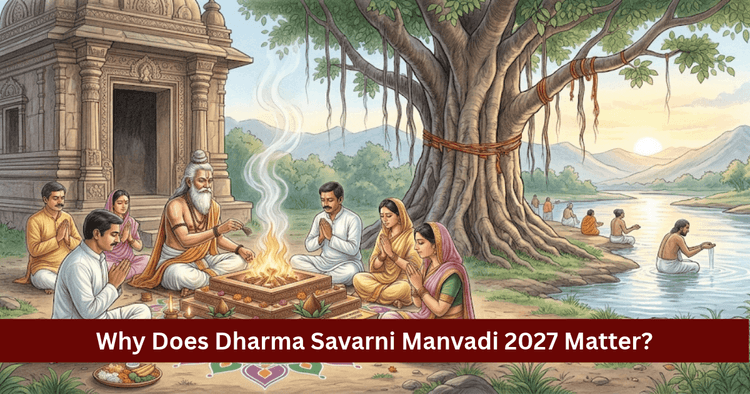
Table of Contents
When a New Chapter in the Vast Wheel of Time Is Remembered
Before every worship, every yajna and every fast, when the priest recites the sankalpa (ritual vow), certain words appear again and again, "Shvetavarahakalpe Vaivasvatamanvantare". Very few people pause to consider what these words mean. They tell us which day of Lord Brahma and which Manu's era we are living in. In the Sanatan tradition, time is seen not as a straight line but as a vast wheel in which yugas, manvantaras and kalpas come again and again. To remember each great turn of this wheel, certain special tithis have been fixed and they are called Manvadi tithis.
Dharma Savarni Manvadi is one such sacred tithi. In 2027 it falls on Monday, 18 January, on Paush Shukla Ekadashi. This day is associated with the beginning of the manvantara of the 11th Manu, Dharma Savarni. The scriptures describe great merit in bathing, charity, chanting and especially tarpan (water offerings) for the ancestors on this day.
| Detail | Information |
|---|---|
| Name of the observance | Dharma Savarni Manvadi |
| Date | 18 January 2027 |
| Day | Monday |
| Hindu month | Paush |
| Paksha (fortnight) | Shukla Paksha (waxing fortnight) |
| Tithi (lunar day) | Ekadashi (eleventh lunar day) |
| Related Manu | The 11th Manu, Dharma Savarni |
| Position of the Sun | Capricorn (Makar) |
| Sunrise in Delhi | Approximately 7:15 in the morning |
| Kutup Muhurat (Delhi) | Approximately 12:10 to 12:50 in the afternoon |
| Aparahna Kaal (Delhi) | Approximately 1:35 to 3:40 in the afternoon |
| Rahu Kaal (Delhi) | Approximately 8:35 to 9:55 in the morning |
| Other observances on the same day | Pausha Putrada Ekadashi, Masik Karthigai |
The scriptures regard the Kutup Muhurat and the Aparahna Kaal (afternoon period) as best for rites for the ancestors. Bathing and charity can be done in the morning, while tarpan and shraddha are best done in the afternoon. Check the local Panchang for exact timings in your city.
Main Rituals at a Glance
- Bathing before sunrise in a holy river or at home in water mixed with Ganga water
- Offering arghya (water offering) to the Sun
- Worship of Lord Vishnu, since Putrada Ekadashi also falls on this day
- Tarpan for the ancestors with sesame and water during the Kutup Muhurat
- Donation of uncooked grain, sesame, clothes and blankets
- A portion of food for the cow, the crow and the dog
- Recitation of the Vishnu Sahasranama or the Pitru Stotra
What Is Manvadi?
The word "Manvadi" is made of two words, Manu and Adi. It means the beginning of a Manu. According to the Puranas, a Manu is appointed in every age to guide creation. He is the first ancestor of human society in that age, the organiser of dharma and the founder of its laws. The reign of one Manu is called a manvantara.
There are 14 Manus in one day of Lord Brahma, that is, 14 manvantaras. To remember the beginning of each manvantara, one fixed tithi of the year is regarded as a Manvadi tithi. So there are 14 Manvadi tithis in a year. Of these, Paush Shukla Ekadashi is regarded as the tithi of the beginning of the manvantara of the 11th Manu, Dharma Savarni.
The scriptures mention 96 occasions for shraddha in a year, called the Shannavati Shraddha. These include 12 Amavasyas, 12 Sankrantis, 4 Yugadi tithis and the 14 Manvadi tithis. This means that every Manvadi tithi is an occasion sanctioned by the scriptures for remembering and satisfying the ancestors.
How Can the Sanatan Reckoning of Time Be Understood?
To understand the importance of Manvadi, it helps to understand a little of the Sanatan reckoning of time. It is so vast that even the modern mind is amazed by its scale.
| Unit of time | Duration |
|---|---|
| Kali Yuga | 432,000 years |
| Dvapara Yuga | 864,000 years |
| Treta Yuga | 1,296,000 years |
| Satya Yuga | 1,728,000 years |
| One Mahayuga (all four yugas) | 4,320,000 years |
| One Manvantara | About 71 Mahayugas, roughly 306.7 million years |
| One Kalpa (one day of Brahma) | 14 Manvantaras, that is, 1000 Mahayugas |
We are now living in the Shveta Varaha Kalpa, in the manvantara of the seventh Manu, Vaivasvata, in the Kali Yuga of the 28th Mahayuga. That is why every sankalpa says "Shvetavarahakalpe Vaivasvatamanvantare Ashtavimshatitame Kaliyuge", meaning "in the Shveta Varaha Kalpa, in the Vaivasvata Manvantara, in the 28th Kali Yuga". This sentence gives our address on the vast map of the universe.
This reckoning teaches a deep humility. A whole human life is less than a moment in this vast wheel of time. Yet the scriptures say that dharma practised in this short life bears fruit for ages to come.
Who Are the 14 Manus?
The Puranas give the names of the 14 Manus. Six have passed, the seventh is the present one and seven are yet to come.
| Order | Name of the Manu | Period |
|---|---|---|
| 1 | Svayambhuva | Past |
| 2 | Svarochisha | Past |
| 3 | Uttama | Past |
| 4 | Tamasa | Past |
| 5 | Raivata | Past |
| 6 | Chakshusha | Past |
| 7 | Vaivasvata | Present |
| 8 | Savarni | Future |
| 9 | Daksha Savarni | Future |
| 10 | Brahma Savarni | Future |
| 11 | Dharma Savarni | Future |
| 12 | Rudra Savarni | Future |
| 13 | Deva Savarni | Future |
| 14 | Indra Savarni | Future |
Some Puranas also give the names of the 13th and 14th Manus as Rauchya and Bhautya. The Manus from the eighth to the twelfth are called "Savarni", a name that points to a tradition connected with Surya Dev and his consort Chhaya. The eighth Manu, Savarni, is regarded as the son of Surya and Chhaya.
What Makes the Dharma Savarni Manvantara Special?
The very name Dharma Savarni reveals the nature of his manvantara. "Dharma" is at the heart of the name. According to the Shrimad Bhagavata Purana, in the 11th manvantara the Indra will be named Vaidhrita and Lord Vishnu will incarnate as Dharmasetu. "Dharmasetu" means the bridge of dharma, the power that carries human beings from the shore of adharma to the shore of dharma. Through this incarnation the three worlds will be protected.
It is a beautiful thought that today we honour the memory of a manvantara that has not yet arrived. Manvadi tithis are not only for remembering the past. They are a chance to bow to the whole wheel of time, past, present and future together. Dharma Savarni Manvadi reminds us that dharma is a continuous stream that flows through every age and gives birth to its protector in every age.
The Worship and Tarpan Vidhi of Dharma Savarni Manvadi
- Wake before sunrise and bathe. If possible, bathe in a holy river. Otherwise, bathe at home in water mixed with Ganga water and a few black sesame seeds.
- Wear clean clothes and offer arghya to the Sun from a copper vessel.
- Worship Lord Vishnu. Since Putrada Ekadashi also falls on this day, offer yellow flowers, Tulsi leaves and panchamrit.
- In the afternoon, around the Kutup Muhurat, sit facing south.
- Take water, black sesame, kusha grass and white flowers in a vessel.
- Taking the names and gotra (lineage) of your ancestors, offer sesame water from cupped hands three times for each.
- During the tarpan, recite the mantra "Om Pitribhyah Svadha Namah".
- Recite the Pitru Stotra or a chapter of the Bhagavad Gita.
- Donate uncooked grain, sesame, jaggery, clothes or a blanket to a Brahmin or someone in need.
- Set aside a portion of food for the cow, the crow and the dog.
Balancing Manvadi With Ekadashi
This year Manvadi and Putrada Ekadashi fall on the same day. Eating grains is forbidden on Ekadashi, so in many families only tarpan with sesame water and the donation of uncooked grain are performed on this day, instead of offering pinda (rice balls) made from grain. Those keeping the Ekadashi fast can earn the merit of the day through tarpan, charity and chanting. For pinda daan or an elaborate shraddha, decide according to your family tradition and the advice of your family priest.
Items for Tarpan and Charity
| Item | Use |
|---|---|
| Black sesame | For tarpan, dear to the ancestors |
| Kusha grass | To hold in the hand during tarpan |
| Ganga water | For purification and tarpan |
| White flowers | For offering to the ancestors |
| Uncooked grain | For charity |
| Blankets and woollen clothes | For charity in the cold season |
| Jaggery and sesame | For charity and prasad |
Main Mantras for Dharma Savarni Manvadi
| Mantra | Meaning | Purpose | Count |
|---|---|---|---|
| Om Pitribhyah Svadha Namah | Salutations to the ancestors, with the offering of svadha | Satisfaction of the ancestors | During tarpan |
| Om Namo Bhagavate Vasudevaya | Salutations to Lord Vasudeva | Grace of Lord Vishnu | 108 times |
| Om Dharmaya Namah | Salutations to Dharma | Devotion to dharma and balance in life | 108 times |
| Om Namah Shivaya | Salutations to Lord Shiva | Grace of Shiva, since it is Monday | 108 times |
The Astrological Significance of Dharma Savarni Manvadi
In Vedic astrology, the ninth house of the horoscope is called the house of dharma. The same house also signifies the father, the guru, the blessings of the ancestors, fortune and pilgrimage. Dharma Savarni Manvadi is linked with both dharma and the ancestors, so this day can be regarded as especially suited to strengthening the ninth house. For those whose ninth house is afflicted, whose fortune does not support them or whose horoscope shows Pitru Dosha, tarpan and charity on this day are considered very fruitful.
The Sun is now in Capricorn, the sign of Saturn. In astrology the Sun signifies the father and the ancestors, while Saturn signifies karma and its fruits. The Sun in Saturn's sign symbolises the link between the karma of the ancestors and the lives of their descendants. Charity and tarpan offered for the ancestors at this time are believed to lighten that karmic bond.
In 2027 the day is a Monday and the Moon is in Krittika nakshatra near its exaltation in Taurus. Tradition places Pitru Loka (the realm of the ancestors) in the upper region of the Moon and the Moon is also described as the medium that carries offerings to the ancestors. In this light, tarpan offered on a day of a strong Moon can be regarded as especially auspicious. The Ekadashi tithi is also dedicated to Lord Vishnu, who himself incarnates in every manvantara to protect dharma.
Remedies for Pitru Dosha and the Ninth House
| Condition in the horoscope | Remedy on Manvadi |
|---|---|
| Pitru Dosha | Offer sesame water tarpan and donate food in the name of the ancestors |
| Afflicted ninth house | Honour a guru or an elderly Brahmin and offer clothes |
| Weak Sun | Offer arghya to the Sun from a copper vessel in the morning |
| Troubles from Saturn | Donate black sesame and blankets |
| Weak Moon | Offer milk and water on the Shivalinga |
| Obstructed fortune | Recite the Vishnu Sahasranama |
Benefits of Dharma Savarni Manvadi
- Satisfaction and blessings of the ancestors
- Relief from obstacles linked to Pitru Dosha
- Strength to the ninth house and to fortune
- Happiness, peace and progress of the lineage in the family
- Special grace of Lord Vishnu, since the day coincides with Ekadashi
- Devotion to dharma and discipline in life
The Message of Manvadi in Today's Life
In modern life, time is divided into hours, days and months. Everyone stays caught up in plans for next week, next month or next year. In this setting, the Manvadi tithi offers a completely different view. It shows that time stretches across hundreds of millions of years and that every person is a small part of this vast stream.
This view frees the mind in two ways. First, it reduces ego, because in such vast time the achievement of any one person is very small. Second, it awakens a sense of responsibility, because passing on to the next generation what one receives from one's ancestors is one's dharma. Tarpan for the ancestors is gratitude towards the past and following dharma is responsibility towards the future. Dharma Savarni Manvadi joins the two together.
Dos and Donts
| Do | Do not |
|---|---|
| Bathe before sunrise | Do not use iron vessels for tarpan |
| Perform tarpan facing south in the afternoon | Do not begin rites for the ancestors during Rahu Kaal |
| Use black sesame and kusha grass | Do not eat grains, since it is Ekadashi |
| Donate uncooked grain, blankets and clothes | Do not speak ill of the ancestors or elders |
| Set aside food for animals and birds | Stay away from meat, alcohol and tamasic food |
When Humanity Bows Before Endless Time
Dharma Savarni Manvadi places a person before the vast form of time, where ages pass like the blink of an eye and Manus come and go. Yet in this vast wheel one thing remains constant and that is dharma. On Monday, 18 January 2027, when the holy fast of Putrada Ekadashi and the sacred period of Uttarayan run together, every drop of sesame water offered to the ancestors will become gratitude to the past and every chant of Vishnu's name a blessing for the future. One who waters the roots keeps the branches green in every age.
FAQ
When is Dharma Savarni Manvadi 2027?
Dharma Savarni Manvadi 2027 falls on Monday, 18 January, on Paush Shukla Ekadashi. Pausha Putrada Ekadashi also falls on the same day.
What is a Manvadi tithi?
A Manvadi tithi is a day linked to the beginning of a Manu's manvantara. There are 14 such tithis in a year.
Who is Dharma Savarni?
Dharma Savarni is the 11th Manu, who will come in the future. According to the Bhagavata Purana, Lord Vishnu will incarnate as Dharmasetu in his manvantara.
How should tarpan be performed on Manvadi?
In the afternoon, around the Kutup Muhurat, face south and offer tarpan with black sesame, kusha grass and water while taking the names of your ancestors.
What should be done when Manvadi and Ekadashi fall together?
In such a case, offer tarpan with sesame water and donate uncooked grain instead of pinda made from grain and worship Lord Vishnu.
Get your accurate Kundali
Generate KundaliDid you like it?
Author
Pt. Sanjeev Sharma (63)
Experience: 20
Consults About: Family Planning, Career
Clients In: Punjab, Haryana, Delhi
Share this article with friends and family
About ZODIAQ
ZODIAQ is an online Vedic Astrology platform. It connects clients seeking astrological advice to experienced astrologers with deep knowledge. Our users also generate kundali and perform kundali milan for free. ZODIAQ also offers services to the Astrologers. Astrologers utilize various offerings by ZODIAQ to serve their clients effectively.
If you are a User
Consult with experienced astrologers and seek their guidance. You can also order handwritten Janm Patrika report with life prediction prepared by experienced astrologers. Generate accurate Kundali, perform Kundali Matching and check horoscope and muhurat. Utilize our online library for all the necessary astrological and spiritual information.
If you are an Astrologer
Create accurate kundali for your clients and perform Kundali Matching for up to 5 people at a time. Write comprehensive Janm Patrika report for your clients with ZODIAQ. Check client details anytime by saving it in client directory. Become more productive by tracking how many clients you guide every day.
WELCOME TO
ZODIAQ
Right Decisions at the right time with ZODIAQ
