Gauna Putrada Ekadashi 2027: Who Should Observe?
By Pt. Amitabh Sharma
The difference between Smarta and Vaishnava traditions, the Ekadashi of sannyasis and the path to moksha
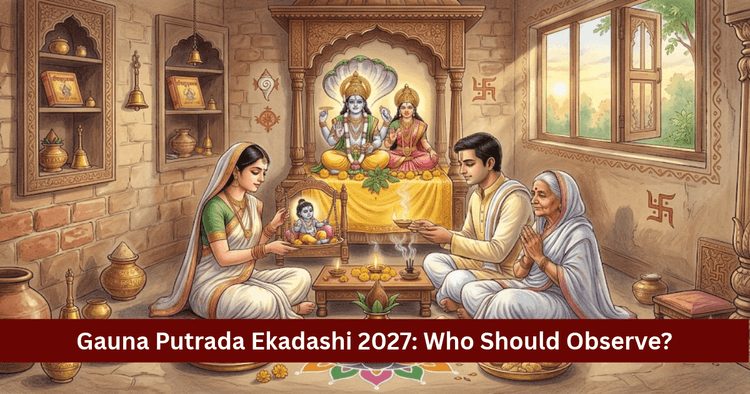
Table of Contents
When a Single Ekadashi Touches Two Sunrises
The reckoning of the Panchang sometimes creates a situation in which a tithi touches the sunrise of two days. When this happens with Ekadashi, devotees naturally wonder on which day to fast. The scriptures offer a beautiful answer. The Ekadashi of the first day is prescribed for householders and the Ekadashi of the second day for sannyasis (renunciates), widows and seekers of moksha (liberation). This second day Ekadashi is called Gauna Ekadashi.
In 2027, exactly this situation arises with Pausha Putrada Ekadashi. The main or Smarta, Putrada Ekadashi falls on Monday, 18 January, while the Gauna Pausha Putrada Ekadashi will be observed on Tuesday, 19 January.
| Detail | Information |
|---|---|
| Name of the fast | Gauna Pausha Putrada Ekadashi |
| Date | 19 January 2027 |
| Day | Tuesday |
| Hindu month | Paush |
| Paksha (fortnight) | Shukla Paksha (waxing fortnight) |
| Tithi (lunar day) | Ekadashi, turning into Dwadashi some time after sunrise |
| Smarta Putrada Ekadashi | 18 January 2027, Monday |
| Parana (breaking the fast) for the Gauna fast | 20 January after sunrise |
| Position of the Sun | Capricorn (Makar) |
| Position of the Moon | Taurus, Rohini nakshatra |
| Sunrise in Delhi | Approximately 7:15 in the morning |
| Rahu Kaal (Delhi) | Approximately 3:10 to 4:30 in the afternoon |
| Deity worshipped | Lord Vishnu |
| Other observances on the same day | Kurma Dwadashi, Tailang Swami Jayanti, Rohini Vrat (Jain) |
The parana of the Gauna Ekadashi fast will be on 20 January after sunrise. Check the exact parana time in your local Panchang or the Panchang of your sampradaya (tradition).
Who Should Fast on Which Day?
| Who observes | Day of the fast | Parana |
|---|---|---|
| Householders, especially couples wishing for children | 18 January, Monday | 19 January |
| Sannyasis and sadhus | 19 January, Tuesday | 20 January |
| Widows | 19 January, Tuesday | 20 January |
| Seekers of moksha | 19 January, Tuesday | 20 January |
| Followers of the Vaishnava sampradaya | According to their tradition's Panchang | According to tradition |
| Devoted followers of Vishnu who wish to fast both days | 18 and 19 January | 20 January |
In some traditions, devotees with special love for Lord Vishnu fast on both days. But this depends on one's capacity and the guidance of one's guru. For an ordinary householder, a single day's fast is fully in keeping with the scriptures.
What Is Gauna Ekadashi?
The word "Gauna" means secondary or supporting. When the Ekadashi tithi grows long and spans two sunrises, the Ekadashi of the first day is called the main or Smarta Ekadashi and the Ekadashi of the second day is called Gauna Ekadashi. This does not mean that Gauna Ekadashi is less important. It only means that it is prescribed for a different kind of seeker.
In the Hindu Panchang, the tithi is reckoned by sunrise. The tithi that prevails at sunrise is regarded as the tithi of that day. When a tithi begins before one sunrise and continues past the next sunrise, it is called a Vriddhi tithi (an extended tithi). In such a case, the same tithi prevails at sunrise on both days. In 2027, Paush Shukla Ekadashi is such a Vriddhi tithi.
The Difference Between the Smarta and Vaishnava Traditions
In India there are two main traditions for reckoning the Ekadashi fast.
The Smarta tradition follows the Dharma Shastras and the Smriti texts. In this tradition, the fast is kept on the day when Ekadashi prevails at sunrise. Most householders follow this tradition.
In the Vaishnava tradition the rules of Ekadashi are even more subtle. This tradition pays special attention to Arunodaya, the period about 96 minutes before sunrise. If even a trace of Dashami tithi is present at Arunodaya, that Ekadashi is regarded as Dashami viddha, that is, touched by Dashami and the fast is kept on the next day. That is why the Vaishnava Ekadashi sometimes falls a day after the Smarta Ekadashi.
| Basis | Smarta tradition | Vaishnava tradition |
|---|---|---|
| Fixing the tithi | The tithi at sunrise | Purity of the Arunodaya period |
| Ekadashi touched by Dashami | Acceptable | Rejected, fast on the next day |
| Main followers | Most householders | Vaishnava sampradayas, sannyasis |
| Fast on an extended Ekadashi | On the first day | Usually on the second day |
Devotees should choose the day according to their family tradition or guru tradition. Both traditions are in keeping with the scriptures and in both the spirit of devotion matters most.
Why the Second Day for Sannyasis?
The scriptures describe different duties for the householder and the sannyasi. A householder's life is bound up with family, society and worldly duties. Prayers for children, happiness, prosperity and the protection of the family come naturally to him. So the first day's Ekadashi, based purely on sunrise, was considered suitable for him.
The sannyasi and the seeker of moksha wish to rise above worldly desires. For such a seeker the purpose of the fast is not any worldly result but the purification of the soul and complete surrender to God. For this seeker, the Ekadashi chosen is one that is fully pure and followed by the sacred touch of Dwadashi. The second day's Ekadashi is joined with Dwadashi and Dwadashi is regarded as a tithi very dear to Lord Vishnu.
Widows were also placed in this group, because traditionally their lives were linked with the path of restraint, austerity and devotion to God. Today this practice can be seen as open to anyone who wishes to fast without desire for any worldly result, purely for the pleasure of God and the welfare of the soul.
How Was Ekadashi Born?
The Padma Purana tells a beautiful story of the appearance of Ekadashi. In the Satya Yuga there was a fearsome demon named Mura who had driven the gods out of heaven. At the gods' prayer, Lord Vishnu fought a long battle with Mura. During the battle, the Lord went to rest in Yoganidra (yogic sleep) in a cave at Badrikashram.
Mura took advantage of this to attack the sleeping Lord. At that very moment a radiant Goddess emerged from the Lord's body and slew Mura. When the Lord awoke, he was deeply pleased with the Goddess. That day was the Ekadashi tithi, so the Lord named the Goddess Ekadashi and granted a boon that whoever kept the Ekadashi fast would have their sins destroyed and receive the grace of the Lord.
The deeper meaning of this story is that Mura is a symbol of ignorance, laziness and sin. When the power of the Lord awakens within a devotee, it destroys these demons. The Ekadashi fast is a means of awakening that divine power within oneself.
Why Are Grains Given Up?
The Padma Purana also says that on Ekadashi all the sins of the world take refuge in grain. So eating grains, especially rice, is regarded as forbidden on this day. From a spiritual point of view, giving up grain lightens the body, reduces laziness and helps fix the mind on remembering God.
The Spiritual Meaning of 11
Ekadashi means the 11th tithi. In spiritual tradition this number is linked with the 11 senses of a human being, the 5 organs of knowledge, the 5 organs of action and the mind. The Ekadashi fast is a practice of bringing these eleven under restraint. For the seeker of moksha, this is the greatest meaning of Gauna Ekadashi. It is a day to draw the senses within and return towards the soul.
A Brief Retelling of the Putrada Ekadashi Story
The story of Pausha Putrada Ekadashi appears in the Bhavishya Purana. King Suketuman and Queen Shaibya of Bhadravati had no child. Distressed, the king wandered through the forest until he reached a lake where the Vishvedevas were bathing. They advised the king to keep the Putrada Ekadashi fast. The king kept the fast and was blessed with a radiant son.
Sannyasis and seekers who keep the Gauna Ekadashi also hear this story. For them its meaning turns to spiritual offspring, that is, giving birth to knowledge, devotion and detachment. A seeker who does not wish for worldly children prays to the Lord on this day for the birth of pure devotion within.
The Puja Vidhi of Gauna Putrada Ekadashi
- On the evening of 18 January, eat a sattvic meal before sunset and resolve to give up grain. If you also fasted on 18 January, simply continue the fast.
- On 19 January, wake before sunrise and bathe.
- Wear clean or yellow clothes and take the vow of the fast before Lord Vishnu.
- Bathe the deity with panchamrit and pure water.
- Offer yellow flowers, sandalwood, akshat (unbroken rice), incense, a ghee lamp and Tulsi leaves. Pluck the Tulsi leaves a day in advance.
- Offer fruits, rock sugar and panchamrit as bhog.
- Chant "Om Namo Bhagavate Vasudevaya" 108 times.
- Recite the Vishnu Sahasranama or the 12th chapter of the Bhagavad Gita, Bhakti Yoga.
- Give priority to silence, chanting and meditation throughout the day.
- Perform the aarti in the evening and keep a night vigil with devotional songs.
- On 20 January after sunrise, bathe, worship and give charity, then break the fast.
Special Rules for the Seeker
| Rule | Purpose |
|---|---|
| Complete avoidance of grains and rice | Purification of the body and removal of laziness |
| As much silence as possible | Restraint of speech and concentration of mind |
| Avoiding sleep during the day | Alertness and steadiness in practice |
| Night vigil | Immersion in the name of God |
| Restraint of the senses | Drawing the 11 senses within |
| Selfless intent | Fasting without desire for any worldly result |
Main Mantras
| Mantra | Meaning | Purpose | Count |
|---|---|---|---|
| Om Namo Bhagavate Vasudevaya | Salutations to Lord Vasudeva | Grace of Lord Vishnu and the wish for moksha | 108 times |
| Om Namo Narayanaya | Salutations to Lord Narayana | Peace of mind and growth of devotion | 108 times |
| Om Devakisuta Govinda Vasudeva Jagatpate, Dehi Me Tanayam Krishna Tvamaham Sharanam Gatah | O son of Devaki, Govinda, Vasudeva, Lord of the universe, Krishna, grant me a child, I take refuge in you | Santana Gopala mantra, for householders | 108 times |
Sannyasis and seekers of moksha should give priority to the Dvadashakshara mantra (twelve syllable mantra) "Om Namo Bhagavate Vasudevaya". It is regarded as the mantra of complete surrender to Lord Vasudeva. In the Shrimad Bhagavatam, Dhruva chanted this very mantra and received the vision of the Lord.
The Astrological Significance of Gauna Ekadashi
On 19 January 2027 the Moon will be in Rohini nakshatra in Taurus. Taurus is the Moon's sign of exaltation and Rohini is regarded as its most beloved nakshatra. The Moon signifies the mind, so on this day the mind can be expected to stay naturally steadier and calmer. For a Gauna Ekadashi built on silence, chanting and meditation, this is a highly favourable position.
The Sun is now in Capricorn, the sign of Saturn. Saturn signifies austerity, renunciation and detachment. The Sun, the significator of the soul, placed in the sign of the planet of detachment is an especially meaningful sign for seekers on the path of sannyas and moksha.
The day is a Tuesday. Mars is the planet of resolve, courage and discipline. Mars symbolises the firmness needed for a strict fast and a night vigil. In astrology Ketu is regarded as the Moksha Karaka (significator of liberation) and the 12th house as the house of moksha. Those with a strong Ketu or 12th house in their horoscope are often seen to have a natural interest in such selfless fasts.
Tailang Swami Jayanti and Kurma Dwadashi also fall on this day. The birth anniversary of a great sannyasi coming together with the Ekadashi of the sannyasis makes the day even holier for spiritual practice.
Remedies for Spiritual Growth
| Condition in the horoscope or life | Remedy |
|---|---|
| Confusion or unrest due to Ketu | Keep silence through the day and read the Vishnu Sahasranama |
| Troubles linked to the 12th house | Give food and clothes to a sannyasi or sadhu |
| Weak Jupiter | Donate yellow items and chana dal |
| Shani's Sade Sati | Donate black sesame and keep a night vigil |
| A restless mind | Chant the Dvadashakshara mantra 108 times |
Benefits of the Gauna Ekadashi Fast
- Self purification and the belief in the shedding of sins
- Restraint of the senses and concentration of mind
- Growth of devotion and detachment
- Grace of Lord Vishnu and progress on the path of moksha
- Calming of spiritual afflictions linked to Ketu and Jupiter
- For householders too, if kept with faith, blessings for children and protection of the family
Dos and Donts
| Do | Do not |
|---|---|
| Choose the day of the fast according to your tradition | Do not argue over the two traditions |
| Pluck Tulsi leaves a day in advance | Do not pluck Tulsi on Ekadashi |
| Keep as much silence and chanting as possible | Avoid idle talk and gossip |
| Keep a night vigil | Do not sleep during the day |
| Break the fast at the right time on 20 January | Do not break the fast during Hari Vasara |
| Serve sannyasis and sadhus | Do not take grains, meat or tamasic food |
When a Fast Rises Above Desire and Becomes Surrender
Gauna Putrada Ekadashi introduces us to a form of fasting in which asking comes to an end and only surrender remains. The first day's fast places the beautiful wishes of the world at the feet of the Lord, while the second day's fast offers oneself to the Lord. On 19 January 2027, when the Moon lights up Rohini in its sign of exaltation and a great sannyasi's birth anniversary is held in holy remembrance, this fast kept with silence, chanting and vigil can lead the mind to the peace the scriptures call the door to moksha. Where desire ends, the nectar of devotion begins.
FAQ
When is Gauna Pausha Putrada Ekadashi 2027?
Gauna Pausha Putrada Ekadashi 2027 falls on Tuesday, 19 January. The main Smarta Putrada Ekadashi falls on 18 January.
Who should observe Gauna Ekadashi?
According to the scriptures, Gauna Ekadashi is for sannyasis, widows and seekers of moksha. Householders keep the first day's fast.
When should the Gauna Ekadashi fast be broken?
Break the Gauna Putrada Ekadashi fast on 20 January after sunrise. Check the exact time in your local Panchang.
What is the difference between Smarta and Vaishnava Ekadashi?
The Smarta tradition follows the tithi at sunrise, while the Vaishnava tradition moves the fast to the next day if Dashami touches the Arunodaya period.
Why is rice not eaten on Ekadashi?
According to the Padma Purana, sins take refuge in grain on Ekadashi. So grains, especially rice, are given up on this day.
Get your accurate Kundali
Generate KundaliDid you like it?
Author
Pt. Amitabh Sharma (56 Years)
Experience: 20
Consults About: Family Planning, Career
Clients In: Punjab, Haryana, Delhi
Share this article with friends and family
About ZODIAQ
ZODIAQ is an online Vedic Astrology platform. It connects clients seeking astrological advice to experienced astrologers with deep knowledge. Our users also generate kundali and perform kundali milan for free. ZODIAQ also offers services to the Astrologers. Astrologers utilize various offerings by ZODIAQ to serve their clients effectively.
If you are a User
Consult with experienced astrologers and seek their guidance. You can also order handwritten Janm Patrika report with life prediction prepared by experienced astrologers. Generate accurate Kundali, perform Kundali Matching and check horoscope and muhurat. Utilize our online library for all the necessary astrological and spiritual information.
If you are an Astrologer
Create accurate kundali for your clients and perform Kundali Matching for up to 5 people at a time. Write comprehensive Janm Patrika report for your clients with ZODIAQ. Check client details anytime by saving it in client directory. Become more productive by tracking how many clients you guide every day.
WELCOME TO
ZODIAQ
Right Decisions at the right time with ZODIAQ
