Ishti Yajna 2027: How Is It Performed?
By Pt. Suvrat Sharma
The ancient Vedic method of the Paurnamasa Ishti, the role of the ritvijs and the deep life message in every offering.
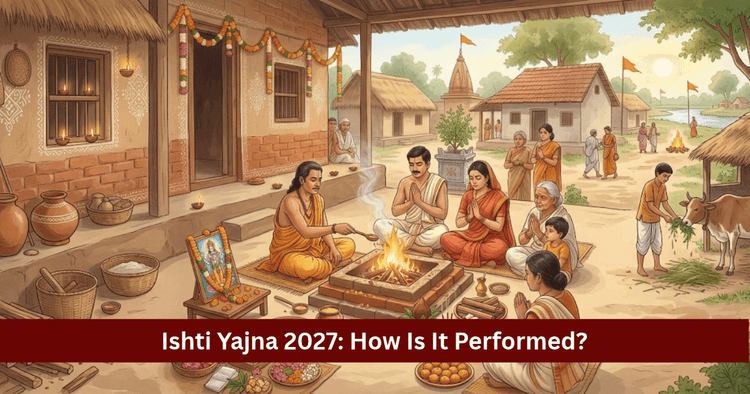
Table of Contents
When Is Ishti 2027 and What Is the Auspicious Time?
Ishti falls on Saturday, 23 January 2027, on Paush Shukla Purnima. It is the Paurnamasa Ishti, performed after the Anvadhan held a day earlier on 22 January. The Ishti is usually performed in the first half of the day after sunrise, with offerings of purodasha and ghee made to Agni and Soma.
Ishti is the Vedic Shrauta yajna in which offerings of purodasha, ghee and other havi are made to the gods through the sacred fire.
The word Ishti comes from the Sanskrit root "Yaj", meaning to worship or to offer. In the Vedic tradition, the Ishti performed on the full moon and new moon is called the Darsha Paurnamasa Ishti. The Shrauta Sutras regard it as the model for all Ishtis and prescribe it as a lifelong duty for an Agnihotri householder.
| Panchang Element | Details |
|---|---|
| Name of the Ritual | Ishti (Paurnamasa Ishti) |
| Date | 23 January 2027, Saturday |
| Hindu Month | Paush, Shukla Paksha (waxing fortnight) |
| Tithi | Purnima, after which Pratipada begins |
| Preceding Ritual | Anvadhan, 22 January 2027 |
| Sunrise in Delhi | Approximately 7:13 AM |
| Rahu Kaal (Delhi) | Approximately 9:50 AM to 11:10 AM |
| Position of the Moon | Cancer |
| Position of the Sun | Capricorn |
| Main Deities | Agni and Agni Soma |
| Panchang Context of the Day | Start of the month of Magha in North India |
The exact date of the Ishti is fixed from the Shrauta Panchang based on the Parva Sandhi, that is, the time when the full moon ends. Vedic families set its timing only under the guidance of their family priest.
What Is the Darsha Paurnamasa Ishti?
The Darsha Paurnamasa Ishti is a Vedic yajna performed twice a month. The Ishti after the new moon is called Darsha Ishti and the one after the full moon is called Paurnamasa Ishti. The deities and offerings differ between the two but the structure of the ritual remains nearly the same.
Darsha means the new moon, when the Moon is seen only together with the Sun and Paurnamasa means related to the full moon.
| Basis | Paurnamasa Ishti | Darsha Ishti |
|---|---|---|
| Time | After the full moon | After the new moon |
| First Main Offering | Purodasha for Agni | Purodasha for Agni |
| Second Main Offering | Purodasha for Agni and Soma | Purodasha for Indra and Agni or an offering of milk and curd for Indra |
| Upamshu Yaja | An offering made with silent chanting | According to tradition |
Because it follows the waxing and waning phases of the Moon, this yajna stays linked to the natural cycle of time. In this way the Ishti is not only worship but a Vedic way of joining human life with the rhythm of the cosmos.
Who Takes Part in the Ishti?
The yajamana (sponsor of the sacrifice), his wife and 4 ritvijs take part in the Darsha Paurnamasa Ishti. These ritvijs are the Adhvaryu, Hotri, Brahman and Agnidhra. Each ritvij has a fixed role and together they complete the yajna according to the full procedure.
A ritvij is a qualified Vedic Brahmin who performs the prescribed acts of the yajna on behalf of the yajamana.
| Participant | Veda or Role | Main Task |
|---|---|---|
| Yajamana | Sponsor of the yajna | Taking the vow and receiving the fruit of the yajna |
| Yajamana's Wife | Partner in dharma | Taking part in special rites such as Patni Samyaja |
| Adhvaryu | Yajurveda | All the manual acts, materials and offerings of the yajna |
| Hotri | Rigveda | Reciting verses to invoke the gods |
| Brahman | Atharvaveda and overall knowledge | Silent supervision of the yajna and correction of errors |
| Agnidhra | Assistant | Tending the fire and assisting the Adhvaryu |
The participation of the yajamana's wife shows that in the Vedic yajna, husband and wife are regarded as equal partners in dharma. A man alone was not regarded as fully entitled to a Shrauta yajna.
What Is the Procedure of the Ishti Yajna?
In the Ishti, the havi (offering) is prepared first and then kusha grass is spread on the altar. This is followed by 5 Prayaja offerings, the main offerings to the chief deities, the Svishtakrit offering, the eating of the Ida and 3 Anuyaja offerings. Finally, dakshina is given and the yajna is complete.
- In the morning the yajamana and the ritvijs bathe and gather at the place of the yajna
- Rice or barley is pounded and ground to prepare flour for the purodasha
- The purodasha is baked in the fire on clay kapalas, 8 kapalas for Agni and 11 kapalas for Agni Soma
- The altar is prepared and kusha grass, called barhis, is spread on it
- The Hotri invokes the gods with verses
- 5 Prayaja or opening offerings, are made
- The main offerings of purodasha and ghee are made to the chief deities
- An offering is made to Agni Svishtakrit, to correct any errors in the yajna
- The Ida, the remaining portion of the havi, is reverently eaten by the yajamana and the ritvijs
- 3 Anuyaja or closing offerings, are made
- The Patni Samyaja rites are performed
- The yajna is concluded by giving dakshina to the ritvijs
Key Terms of the Ishti and Their Meaning
| Term | Meaning |
|---|---|
| Purodasha | A sacred cake made from rice or barley flour, offered to the gods |
| Kapala | Clay potsherds on which the purodasha is baked |
| Barhis | Kusha grass spread on the altar |
| Prayaja | Offerings made before the main offerings |
| Svishtakrit | The fire that completes the yajna correctly |
| Ida | The sacred remainder eaten after the yajna |
| Anuyaja | Offerings made after the main offerings |
| Dakshina | Honour and gifts given to the ritvijs |
What Is the Spiritual Meaning of the Acts of the Ishti?
Every act of the Ishti carries a deep message for life. The Svishtakrit offering teaches that one should accept error in every action, the Ida teaches that prasad should be shared before it is eaten and dakshina teaches gratitude towards those who give knowledge.
The spirit of the Svishtakrit offering is very beautiful. The one performing the yajna accepts that human beings can make mistakes and so prays to Agni to fill whatever was lacking. It is a lesson in humility.
- The Prayajas teach that preparation and prayer are needed before a great task
- The main offering teaches that the best should be offered to God first
- The Svishtakrit teaches us to accept our mistakes and pray for correction
- The Ida teaches that prasad should be eaten together
- The Anuyajas teach that gratitude should remain even after the work is done
- Dakshina teaches respect for the guru and the learned
How Can an Ordinary Householder Adopt the Spirit of the Ishti?
The full Shrauta Ishti is performed only by Agnihotri families with qualified ritvijs. Yet any householder can adopt its spirit in a simple form on this day.
- After the morning bath, perform a small havan at home
- Make 11 or 21 offerings with the Gayatri Mantra
- Keep the feeling of "Idam Na Mama", meaning "this is not mine", with each offering
- Make one final offering in a spirit of seeking forgiveness for your mistakes
- Share the prasad of the havan with every member of the family
- Give respect and dakshina to a Vedic scholar or guru
What Are the Main Mantras of the Ishti?
| Mantra | Meaning | Use |
|---|---|---|
| Om Agnaye Svaha, Idam Agnaye Na Mama | This offering is for Agni, not mine | Offering to Agni |
| Om Agnishomabhyam Svaha, Idam Agnishomabhyam Na Mama | This offering is for Agni and Soma, not mine | The second Paurnamasa offering |
| Om Agnaye Svishtakrite Svaha, Idam Agnaye Svishtakrite Na Mama | This offering is for Agni who completes the yajna, not mine | Svishtakrit offering |
| Om Bhur Bhuvah Svah Tat Savitur Varenyam Bhargo Devasya Dhimahi Dhiyo Yo Nah Prachodayat | We meditate on the supreme radiance of Savitar, may he inspire our intellect | In a simple household havan |
What Is the Astrological Influence of the Ishti?
On 23 January 2027 the Moon will be in Cancer and the Sun in Capricorn. On the full moon the Sun and Moon face each other, which the Vedic tradition regards as the time when Soma is full. That is why offerings are made to Soma along with Agni in the Paurnamasa Ishti.
In the Vedic view, Agni symbolises the radiance of the Sun and Soma the nectar of the Moon. Worship of both Agni and Soma in the Paurnamasa Ishti expresses a balance between the Sun and the Moon. This year the day is a Saturday, the day of Saturn, significator of discipline and regular duty and the Shrauta yajna is itself another name for regularity and discipline.
| Planet | Possible Problem | Remedy on the Day of Ishti |
|---|---|---|
| Sun | Lack of inner strength | Offer arghya to the Sun in the morning and make Gayatri offerings in a havan |
| Moon | Mental instability | Remember Chandra Dev and donate something made of milk |
| Saturn | Obstacles in work and laziness | Offer black sesame in the havan and donate sesame |
| Jupiter | Lack of the guru's grace | Give dakshina to a Vedic scholar |
| Mars | Low energy | Worship fire with a ghee lamp |
What Should and Should Not Be Done on the Day of Ishti?
Purity, restraint and gratitude matter most on the day of the Ishti. A havan, Gayatri chanting, sharing prasad and honouring the learned are auspicious on this day. Disrespect towards fire, tamasic food, pride and turning the yajna into a mere show are regarded as forbidden.
- After the morning bath, worship the fire or a lamp
- Use only pure ghee, sesame, barley and samidha in the havan
- Share the prasad of the yajna with everyone before eating it
- Give respect and dakshina to scholars and teachers
- Do not put plastic, waste or impure items into the fire
- Do not consume meat, alcohol or tamasic food
- Do not begin the havan during Rahu Kaal
- Do not turn the yajna into a means of show or competition
When Ego Too Is Offered Into the Fire With Each Offering
The Ishti yajna reminds us that renunciation and gratitude lie at the heart of Vedic life. The spirit of "Na Mama" spoken with each offering frees a person from ego and makes them a humble participant in the vast order of the cosmos.
On 23 January 2027, as the holy month of Magha begins after Pausha Purnima, even a small offering made at home can connect one with the ancient yajna tradition that has kept the fire burning on every full moon and new moon for thousands of years.
FAQ
When is Ishti 2027?
Ishti falls on Saturday, 23 January 2027, on Paush Shukla Purnima. It is the Paurnamasa Ishti, performed after the Anvadhan of 22 January.
What is the Ishti yajna?
Ishti is the Vedic Shrauta yajna in which offerings of purodasha and ghee are made to the gods through the sacred fire. It is performed after every full moon and new moon.
Which deities receive offerings in the Paurnamasa Ishti?
In the Paurnamasa Ishti, purodasha is offered mainly to Agni and to Agni Soma. The Upamshu Yaja and the Svishtakrit offering are also made.
How many ritvijs take part in the Ishti?
The Darsha Paurnamasa Ishti has 4 ritvijs, namely the Adhvaryu, Hotri, Brahman and Agnidhra. The yajamana and his wife also take part in the yajna.
What is the meaning of the Svishtakrit offering?
The Svishtakrit offering is made to the fire that completes the yajna correctly. Its spirit is that Agni Dev may correct any mistake left in the yajna.
Get your accurate Kundali
Generate KundaliDid you like it?
Author
Pt. Suvrat Sharma (63)
Experience: 20
Consults About: Family Planning, Career
Clients In: Punjab, Haryana, Delhi
Share this article with friends and family
About ZODIAQ
ZODIAQ is an online Vedic Astrology platform. It connects clients seeking astrological advice to experienced astrologers with deep knowledge. Our users also generate kundali and perform kundali milan for free. ZODIAQ also offers services to the Astrologers. Astrologers utilize various offerings by ZODIAQ to serve their clients effectively.
If you are a User
Consult with experienced astrologers and seek their guidance. You can also order handwritten Janm Patrika report with life prediction prepared by experienced astrologers. Generate accurate Kundali, perform Kundali Matching and check horoscope and muhurat. Utilize our online library for all the necessary astrological and spiritual information.
If you are an Astrologer
Create accurate kundali for your clients and perform Kundali Matching for up to 5 people at a time. Write comprehensive Janm Patrika report for your clients with ZODIAQ. Check client details anytime by saving it in client directory. Become more productive by tracking how many clients you guide every day.
WELCOME TO
ZODIAQ
Right Decisions at the right time with ZODIAQ
