Jain Rohini Vrat 2027: How to Observe?
By Pt. Abhishek Sharma
Worship of Bhagwan Vasupujya, the story of Queen Rohini and the auspicious influence of Rohini nakshatra
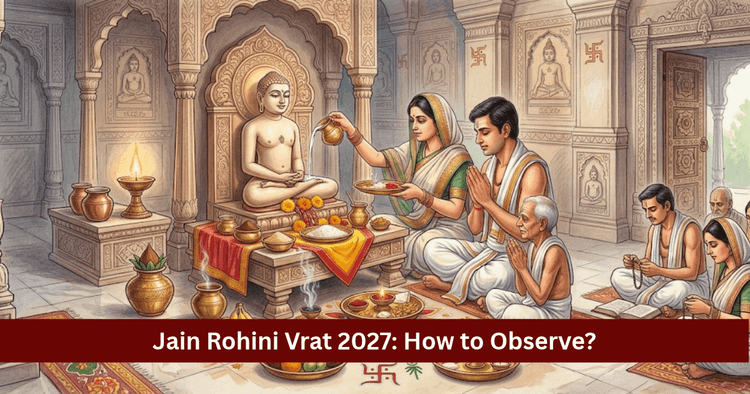
Table of Contents
When the Flame of Austerity Protects a Family's Happiness
In the Jain tradition, tapa (austerity) is not seen merely as a way of troubling the body. It is a process of slowly removing the dust of karma that has settled on the soul. A beautiful and popular form of this tradition of austerity is the Rohini Vrat. This fast is kept each month on the day when Rohini nakshatra is in the sky after sunrise. In Jain families and especially among women, the fast is observed with deep devotion. It is believed to open the way to happiness and peace in the family, long life for the husband and freedom from sorrow.
In 2027, the Rohini Vrat of January falls on Tuesday, 19 January. The fast is dedicated to Bhagwan Vasupujya, the 12th Tirthankara of Jainism.
| Detail | Information |
|---|---|
| Name of the fast | Rohini Vrat |
| Date | 19 January 2027 |
| Day | Tuesday |
| Basis | Jain calendar, Rohini nakshatra |
| Nakshatra (lunar mansion) | Rohini |
| Moon sign | Taurus (Vrishabha) |
| Hindu month and fortnight | Paush month, Shukla Paksha (waxing fortnight) |
| Revered one | Bhagwan Vasupujya, the 12th Tirthankara |
| Sunrise in Delhi | Approximately 7:15 in the morning |
| Sunset in Delhi | Approximately 5:50 in the evening |
| Rule for food | Before sunset only, eating at night is forbidden |
| Parana (breaking the fast) | The next day after sunrise, according to the Jain calendar |
| Duration of the fast | By tradition 3, 5 or 7 years, followed by Udyapan |
The Rohini Vrat is fixed by Rohini nakshatra, so confirm the start and end times of the nakshatra with the Jain Panchang of your region or your temple. In the Jain tradition food is not taken after sunset, so those keeping Ekasan should finish their meal before sunset.
Main Observances at a Glance
- Waking and bathing in Brahma Muhurat (the hour before dawn)
- Visiting the Jinalaya (Jain temple) for the abhishek and Ashtadravya puja of Bhagwan Vasupujya
- A full fast, Ekasan or only prasuk (boiled) water, according to capacity
- Chanting the Namokar Mantra and practising Samayik (equanimity meditation)
- Studying the Jinvani (scriptures) and listening to the Rohini Vrat story
- Charity to the needy and compassion for all living beings
- Parana the next day after sunrise
What Is Rohini Vrat?
Rohini Vrat is one of the major fasts of Jainism. There are 27 nakshatras in the sky and the Moon completes its round through all of them in about 27 days. So Rohini nakshatra comes roughly every 27 days and the fast is kept 12 or 13 times a year.
The fast is mainly observed by women. Married women keep it for the long life of their husbands, the happiness and peace of the family and the prosperity of the home. But it is not limited to women. Men too may keep it for self purification, the shedding of karma and freedom from the sorrows of life.
By tradition, Rohini Vrat is kept continuously for a fixed period. Some families keep it for 3 years, some for 5 and some for 7. A common tradition is to keep it for 5 years and 5 months. When the period is complete, an Udyapan (concluding ceremony) is held, with special worship, charity and a meal for fellow Jains.
Who Is Bhagwan Vasupujya?
Bhagwan Vasupujya is the 12th of the 24 Tirthankaras of Jainism. He was born in Champapuri, near present day Bhagalpur in Bihar. His father was King Vasupujya and his mother Queen Jaya, also called Jayavati.
| Detail | Information |
|---|---|
| Order | 12th Tirthankara |
| Birthplace | Champapuri |
| Father | King Vasupujya |
| Mother | Queen Jaya |
| Lanchhan (emblem) | Buffalo (Mahisha) |
| Colour | Red |
| Place of Nirvana | Champapuri |
A special feature of Bhagwan Vasupujya is that all four of his Kalyanakas (auspicious life events), his birth, initiation, attainment of Keval Gyan (omniscience) and Nirvana, are believed to have taken place in Champapuri. Most Tirthankaras attained Nirvana at Sammed Shikhar but Bhagwan Vasupujya attained moksha from Champapuri. That is why Champapuri is a deeply sacred pilgrimage site for the Jain community.
Tradition regards him as a Bal Brahmachari Tirthankara, one who remained celibate from youth. He gave up royal comforts, took initiation in his youth and attained Keval Gyan through severe austerity. His life carries a message of restraint, renunciation and inner strength, which matches the core spirit of the Rohini Vrat perfectly.
The Story of Rohini Vrat
There is a well known story linked to Rohini Vrat in the Jain tradition, which explains the doctrine of karma beautifully.
According to the story, in ancient times there was a queen whose name is given as Sindhumati. Once a muni (Jain monk) came to her home for alms. Out of pride and carelessness, the queen served the muni a bitter gourd. That food caused the muni great suffering and he passed away. Because of this grave sinful act, the queen had to suffer for many births.
After many births of suffering, she was born as a girl whose body gave off a foul smell. For this reason she was named Durgandha, the foul smelling one. No one came near her and her life passed in loneliness and humiliation. One day she met a wise muni. He revealed to her the secret of her karma from past lives and inspired her to keep the Rohini Vrat.
Durgandha kept the Rohini Vrat with complete faith and discipline. Through the power of the fast and austerity, her sinful karma was gradually destroyed. In her next birth she was born as Rohini, daughter of the king of Champapuri. Rohini was very beautiful, virtuous and fortunate. At her swayamvar (bride's choice ceremony) she married Prince Ashoka of Hastinapur.
The most touching part of the story is that Rohini had never experienced sorrow in her whole life. One day, from a palace window, she saw a woman weeping for her dead son. Rohini could not understand what the woman was doing and asked what kind of dance it was. King Ashoka was astonished to hear this. It is said that to teach Rohini the meaning of sorrow, the king staged an incident in which their son was dropped from a height but by the power of Rohini's merit the child came to no harm.
Later a wise muni told the king and queen that all this was the fruit of the Rohini Vrat kept by Rohini in her past life. After this, both King Ashoka and Queen Rohini took up the fast and finally walked the path of restraint towards the welfare of the soul.
The Message of the Story
This story makes the Jain doctrine of karma clear. Every action surely bears fruit, whether in this life or in lives to come. But the story offers hope, not despair. Through sincere repentance, austerity and restraint, even the heaviest karma can be destroyed. The journey from Durgandha to Rohini shows that the purification of the soul is always possible.
The Vidhi of Rohini Vrat
- On the day of Rohini nakshatra, wake in Brahma Muhurat, bathe and wear clean clothes.
- Take the vow of the fast in your mind and decide the type of fast according to your capacity.
- Go to the Jinalaya and perform the abhishek of the idol of Bhagwan Vasupujya with prasuk water.
- Perform the Ashtadravya puja, offering the eight substances: water, sandalwood, akshat (unbroken rice), flowers, naivedya (food offering), lamp, incense and fruit.
- Chant at least one mala (108 beads) of the Namokar Mantra.
- Chant the mantra of Bhagwan Vasupujya and perform his aarti.
- Read or listen to the story of the Rohini Vrat.
- During the day, practise Samayik and study the Jinvani.
- Donate food, clothes or necessary items to the needy.
- If you are keeping Ekasan, eat one sattvic meal before sunset.
- In the evening perform Pratikraman (ritual repentance) and seek forgiveness for the mistakes of the day.
- The next day after sunrise, worship and then break the fast.
Types of Fast
| Type of fast | Rule | Suitable for |
|---|---|---|
| Upvas | No food through the day, only prasuk water or not even that | Healthy and practised observers |
| Ekasan | One meal in the day, eaten seated in one place | Most householders |
| Ayambil | One plain meal without ghee, oil, milk or spices | Observers inclined to austerity |
| Biyasan | Two limited meals in the day | The elderly, the ill and the weak |
In the Jain tradition, root vegetables such as potato, onion, garlic, carrot and radish are not eaten on fasting days. Food should be sattvic, fresh and taken before sunset. Pregnant women, the ill and those on medication may keep Biyasan or Ekasan instead of a strict fast. In Jainism the power of austerity rests on intention, not on troubling the body needlessly.
Main Mantras for Rohini Vrat
| Mantra | Meaning | Count |
|---|---|---|
| Namo Arihantanam, Namo Siddhanam, Namo Ayariyanam, Namo Uvajjhayanam, Namo Loe Savva Sahunam | I bow to the Arihantas, the Siddhas, the Acharyas, the Upadhyayas and all the monks of the world | 108 times |
| Om Hreem Shri Vasupujya Jinendraya Namah | Salutations to Bhagwan Vasupujya, the Lord of the Jinas | 108 times |
The Namokar Mantra is the most sacred and fundamental mantra of Jainism. It bows not to any individual by name but to qualities. The mantra teaches that worship is offered not to a person but to the purity of soul that person has attained.
The Vidhi of Udyapan
When the fixed period of the Rohini Vrat is complete, the Udyapan is performed. The Udyapan is a celebration of the completion of the fast and of gratitude.
- Special worship and a Vidhan (ritual ceremony) of Bhagwan Vasupujya at the Jinalaya
- Donating worship items, scriptures or necessary objects to the temple
- A meal for fellow Jains
- Offering food to munis and sadhvis (Jain monks and nuns), if the opportunity arises
- Charity for the needy, animals and birds
- Collective chanting of the Namokar Mantra with the family
The Udyapan ritual may differ slightly among Jain sects and regions, so it is wise to seek guidance from the Acharya or a learned person at your temple.
The Astrological Significance of Rohini Nakshatra
From the perspective of Indian astrology, Rohini nakshatra is the fourth of the 27 nakshatras. It lies entirely within Taurus and is ruled by the Moon. Taurus is the sign of the Moon's exaltation, so the Moon in Rohini is considered very strong and auspicious. This nakshatra is regarded as a symbol of creation, nourishment, beauty, prosperity and stability.
The Moon signifies the mind. When the Moon is strong, the mind stays calm, steady and cheerful. Steadiness of mind is most essential for fasting, meditation and restraint. So austerity practised in Rohini nakshatra can be regarded as especially favourable for mastering the mind.
In 2027 the fast falls on a Tuesday. Mars is the planet of courage, resolve and discipline. This meeting of the Moon's coolness and the firmness of Mars can be seen as giving the observer both a gentle heart and firm resolve. At the same time the Sun is in Capricorn, a sign regarded as one of restraint and austerity.
| Astrological element | Position on Rohini Vrat 2027 | Indication |
|---|---|---|
| Nakshatra | Rohini | Creation, nourishment and beauty |
| Moon | In Taurus, exalted | Steadiness and peace of mind |
| Weekday | Tuesday | Firm resolve and discipline |
| Sun | Capricorn | Restraint and austerity |
| Paksha | Shukla Paksha | Growing light, spiritual progress |
Benefits of Rohini Vrat
- Happiness, peace and harmony in the family
- The belief in a long life for the husband and sweetness in married life
- Shedding of the bonds of past karma
- A sense of freedom from the sorrows and troubles of life
- Steadiness of mind, patience and inner strength
- Self purification and spiritual progress
The Message of Rohini Vrat in Today's Life
Life today is full of rush, stress and discontent. Everyone is racing to gain more, yet peace of mind keeps shrinking. Rohini Vrat shows a completely different path. It teaches that happiness lies not in outer things but in inner restraint.
Limiting food for one day a month, spending some time in silence and meditation, giving to others and asking forgiveness for one's mistakes are small practices that slowly transform the whole of life. The story of Queen Rohini shows that in the life of one who sows the seeds of austerity and compassion, not even the shadow of sorrow falls.
Dos and Donts
| Do | Do not |
|---|---|
| Wake in Brahma Muhurat and visit the Jinalaya | Do not eat after sunset |
| Drink only prasuk water | Do not eat root vegetables |
| Chant the Namokar Mantra | Do not harm any living being |
| Practise Samayik and Pratikraman | Avoid anger, gossip and harsh words |
| Give to the needy | Do not break the rules of the fast without reason |
| Perform the Udyapan when the period is complete | Do not practise austerity for show |
When the Lamp of Restraint Ends the Darkness of Sorrow
Rohini Vrat is not just a single day's fast but a spiritual journey that runs for years. The story of Durgandha becoming Rohini gives hope to everyone worn out by the troubles of life. The fast teaches that every soul holds the possibility of infinite purity, waiting only to be awakened through restraint, austerity and compassion. On 19 January 2027, when the Moon lights up Rohini nakshatra in its sign of exaltation, a resolve made at the feet of Bhagwan Vasupujya can open the door to happiness for the family and peace for the soul. Where there is restraint, sorrow cannot stay.
FAQ
When is Rohini Vrat in January 2027?
The Rohini Vrat of January 2027 falls on Tuesday, 19 January, when Rohini nakshatra will prevail after sunrise.
To whom is Rohini Vrat dedicated?
Rohini Vrat is dedicated to Bhagwan Vasupujya, the 12th Tirthankara of Jainism, whose birth and Nirvana took place in Champapuri.
For how many years is Rohini Vrat kept?
By tradition the fast is kept for 3, 5 or 7 years. Many families keep it for 5 years and 5 months and then perform the Udyapan.
What should be eaten during Rohini Vrat?
The fast is kept as Upvas, Ekasan or Ayambil. Food should be sattvic, free of root vegetables and taken before sunset.
When should Rohini Vrat be broken?
The Rohini Vrat is broken the next day after sunrise, after worship, according to the Jain calendar.
Get your accurate Kundali
Generate KundaliDid you like it?
Author

Pt. Abhishek Sharma (63)
Experience: 20
Consults About: Family Planning, Career
Clients In: Punjab, Haryana, Delhi
Share this article with friends and family
About ZODIAQ
ZODIAQ is an online Vedic Astrology platform. It connects clients seeking astrological advice to experienced astrologers with deep knowledge. Our users also generate kundali and perform kundali milan for free. ZODIAQ also offers services to the Astrologers. Astrologers utilize various offerings by ZODIAQ to serve their clients effectively.
If you are a User
Consult with experienced astrologers and seek their guidance. You can also order handwritten Janm Patrika report with life prediction prepared by experienced astrologers. Generate accurate Kundali, perform Kundali Matching and check horoscope and muhurat. Utilize our online library for all the necessary astrological and spiritual information.
If you are an Astrologer
Create accurate kundali for your clients and perform Kundali Matching for up to 5 people at a time. Write comprehensive Janm Patrika report for your clients with ZODIAQ. Check client details anytime by saving it in client directory. Become more productive by tracking how many clients you guide every day.
WELCOME TO
ZODIAQ
Right Decisions at the right time with ZODIAQ
