Magh Bihu 2027: When and How to Celebrate?
By Pt. Suvrat Sharma
The hidden harmony of fire, grain and the Sun in Assam's harvest festival
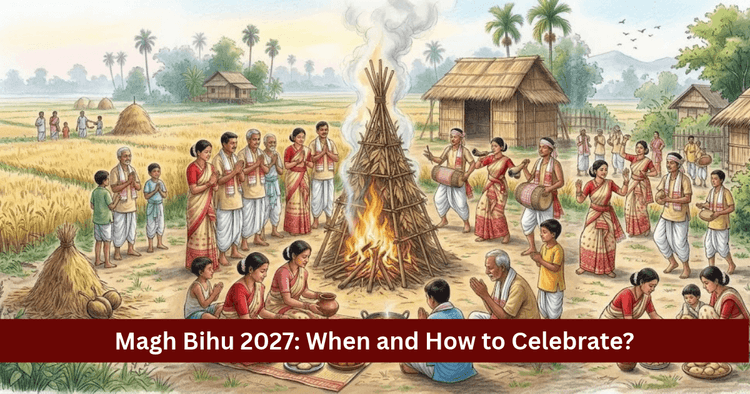
Table of Contents
When Granaries Fill and Fire Bears Witness
When the last sheaves of paddy have been cut and carried into the granaries of Assam, when the scent of straw drifts through the cold morning mist over the fields and when an entire village gathers around a single fire like one large family, Magh Bihu arrives. It is not merely a festival. It is a celebration of the labour that the farmer has shared with sunlight, rain and soil throughout the year. In 2027, Magh Bihu will be celebrated on Friday, 15 January and the night before it, 14 January, will be the night of Uruka.
The table below brings together all the key Panchang details of Magh Bihu 2027, so that everyone preparing for the festival can understand the correct timing and the correct method well in advance.
| Detail | Information |
|---|---|
| Name of the festival | Magh Bihu, also called Bhogali Bihu |
| Main date | 15 January 2027 |
| Day | Friday |
| Night of Uruka | 14 January 2027, Thursday |
| Sun enters Capricorn (Makar) | Night of 14 January 2027 |
| Punya Kaal (auspicious period) | 15 January, from sunrise until midday |
| Maha Punya Kaal (most auspicious period) | Roughly the first 2 hours after sunrise |
| Lunar month and fortnight | Paush month, Shukla Paksha (waxing fortnight, Amanta reckoning) |
| Tithi at sunrise | Around Shukla Ashtami (the eighth lunar day) |
| Solar month | First day of the month of Magh in the Assamese calendar |
| Sunrise in Guwahati | Approximately 6:15 in the morning |
| Sunset in Guwahati | Approximately 4:50 in the evening |
| Basis of the calendar | Solar calendar |
Since the Sun changes sign during the night, the classical rule places the Punya Kaal for bathing, charity and worship on the following morning, that is, 15 January. Sunrise times can differ by a few minutes from city to city, so it is wise to check the local Panchang for the exact Muhurat.
Key Rituals at a Glance
- Building the Meji and the Bhelaghar in the fields or an open ground on the evening of 14 January
- A community feast on the night of Uruka, where families and neighbours eat together
- Bathing at dawn on 15 January and wearing clean clothes
- Lighting the Meji with prayers to Agni Dev, the Fire God
- Offering pitha, betel nut, sesame and rice into the fire of the Meji
- Seeking blessings from elders, giving charity and enjoying traditional dishes
Basic Observances of the Festival
- Always bathe before lighting the Meji
- Offer only pure and sattvic items into the fire
- Donate sesame, jaggery, rice or woollen clothes during the Punya Kaal
- Share the Uruka feast with everyone and leave no one alone
- Respectfully place the half burnt wood or ash of the Meji near fruit bearing trees
What Is Magh Bihu and Why Is It Called Bhogali Bihu?
Magh Bihu is the harvest festival of Assam, celebrated after the paddy harvest is complete. In the life of Assamese society, Bihu is not just a date on the calendar. It is a symbol of identity, of memory and of the bond between the people and their land. Magh Bihu is also known as Bhogali Bihu. The word "Bhog" means food, enjoyment and consumption. At this time the granaries are full, so the festival becomes an occasion to eat freely, feed others and share generously.
There are several views on the origin of the word Bihu. One view connects it to the Sanskrit word "Vishu", which is associated with the transition of the Sun and the balance of day and night. Another view links it to the traditions of local tribal languages, in which people prayed to the land and the gods for prosperity of the crop. Both views share one common thread. The roots of Bihu lie in nature, in the seasons and in agricultural life.
It is also important to understand that Magh Bihu falls at exactly the same time as Makar Sankranti is observed in other parts of the country. When the Sun leaves Sagittarius (Dhanu) and enters Capricorn (Makar), the month of Magh begins in the Assamese solar calendar and Magh Bihu is celebrated on its first day. In this way the festival is deeply connected with folk culture on one side and fully grounded in the solar principles of Vedic astrology on the other.
The Three Bihus of Assam and the Place of Magh Bihu
Three Bihus are celebrated in Assam over the course of a year and each is linked to a different stage of farming. Looking at the three together reveals how beautifully Assamese culture has woven the agricultural cycle into its festivals.
| Name of the Bihu | Other name | Time | Stage of the farming cycle | Mood |
|---|---|---|---|---|
| Bohag Bihu | Rongali Bihu | Mid April | Before sowing, the new year | Joy and colour |
| Kati Bihu | Kongali Bihu | Mid October | Crop standing in the field, granaries empty | Restraint and prayer |
| Magh Bihu | Bhogali Bihu | Mid January | Harvest complete, granaries full | Feasting and gratitude |
During Kati Bihu, when the paddy is ripening in the fields and grain at home is scarce, people light lamps beneath the Tulsi plant and pray for the protection of the crop. That is why it is called Kongali Bihu, the Bihu of scarcity. A few months later the same prayer bears fruit and by Magh Bihu the granaries are full. Seen this way, the prayer of Kati Bihu and the feast of Magh Bihu are two chapters of the same story. The first chapter holds patience and the second holds the reward.
Bohag Bihu welcomes the new year and new sowing, while Magh Bihu celebrates the successful close of the old farming year. This is why Magh Bihu also carries a quiet sense of farewell and contentment, as though the people were saying to the earth, thank you for what you gave this year.
How Is the Night of Uruka Celebrated?
The evening and night before Magh Bihu is called Uruka. In 2027, Uruka will fall on Thursday, 14 January. This night is considered the soul of the entire festival, because it is on this night that preparation, reunion and shared joy reach their peak.
On the day of Uruka, the young men of the village reach the fields during daylight. There they build two kinds of structures from bamboo, dry straw, banana leaves and wood. The first is the Meji, a tall cone shaped structure that is offered to the fire the next morning. The second is the Bhelaghar, a temporary hut. People sit inside the Bhelaghar all night, talking, singing and feasting.
The Uruka feast is one of the most vibrant traditions of this festival. Freshly caught fish, rice, seasonal vegetables and in many places meat are cooked for the feast. Vegetarian families prepare dal, vegetables, pitha and kheer according to their own customs. The meal does not belong to any one household. Every family contributes something and everyone cooks together.
The night of Uruka also carries a social meaning. Even people who have had disagreements during the year sit beside the same fire on this night. The village elders tell old stories, the children play and the young prepare for the next morning's ritual. In a sense, the night of Uruka becomes a chance to tie together the scattered threads of society once again.
Main Traditions of Uruka Night
- Building the Meji and the Bhelaghar together as a community
- A shared feast in the fields or on a riverbank
- Folk songs, storytelling and reconciliation
- Staying awake through the night in the Bhelaghar
- In some places, a playful custom of "stealing" a neighbour's firewood or vegetables, which nobody takes amiss
What Is the Ritual of Meji Burning?
The holiest moment on the morning of Magh Bihu is the burning of the Meji. It is not simply lighting a bonfire. It is an ancient way of thanking Agni Dev, the Fire God and seeking blessings for the year ahead. In the Vedic tradition, Agni is called the mouth of the gods, meaning that whatever is offered into the fire with devotion reaches the gods. The burning of the Meji is the folk expression of this very idea.
Steps of the Meji Burning
- On 15 January, wake up at dawn before sunrise and bathe. If possible, bathe in a river or pond. Otherwise, bathe at home with a few sesame seeds added to the water.
- Wearing clean clothes, go to the Meji with your family and the people of the village.
- First offer water to Surya Dev, the Sun God and remember your family deity.
- The village elder or the head of the family lights the Meji.
- Walk around the Meji and pray to Agni Dev for the protection of the family, livestock and fields.
- Offer pitha, betel nut, betel leaf, sesame, rice and jaggery into the fire.
- Once the Meji has cooled, respectfully place its half burnt wood or ash near the roots of fruit bearing trees.
- Return home, touch the feet of elders, receive their blessings and then enjoy the feast.
The custom of placing the ash of the Meji near trees holds a beautiful meaning. Folk belief holds that it makes the trees bear more fruit. Symbolically, the fire that burned as thanks for the old harvest returns its ash to the earth as the seed of new prosperity. This is the cycle of life, in which nothing goes to waste.
What Is the Astrological Basis of Magh Bihu?
From the perspective of Vedic astrology, the most important basis of Magh Bihu is the entry of the Sun into Capricorn. The Sun passes through all 12 zodiac signs in a year and each change of sign is called a Sankranti. Among these 12 Sankrantis, Makar Sankranti is considered the most auspicious, because tradition counts the beginning of the Sun's northward journey, Uttarayan, from this time.
The scriptures call Uttarayan the day of the gods. It is believed that the merit of charity, chanting, austerity and good deeds performed during this period multiplies many times over. Nature also bears witness to this change. The days slowly grow longer, the harshness of winter begins to ease and life starts moving again.
The Father and Son Bond of the Sun and Saturn
The ruler of Capricorn is Shani Dev, Saturn and in astrology Saturn is regarded as the son of the Sun. Puranic stories mention distance and discord between the father and the son. On Makar Sankranti, the Sun himself visits the house of his son. This is seen as a symbol of frozen relationships thawing and old differences coming to an end.
This is why sesame holds special importance on this day. Black sesame is associated with Saturn and jaggery represents the energy of the Sun. When sesame and jaggery come together, they symbolise the union of the Sun and Saturn. The til pitha and til laru of Assam keep this deep symbolism alive in the form of folk food, whether or not the person eating them knows its astrological meaning.
Why Does the Solar Calendar Matter?
Most Indian fasts and festivals are based on lunar tithis, so their dates shift every year. Magh Bihu is an exception. It follows the solar calendar, so it falls on 14 or 15 January almost every year. The Assamese calendar also runs on solar reckoning, in which a new month begins with the Sun's entry into a sign.
It is worth noting that solar festivals are directly linked to the seasons. The farming cycle depends on the movement of the Sun, not on the phases of the Moon. That is why harvest festivals of farmers, such as Magh Bihu, Pongal and Lohri, are celebrated around the time the Sun enters Capricorn.
What Does the Friday Alignment of 2027 Indicate?
In 2027, Magh Bihu falls on a Friday. In astrology, Friday is the day of Venus (Shukra) and Venus is the significator of enjoyment, beauty, delicious food, art, music and family happiness. When Bhogali Bihu, whose very essence is enjoyment and abundance, falls on the day of Venus, the alignment becomes meaningful in itself.
This alignment can be understood to mean that family reunions, folk songs, dance and shared feasting may feel especially joyful at this year's festival. Those who seek the favourable results of Venus may donate white clothes, rice, rock sugar or sweets made from milk on this day. The Moon will also be in its waxing fortnight with growing phases, which is considered favourable for a cheerful mind and new beginnings.
What Should Each Zodiac Sign Donate on Magh Bihu?
Charity holds special importance during the Punya Kaal of Makar Sankranti. The table below lists suitable donations for each sign based on traditional astrological beliefs. Charity should always be given according to one's capacity and with a sincere heart, because its merit is decided by intention and not by quantity.
| Zodiac sign | Recommended donation | Related quality |
|---|---|---|
| Aries (Mesha) | Jaggery, red cloth, peanuts | Courage and energy |
| Taurus (Vrishabha) | White sesame, rice, rock sugar | Stability and comfort |
| Gemini (Mithuna) | Green moong, green vegetables | Intellect and communication |
| Cancer (Karka) | Rice, milk, white cloth | Peace of mind |
| Leo (Simha) | Jaggery, wheat, a copper vessel | Confidence and honour |
| Virgo (Kanya) | Moong khichdi, green fruits | Health and discernment |
| Libra (Tula) | White cloth, rice, ghee | Balance and beauty |
| Scorpio (Vrishchika) | Jaggery, red lentils, woollen clothes | Courage and protection |
| Sagittarius (Dhanu) | Yellow lentils, turmeric, bananas | Wisdom and fortune |
| Capricorn (Makara) | Black sesame, a blanket, mustard oil | Duty and patience |
| Aquarius (Kumbha) | Black sesame, woollen clothes, shoes | Service and justice |
| Pisces (Meena) | Chana dal, yellow clothes, saffron | Devotion and compassion |
Which Mantras and Remedies Should Be Practised on Magh Bihu?
Chanting a few simple mantras during the Meji burning and the Punya Kaal steadies the mind and deepens the spiritual spirit of the festival. These mantras can be chanted without any elaborate ritual, with a pure heart and clear pronunciation.
| Purpose | Mantra | Meaning | Count |
|---|---|---|---|
| Blessings of the Sun | Om Ghrini Suryaya Namah | Salutations to the radiant Sun | 108 times |
| Calming Saturn's influence | Om Sham Shanaishcharaya Namah | Salutations to Shani, the slow moving one | 108 times |
| Offering to Agni | Om Agnaye Svaha | This offering is given to Agni, the Fire God | With each offering |
| Pleasing Venus | Om Shum Shukraya Namah | Salutations to Shukra, Venus | 108 times |
Simple Remedies for the Day
- Offer arghya (water offering) to the Sun from a copper vessel filled with water, red flowers and a few sesame seeds
- Give a blanket or warm clothes to someone in need
- Feed jaggery and green fodder to a cow
- Offer sweets made of sesame and jaggery to the elders of the house and receive their blessings
- Sit before the fire of the Meji, acknowledge the mistakes of the past year and make new resolutions
For those whose horoscope is passing through Shani's Sade Sati or Dhaiya, the day of Makar Sankranti is considered especially beneficial. Donating black sesame and chanting the Shani mantra on this day are believed to help soften Saturn's harsh influence. Similarly, those with a weak Sun in their horoscope should certainly offer arghya to the Sun on this day.
Traditional Dishes That Give the Festival Its Flavour
The very name Bhogali Bihu tells us that food is at the heart of this festival. Yet this food is not only about taste. Every dish is made from the rice, sesame, jaggery and coconut of the new harvest, so every bite carries a thank you to the earth. In Assamese homes, the making of pitha and laru begins several days before Magh Bihu and the women of the house do this work together.
| Dish | Main ingredients | Special feature |
|---|---|---|
| Til Pitha | Ground rice, sesame, jaggery | A thin rice layer filled with sesame and jaggery, the most famous pitha |
| Narikol Pitha | Rice flour, coconut, jaggery | Sweet and fragrant |
| Ghila Pitha | Rice flour, jaggery | A fried pitha |
| Sunga Pitha | Rice, bamboo tube | Cooked inside a bamboo tube |
| Narikol Laru | Coconut, jaggery or sugar | A round sweet like a laddoo |
| Til Laru | Sesame, jaggery | Gives warmth to the body in winter |
| Jolpan | Chira, muri, akhoi, curd, jaggery | A traditional breakfast |
| Sunga Saul | Sticky rice, bamboo | Rice cooked in bamboo |
From the perspective of Ayurveda, these dishes appear to have been designed with great care. In the harsh cold of January, sesame and jaggery give warmth to the body, keep digestion active and sustain energy. The combination of curd and chira is light and nourishing. In this way, the food of Magh Bihu suits the season as well as the tradition.
Folk Culture, Games and the Spirit of Community
Magh Bihu also has a rich tradition of games. Throughout the day, villages hold all kinds of contests in which children, youth and elders take part. The aim of these games is less about winning and more about enjoying together.
- Tekeli Bhonga, in which a clay pot is broken while blindfolded
- Koni Juj, a game played by knocking eggs against each other
- Traditional wrestling and races
- Tug of war and other rural games
- In some areas, traditional animal contests, which are now subject to legal rules and animal welfare standards
The most beautiful side of Magh Bihu is its sense of community. Today, when people live in cities and families are scattered, the people of Assam still try to return to their villages for Magh Bihu. Even in cities, Mejis are built at the neighbourhood level and community feasts are held. This shows that tradition is not just a thing of the past but that it still has the power to bring people together.
How Is Magh Bihu Related to Other Harvest Festivals of India?
When the Sun enters Capricorn, all of India celebrates the harvest and the Sun in one form or another. The names are different and the customs are different but the essence is the same, gratitude towards nature and a welcome to the energy of the Sun.
| Region | Name of the festival | Main tradition |
|---|---|---|
| Assam | Magh Bihu | Meji burning, Uruka feast, pitha |
| Punjab and Haryana | Lohri | Bonfire, revdi, peanuts, folk songs |
| Tamil Nadu | Pongal | Pongal made from new rice, worship of the Sun |
| Gujarat | Uttarayan | Kite festival, til chikki |
| Uttar Pradesh and Bihar | Khichdi | Holy dip in the Ganga, donation of khichdi |
| Maharashtra | Makar Sankranti | Exchange of tilgul |
One thing becomes clear from this table. Fire holds a central place in both Magh Bihu and Lohri. Dishes made from new rice are central to both Pongal and Magh Bihu. And sesame and jaggery appear in some form in almost every region. This is living proof of the cultural unity of India, where a single change of sign by the Sun is celebrated in every corner of the country in its own way.
Dos and Donts of Magh Bihu
| Do | Do not |
|---|---|
| Wake before sunrise and bathe | Do not eat before the Meji is burned |
| Offer arghya to the Sun | Do not put plastic or impure items into the fire |
| Donate sesame and jaggery during the Punya Kaal | Do not insult anyone or speak harshly |
| Seek the blessings of elders | Do not waste food |
| Share the Uruka feast with everyone | Do not cause suffering to animals |
| Give the ash of the Meji to fruit trees | Do not break the dignity of the festival through intoxication |
| Give warm clothes to the needy | Do not do anything that harms the environment |
The Spiritual and Psychological Message of Magh Bihu
The deepest message of Magh Bihu is gratitude. Giving thanks for what has been received makes a person humble. The farmer knows that alongside his own labour, sunlight, rain, soil and time also played their part before the harvest reached home. Offering into the fire of the Meji is a symbol of this acceptance, that no human being achieves anything alone.
From a psychological point of view, the festival is also a kind of closing ritual. A whole year of labour, worry and waiting turns into a single night of celebration. On the night of Uruka, people leave their stress behind, sing, laugh and sit together. Then in the morning fire, it is as though everything old is burned away and the mind becomes lighter and ready for the farming work of the new year.
In the Vedic view, fire is the symbol of purification. Whatever fire touches, it transforms. If, at the time of the Meji burning, a person also mentally surrenders inner anger, envy, laziness and negative thoughts to that fire, the festival becomes not just an outer celebration but an inner journey. The Sun's turn towards Uttarayan also points to this inner journey, from darkness towards light and from inertia towards movement.
The most beautiful thing is that Magh Bihu does not see enjoyment as a sin. It says that enjoying the happiness earned after hard work is also part of righteous living, provided that happiness is shared. The "Bhog" of Bhogali Bihu is not selfish indulgence. It is collective enjoyment, in which every neighbour, every guest and every person in need has a share.
When the Blessing of the Earth Glows in the Flame
Magh Bihu 2027 arrives on a day when the Sun will have entered Capricorn, the Moon will be in its waxing fortnight with growing phases and Friday will bring the energy of enjoyment and delight. From the night of Uruka on 14 January to the Meji burning at dawn on 15 January, the festival reminds people that every grain of food is born from the union of the earth, the Sun and human effort.
A person who bathes, offers arghya to the Sun, gives charity and worships the fire with a sincere heart on this day does not merely follow a tradition. Such a person connects with the ancient wisdom that says true prosperity lies in balance with nature. The flame of the Meji dies down but its warmth stays in the heart all year long. That is the true gift of Magh Bihu.
FAQ
When is Magh Bihu in 2027?
Magh Bihu 2027 will be celebrated on Friday, 15 January. Uruka will be observed a day earlier, on the night of Thursday, 14 January.
Why is Magh Bihu called Bhogali Bihu?
"Bhog" means food and enjoyment. After the harvest the granaries are full, so the festival becomes a celebration of community feasts, pitha, laru and joy.
What happens on the night of Uruka?
On the night of Uruka, people build the Meji and the Bhelaghar in the fields, share a community feast, sing folk songs and stay together in the Bhelaghar through the night.
What is the astrological significance of Magh Bihu?
The festival is based on the Sun's entry into Capricorn. Capricorn is the sign of Saturn, so worshipping the Sun, donating sesame and chanting the Shani mantra are considered auspicious on this day.
How is the Meji burning performed?
After bathing at dawn, offer water to the Sun, light the Meji, walk around it and offer pitha, sesame, betel nut and rice into the fire while praying to Agni Dev.
Get your accurate Kundali
Generate KundaliDid you like it?
Author
Pt. Suvrat Sharma (63)
Experience: 20
Consults About: Family Planning, Career
Clients In: Punjab, Haryana, Delhi
Share this article with friends and family
About ZODIAQ
ZODIAQ is an online Vedic Astrology platform. It connects clients seeking astrological advice to experienced astrologers with deep knowledge. Our users also generate kundali and perform kundali milan for free. ZODIAQ also offers services to the Astrologers. Astrologers utilize various offerings by ZODIAQ to serve their clients effectively.
If you are a User
Consult with experienced astrologers and seek their guidance. You can also order handwritten Janm Patrika report with life prediction prepared by experienced astrologers. Generate accurate Kundali, perform Kundali Matching and check horoscope and muhurat. Utilize our online library for all the necessary astrological and spiritual information.
If you are an Astrologer
Create accurate kundali for your clients and perform Kundali Matching for up to 5 people at a time. Write comprehensive Janm Patrika report for your clients with ZODIAQ. Check client details anytime by saving it in client directory. Become more productive by tracking how many clients you guide every day.
WELCOME TO
ZODIAQ
Right Decisions at the right time with ZODIAQ
