Shakambhari Purnima 2027: What Should You Do?
By Pt. Sanjeev Sharma
The Jayanti of the Mother of nourishment, the Paush Purnima bath and a full Moon in Pushya nakshatra
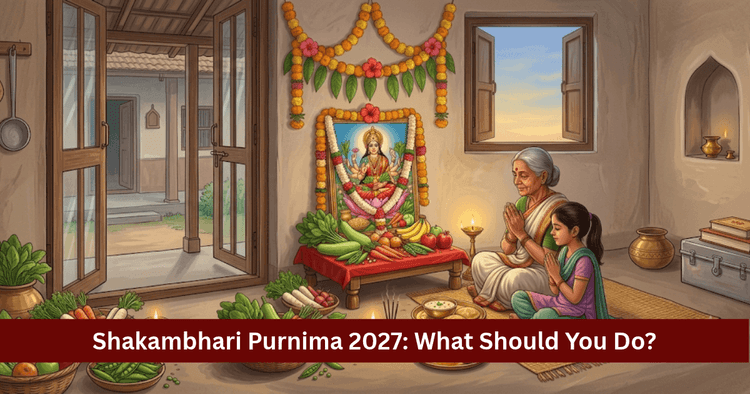
Table of Contents
When the Full Moon Bathes the Mother of Nourishment
On the full moon night of the month of Paush, when the full Moon spreads its light through the cold air, a special festival comes to a close in many temples from the north to the south of India. This festival is Shakambhari Navratri, which begins on Paush Shukla Ashtami and concludes on Paush Purnima. This full moon is regarded as the day of Mata Shakambhari's appearance, so it is called Shakambhari Purnima or Shakambhari Jayanti.
In 2027, Shakambhari Purnima will be celebrated on Friday, 22 January. The day is not only for worship of the Goddess but also for the holy bath and charity of Paush Purnima and the beginning of the Magh month Kalpavas at Prayag.
| Detail | Information |
|---|---|
| Name of the festival | Shakambhari Purnima, Shakambhari Jayanti |
| Date | 22 January 2027 |
| Day | Friday |
| Hindu month | Paush |
| Paksha (fortnight) | Shukla Paksha (waxing fortnight) |
| Tithi (lunar day) | Purnima (full moon) |
| Shakambhari Navratri | 16 January to 22 January 2027 |
| Position of the Moon | Cancer, Pushya nakshatra |
| Position of the Sun | Capricorn (Makar) |
| Sunrise in Delhi | Approximately 7:14 in the morning |
| Sunset in Delhi | Approximately 5:53 in the evening |
| Rahu Kaal (Delhi) | Approximately 11:10 in the morning to 12:30 in the afternoon |
| Goddess worshipped | Mata Shakambhari, in her Banashankari form |
| Other observances on the same day | Paush Purnima, Thaipusam |
Purnima tithi will prevail at sunrise on 22 January, so bathing, charity and worship of the Goddess will be done on this day. The Purnima tithi may end around evening on this day. Devotees who keep the Purnima fast and offer arghya to the Moon at night should check the day of the fast in their local Panchang, because in some places the Purnima fast may fall a day earlier, on 21 January.
Main Rituals at a Glance
- Bathing in Brahma Muhurat (the hour before dawn) in a holy river or at home with Ganga water
- Offering arghya (water offering) to the Sun
- Worship of Mata Shakambhari with fresh vegetables, fruits and greens as bhog
- Reciting the 11th chapter of the Durga Saptashati
- The concluding offering and havan (fire ritual) of Shakambhari Navratri
- Donating grain, vegetables, fruits, blankets and clothes
- Satyanarayan Katha and Lakshmi Puja, if possible
What Is Shakambhari Purnima?
Shakambhari Purnima is dedicated to the compassionate form of Mata Durga who gave life to the world during a terrible famine by giving it food and vegetation. "Shaka" means greens, vegetables and plants and "Ambhari" means the one who holds or nourishes. So Shakambhari means the Mother who nourishes the world with plants.
Shakambhari Navratri, which begins on Paush Shukla Ashtami, concludes on this full moon. In January 2027 it began on 16 January with Banada Ashtami. Unlike Sharadiya and Chaitra Navratri, this Navratri is not exactly 9 days long. Since it runs from Ashtami to Purnima, it usually lasts 8 days and it can be slightly shorter or longer as tithis shrink or extend.
In South India, especially in Karnataka, the Mother is worshipped as Banashankari. A large jatra (temple fair) is held during these days at the Banashankari temple near Badami and devotees come from far and wide for darshan. In North India the same Goddess is worshipped as Shakambhari.
The Story of Mata Shakambhari
The story of Mata Shakambhari appears in the Devi Bhagavata Purana and the Durga Saptashati. A demon named Durgam performed severe penance and obtained the four Vedas from Lord Brahma. With the Vedas lost, all yajnas, worship and works of dharma came to a halt. The gods no longer received offerings and rain ceased on earth. A terrible famine lasted many years, rivers and ponds dried up and living beings suffered from hunger.
Then the sages went to the Himalayas and praised the Goddess. She appeared and seeing the suffering of her children, tears flowed from her eyes. She shed tears from hundreds of eyes for 9 days without pause and rain returned to the earth and the rivers filled again. That is why she was called Shatakshi. Then the Goddess brought forth greens, fruits, roots and grains from her own body and fed the hungry world. In this form she came to be known as Shakambhari.
In the end the Goddess fought the demon Durgam, slew him and restored the Vedas. Because she slew Durgam, she also became famous by the name Durga. In the 11th chapter of the Durga Saptashati, the Goddess herself foretells this incarnation.
The Three Forms in the Story and Their Meaning
| Form of the Goddess | Act | Meaning |
|---|---|---|
| Shatakshi | Bringing rain by shedding tears from hundreds of eyes | Compassion that melts at the sight of another's sorrow |
| Shakambhari | Nourishing the world with plants | The power of sustaining and nourishing |
| Durga | Slaying the demon Durgam | Destruction of adharma and ignorance |
This story shows three qualities of the Mother together, first compassion, then nourishment and finally protection. The same sequence can be seen in the life of every mother. She first understands her child's sorrow, then nurtures the child and, when needed, becomes the greatest force for the child's protection.
The Principal Shrines of Mata Shakambhari
| Shrine | Location | Special feature |
|---|---|---|
| Shakambhari Devi Temple | Saharanpur, Uttar Pradesh | An ancient seat of the Goddess in the Shivalik hills |
| Shakambhari Mata Temple | Sambhar, Rajasthan | Near Sambhar Lake, the name Sambhar is said to come from Shakambhari |
| Shakambhari Mata Temple | Sakrai, Sikar, Rajasthan | An ancient temple in the Aravalli hills |
| Banashankari Temple | Badami, Karnataka | Family Goddess of the Chalukya dynasty, with a large jatra in Paush |
In the Chauhan dynasty of Rajasthan, Shakambhari Mata has long been worshipped as the family Goddess. At all these shrines, special worship, fairs and community meals are held on Shakambhari Purnima.
The Holy Bath of Paush Purnima and Kalpavas
Shakambhari Purnima is also Paush Purnima, a deeply sacred tithi in its own right. The scriptures describe bathing in the Ganga, the Yamuna and the Sangam on Paush Purnima as especially meritorious.
According to tradition, the Kalpavas of the month of Magh begins at Prayagraj on the banks of the Triveni Sangam on Paush Purnima and continues until Magh Purnima. Kalpavasis live on the banks of the Sangam for a whole month, bathing daily and practising chanting and satsang while eating one sattvic meal a day. It is believed that the merit of Kalpavas washes away the sins of many lifetimes.
Those who cannot go to Prayag or the banks of the Ganga can bathe at home with Ganga water and a few sesame seeds added to the water. Remembering the holy rivers while bathing is considered just as fruitful.
The Puja Vidhi of Shakambhari Purnima
- Wake in Brahma Muhurat and bathe. If possible, bathe in a holy river.
- Wear clean red or green clothes and offer arghya to the Sun from a copper vessel.
- Spread a red cloth at the place of worship and place an idol or picture of Mata Shakambhari or Mata Durga.
- Set up a kalash filled with water and place mango leaves and a coconut on it.
- Offer kumkum, turmeric, akshat (unbroken rice), red flowers, a chunari and items of adornment to the Mother.
- Place fresh green vegetables, leafy greens, seasonal fruits, roots and grains before the Mother. Many families offer bhog of dishes made from many kinds of vegetables on this day.
- Light a ghee lamp and chant the Mother's mantra 108 times.
- Recite the 11th chapter of the Durga Saptashati.
- If you kept the Shakambhari Navratri fast, perform a havan today and make the concluding offering.
- Perform the aarti and share the vegetable prasad with family and neighbours.
- Donate grain, vegetables, fruits and warm clothes to the needy.
- At night after moonrise, offer water mixed with milk to the Moon.
Friday and Lakshmi Puja
In 2027 this full moon falls on a Friday. Friday is the day of Mata Lakshmi and Lakshmi worship on Purnima is considered especially fruitful. In the evening, light a ghee lamp, perform the aarti of Mata Lakshmi and offer kheer as bhog. Many families also hold the Satyanarayan Katha on Purnima. The worship of both Shakambhari, the Goddess of food and Lakshmi, the Goddess of wealth, on the same day is considered an auspicious sign of prosperity in both food and wealth at home.
Main Mantras
| Mantra | Meaning | Purpose | Count |
|---|---|---|---|
| Om Shakambhari Devyai Namah | Salutations to Goddess Shakambhari | Food, health and prosperity | 108 times |
| Om Dum Durgayai Namah | Salutations to Goddess Durga | Protection and removal of obstacles | 108 times |
| Om Shreem Mahalakshmyai Namah | Salutations to Goddess Mahalakshmi, with the seed sound of abundance | Wealth and good fortune | 108 times |
| Om Som Somaya Namah | Salutations to Soma, the Moon | Grace of the Moon and peace of mind | 108 times |
The Astrological Significance of Shakambhari Purnima
The month of Paush takes its name from Pushya nakshatra, because on the full moon of this month the Moon is usually in Pushya nakshatra. In 2027 too, the Moon will be in Pushya nakshatra in Cancer on Shakambhari Purnima. In Vedic astrology Pushya is counted among the most auspicious nakshatras. "Pushya" itself means the one who nourishes. Its deity is Brihaspati and its symbol is regarded as the udder of a cow, a symbol of nourishment and milk.
This alignment is deeply meaningful. The Jayanti of the Goddess whose whole form is linked with nourishing the world falls in Pushya, the nakshatra of nourishment. Cancer is also the Moon's own sign. On the full moon, the fully strong Moon will be in its own sign, in the nakshatra of nourishment. In astrology the Moon signifies the mother, the mind, water and nourishment. There could hardly be a more beautiful planetary position for the worship of Mata Shakambhari.
On this day the Sun will be in Capricorn and the Moon directly opposite in Cancer. Capricorn is the sign of Saturn and Saturn is also regarded as the lord of Pushya nakshatra. Saturn signifies grain, farming, labour and the poor. So donating food on this day is also considered pleasing to Saturn.
The day is a Friday. Venus signifies beauty, prosperity, happiness and the grace of Lakshmi. The full Moon and the day of Venus together make this Purnima special for the happiness and prosperity of the home.
| Astrological element | Position | Indication |
|---|---|---|
| Moon | Cancer, own sign, full | Peace of mind, the Mother's grace |
| Nakshatra | Pushya | Nourishment, auspiciousness and growth |
| Sun | Capricorn | Austerity, duty and Uttarayan |
| Weekday | Friday | Grace of Lakshmi and prosperity |
| Tithi | Purnima | Fullness and fulfilment |
Astrological Remedies
| Situation | Remedy on Shakambhari Purnima |
|---|---|
| Weak Moon | Offer water mixed with milk to the Moon at night and donate rice |
| Shani's Sade Sati or Dhaiya | Donate grain and blankets to the poor |
| Financial hardship | Offer kheer to Mata Lakshmi and recite the Shri Suktam |
| Health problems | Offer green vegetables to Mata Shakambhari and take them as prasad |
| Mental unrest | Sit before the full Moon and chant "Om Som Somaya Namah" |
Benefits of Shakambhari Purnima
- The belief that the home will never lack food or wealth
- Protection of the family's health and nourishment
- Peace of mind and happiness through the grace of the Moon and Venus
- Relief from troubles connected with Saturn
- Shedding of sins through the bath and charity of Paush Purnima
- A sense of gratitude towards nature and food
The Message of Mata Shakambhari Today
Across the world today, food waste and hunger appear side by side. On one hand leftover food is thrown from plates and on the other millions go to sleep hungry. The story of Mata Shakambhari raises a deep question about this contradiction. The Goddess who wept at the sight of a hungry world will be truly worshipped only when her devotees are also moved at the sight of someone hungry.
Mata Shakambhari is also the Goddess of nature. Every tree, every field and every green leaf is her form. So planting a sapling, resolving to save water and stopping food waste on this day are as great a worship of the Mother as lighting a lamp in a temple.
Dos and Donts
| Do | Do not |
|---|---|
| Bathe in Brahma Muhurat | Do not sleep late after sunrise |
| Offer fresh vegetables and fruits to the Mother | Do not offer stale or spoiled items |
| Donate grain, vegetables and blankets | Do not waste food |
| Offer arghya to the Moon at night | Do not begin the worship during Rahu Kaal |
| Plant a sapling | Do not cut green trees unnecessarily |
| Eat sattvic food | Do not take meat, alcohol or tamasic food |
When the Greenery of Compassion Smiles in the Moonlight
Shakambhari Purnima reminds us that the most beautiful form of God is compassion. The Mother who turned her tears into rain at the sight of the world's hunger and grew food from her own body is still present today in the green of every field and the grain on every plate. On Friday, 22 January 2027, when the full Moon lights up Pushya, the nakshatra of nourishment, in its own sign, a basket of vegetables offered at the Mother's feet, a meal given to someone hungry and a single dip in the Sangam can fill life with nourishment, peace and prosperity. In a home where food is honoured, Mata Shakambhari's storehouse never runs empty.
FAQ
When is Shakambhari Purnima 2027?
Shakambhari Purnima 2027 will be celebrated on Friday, 22 January, on Paush Purnima. Shakambhari Navratri will conclude on the same day.
What are the dates of Shakambhari Navratri 2027?
Shakambhari Navratri begins on 16 January 2027 with Banada Ashtami and concludes on 22 January with Shakambhari Purnima.
What bhog should be offered on Shakambhari Purnima?
Mata Shakambhari is offered fresh green vegetables, leafy greens, seasonal fruits, roots and dishes made from vegetables.
Why does Kalpavas begin on Paush Purnima?
According to tradition, the Kalpavas of the month of Magh begins on the banks of the Sangam at Prayagraj on Paush Purnima and continues until Magh Purnima.
What is the astrological significance of Shakambhari Purnima?
On this day the full Moon will be in its own sign Cancer, in Pushya nakshatra. Pushya is the nakshatra of nourishment, so this yoga is very auspicious for worshipping the Mother who gives food.
Get your accurate Kundali
Generate KundaliDid you like it?
Author

Pt. Sanjeev Sharma (63)
Experience: 20
Consults About: Family Planning, Career
Clients In: Punjab, Haryana, Delhi
Share this article with friends and family
About ZODIAQ
ZODIAQ is an online Vedic Astrology platform. It connects clients seeking astrological advice to experienced astrologers with deep knowledge. Our users also generate kundali and perform kundali milan for free. ZODIAQ also offers services to the Astrologers. Astrologers utilize various offerings by ZODIAQ to serve their clients effectively.
If you are a User
Consult with experienced astrologers and seek their guidance. You can also order handwritten Janm Patrika report with life prediction prepared by experienced astrologers. Generate accurate Kundali, perform Kundali Matching and check horoscope and muhurat. Utilize our online library for all the necessary astrological and spiritual information.
If you are an Astrologer
Create accurate kundali for your clients and perform Kundali Matching for up to 5 people at a time. Write comprehensive Janm Patrika report for your clients with ZODIAQ. Check client details anytime by saving it in client directory. Become more productive by tracking how many clients you guide every day.
WELCOME TO
ZODIAQ
Right Decisions at the right time with ZODIAQ
