Pongal 2027: How to Worship the Sun?
By Pt. Narendra Sharma
A festival of overflowing milk, new rice and gratitude to the Sun God on Makar Sankranti
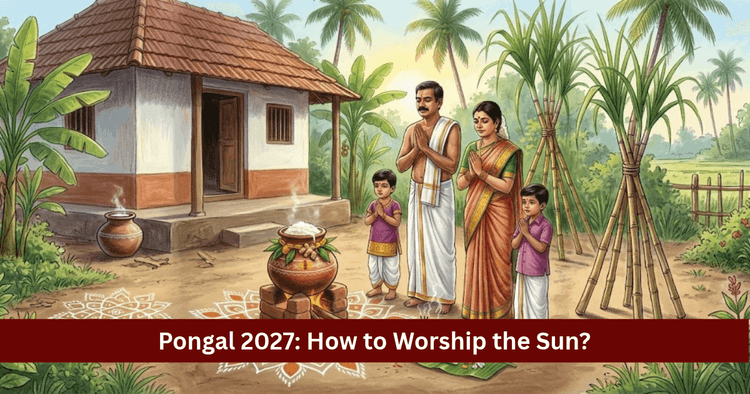
Table of Contents
When Prosperity Overflows With the Boiling Milk
In the homes of Tamil Nadu, the first morning of the month of Thai is filled with a special sense of anticipation. Before sunrise a beautiful kolam of rice flour appears in the courtyard. Tall stalks of sugarcane stand on both sides of the door. A new clay pot, with fresh turmeric and ginger plants tied around its neck, is placed on a stove under the open sky. The whole family stands around that pot waiting for the one moment when the milk will boil over. And as soon as it rises and spills, everyone calls out together, "Pongalo Pongal".
This is Thai Pongal, the greatest harvest festival of Tamil society and a festival of gratitude to Surya Dev, the Sun God. In 2027, Pongal will be celebrated on Friday, 15 January, on the day of Makar Sankranti.
| Detail | Information |
|---|---|
| Name of the festival | Thai Pongal |
| Date | 15 January 2027 |
| Day | Friday |
| Tamil month | First day of the month of Thai |
| Basis of the calendar | Solar calendar, Makar Sankranti |
| Sun enters Capricorn (Makar) | Night of 14 January 2027 |
| Punya Kaal (auspicious period) | 15 January, from sunrise until midday |
| Lunar month and fortnight | Paush month, Shukla Paksha (waxing fortnight) |
| Lunar tithi | Around Shukla Saptami (seventh lunar day) |
| Sunrise in Chennai | Approximately 6:35 in the morning |
| Sunset in Chennai | Approximately 6:05 in the evening |
| Best time to cook Pongal | From sunrise until about 10:50 in the morning |
| Rahu Kaal (Chennai) | Approximately 10:55 in the morning to 12:20 in the afternoon |
| Deity worshipped | Surya Dev, the Sun God |
Since the Sun changes sign on the night of 14 January, the Punya Kaal of the Sankranti falls on the following morning, 15 January. Cooking the pongal and offering it to the Sun after sunrise and before Rahu Kaal will be most auspicious. Check the local Panchang for exact timings in your city.
Main Rituals at a Glance
- Bathing at dawn and wearing new clothes
- Drawing a kolam of rice flour in the courtyard
- Decorating the door with sugarcane, mango leaves and banana stems
- Cooking pongal in a new clay pot tied with turmeric and ginger plants
- Calling out "Pongalo Pongal" as the milk boils over
- Offering pongal, sugarcane, bananas and coconut to Surya Dev on a banana leaf
- Offering arghya (water offering) and aarti to the Sun
- A family meal and blessings from elders
What Is Pongal and How Did It Get Its Name?
"Pongal" is a Tamil word meaning to boil, to rise or to overflow. The name comes from the dish made on this day with new rice, milk and jaggery. But the word carries a deeper feeling too. Just as milk boils over the rim of the pot, may happiness, food and prosperity overflow in the life of the family. That is the prayer of this festival.
Pongal is a four day festival and Thai Pongal is the second and main day.
| Day | Festival | Date in 2027 | Main spirit |
|---|---|---|---|
| First day | Bhogi | 14 January, Thursday | Discarding old things, worship of Indra Dev |
| Second day | Thai Pongal | 15 January, Friday | Worship of Surya Dev, pongal of new rice |
| Third day | Mattu Pongal | 16 January, Saturday | Worship of cows and bulls |
| Fourth day | Kaanum Pongal | 17 January, Sunday | Visiting family, social bonding |
There is a very famous Tamil saying, "Thai Pirandhal Vazhi Pirakkum". It means that when the month of Thai is born, a new path is born. For the farmer, Thai is the time after the harvest, when there is grain at home, debts are repaid, marriages are arranged and new plans are made. That is why the first day of Thai is regarded as a day of hope and new beginnings.
Ancient Tamil Sangam literature also mentions the bathing, fasting and festivities of the month of Thai. This shows that the festival has been part of Tamil life for thousands of years. Today it is celebrated with great enthusiasm not only in Tamil Nadu but also in Puducherry, Sri Lanka, Malaysia, Singapore and by Tamil communities across the world.
The Story From Bhogi to Pongal
Bhogi is celebrated a day before Pongal. On this day the home is cleaned and old, broken or useless items are burned in a bonfire. Neem, mango leaves and avaram flowers are tied at the door, a custom called Kaappu Kattu. It is regarded as a symbol of protection for the home.
A beautiful story is linked to Bhogi. It is said that the people of Braj used to worship Indra, the god of rain, every year. Lord Krishna explained to them that the rain, the earth and Govardhan hill were what truly sustained their cattle and fields, so they should worship nature. This angered Indra and he unleashed a terrible downpour. Krishna then lifted Govardhan hill on his little finger and saved everyone. Indra's pride was broken and he asked for forgiveness. Forgiving him, Krishna said that Indra too would continue to be honoured at harvest time. That is why on Bhogi, Indra is thanked for the rain.
The meaning of this sequence is beautiful. On the first day the god of rain is thanked, on the second day the Sun God, on the third day the animals and on the fourth day the family and society. A harvest is never the gift of one alone. Food reaches the home through the cooperation of rain, sunlight, animals and human beings. The four day sequence of Pongal celebrates this truth.
The Puja Vidhi of Thai Pongal
- Wake before sunrise and bathe. If possible, add a few sesame seeds to the water.
- Wear new or clean clothes. In the Tamil tradition, wearing new clothes on this day is considered auspicious.
- Wash the courtyard and draw a kolam with rice flour. In many homes the kolam shows the Sun, sugarcane or the pongal pot.
- Hang a garland of mango leaves at the door and stand stalks of sugarcane beside it.
- Tie a turmeric plant and a ginger plant around the neck of a new clay pot. Mark the pot with turmeric, sandalwood and kumkum.
- In an open courtyard where sunlight falls, light a stove of firewood or dried cow dung cakes and place the pot on it.
- Pour milk and water into the pot and wait for it to boil.
- As soon as the milk boils over, the whole family calls out "Pongalo Pongal" and blows a conch.
- Then add new rice, moong dal and jaggery to make sweet pongal. Finally add ghee, cashews, raisins and cardamom.
- Place the pongal, sugarcane, bananas, coconut, turmeric and betel leaves with betel nut on a banana leaf and offer it to Surya Dev.
- Offer arghya to the Sun from a copper vessel and chant the mantras given below.
- Perform the aarti with camphor, then touch the feet of elders for their blessings and share the prasad with the family.
The Belief About the Direction of the Overflow
In folk tradition, people watch which direction the milk overflows from the pot. Overflowing towards the east is considered most auspicious, because the east is the direction of the Sun. It is seen as a sign of happiness and prosperity in the coming year. This belief turns the moment into one of excitement and hope for the family.
Main Dishes of Pongal
| Dish | Main ingredients | Special feature |
|---|---|---|
| Sakkarai Pongal | New rice, moong dal, jaggery, ghee, cardamom | The sweet pongal offered to the Sun |
| Ven Pongal | Rice, moong dal, black pepper, cumin, ghee | Savoury pongal, the main morning meal |
| Sugarcane | Fresh sugarcane | A symbol of sweetness and prosperity |
| Vadai | Urad dal | Part of the festive meal |
| Payasam | Milk, rice or vermicelli, jaggery | A sweet dish |
Main Mantras for Pongal
| Mantra | Meaning | Purpose | Count |
|---|---|---|---|
| Om Ghrini Suryaya Namah | Salutations to the radiant Sun | Grace of Surya Dev, health and fame | 108 times |
| Om Hraam Hreem Hraum Sah Suryaya Namah | The seed mantra of the Sun, invoking his energy | Inner strength and leadership | 108 times |
| Om Adityaya Vidmahe Divakaraya Dhimahi, Tanno Suryah Prachodayat | May we know Aditya, meditate on the maker of the day and may the Sun inspire us | Surya Gayatri, for wisdom and radiance | 11 times |
Those who can give more time may also recite the Aditya Hridayam Stotra on this day. According to the Ramayana, the sage Agastya taught this hymn to Lord Rama before the battle, giving him the strength to win.
The Astrological Significance of Pongal
The foundation of Thai Pongal is the entry of the Sun into Capricorn. In Vedic astrology the Sun signifies the soul, the father, health, fame, government and leadership. According to tradition, Uttarayan begins with Makar Sankranti and is called the day of the gods. Worship of the Sun during this period is believed to bring manifold merit.
Capricorn is the sign of Saturn and Saturn is regarded as the son of the Sun. On Makar Sankranti the Sun visits the house of his son, a symbol of differences between father and son coming to an end. That is why sesame and jaggery are important on this day, as they please both Saturn and the Sun.
In 2027 the festival comes with a special alignment. At sunrise on this day the tithi will be around Shukla Saptami and traditionally the lord of the Saptami tithi is the Sun God himself. So the festival of the Sun falls close to the tithi of the Sun. The day is also a Friday, the day of Venus. Venus signifies sweetness, enjoyment, beauty, celebration and family happiness. For a festival of sweet pongal, sugarcane, new clothes and shared family meals, falling on the day of Venus makes it even more joyful.
Remedies to Strengthen the Sun
| Situation | Remedy on Pongal |
|---|---|
| Weak Sun in the horoscope | At sunrise, offer arghya from a copper vessel with red flowers and jaggery |
| Tension in the relationship with the father | Touch your father's feet for his blessings and feed him sweet pongal |
| Obstacles in government work | Donate wheat, jaggery and copper |
| Lack of self confidence | Recite the Aditya Hridayam Stotra |
| Frequent poor health | Practise Surya Namaskar and chant the Sun's seed mantra |
| Shani's Sade Sati or Dhaiya | Donate black sesame and jaggery |
The Spiritual and Social Message of Pongal
The greatest message of Pongal is gratitude. Thanking the Sun, without whom not a single grain could grow, once a year with the whole family reminds human beings of their limits and their dependence on nature. The boiling milk is not just a kitchen scene. It is a symbol of the feeling that when the heart fills with gratitude, it too overflows and reaches others.
Pongal is cooked in an open courtyard before the Sun, not in a closed kitchen. Behind this lies a beautiful idea. Food that grew by the grace of the Sun should first be cooked and offered before the Sun himself. This tradition gives people a chance to connect directly with nature.
From a social point of view, Pongal brings the whole community together. On this day pongal is shared among neighbours, farmers give new clothes and grain to their farm workers and all members of the family sit and eat together. In today's busy life, where family members live in different cities, Pongal becomes a reason to bring them back to one courtyard.
Benefits of Celebrating Pongal
- Health, fame and inner strength through the grace of Surya Dev
- The belief in growth of food and wealth at home
- Sweetness in the relationship between father and son
- Relief from Saturn's troubles
- Love and unity in the family
- An auspicious start for new work and plans
Dos and Donts
| Do | Do not |
|---|---|
| Bathe before sunrise | Do not sleep late after sunrise |
| Cook pongal in the open courtyard facing the Sun | Do not offer pongal during Rahu Kaal |
| Use a new clay pot | Do not use an old or broken pot |
| Make the first offering to Surya Dev | Do not eat pongal before the offering |
| Share pongal with neighbours and the needy | Do not waste food |
| Donate sesame, jaggery and grain | Do not speak harshly to anyone |
When the First Ray of the Sun Descends as a Blessing
On the morning of Thai Pongal, when the first ray of the Sun falls on the kolam decorated courtyard and milk overflows from the clay pot, the moment is no longer just a tradition. It becomes a silent conversation between humanity, nature and God. On Friday, 15 January 2027, when the Sun will have entered Capricorn and the first sun of Thai will rise, a single arghya offered with a sincere heart and a single leaf of pongal shared with love can open a new path for the whole year. In a home where gratitude overflows, prosperity never stops.
FAQ
When is Pongal 2027?
Thai Pongal 2027 will be celebrated on Friday, 15 January, on Makar Sankranti. Bhogi falls on 14 January, Mattu Pongal on 16 January and Kaanum Pongal on 17 January.
What is the auspicious time to cook Pongal?
On 15 January, cooking pongal and offering it to the Sun from sunrise until about 10:50 in the morning, before Rahu Kaal, is best.
Which deity is worshipped on Pongal?
Surya Dev is worshipped on Thai Pongal. He is offered sweet pongal made from new rice, along with sugarcane, bananas and coconut.
Why do people say Pongalo Pongal?
When the milk boils over the pot, the family calls out "Pongalo Pongal". It is a prayer for happiness and prosperity to overflow in life.
What is the astrological significance of Pongal?
The festival is linked to the Sun's entry into Capricorn and the start of Uttarayan. Worshipping the Sun on this day is believed to bring inner strength, health and fame.
Get your accurate Kundali
Generate KundaliDid you like it?
Author

Pt. Narendra Sharma (63)
Experience: 20
Consults About: Family Planning, Career
Clients In: Punjab, Haryana, Delhi
Share this article with friends and family
About ZODIAQ
ZODIAQ is an online Vedic Astrology platform. It connects clients seeking astrological advice to experienced astrologers with deep knowledge. Our users also generate kundali and perform kundali milan for free. ZODIAQ also offers services to the Astrologers. Astrologers utilize various offerings by ZODIAQ to serve their clients effectively.
If you are a User
Consult with experienced astrologers and seek their guidance. You can also order handwritten Janm Patrika report with life prediction prepared by experienced astrologers. Generate accurate Kundali, perform Kundali Matching and check horoscope and muhurat. Utilize our online library for all the necessary astrological and spiritual information.
If you are an Astrologer
Create accurate kundali for your clients and perform Kundali Matching for up to 5 people at a time. Write comprehensive Janm Patrika report for your clients with ZODIAQ. Check client details anytime by saving it in client directory. Become more productive by tracking how many clients you guide every day.
WELCOME TO
ZODIAQ
Right Decisions at the right time with ZODIAQ
