Why Is Vaishnava Putrada Ekadashi 2027 Different?
By Pt. Narendra Sharma
The rule of Dashami viddha, the story of King Ambarisha and a rare alignment with Krishna's birth nakshatra
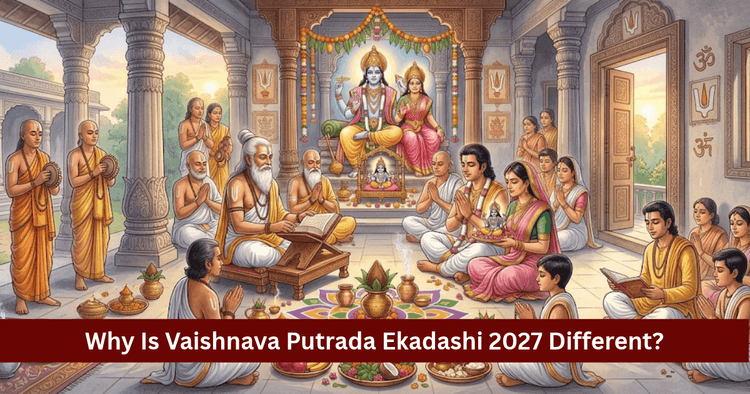
Table of Contents
When a Fast of Devotion Meets the Precision of the Panchang
In the Vaishnava tradition, Ekadashi is not merely a fast. It is called Hari Vasara, the day of Lord Hari. For a Vaishnava devotee, it is the day to set everything aside and become absorbed in the name, form and pastimes of the Lord. Because of this spirit, the Vaishnava sampradayas (traditions) have kept the rules for reckoning Ekadashi very precise and pure. Because of these rules, the Vaishnava Ekadashi sometimes falls a day after the ordinary Smarta Ekadashi.
This is what is happening with Pausha Putrada Ekadashi in 2027. The Smarta Putrada Ekadashi falls on Monday, 18 January, while the Vaishnava Pausha Putrada Ekadashi will be observed on Tuesday, 19 January.
| Detail | Information |
|---|---|
| Name of the fast | Vaishnava Pausha Putrada Ekadashi |
| Date | 19 January 2027 |
| Day | Tuesday |
| Hindu month | Paush |
| Paksha (fortnight) | Shukla Paksha (waxing fortnight) |
| Tithi (lunar day) | Ekadashi, turning into Dwadashi some time after sunrise |
| Smarta Putrada Ekadashi | 18 January 2027, Monday |
| Day of parana (breaking the fast) | 20 January 2027, Wednesday |
| Rule for parana | After sunrise and before Dwadashi ends |
| Position of the Moon | Taurus, Rohini nakshatra |
| Position of the Sun | Capricorn (Makar) |
| Sunrise in Delhi | Approximately 7:15 in the morning |
| Deity worshipped | Lord Vishnu, Shri Krishna |
Budha Pradosh Vrat also falls on 20 January and it is observed on the Trayodashi tithi. This means that on that day the Dwadashi tithi will end after some time and turn into Trayodashi. In the Vaishnava tradition, breaking the fast within Dwadashi is considered very important. So look carefully at the parana time given in the Panchang of your sampradaya or temple and break the fast within it.
Main Observances at a Glance
- Restraint and sattvic prasad from the evening of Dashami
- Complete avoidance of grains, pulses and beans on Ekadashi
- Bathing in Brahma Muhurat (the hour before dawn) and service to Tulsi and the Lord
- Chanting the holy name, kirtan and hearing the Shrimad Bhagavatam
- Avoiding sleep during the day and keeping a night vigil
- Offering bhog to the Lord within Dwadashi and breaking the fast with that prasad
Why Does the Vaishnava Ekadashi Differ From the Smarta Ekadashi?
The Vaishnava tradition gives the greatest importance to the purity of Ekadashi. According to this tradition, Ekadashi is fixed not only by sunrise but by Arunodaya. Arunodaya is the period about 96 minutes before sunrise, when the first redness appears in the sky.
If even a small trace of Dashami tithi is present at Arunodaya, that Ekadashi is called Dashami viddha. Viddha means affected by contact. According to the Vaishnava scriptures, the fast is not kept on an Ekadashi touched by Dashami and is moved to the next day. The idea behind this is that a fast offered to the Lord should be completely pure, with no mixing of another tithi.
In the Gaudiya Vaishnava tradition, the Hari Bhakti Vilasa compiled by Shri Sanatana Goswami is regarded as the main authority on Vaishnava conduct. It describes the rules of Ekadashi in great detail. Similarly, the Shri sampradaya, Madhva sampradaya, Nimbarka sampradaya and Vallabha sampradaya each have their own traditions, in which the rules for reckoning Ekadashi may differ slightly.
| Sampradaya | Principal Acharya | Main deity |
|---|---|---|
| Shri sampradaya | Shri Ramanujacharya | Lakshmi Narayana |
| Madhva sampradaya | Shri Madhvacharya | Shri Krishna, Vishnu |
| Nimbarka sampradaya | Shri Nimbarkacharya | Radha Krishna |
| Vallabha sampradaya | Shri Vallabhacharya | Shrinathji, Bal Krishna |
| Gaudiya sampradaya | Shri Chaitanya Mahaprabhu | Radha Krishna |
So every Vaishnava devotee should choose the day of the fast according to the Panchang of their own sampradaya or temple.
The Story of King Ambarisha: A Wonderful Episode of Ekadashi and Dwadashi
In the Vaishnava tradition, the most famous story explaining the importance of Ekadashi is that of King Ambarisha, told in the ninth canto of the Shrimad Bhagavatam. The story is especially important because it also makes clear the rule of breaking the fast within Dwadashi.
King Ambarisha ruled the seven continents but his heart was set not on the world but on the Lord. With his speech he sang the Lord's glories, with his hands he served the temple, with his ears he heard the Lord's stories and with his eyes he beheld the Lord. He kept every Ekadashi fast with full discipline.
Once the king kept a special year long vow of Ekadashi and Dwadashi. At its completion, on Dwadashi, just as he was about to break his fast, the sage Durvasa arrived with his disciples. The king welcomed him with respect and invited him to eat. Durvasa said he would first bathe in the Yamuna and then return and he left.
The sage was very late in returning. The Dwadashi tithi was about to end. The king faced a dilemma of dharma. If he ate without his guest, the guest would be insulted. And if he did not break the fast within Dwadashi, the vow would be broken. Then, on the advice of the Brahmins, the king broke the fast by drinking only water, because the scriptures regard drinking water as both eating and not eating.
When Durvasa returned and learned of this, he became furious. He created a terrible demoness from a lock of his hair and sent her to kill the king. The king stood calmly, because he had complete faith in the Lord. At that moment the Lord's Sudarshana Chakra appeared, destroyed the demoness and then began to chase Durvasa.
Durvasa went for protection to Brahma, to Shiva and finally to Lord Vishnu himself. The Lord said, "I am under the control of my devotees. The devotees are my heart and I am the heart of the devotees. Only Ambarisha can protect you." At last Durvasa returned to Ambarisha. The king humbly praised the Sudarshana Chakra and saved the sage. All this time the king himself had not eaten, because he had been waiting for his guest to return.
The Messages of the Story
- The Ekadashi fast is complete surrender to the Lord
- Breaking the fast within Dwadashi is an essential part of the vow
- The Lord himself protects a true devotee
- Pride, even that of an ascetic, bows in the end
- The greatest qualities of a devotee are humility and forgiveness
Vaishnava Food Rules for Ekadashi
In the Vaishnava tradition, the food rules for Ekadashi can be stricter than the general ones. They vary by sampradaya but the following are commonly followed.
| Items to avoid | Items that may be taken |
|---|---|
| All grains such as rice, wheat, barley and millet | Fruits and dry fruits |
| All pulses such as moong, arhar, chana and urad | Milk, curd butter and ghee |
| Beans such as peas and rajma | Some vegetables such as potato, sweet potato and arbi |
| Flour made from grains and gram flour | Buckwheat, water chestnut and amaranth flour |
| Onion, garlic and non vegetarian food | Rock salt, black pepper and cumin |
| Alcohol and intoxicants | Coconut and peanuts |
Many Gaudiya Vaishnava devotees also give up certain spices on this day. Those who are able keep a nirjala fast, without even water. But Vaishnava Acharyas have always said that the root purpose of the fast is to remember the Lord more. If hunger turns the mind away from the Lord towards worrying about food, it is better to take fruits and keep the mind on devotion.
The Worship and Service Vidhi of Vaishnava Putrada Ekadashi
- On the evening of 18 January, take sattvic prasad before sunset and make the vow for the next day's fast.
- On 19 January, wake in Brahma Muhurat, bathe and apply tilak.
- Offer water to Tulsi Maharani and walk around her. Remember that Tulsi leaves are not plucked on Ekadashi.
- Perform the Mangala Aarti (dawn worship) of Lord Shri Krishna or Vishnu.
- Bathe the deity with panchamrit and adorn him with new clothes and flowers.
- Offer Ekadashi bhog of fruits, dry fruits and milk preparations, with Tulsi leaves plucked in advance.
- Chant the Hare Krishna Mahamantra. Devotees of the Gaudiya tradition chant more rounds than usual on this day.
- Read the Shrimad Bhagavatam, especially the story of Ambarisha or the Bhagavad Gita.
- Read or listen to the story of Putrada Ekadashi.
- Perform the evening aarti and kirtan.
- Keep a night vigil with devotional songs and stories of the Lord.
- On 20 January after sunrise, offer grain bhog to the Lord and break the fast with that prasad before Dwadashi ends.
Main Mantras
| Mantra | Meaning | Purpose | Count |
|---|---|---|---|
| Hare Krishna Hare Krishna Krishna Krishna Hare Hare, Hare Rama Hare Rama Rama Rama Hare Hare | A calling out to the Lord and his divine energy through the names Hare, Krishna and Rama | The Hare Krishna Mahamantra, for pure devotion | Rounds according to tradition |
| Om Namo Bhagavate Vasudevaya | Salutations to Lord Vasudeva | Surrender to Lord Vasudeva | 108 times |
| Om Devakisuta Govinda Vasudeva Jagatpate, Dehi Me Tanayam Krishna Tvamaham Sharanam Gatah | O son of Devaki, Govinda, Vasudeva, Lord of the universe, Krishna, grant me a child, I take refuge in you | Santana Gopala mantra | 108 times |
The Kali Santarana Upanishad describes the Hare Krishna Mahamantra as the most powerful name mantra for the Kali Yuga. It contains only three names of the Lord, Hare, Krishna and Rama, repeated 16 times. In the Vaishnava tradition, Ekadashi is regarded as a special day for chanting the holy name.
The Astrological Significance of Vaishnava Putrada Ekadashi
A very beautiful alignment forms on the Vaishnava Putrada Ekadashi of 2027. On this day the Moon will be in Rohini nakshatra. Rohini is the very nakshatra in which Lord Shri Krishna was born. Rohini nakshatra holds special importance on Janmashtami too. So the Ekadashi of Krishna's devotees falls in Krishna's own birth nakshatra.
The Moon is also in Taurus, the sign of its exaltation. The symbol of Taurus is the bull and the sign is associated with cows, farming and nourishment. For the worship of Gopala Krishna, the protector of cows, this position is especially meaningful.
For Vaishnava householders fasting with the wish for children, this alignment is also auspicious. In astrology the Moon signifies the mother and the womb and children are judged from the fifth house and Jupiter. A strong Moon together with the worship of Lord Vishnu, regarded as the presiding deity of Jupiter, can be considered auspicious for the blessing of children.
The day is a Tuesday and the Sun is in Capricorn. The firmness of Mars gives strength for a strict fast and a night vigil, while the Sun in Capricorn points to austerity and restraint.
| Astrological element | Position | Indication |
|---|---|---|
| Nakshatra | Rohini | The birth nakshatra of Shri Krishna |
| Moon | Exalted in Taurus | Steadiness of mind, motherhood |
| Sun | Capricorn | Austerity and restraint |
| Weekday | Tuesday | Firm resolve |
| Tithi | Ekadashi into Dwadashi | Hari Vasara and the Lord's beloved tithi |
Benefits of the Vaishnava Ekadashi Fast
- Grace of Lord Shri Krishna and Vishnu
- Growth of pure devotion and love for the holy name
- The belief in the fulfilment of the wish for children
- Shedding of sins and purification of the mind
- Restraint of the senses and inner strength
- Love, peace and devotion to the Lord in the family
Dos and Donts
| Do | Do not |
|---|---|
| Fast according to your sampradaya's Panchang | Do not eat grains, pulses or beans |
| Serve and walk around Tulsi | Do not pluck Tulsi leaves on Ekadashi |
| Chant the holy name and sing kirtan | Do not sleep during the day |
| Hear the Shrimad Bhagavatam | Do not criticise any tradition |
| Break the fast within Dwadashi | Do not break the fast after Dwadashi has passed |
| Honour guests and Vaishnavas | Avoid anger and pride |
When a Devotee's Purity Wins the Heart of the Lord
Vaishnava Putrada Ekadashi teaches that precision in devotion is also a form of love. Just as a lover carefully prepares every gift for the beloved, a Vaishnava devotee wishes to keep the fast pure in every way. The story of King Ambarisha reminds us that the Sudarshana Chakra itself appears to protect such a devotee. On 19 January 2027, when the Moon is in Rohini, the birth nakshatra of Shri Krishna, this fast kept with the holy name, service to Tulsi and sincere prayer can open the door to the blessing of children, peace and the love of the Lord in a devotee's life. The Lord says that the devotee is his heart and one who becomes his heart has nothing left to fear.
FAQ
When is Vaishnava Pausha Putrada Ekadashi 2027?
Vaishnava Pausha Putrada Ekadashi 2027 falls on Tuesday, 19 January. The Smarta Putrada Ekadashi falls on 18 January.
Why does the Vaishnava Ekadashi fall a day later?
In the Vaishnava tradition, if a trace of Dashami is present at Arunodaya, the Ekadashi is regarded as Dashami viddha and the fast is kept on the next day.
When should the Vaishnava Putrada Ekadashi fast be broken?
Break the fast on 20 January after sunrise and before Dwadashi ends. Check the exact time in your sampradaya's Panchang.
What should not be eaten on Vaishnava Ekadashi?
All grains, pulses, beans, onion, garlic and non vegetarian food are given up on this day. Fruits, milk and fasting foods such as buckwheat may be taken.
Why is the story of King Ambarisha read on Ekadashi?
The story of King Ambarisha shows the glory of the Ekadashi fast and the importance of breaking it within Dwadashi and it shows that the Lord himself protects his devotee.
Get your accurate Kundali
Generate KundaliDid you like it?
Author
Pt. Narendra Sharma (63)
Experience: 20
Consults About: Family Planning, Career
Clients In: Punjab, Haryana, Delhi
Share this article with friends and family
About ZODIAQ
ZODIAQ is an online Vedic Astrology platform. It connects clients seeking astrological advice to experienced astrologers with deep knowledge. Our users also generate kundali and perform kundali milan for free. ZODIAQ also offers services to the Astrologers. Astrologers utilize various offerings by ZODIAQ to serve their clients effectively.
If you are a User
Consult with experienced astrologers and seek their guidance. You can also order handwritten Janm Patrika report with life prediction prepared by experienced astrologers. Generate accurate Kundali, perform Kundali Matching and check horoscope and muhurat. Utilize our online library for all the necessary astrological and spiritual information.
If you are an Astrologer
Create accurate kundali for your clients and perform Kundali Matching for up to 5 people at a time. Write comprehensive Janm Patrika report for your clients with ZODIAQ. Check client details anytime by saving it in client directory. Become more productive by tracking how many clients you guide every day.
WELCOME TO
ZODIAQ
Right Decisions at the right time with ZODIAQ
