Ashwasena Naga’s Revenge
By Pt. Nilesh Sharma
The Mahabharata secret of Karna's arrow and Sri Krishna's play
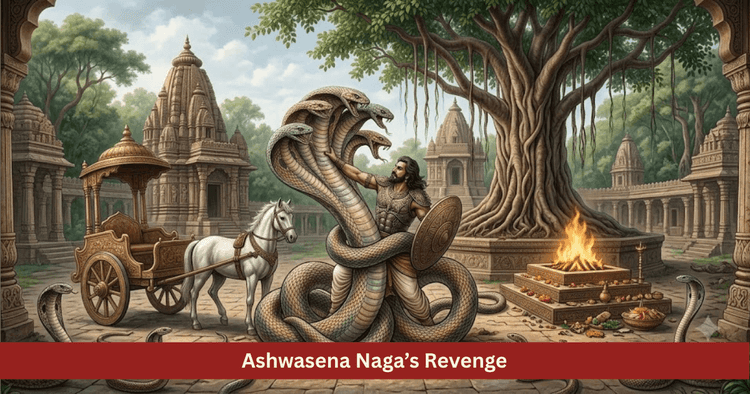
Table of Contents
From Khandava Forest to Kurukshetra
In the Mahabharata war, the generous Karna had a serpent named Ashwasena present with him and that serpent could take the form of an arrow. This was the same serpent whose family was burned to ashes when Arjuna set fire to the Khandava forest. Burning in the fire of revenge, Ashwasena went and sat upon Karna’s arrow so that he could kill Arjuna. however through the play of Sri Krishna, Arjuna’s chariot sank into the earth and the arrow passed by, carrying away Arjuna’s crown. This story shows how deadly and unerring the energy of Nagas can become when they act from a sense of revenge.
| Subject | Details |
|---|---|
| Name of the serpent | Ashwasena |
| Father | Takshaka Naga |
| Relation | Enemy seeking revenge against Arjuna |
| Initial episode | Burning of the Khandava forest |
| Mahabharata episode | Battle between Karna and Arjuna |
| Result | Arjuna was saved |
This episode is not merely a battle story. It is a deep indication of anger, revenge, karma and divine intervention. When a being turns sorrow into revenge, its energy becomes sharp, yet its direction also becomes dangerous.
Who Was Ashwasena
Ashwasena was the son of Takshaka Naga. When the Khandava forest was burning, his mother swallowed him in an attempt to save him. She fled through the sky path but Arjuna saw her and shot an arrow at her hood. Ashwasena's mother died but Ashwasena escaped.
| Fact | Details |
|---|---|
| Father | Takshaka Naga |
| Mother | The suffering serpent queen of Khandava forest |
| Rescue | Mother tried to save him by placing him in her mouth |
| Event | Arjuna's arrow |
| Result | Mother died, Ashwasena escaped |
This event ignited such a fire of revenge within him that he regarded Arjuna as a lifelong enemy. The story shows that unhealed grief can turn into enduring hostility.
Effect of the Khandava Forest Fire
The burning of the Khandava forest is an extremely important episode in the Mahabharata. Sri Krishna and Arjuna supported Agni and therefore the burning of the forest became possible. Many beings were destroyed in this fire. Ashwasena's mother was among those victims.
| Episode | Effect |
|---|---|
| Burning of Khandava forest | Destruction of forest |
| Loss of living beings | Intense sorrow |
| Ashwasena's mother | Death |
| Ashwasena's mind | Revenge |
| Enmity toward Arjuna | Lasting hostility |
This makes it clear that even in acts done for dharma, if a living being receives a deep wound, its memory can remain alive for a very long time. Naga consciousness is regarded as sharp and memorable.
The Fire of Revenge
Ashwasena escaped, yet his heart found no peace. When he learned that the great war was going to take place in Kurukshetra, he planned to kill Arjuna. He felt that if Arjuna died, the strength of the Pandavas would be reduced by half.
| Feeling | Result |
|---|---|
| Sorrow | Anger |
| Anger | Revenge |
| Revenge | Search for opportunity in war |
| Aim | Killing Arjuna |
| Expectation | Weakening of the Pandavas |
Here the darker side of Naga energy becomes visible, when protection turns into revenge. When power has no peace, the same power can become destructive.
Karna and the Naga Arrow
In the Mahabharata war, Ashwasena entered Karna's quiver and decided to take the form of an arrow to attack Arjuna. Karna had no awareness of it. Ashwasena thought that if he rode upon the arrow and was released, Arjuna's death would become certain.
Sequence of events
-
Karna and Arjuna were locked in fierce combat.
-
Ashwasena entered Karna's quiver.
-
Karna released the arrow.
-
The target was Arjuna's death.
-
Sri Krishna immediately understood the situation.
| Step | Details |
|---|---|
| Plan | Killing of Arjuna |
| Means | Karna's arrow |
| Supporting force | Ashwasena Naga |
| Result | Failure of the attempt |
| Divine intervention | Sri Krishna's play |
This episode also reveals that in a great war, not only outer force but also subtle intentions enter the battlefield.
The Play of Sri Krishna
When Karna released the arrow, Sri Krishna understood the situation through his far seeing wisdom. He caused Arjuna's chariot to sink into the earth. As a result, the arrow passed by, tearing away Arjuna's crown instead of striking his neck.
| Sri Krishna's play | Effect |
|---|---|
| Chariot sinking into earth | Target changed |
| Crown broken | Arjuna was saved |
| Arrow failed | Ashwasena's defeat |
| Timing | Divine protection |
This event is not just a miracle. It shows that for the protection of dharma, timing, vision and subtle arrangement all work together. Where a human sees only an arrow, Sri Krishna sees the root cause.
The Nature of Naga Energy
This story gives a profound lesson about Naga energy. The power of a Naga is intense. It is subtle and also unerring. If revenge fills it, it becomes extremely destructive.
| Naga energy | Quality |
|---|---|
| Intensity | Quick response |
| Subtlety | Hidden influence |
| Memory | Does not forget enmity |
| Precision | Hits the target |
| Revenge | Destructive form |
This very strength makes Nagas both fearsome and profound. They can protect and they can strike. That is why the Puranic tradition holds both reverence and caution toward Nagas.
Karna's Role
Karna was generous and heroic. Yet in this episode, he became a vehicle for Ashwasena. Karna's valor and the serpent's revenge joined together to create a deadly attack on Arjuna. Still, the divine order defeated it.
| Aspect of Karna | Details |
|---|---|
| Generosity | Great donor |
| Valor | Immense bravery |
| Error | Not understanding the serpent's plan |
| Result | The arrow failed |
This teaches that valor must be accompanied by discernment. Strength alone is not enough. Insight and alertness are also needed.
The Karmic Result of Revenge
Ashwasena's story also points toward karma. His family burned and that was his sorrow. But sorrow does not become answered by revenge. When revenge becomes the center of life, one's own energy begins to scatter.
| Feeling | Karmic result |
|---|---|
| Sorrow | Memory |
| Memory | Enmity |
| Enmity | Violence |
| Violence | Instability |
| Instability | Destruction |
This episode teaches that nurturing hostility for too long makes a being's consciousness more rigid. The path of dharma is compassion, restraint and understanding.
Spiritual Message of This Story
The story of Ashwasena Naga can be read on many levels. Outwardly it is a battle episode. Inwardly it is a story of anger, revenge, divine protection and unfinished enmity.
-
Revenge gives power, yet it takes away peace.
-
Divine intervention remains active in the protection of dharma.
-
Naga energy is subtle, intense and influential.
-
Valor must be joined with discernment.
-
Self restraint is greater than hostility.
| Message | Meaning |
|---|---|
| Revenge | Destructive fire |
| Dharma protection | Divine order |
| Naga power | Subtle intensity |
| Discernment | Right decision |
| Restraint | Spiritual strength |
The true fruit of this story arises when a person recognizes the Ashwasena within and transforms it into peace.
FAQ
Who was Ashwasena Naga?
Ashwasena was the son of Takshaka Naga and is remembered in the Mahabharata as an enemy seeking revenge against Arjuna.
Why did Ashwasena want to kill Arjuna?
His mother died during the burning of the Khandava forest, so he wanted to kill Arjuna out of revenge.
How did Ashwasena come onto Karna's arrow?
During the Kurukshetra war, Ashwasena entered Karna's quiver and tried to attack Arjuna in the form of an arrow.
How was Arjuna saved?
Sri Krishna made Arjuna's chariot sink into the earth, causing the arrow to pass by after touching Arjuna's crown.
What is the main message of this story?
The main message is that revenge leads toward destruction, while divine power remains active in the protection of dharma.
Get your accurate Kundali
Generate KundaliDid you like it?
Author

Pt. Nilesh Sharma (63)
Experience: 20
Consults About: Family Planning, Career
Clients In: Punjab, Haryana, Delhi
Share this article with friends and family
About ZODIAQ
ZODIAQ is an online Vedic Astrology platform. It connects clients seeking astrological advice to experienced astrologers with deep knowledge. Our users also generate kundali and perform kundali milan for free. ZODIAQ also offers services to the Astrologers. Astrologers utilize various offerings by ZODIAQ to serve their clients effectively.
If you are a User
Consult with experienced astrologers and seek their guidance. You can also order handwritten Janm Patrika report with life prediction prepared by experienced astrologers. Generate accurate Kundali, perform Kundali Matching and check horoscope and muhurat. Utilize our online library for all the necessary astrological and spiritual information.
If you are an Astrologer
Create accurate kundali for your clients and perform Kundali Matching for up to 5 people at a time. Write comprehensive Janm Patrika report for your clients with ZODIAQ. Check client details anytime by saving it in client directory. Become more productive by tracking how many clients you guide every day.
WELCOME TO
ZODIAQ
Right Decisions at the right time with ZODIAQ
