Balarama as Sheshnaga Avatar
By Aparna Patni
Wondrous episode of return to Kshira Sagara and dharma protection
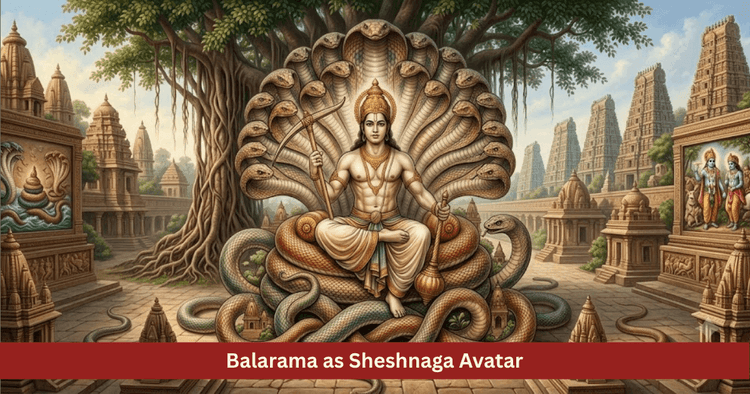
Table of Contents
Return to Kshira Sagara
In Dvapara Yuga, Lord Sri Krishna's elder brother Balarama was the direct incarnation of Sheshanaga himself. According to Srimad Bhagavata, when the Yadu dynasty was destroyed and Balarama decided to leave his body, he sat in meditation posture on the seashore. At that time, from his mouth emerged a massive white serpent with a thousand hoods, which directly merged into the Kshira Sagara within the ocean. This event shows how the divine consciousness of Sheshanaga descends to the earth plane to protect dharma and, upon completion of the task, merges back into its cosmic form.
| Subject | Details |
|---|---|
| Avatar | Balarama, part of Sheshanaga |
| Yuga | Dvapara Yuga |
| Relation | Elder brother of Sri Krishna |
| End | Meditation on seashore |
| Manifestation | Thousand hooded Sheshanaga |
| Merging place | Kshira Sagara |
| Message | Dharma protection and cosmic merging |
This story is not only a mythological event. It is a deep symbol of spiritual practice, karma yoga and the principle of avatar. Balarama's avatar and his end both reflect the protection of dharma and the cycle of divine consciousness.
Who Is Sheshanaga
Sheshanaga is also called Adishesha. He remains seated as the bed and canopy of Lord Vishnu. In Kshira Sagara, Lord Vishnu rests on the bed of Sheshanaga's hoods.
| Form of Sheshanaga | Meaning |
|---|---|
| Adishesha | The oldest and supreme |
| Vishnu's bed | Support and protection |
| Thousand hoods | Infinite power |
| Kshira Sagara abode | Divine realm |
| Avatar | Protection of dharma |
Sheshanaga is not only a serpent. He is cosmic energy, balance and protector of dharma. Whenever adharma increases on earth, Sheshanaga takes avatar.
Birth of Balarama and Sankarshana
The birth of Balarama was an extremely wonderful and divine event. This story is described in Srimad Bhagavata Mahapurana, Harivamsha Purana and other scriptures. Out of fear of Kamsa, the Yogamaya power of Lord Vishnu made the seventh pregnancy of Devaki invisible and transferred it to the womb of Rohini. Therefore Balarama is also called Sankarshana avatar, which means transfer of the womb.
| Birth element | Details |
|---|---|
| Mother | Rohini |
| Father | Vasudeva |
| Foster parents | Nanda and Yashoda |
| Avatar name | Sankarshana |
| Meaning | Transfer of womb |
Balarama remained with Nanda Baba in Gokula. He grew up with Sri Krishna and helped in the establishment of dharma.
Names and Form of Balarama
Balarama is known by many names. Baladeva, Haladhara, Sankarshana and Sheshanaga avatar are his prominent names.
| Name | Meaning |
|---|---|
| Balarama | Strength and bliss |
| Baladeva | Respect for elder brother |
| Haladhara | Bearer of the plough |
| Sankarshana | Transfer of womb |
| Sheshanaga avatar | Divine form |
Balarama's form was extremely radiant. He carried a plough and mace. He is regarded as the protector of agriculture, strength and dharma.
Protection of Dharma in Dvapara Yuga
In Dvapara Yuga, as the elder brother of Vishnu's avatar Krishna, Balarama played an important role in establishing dharma. Together with Krishna, he destroyed Kamsa and eliminated adharma.
| Action | Result |
|---|---|
| Killing of Kamsa | Destruction of adharma |
| Establishment of dharma | Victory of truth |
| Support to Krishna | Divine work |
| Neutrality in Mahabharata | Following dharma |
Balarama did not fight in the Mahabharata war. He remained neutral and followed dharma. He believed that there was adharma in both sides of the war.
Destruction of the Yadu Dynasty
The destruction of the Yadu dynasty was a tragic event. After this destruction, Balarama decided to leave his body. He went to the seashore and sat in meditation posture.
| Event | Details |
|---|---|
| Yadu dynasty destruction | Tragic end |
| Balarama's decision | Leaving the body |
| Place | Seashore |
| State | Meditation posture |
This event shows that when the work of dharma on earth is completed, the avatar merges back into its original form.
Manifestation of Sheshanaga
From the mouth of Balarama, seated in meditation on the seashore, emerged a massive white serpent with a thousand hoods. This was the divine form of Sheshanaga.
| Manifestation | Details |
|---|---|
| Form | Massive Sheshanaga |
| Hoods | Thousand |
| Color | White |
| Path | Directly into the ocean |
| Destination | Kshira Sagara |
This sight was extremely wonderful and divine. Devotees saw this event with their own eyes and this story has been coming down through generations.
Merging into Kshira Sagara
Sheshanaga directly merged into the Kshira Sagara within the ocean. Kshira Sagara is the abode of Lord Vishnu. Here Sheshanaga again became the bed of Vishnu.
| Merging | Meaning |
|---|---|
| Kshira Sagara | Abode of Vishnu |
| Bed | Support and protection |
| Cosmic form | Original form |
| Dharma complete | Avatar's work finished |
This event shows that upon completion of the avatar's work, it merges back into its cosmic form.
Divine Consciousness of Sheshanaga
The divine consciousness of Sheshanaga descends to the earth plane and protects dharma. Whenever adharma increases on earth, Sheshanaga takes avatar.
| Consciousness | Work |
|---|---|
| Dharma protection | Destruction of adharma |
| Avatar | Birth on earth |
| Work complete | Return |
| Cosmic merging | Original form |
In Treta Yuga, Sheshanaga took avatar as Lakshmana. In Dvapara Yuga, he became Balarama. In this way Sheshanaga protects dharma in every age.
Spiritual Message
Several deep spiritual messages are obtained from Balarama's avatar and his end.
-
Protection of dharma is supreme.
-
The work of avatar is establishing dharma.
-
Upon completion of work, return happens.
-
The consciousness of Sheshanaga is cosmic.
-
Liberation is attained through meditation and surrender.
| Message | Meaning |
|---|---|
| Dharma protection | Supreme duty |
| Avatar work | Establishment of dharma |
| Return | Completion of work |
| Cosmic consciousness | Infinite form |
| Meditation | Path to liberation |
Thus Balarama's life is a wonderful example of dharma, karma and devotion.
Protectors of Agriculture and Dharma
Balarama is regarded as the protector of agriculture and dharma. He carried a plough, which is a symbol of agriculture.
| Protection | Symbol |
|---|---|
| Agriculture | Plough |
| Dharma | Neutrality |
| Strength | Mace |
| Brotherly love | With Krishna |
Balarama's life teaches that both agriculture and dharma are the foundation of life.
Neutrality in Mahabharata
Balarama did not fight in the Mahabharata war. He remained neutral. He believed that there was adharma in both sides of the war.
| Neutrality | Reason |
|---|---|
| No war | Adharma in both sides |
| Following dharma | Justice |
| Support to Krishna | Brotherly love |
| Teaching Bhima and Duryodhana | Guru duty |
Balarama had taught mace fighting to both Bhima and Duryodhana. He remained just toward both.
FAQ
Who was Balarama?
Balarama was the elder brother of Lord Sri Krishna and is regarded as the direct incarnation of Sheshanaga.
How was Balarama born?
The birth of Balarama was wonderful. Yogamaya transferred the seventh pregnancy of Devaki to the womb of Rohini, therefore he is also called Sankarshana.
Why did Balarama not fight in the Mahabharata?
Balarama did not fight in the Mahabharata because he saw adharma in both sides. He remained neutral and followed dharma.
How did Balarama meet his end?
After the destruction of the Yadu dynasty, Balarama sat in meditation posture on the seashore. Sheshanaga emerged from his mouth and merged into Kshira Sagara.
Who is Sheshanaga?
Sheshanaga is called Adishesha and remains seated in Kshira Sagara as the bed and canopy of Lord Vishnu. He is the protector of dharma.
Get your accurate Kundali
Generate KundaliDid you like it?
Author

Aparna Patni (63)
Experience: 20
Consults About: Family Planning, Career
Clients In: Punjab, Haryana, Delhi
Share this article with friends and family
About ZODIAQ
ZODIAQ is an online Vedic Astrology platform. It connects clients seeking astrological advice to experienced astrologers with deep knowledge. Our users also generate kundali and perform kundali milan for free. ZODIAQ also offers services to the Astrologers. Astrologers utilize various offerings by ZODIAQ to serve their clients effectively.
If you are a User
Consult with experienced astrologers and seek their guidance. You can also order handwritten Janm Patrika report with life prediction prepared by experienced astrologers. Generate accurate Kundali, perform Kundali Matching and check horoscope and muhurat. Utilize our online library for all the necessary astrological and spiritual information.
If you are an Astrologer
Create accurate kundali for your clients and perform Kundali Matching for up to 5 people at a time. Write comprehensive Janm Patrika report for your clients with ZODIAQ. Check client details anytime by saving it in client directory. Become more productive by tracking how many clients you guide every day.
WELCOME TO
ZODIAQ
Right Decisions at the right time with ZODIAQ
