Garuda and Naga Rivalry
By Pt. Nilesh Sharma
The astrological meaning of the mythic hostility between Kadru, Vinata and Garuda
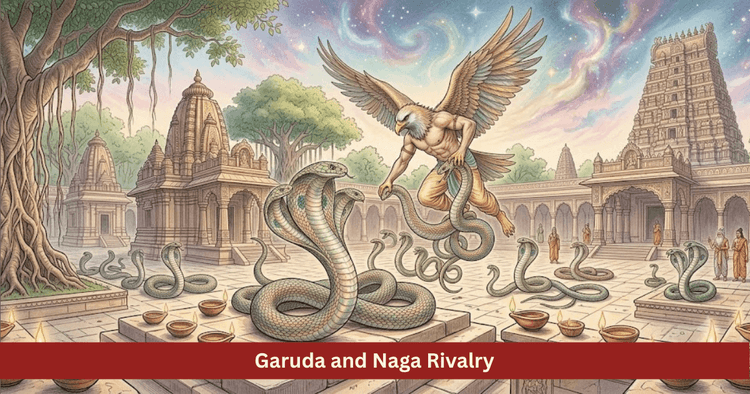
Table of Contents
The Bet of Kadru and Vinata
The roots of the natural hostility between king of birds Garuda and the Nagas are hidden in a wager between the two wives of Prajapati Kashyapa, Kadru and Vinata. Kadru was the mother of the Nagas and Vinata was the mother of Garuda. This wager later drew a deep line in the relations between the gods, the Nagas and Garuda. Kadru deceitfully made Vinata her slave and to free Vinata from the feeling of bondage Garuda had to bring the pot of amrita from the realm of the gods. For this reason Garuda became the supreme enemy of the Nagas. In astrology, the energies of Garuda and Naga are considered opposite to each other. On Nag Panchami, worshipping Garuda and Naga together removes enemy obstacles and family discord.
| Subject | Details |
|---|---|
| Core figures | Kadru and Vinata |
| Kadru's relation | Mother of the Nagas |
| Vinata's relation | Mother of Garuda |
| Main event | Wager and bondage |
| Garuda's task | Bringing the pot of amrita |
| Astrological meaning | Balancing opposite energies |
| Benefit of Nag Panchami | Relief from enemy obstacles and quarrels |
This story is not only a mythological conflict. It is also a deep symbol of ego, deceit, service, liberation and resolve. The enmity between Naga and Garuda appears intense on the surface, yet within it lies the pain of family relations and the struggle to protect dharma.
Kashyapa Rishi and His Two Wives
Prajapati Kashyapa had two prominent wives, Kadru and Vinata. Kadru was regarded as the mother of the Nagas and Vinata as the mother of Garuda and Aruna. Their natures were different and that difference later reflected in the fate of their offspring.
The branch of Kashyapa's descendants is highly famous in Puranic tradition. Kadru's children are described as serpents, while Vinata's children appear in the form of radiant birds. The seed of this contrast was originally planted in the rivalry between the mothers.
| Character | Role |
|---|---|
| Kashyapa | Prajapati and sage |
| Kadru | Mother of the Nagas |
| Vinata | Mother of Garuda |
| Naga offspring | Serpent lineage |
| Garuda offspring | Bird king lineage |
| Core emotion | Rivalry and hostility |
This story shows that even a small imbalance in a family can affect the relations of coming generations. Therefore dharma is not only a matter of outer worship, it also demands dignity and truth within the home.
Bondage Created by Deceit
According to the story, Kadru deceitfully made Vinata her slave. This event is not only a tale of victory or defeat. It is a symbol of that mental bondage which forces truth to bow before falsehood.
The feeling of slavery arises within a person when fear, confusion or greed cause him to lose his natural radiance. To free Vinata from bondage, Garuda had to take a great resolve. This resolve was not ordinary. It carried power, service and courage together.
| State | Meaning |
|---|---|
| Deceit | Influence of falsehood |
| Feeling of slavery | Mental and social bondage |
| Pain of Vinata | Humiliation and inequality |
| Garuda's resolve | Effort for liberation |
| Pot of amrita | Freedom and divinity |
This episode also makes it clear that hostility is not born only from the body but also from the wound of the mind. That is why Puranic stories touch psychology and dharma together.
Garuda Bringing Amrita
To liberate Vinata from bondage, Garuda had to bring the pot of amrita from the realm of the gods. This was an extremely heroic task. The pot of amrita was not only a vessel. It was a symbol of liberation, power and divine grace.
Garuda completed this task with his strength and intelligence. After this event he came to be regarded as the supreme enemy of the Nagas. Because the story of reaching amrita also involved the Nagas and later a lasting hostility became established between them.
| Episode | Meaning |
|---|---|
| Realm of the gods | The sphere of divine power |
| Pot of amrita | Immortality and liberation |
| Garuda's journey | Unyielding resolve |
| Result | Hostility with Nagas |
| Spiritual feeling | Liberation from bondage |
Garuda's action was not only for his mother. It was also a symbol of protecting dharma, restoring self respect and ending humiliation.
Why Are Garuda and Naga Considered Opposites?
Garuda and Naga are considered opposite energies. Garuda symbolizes the sky, movement, radiance and freedom. Naga symbolizes the earth, depth, kundalini and subtle mystery. One is upward moving and the other is inward looking.
This difference became the form of opposition in mythological symbols. From a scriptural perspective too, Garuda represents momentum and vitality while Naga represents stability, protection and hidden power. Both energies can create balance together, yet when imbalanced they create conflict.
| Energy | Qualities |
|---|---|
| Garuda | Movement, radiance, sky element |
| Naga | Depth, mystery, earth element |
| Garuda tendency | Upward moving and intense |
| Naga tendency | Inward looking and steady |
| Imbalance | Enmity and conflict |
Therefore in astrology and dharma both, it is believed that proper worship of these symbols brings balance. If one provokes the other without understanding its power, unnecessary conflict increases in life.
Meaning in Astrology
In astrology, the energies of Garuda and Naga are considered opposite to each other. This opposition is not only a matter of planets. It is an indication of two different tendencies at the level of energy. Garuda symbolizes radiance, decision and the power to rise upward. Naga symbolizes deep intuition, protection and hidden karmic force.
When these two energies become imbalanced in a person's life, tension may increase in decisions, relationships and conduct. Yet when balanced through proper worship and contemplation, the same energy becomes beneficial.
| Astrological sign | Effect |
|---|---|
| Garuda energy | Movement and victory |
| Naga energy | Peace and protection |
| Imbalance | Hostility and quarrels |
| Balance | Self defense and stability |
| Worship | Mental purification |
This aspect of astrology teaches a person that understanding opposition and establishing balance is dharma.
Joint Worship on Nag Panchami
On Nag Panchami, the tradition of worshipping Garuda and Naga together carries deep meaning. This worship is not only a symbolic union. It is a remedy for calming the roots of hostility. Learning to carry both Naga and Garuda energies together is wisdom.
When both are worshipped together, enemy obstacles and family discord are destroyed. Garuda represents radiance and Naga represents stability. Combined worship develops both courage and patience in a person.
| Aspect of worship | Result |
|---|---|
| Remembering Garuda | Courage and victory |
| Remembering Naga | Peace and protection |
| Joint worship | Pacification of enmity |
| Nag Panchami | Highly fruitful day |
| Family result | Reduction in quarrels |
This tradition also teaches that hostility should not be removed only from outside. It should also be pacified within consciousness. Only then does the home atmosphere become stable and auspicious.
Pacifying Enemy Obstacles
Enemy obstacles are not only external opposition. They also include clashes of thought, bitterness in relationships and repeated hindrances. On Nag Panchami the worship of Garuda and Naga is believed to provide relief on all these levels.
When a person directs energy correctly, enemies also begin to lose their effect. If Garuda's radiance and Naga's depth come together, fear within decreases and external opposition weakens.
| Form of enemy obstacle | Solution |
|---|---|
| Ideological opposition | Discernment |
| Family discord | Harmony |
| External enemy | Inner strength |
| Mental unrest | Worship and restraint |
| Karmic blockage | Pure conduct |
Therefore this worship is not only faith. It is a deep spiritual method of handling life's adversity.
Family Discord and Its Remedy
The story of Kadru and Vinata is also a deep symbol of family discord. Sometimes a small lie, inequality or ego creates tension that lasts for generations. In this story the feeling of bondage and liberation teaches that hostility born from humiliation is not easy to remove, yet it is certainly possible.
The worship of Garuda and Naga on Nag Panchami is linked with calming such bitter relations within the family. When one side of the home speaks only in the language of victory and the other only in the language of pain, conflict increases. Worship brings humility into the mind.
| Family problem | Spiritual remedy |
|---|---|
| Ego | Humility |
| Falsehood | Truth |
| Bitterness | Gentle speech |
| Distrust | Faith |
| Hostility | Joint worship |
Therefore Nag Panchami is not only a day of serpent worship for families. It is also an opportunity to restore balance in relationships.
The Balanced Message of Garuda and Naga
From the story of Garuda and Naga one should understand that every opposition is not hostility. Sometimes two different powers live together in one life. One gives movement, the other depth. One gives progress, the other protection.
If balance remains between these two, a person becomes radiant and calm together. He moves forward and remains steady within. This is the greatest message of this mythological story.
| Power | Positive use |
|---|---|
| Garuda | Goal, courage, victory |
| Naga | Caution, depth, protection |
| Balance of both | Mature life |
| Imbalance | Conflict |
| Joint remembrance | Peace and success |
Thus on Nag Panchami, worshipping both Garuda and Naga is not an outer tradition alone. It is a subtle discipline that balances life.
FAQ
Why are Garuda and Naga considered enemies?
Garuda and Naga are considered enemies because of the Puranic wager between Kadru and Vinata and the story of bondage that followed.
Who were Kadru and Vinata?
Kadru was the mother of the Nagas and Vinata was the mother of Garuda. These two wives of Kashyapa Rishi form the basis of the story.
Why was Garuda considered the enemy of the Nagas?
Garuda had to bring the pot of amrita from the realm of the gods to free Vinata from bondage and after this episode Garuda and the Nagas were seen as permanent rivals.
Why are Garuda and Naga both worshipped on Nag Panchami?
Worshipping both on Nag Panchami is believed to calm enemy obstacles, family quarrels and the imbalance of energy.
What is the astrological meaning of Garuda and Naga?
Garuda symbolizes radiance, movement and the sky element, while Naga symbolizes depth, stability and the earth element. Their balance is considered beneficial in life.
Get your accurate Kundali
Generate KundaliDid you like it?
Author

Pt. Nilesh Sharma (63)
Experience: 20
Consults About: Family Planning, Career
Clients In: Punjab, Haryana, Delhi
Share this article with friends and family
About ZODIAQ
ZODIAQ is an online Vedic Astrology platform. It connects clients seeking astrological advice to experienced astrologers with deep knowledge. Our users also generate kundali and perform kundali milan for free. ZODIAQ also offers services to the Astrologers. Astrologers utilize various offerings by ZODIAQ to serve their clients effectively.
If you are a User
Consult with experienced astrologers and seek their guidance. You can also order handwritten Janm Patrika report with life prediction prepared by experienced astrologers. Generate accurate Kundali, perform Kundali Matching and check horoscope and muhurat. Utilize our online library for all the necessary astrological and spiritual information.
If you are an Astrologer
Create accurate kundali for your clients and perform Kundali Matching for up to 5 people at a time. Write comprehensive Janm Patrika report for your clients with ZODIAQ. Check client details anytime by saving it in client directory. Become more productive by tracking how many clients you guide every day.
WELCOME TO
ZODIAQ
Right Decisions at the right time with ZODIAQ
