Kadru's Curse and Serpent Tongues
By Pt. Abhishek Sharma
The story of Ucchaishrava, amrita and the divided serpent tongue
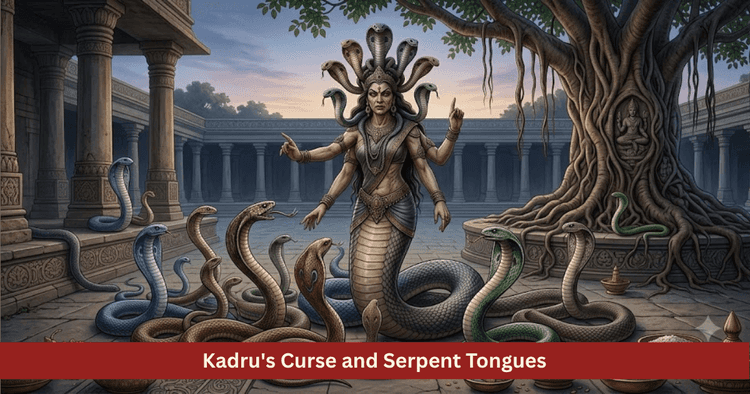
Table of Contents
The Core Message of the Story
The story of serpent mother Kadru is connected with the fate of the Nagas, King Janamejaya's Sarpa Satra Yajna and the Puranic explanation for the divided serpent tongue. This account is not merely an extraordinary tale. It contains profound signs of ego, falsehood, greed and the consequences of karma.
This story holds special meaning in the context of festivals such as Nag Panchami. It teaches that victory gained through deception eventually weakens relationships. It also shows that any act performed in greed can affect the body, mind and direction of life.
| Subject | Details |
|---|---|
| Main characters | Kadru, Vinata, Sage Kashyapa, the Nagas and Garuda |
| Center of the story | A dispute over the color of Ucchaishrava's tail |
| Kadru's decision | She asked her serpent sons to make the horse's tail appear black |
| Curse | Nagas who refused would be burned in Janamejaya's Sarpa Satra Yajna |
| Mystery of the tongue | The tongue divided into 2 parts while licking the vessel placed on sacred Kusha grass |
| Spiritual message | Remain cautious of the karmic consequences of falsehood, ego and greed |
Who Were Kadru and Vinata?
Kadru and Vinata held a special place among the many wives of Prajapati Kashyapa. Kadru is regarded as the mother of the Nagas, while Vinata was the mother of Garuda and Aruna. Their lineages later played important roles in Puranic narratives.
Kadru's sons were the Nagas. Shesha Naga, Vasuki, Takshaka, Karkotaka and many other Nagas are mentioned among them. Garuda held a very high place among Vinata's sons and is regarded as the vehicle of Lord Vishnu. Thus, the relationship between Nagas and Garuda does not only represent conflict. It also symbolizes 2 distinct forces within creation.
On one side, Nagas represent depth, mystery, earth, water, hidden power and protection. On the other side, Garuda symbolizes the sky, movement, vision, radiance and liberated consciousness. The story of Kadru and Vinata reveals the tension that arose between these 2 tendencies.
The Episode of Ucchaishrava
Many divine treasures emerged from the churning of the cosmic ocean. Among them was the divine horse called Ucchaishrava. This horse was renowned for its extraordinary white radiance, splendor and beauty. Its body was described as brilliantly white.
One day, Kadru and Vinata saw Ucchaishrava. They disagreed about its color. Vinata said that the horse was entirely white. Kadru said that its tail was black.
This disagreement became a wager between them. They decided to look at the horse the next day and determine the truth. The one who lost the wager would become the other's servant. This was not an ordinary condition because it involved freedom, dignity and the future.
What Did Kadru Ask Her Sons?
Kadru knew that Ucchaishrava's tail was truly white. Yet, to gain victory, she asked her serpent sons to coil around the horse's tail so that it would appear black. In this way, Vinata could be defeated in the wager.
Kadru's request did not follow the path of truth. It shows the moment when the desire to win takes a person away from justice. The Nagas also faced a difficult situation. They respected their mother's command, yet they could not accept becoming partners in deception.
Many Nagas refused to obey Kadru. Their refusal was not merely disobedience. It was a moral disagreement with falsehood. Yet, when anger and ego dominate the mind, even wise counsel can appear like opposition.
Kadru's Curse and Its Effect
Kadru became deeply angry at the disagreement of her sons. She cursed the Nagas that they would be burned in the Sarpa Satra Yajna of King Janamejaya in the future. This curse was extremely grave for the serpent lineage.
The curse later became connected with the story of King Parikshit, Takshaka Naga and King Janamejaya. King Parikshit died from the bite of Takshaka Naga. To avenge his father's death, Janamejaya began the Sarpa Satra Yajna, in which the power of mantras drew Nagas toward the sacrificial fire.
Kadru's curse appeared to bear fruit at that time. Many Nagas began falling into the sacrificial fire. The serpent lineage faced the threat of destruction. Yet destiny brought Astika Muni into that same lineage. Through Vedic knowledge, humility and righteous wisdom, he pleased Janamejaya and stopped the yajna.
Thus, Kadru's curse could not bring complete destruction. Through the efforts of Astika Muni, many Nagas were saved. This episode shows that even amid severe karmic consequences, righteous effort and compassion can open a path of transformation.
| Event | Karmic indication |
|---|---|
| Kadru's false request | Moving away from truth for victory |
| The Nagas' refusal | The voice of conscience and moral courage |
| A curse given in anger | Far reaching consequences of impulsive speech |
| Sarpa Satra Yajna | A collective crisis born from revenge |
| Astika Muni's intervention | Protection through knowledge, humility and dharma |
| The saving of Nagas | The possibility of compassion amid karmic consequences |
Vinata's Defeat and Garuda's Resolve
Some serpent sons of Kadru obeyed their mother and coiled around Ucchaishrava's tail. The next day, the tail appeared black. Vinata lost the wager and had to become Kadru's servant.
Vinata's servitude deeply pained her son Garuda. Garuda asked the Nagas what he must do to free his mother from servitude. The Nagas placed a condition before him. They asked him to bring amrita, the sacred nectar of immortality.
Amrita was under the protection of the devas. Obtaining it was extremely difficult. Yet Garuda took a great resolve for his mother's freedom. His journey became a tale of strength, patience, wisdom and devotion to his mother.
A deeper meaning emerges here. Kadru gained victory through deception, while Garuda chose the path of freedom through hard work and sacrifice. The outcomes of these 2 paths were different. Deception increased fear and conflict, while devotion brought Garuda honor and a divine place.
Amrita, Kusha and the Divided Serpent Tongue
After great effort, Garuda brought the vessel of amrita to the Nagas. He told them that he would place the amrita on Kusha grass. He asked the Nagas to bathe and purify themselves first, after which they could receive it. Garuda then departed.
After Garuda left, Indra, the king of the devas, took the vessel of amrita back. When the Nagas returned after bathing, they saw that the vessel was no longer on the Kusha grass. Hoping that a few subtle drops of amrita remained, the Nagas began to lick the Kusha grass.
The edges of Kusha grass are sharp. While licking it, the tongues of the Nagas were cut in the middle and divided into 2 parts. This is why serpent tongues appear forked even today. In Puranic tradition, this event is regarded as the reason for the divided serpent tongue.
This episode is connected with the desire to obtain amrita, yet it also indicates greed. In their impatience to obtain amrita, the Nagas did not remain patient after seeing that the vessel was gone. Their intense desire to receive the drops left on the Kusha grass caused them pain.
| Element | Puranic meaning |
|---|---|
| Amrita | Immortality, divine power and a rare attainment |
| Kusha | Purity, yajna rites and discipline |
| Sharp Kusha edges | Consequences of uncontrolled desire |
| Divided tongue | Pain arising from greed and impatience |
| Garuda's resolve | Devotion to his mother and righteous effort |
| Indra taking amrita | Preservation of order within the divine arrangement |
Vedic Importance of Kusha Grass
Kusha is regarded as highly sacred in Vedic rituals. It is used in yajna, shraddha, meaning rites for ancestors, tarpana, meaning water offerings, sankalpa, meaning a sacred resolve and many religious observances. Kusha represents purity, concentration and the discipline of action.
The sharpness of Kusha is also symbolically significant. When a sacred object is used with reverence and proper procedure, it becomes beneficial. Yet, when it is approached through greed or carelessness, the same object can become a cause of pain. This part of the story moves beyond an outer event and becomes a subtle lesson about human conduct.
Dharma does not rest only in the sacredness of objects. It also rests in purity of vision and conduct toward them. The story of the Nagas licking Kusha grass reminds us that a sacred goal requires sacred means and a patient mind.
Spiritual Meaning of Kadru's Story
Many human tendencies appear in Kadru's story. Kadru's false demand represents a mind that seeks victory by any means. Vinata's defeat shows that falsehood may bring temporary gain, yet it gives rise to pain and imbalance.
One group of Nagas obeyed their mother's command, while another opposed it. This resembles the conflict within a human being. On one side, there is external pressure. On the other side, the conscience insists upon truth. The right decision is not always easy, yet the karmic burden of joining falsehood can become heavier.
Licking Kusha for amrita represents the state of mind in which a person becomes impatient due to incomplete information, desire or fear. Such a person loses discernment between what is beneficial and harmful. therefore the central message of this story is that patience, truth and restraint protect life.
Serpent Symbolism in Vedic Astrology
In Vedic astrology, serpent symbolism is primarily connected with Rahu and Ketu. These are shadow grahas or celestial influences, which can indicate karmic entanglements, intense desire, fear, confusion, sudden changes and hidden tendencies in a person's life.
Rahu amplifies desire. When desire moves away from discernment, it can lead toward confusion, dissatisfaction and improper means. Kadru's deception and the Nagas' impatience to obtain amrita help explain this psychological tendency.
Ketu signifies detachment, mystery, past karma and the inward search. When a person follows restraint, spiritual practice and truthfulness, this energy can lead toward self reflection. Yet in an imbalanced state, a person may experience bitterness, isolation or uncertain fear.
The astrological meaning of this Naga story does not aim to increase fear. Its purpose is to understand the relationship between karma, desire and consciousness. Planetary positions may indicate tendencies and motivations but a person's good actions, discernment and discipline strengthen the direction of life.
| Astrological indication | Balanced practice |
|---|---|
| Intense desire and dissatisfaction | Contentment, a regular routine and adherence to truth |
| Fear or confusion | Remembrance of Shiva, meditation and clear communication |
| Family tension | Control over anger and respectful conduct |
| Karmic restlessness | Service, charity and self examination |
| Hidden competition | Humility and righteous effort |
The Meaning of Serpent Venom and Mystery
In the Puranic view, serpent venom is not only an outer power. It also symbolizes energy, protection, anger and hidden capacity. A serpent uses venom for protection. In the same way, human beings also carry forces within that can protect when balanced but can hurt relationships when stirred by impulse.
The 2 branches of a serpent's tongue are also connected with its subtle sensory ability. Serpents use their tongues to understand scent and direction in their surroundings. The Puranic story explains this through the episode of Kusha grass, while in nature it is part of their distinctive physical structure.
It is important to understand this difference. Puranic stories reveal moral and spiritual truths of life. The study of nature explains the physical structure and behavior of living beings. Both perspectives deserve respect in their proper place.
Lessons for Family and Conduct
The story of Kadru and Vinata also illuminates family relationships. When comparison, competition and stubborn insistence on winning enter relationships, trust begins to diminish. The desire to defeat another person often creates unrest within oneself as well.
Truth and affection should be the foundation of communication among parents, children and family members. Kadru's curse given in anger shows that words spoken in impulse can have effects far into the future. therefore it is necessary to pause and reflect before using harsh words in the home.
Garuda's conduct reveals another direction. He chose a difficult path for his mother's freedom, yet he did not rely on deception. This story teaches that solutions gained through devotion, effort and restraint are more lasting.
The Bright Path of Truth and Restraint
Kadru's curse, the crisis of the Nagas, Garuda's resolve and the story of the serpent tongue cut by Kusha touch many levels of life. The power of speech, the force of desire, the result of karma and the possibility of compassion appear together in this account.
While remembering this story during Nag Panchami, one should hold respect for Nagas rather than fear. Protection of living beings, balance of nature and preservation of truth within the mind are the finest observance of this tradition.
When a person chooses truth instead of deception, contentment instead of greed and discernment instead of anger, many complications of life begin to settle. This is the enduring light of the profound story of Kadru and the Nagas.
FAQ
Why did Kadru curse the Nagas?
Kadru cursed the Nagas because many of them refused to join her deception to make Ucchaishrava's tail appear black.
How did the serpent tongue divide into 2 parts?
According to the Puranic story, the Nagas licked Kusha grass while searching for drops of amrita. The sharp edges of the grass cut their tongues in the middle and divided them into 2 parts.
What is the connection between Kadru's curse and Janamejaya's Sarpa Satra Yajna?
Kadru cursed the Nagas that they would be burned in King Janamejaya's Sarpa Satra Yajna. The curse appeared to take effect during the yajna but Astika Muni stopped it and saved many Nagas.
Why did Vinata lose in the story of Ucchaishrava?
Some serpent sons of Kadru coiled around Ucchaishrava's white tail, making it appear black. Due to this deception, Vinata lost the wager and became Kadru's servant.
What is the spiritual message of the Naga story?
The story teaches that falsehood, ego, anger and greed increase suffering, while truth, patience, restraint and righteous effort bring balance to life.
Get your accurate Kundali
Generate KundaliDid you like it?
Author

Pt. Abhishek Sharma (63)
Experience: 20
Consults About: Family Planning, Career
Clients In: Punjab, Haryana, Delhi
Share this article with friends and family
About ZODIAQ
ZODIAQ is an online Vedic Astrology platform. It connects clients seeking astrological advice to experienced astrologers with deep knowledge. Our users also generate kundali and perform kundali milan for free. ZODIAQ also offers services to the Astrologers. Astrologers utilize various offerings by ZODIAQ to serve their clients effectively.
If you are a User
Consult with experienced astrologers and seek their guidance. You can also order handwritten Janm Patrika report with life prediction prepared by experienced astrologers. Generate accurate Kundali, perform Kundali Matching and check horoscope and muhurat. Utilize our online library for all the necessary astrological and spiritual information.
If you are an Astrologer
Create accurate kundali for your clients and perform Kundali Matching for up to 5 people at a time. Write comprehensive Janm Patrika report for your clients with ZODIAQ. Check client details anytime by saving it in client directory. Become more productive by tracking how many clients you guide every day.
WELCOME TO
ZODIAQ
Right Decisions at the right time with ZODIAQ
