Nag Panchami and Astika Muni
By Aparna Patni
The timeless story of Sarpa Satra Yajna, dharma and compassion
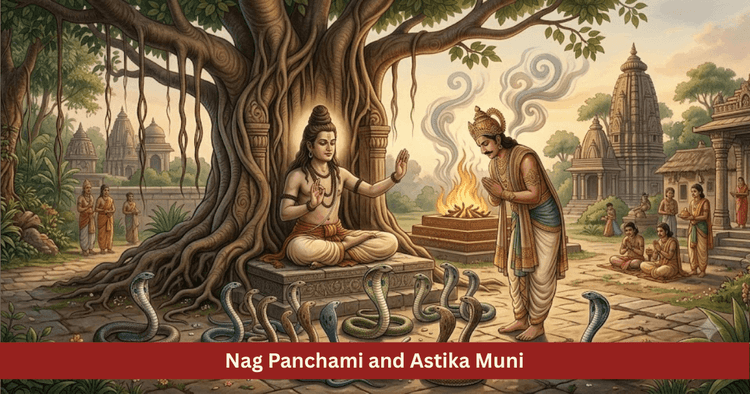
Table of Contents
The Sacred Significance of Shravana Shukla Panchami
Nag Panchami is not only a festival of serpent worship. It is also a remembrance of compassion, respect for life and the choice of righteous wisdom over revenge. On the fifth lunar day of the bright fortnight of Shravana, Astika Muni stopped King Janamejaya's devastating Sarpa Satra Yajna. On that day, countless serpents were saved and dharma prevailed over anger.
| Subject | Details |
|---|---|
| Festival | Nag Panchami |
| Lunar date | Shravana month, bright fortnight, fifth lunar day |
| Main remembrance | Astika Muni and the stopping of the Sarpa Satra Yajna |
| Central spirit | Compassion for living beings, protection, restraint and balance |
| Traditional worship | Remembrance of Nag Devata, offering water instead of milk, prayer and charity |
| Special belief | Peace from serpent fear, family protection and harmony in household life |
The spiritual message of this lunar date is deeply subtle. Every being in creation has its own place, nature and field of karma. To regard serpents only as symbols of fear or venom is an incomplete view. In Indian tradition, they are associated with Patala Loka, the realm beneath the earth, the water element, fertility of the land, hidden power and protection.
Revenge Born From King Parikshit's Death
After the era of Mahabharata, King Parikshit of Hastinapura was a radiant ruler of the lineage of his father Abhimanyu and mother Uttara. One day, while hunting in the forest, he became exhausted and thirsty. There he saw Sage Shamika absorbed in deep meditation. The king asked for water but the sage did not respond because he was immersed in meditation.
At that moment, King Parikshit lost his composure. In anger, he placed a dead serpent around the sage's neck. This action arose from a brief impulse, yet every action bears consequences within the order of dharma.
When Shringi, the son of Sage Shamika, learned about the incident, he angrily cursed the king. He declared that on the seventh day, King Parikshit would die from the bite of Takshaka Naga. Sage Shamika felt sorrow over his son's harsh curse but the effect of the spoken words could not be withdrawn.
When the appointed time arrived, Takshaka Naga bit King Parikshit. The king's death filled his son Janamejaya with grief and deep revenge. That revenge later became the cause of the terrible Sarpa Satra Yajna.
The Terrifying Reach of Sarpa Satra Yajna
King Janamejaya decided that Takshaka and all serpents in the world should be destroyed. He invited learned Ritvijas, the officiating priests of a Vedic sacrifice and yajna acharyas to begin the Sarpa Satra Yajna. Through the power of Vedic mantras, serpents were pulled from their abodes and fell toward the sacrificial fire.
According to the traditional account, fear spread through the serpent realm. Many serpents fell into the fire and perished. This was no longer punishment for the deed of a single serpent. The king's grief had taken the form of collective destruction.
Here, the most important question of dharma arises. Was it just to punish the entire serpent lineage for the act of one serpent? In the Vedic view, the answer is clear. Punishment must rest on wisdom, not blind revenge.
Takshaka too began to be drawn toward the sacrificial fire. It is said that he had sought refuge with Indra, the king of the devas. The power of the yajna mantras was so strong that Indra too began to be pulled toward the fire along with Takshaka. The devas, sages and serpent lineage then waited for a way to stop this destruction.
How Was Astika Muni Born?
The birth of Astika Muni is itself connected with a profound account of dharma. His father, Maharshi Jaratkaru, was a great ascetic. He remained devoted to austerity and knowledge, away from worldly bonds. One day, he saw his ancestors hanging in a suspended state. They told him that their spiritual progress was obstructed because their lineage was coming to an end.
After seeing the suffering of his ancestors, Maharshi Jaratkaru agreed to marry. Yet he placed a special condition. He would marry only a woman also named Jaratkaru and he would not bear the responsibility of supporting her.
On the other hand, Naga King Vasuki was concerned about his sister's marriage. He knew that the serpent lineage would face a crisis in the future and that the son of Maharshi Jaratkaru would protect them. Vasuki's sister, who is also associated with Manasa Devi in several traditions, was named Jaratkaru. She married Maharshi Jaratkaru.
Their son was named Astika. Astika means one who has faith in truth, dharma and existence. From childhood, he was skilled in the Vedas, sacred duties, austerity, humility and the discipline of speech. Within him lived both his father's ascetic power and his mother's compassion for the serpent lineage.
| Element | Connection with Astika Muni |
|---|---|
| Father | Maharshi Jaratkaru |
| Mother | Naga maiden Jaratkaru, associated with Manasa Devi in some traditions |
| Maternal uncle | Naga King Vasuki |
| Purpose of birth | To save the serpent lineage from destruction |
| Main qualities | Vedic knowledge, austerity, humility, compassion and righteous wisdom |
| Meaning of his name | One who has faith in truth and dharma |
How Did Astika Muni Stop the Yajna?
When the Sarpa Satra Yajna reached its peak, Naga King Vasuki requested Astika Muni to protect the serpent lineage. Astika Muni arrived at the sacrificial site where King Janamejaya, learned Brahmins and yajna officiants were present. He first praised the king and the scholars engaged in the yajna. His speech was humble, yet it carried the radiance of Vedic knowledge and the strength of truth.
King Janamejaya was pleased by Astika Muni's wisdom, character and spiritual presence. He asked him to request a boon. At that very moment, Astika Muni asked that the Sarpa Satra Yajna be stopped.
The king first felt uncertain. Takshaka had not yet fully fallen into the sacrificial fire and the memory of his father's death still lived within Janamejaya. The yajna priests also warned the king that taking back a promised boon would go against dharma. In the end, the king honored his word and stopped the yajna.
This was the decisive moment when the fire of revenge was calmed. Countless serpents were saved. Astika Muni did not stop destruction through a display of force. He did so through humble wisdom and an unwavering appeal to dharma.
Significance of Shravana Shukla Panchami
Tradition holds that the Sarpa Satra Yajna was stopped on the fifth lunar day of the bright fortnight of Shravana. This is why Nag Panchami is observed on this day. The festival is an occasion to remember Astika Muni, honor Nag Devata and pray for the balance of nature.
The month of Shravana is closely associated with the worship of Shiva, rain, water, greenery and the fertile power of the earth. Serpents are also connected with Lord Shiva, whose neck is adorned with Vasuki Naga. The serpent as Shiva's ornament suggests that even a force which appears fearful can become sacred protection through spiritual discipline, balance and compassion.
The fifth lunar day is traditionally regarded as favorable for serpent energy. Panchami is seen as a lunar date connected with sensitivity, protection and the subtle balance of life. therefore worship on Nag Panchami is not only an outer ritual. It is also an invitation to calm the anger, fear and revenge hidden within the mind.
What Simple Practices Should Be Observed?
The focus of Nag Panchami worship should be respect, not fear. Capturing a serpent for worship or causing pain to living beings due to superstition does not align with dharma. Serpents are essential creatures of nature and their protection expresses the true spirit of this festival.
Useful Steps for Worship
-
Bathe in the morning and wear clean clothes.
-
Remember Nag Devata, Lord Shiva and Astika Muni at the home shrine.
-
Before an image or symbol of a serpent, offer water, flowers, akshata, meaning unbroken rice grains and sandalwood paste.
-
Offer water instead of pouring milk on the ground or into a snake burrow, because serpents do not naturally drink milk and it may harm them.
-
Pray for family protection, freedom from fear and balance of mind.
-
Resolve to practice compassion for living beings and undertake a practical act of environmental protection.
-
If possible, donate food, clothing or useful items to a person in need.
What Should Be Avoided?
| What to avoid | Reason |
|---|---|
| Capturing a living serpent for worship | It can cause pain and danger to the serpent |
| Pouring milk into a snake burrow | It may harm both the serpent's health and habitat |
| Following beliefs that spread fear | The foundation of the festival is faith and wisdom |
| Holding revenge or bitterness | Astika Muni's story teaches forgiveness and balance |
| Damaging nature | Nag Panchami honors protection of life and respect for the environment |
Serpent Fear and Peace of Mind
The belief that remembrance of Astika Muni brings relief from serpent fear is not limited to external safety. The serpent can be understood at many levels. It may also represent hidden fear, suppressed anger, uncontrolled desires and life's uncertainties.
When a person reads or listens to the story of Astika Muni, one understands how a calm voice and righteous wisdom can become great protection even in a fierce situation. Janamejaya's grief led him toward destruction, while Astika Muni's compassion transformed the same situation into the protection of life.
therefore the remembrance performed on Nag Panchami teaches that violence is not the answer to fear. Wisdom, prayer, caution and coexistence offer more lasting remedies.
Serpent Symbolism in Vedic Astrology
In Vedic astrology, Rahu and Ketu are regarded as shadow grahas or celestial influences. In Puranic symbolism, they are also linked with serpent forms. Rahu and Ketu may indicate areas of life where confusion, intense desire, sudden change, karmic entanglement or inner restlessness can be felt.
The spiritual spirit of Nag Panchami inspires a person to bring balance to these subtle disturbances. This does not mean that worship alone will remove every problem in life. A true remedy requires ethical conduct, honesty, respect for parents, compassion for living beings, regular prayer and purification of one's actions.
| Astrological indication | Spiritual practice |
|---|---|
| Confusion linked with Rahu | Practice truth, clarity and restraint |
| Detachment or restlessness linked with Ketu | Meditation, prayer and service |
| Frightening dreams or mental stress | Remembrance of Shiva and a regular routine |
| Family bitterness | Forgiveness, dialogue and gentle speech |
| Distance from nature | A resolve to protect water, trees and living beings |
Astika's Story and Family Life
The story of Astika Muni also holds importance for households. Maharshi Jaratkaru understood his duty toward his ancestors. Naga King Vasuki remained patient for the protection of his lineage. Astika Muni united the welfare of both lineages through the path of dharma. The story reveals a beautiful balance of duty, family continuity, compassion and wisdom.
Happiness and prosperity in a home do not arise from wealth alone. Respectful communication, control over anger, reverence for elders and compassion toward living beings are also foundations of prosperity. Remembering Astika Muni on Nag Panchami can become a simple sacred practice that guides a household toward this inner prosperity.
When Dharma Restrained Anger
King Janamejaya's grief was not false. His father's death was a deep wound for him. Yet every decision made after pain is not necessarily righteous. The story of the Sarpa Satra Yajna teaches that anger born from sorrow can consume even the innocent when it is not guided by wisdom.
The arrival of Astika Muni is therefore not only an event in which serpents were saved. It is a remembrance of the power of dharma that stops destruction at the right moment. The festival of Shravana Shukla Panchami has preserved this life affirming message through generations.
With reverence, the remembrance of Astika Muni, Nag Devata and Lord Shiva on Nag Panchami can cultivate humility in the mind, harmony in the family and a more sensitive view toward life. This is the most beautiful spiritual practice of this sacred lunar date.
FAQ
Why is Astika Muni remembered on Nag Panchami?
Astika Muni stopped King Janamejaya's Sarpa Satra Yajna and saved countless serpents. therefore his remembrance on Nag Panchami is associated with protection of life, compassion and peace from serpent fear.
Why did King Janamejaya perform the Sarpa Satra Yajna?
King Janamejaya performed the Sarpa Satra Yajna to take revenge for the death of his father, King Parikshit, who died from the bite of Takshaka Naga.
On which lunar date is Nag Panchami celebrated?
Nag Panchami is celebrated on the fifth lunar day of the bright fortnight of the Shravana month.
Should milk be offered to serpents on Nag Panchami?
Offering milk to a living serpent or pouring milk into a snake burrow is not appropriate, because serpents do not naturally drink milk. Offering water during worship is a more sensitive and suitable practice.
Who were the parents of Astika Muni?
Astika Muni's father was Maharshi Jaratkaru. His mother was the Naga maiden Jaratkaru, who is also associated with Manasa Devi in some traditions.
Get your accurate Kundali
Generate KundaliDid you like it?
Author

Aparna Patni (63)
Experience: 20
Consults About: Family Planning, Career
Clients In: Punjab, Haryana, Delhi
Share this article with friends and family
About ZODIAQ
ZODIAQ is an online Vedic Astrology platform. It connects clients seeking astrological advice to experienced astrologers with deep knowledge. Our users also generate kundali and perform kundali milan for free. ZODIAQ also offers services to the Astrologers. Astrologers utilize various offerings by ZODIAQ to serve their clients effectively.
If you are a User
Consult with experienced astrologers and seek their guidance. You can also order handwritten Janm Patrika report with life prediction prepared by experienced astrologers. Generate accurate Kundali, perform Kundali Matching and check horoscope and muhurat. Utilize our online library for all the necessary astrological and spiritual information.
If you are an Astrologer
Create accurate kundali for your clients and perform Kundali Matching for up to 5 people at a time. Write comprehensive Janm Patrika report for your clients with ZODIAQ. Check client details anytime by saving it in client directory. Become more productive by tracking how many clients you guide every day.
WELCOME TO
ZODIAQ
Right Decisions at the right time with ZODIAQ
