Nag Panchami and Earth Rest
By Pt. Amitabh Sharma
The spiritual reason for not plowing and not digging
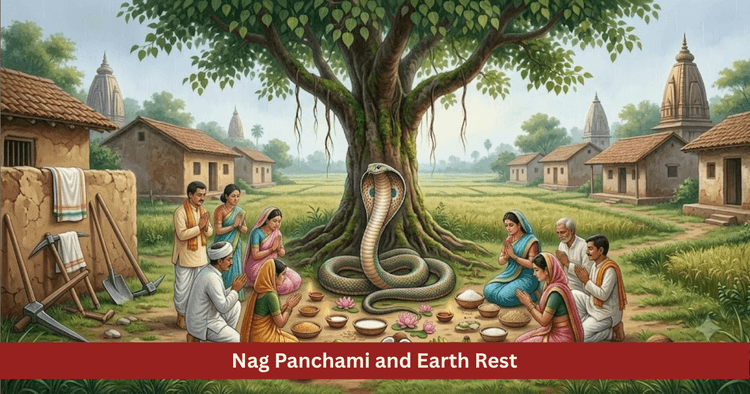
Table of Contents
One Day of Honor for Earth
In the Sanatana tradition, tilling the land, digging or cutting leafy vegetables on Nag Panchami is strictly prohibited. This strict rule is not merely an external restriction. A deep ecological and spiritual reason lies behind it. During the monsoon season, serpents take shelter in burrows inside the earth and pass through their breeding period. If the plow is used on this day, serpents hidden beneath the soil and their eggs may be destroyed.
| Subject | Details |
|---|---|
| Festival | Nag Panchami |
| Prohibited activities | Plowing fields, digging earth, cutting leafy vegetables |
| Season | Monsoon, Shravana month |
| Main reason | Protection of serpents, breeding period, non violence |
| Spiritual feeling | Rest for earth, compassion toward nature |
| Result | Protection of life, family peace, merit |
Out of this great thought of compassion toward nature and protection of living beings, the sages created a religious rule to give rest to the earth and avoid digging on Nag Panchami. This rule is not only for farmers. It is a collective resolve for all householders and society.
Monsoon and Serpent Breeding
Nag Panchami is observed on the fifth lunar day of the bright fortnight in the Shravana month. This time is the middle part of the monsoon season. According to seasonal science, the soil contains more moisture during this period and underground beings are more active. Serpents spend more time in burrows inside the earth at this time.
This period is connected with their breeding and the birth of new generations. If the earth is dug, plowed or deeply excavated at this time, serpent burrows, eggs and young ones may be destroyed. The sages kept this fact in mind and created a religious rule directly linked with protection of beings.
| Monsoon effect | Impact on serpent life |
|---|---|
| More moisture in soil | More dwelling in burrows |
| Coolness and shade | Favorable environment for breeding |
| Abundance of insects | Availability of food |
| Underground activity | Need to protect eggs and young ones |
The rule of not digging on Nag Panchami is connected with this protective feeling. It is not only a one day fast. It is a symbol of deep sensitivity toward the earth and the living beings inside it.
The Wider Form of Non Violence
In the Indian tradition, non violence is not limited only to human beings. It is a feeling of compassion toward all living beings. The rule of not working on land on Nag Panchami reveals this wider form of non violence. When a farmer does not plow, when a householder does not dig, he is not only following a rule. He expresses a deep reverence toward life.
The meaning of non violence is not only to avoid hurting someone. It also means not doing actions that may harm any living being. Nag Panchami gives this resolve a collective form. The whole society stops disturbing the earth for one day. It is a day of silent respect.
Why Give Rest to Earth?
The feeling of giving rest to the earth also aligns with modern environmental awareness. Continuous farming, construction, digging and exploitation tire the earth. Its fertile power diminishes. The sages understood this fact and created a provision to give rest to the earth at least one day in a year.
Nag Panchami day is a symbol of this rest. This day gives the earth a chance to breathe. On this day there is no deep digging, no heavy plowing. The stream of life beneath the soil remains untouched.
| Meaning of earth rest | Spiritual indication |
|---|---|
| One day halt | Restraint and balance |
| Not digging | Respect for inner peace |
| Not plowing | Following the natural cycle |
| Not cutting vegetables | Not hindering growth of life |
| Resolve of rest | Gratitude and humility |
This rest is not only for the earth. It is also rest for the human mind. When a person deliberately stops work for one day, restraint and patience awaken within him as well.
Environmental Wisdom in Sanatana Tradition
The environmental wisdom hidden in the Sanatana tradition is extremely subtle and vast. Action according to seasons, restrictions according to lunar days and determination of lifestyle according to the panchang are part of this wisdom. The rule of not working on land on Nag Panchami is a living example of this tradition.
This rule is not only religious faith. It also holds a scientific view. During monsoon, the structure of soil is delicate. Excessive digging can cause soil erosion, obstruction in water drainage and ecological imbalance. The sages gave it a religious form and reached every level of society.
| Sanatana principle | Environmental relation |
|---|---|
| Conduct according to season | Respect for natural cycle |
| Special day restrictions | Protection of beings |
| Lifestyle according to panchang | Balanced routine |
| Ahimsa paramo dharmah | Compassion toward all beings |
This wisdom is even more relevant in today's time. When environmental crisis is deepening, the feeling of giving rest to the earth becomes a necessary teaching.
Meaning of Prohibition on Cutting Vegetables
On Nag Panchami, not only plowing or digging is prohibited. Cutting leafy vegetables is also forbidden. The meaning is not only that food should not be prepared. It has a deeper spiritual and ecological meaning.
During monsoon, growth of plants is rapid. Around Nag Panchami, many plants are putting out new sprouts and branches. Cutting them at this time obstructs their growth. The sages gave plants a chance to grow on this day.
| Prohibited activity | Reason |
|---|---|
| Plowing | Protection of serpents and eggs |
| Digging earth | Protection of underground life |
| Cutting vegetables | Not hindering growth of plants |
| Deep digging | Ecological balance |
This prohibition also teaches a person that it is necessary not only to take from nature but also to pause for some time. This balance is the identity of the Sanatana lifestyle.
Harmony Between Karma and Nature
The rule of not working on land on Nag Panchami establishes harmony between action and nature. Man is a doer but his action should not be against the cycle of nature. When nature is in a particular state, man should act in accordance with it.
This harmony is not only with outer nature. It is also with inner nature. When a person deliberately does not disturb the earth for one day, the tendency for unnecessary interference becomes calm within him as well. Patience, discernment and restraint grow in the mind.
| Nature of action | Relation with nature |
|---|---|
| Restrained action | Respect for natural cycle |
| One day halt | Balance and self control |
| Non violent conduct | Protection of life |
| Religious resolve | Collective consciousness |
This harmony is useful even in today's fast paced life. When a person moves in tune with nature, his life also becomes more steady and peaceful.
What Is the Meaning in Modern Context?
In today's time, many people live in cities. They do not directly plow fields. Yet this rule of Nag Panchami is relevant for them as well. Its meaning is to maintain sensitivity toward nature. To avoid actions that harm the environment.
In modern context, it can also mean that unnecessary construction, deep digging, use of heavy machinery and anti nature activities should be avoided on this day. This one day resolve can awaken environmental consciousness.
| Modern application | Meaning |
|---|---|
| Halting construction for one day | Environmental protection |
| Not running heavy machines | Rest for nature |
| Avoiding plaster and digging | Protection of underground life |
| Environmental resolve | Collective responsibility |
This rule is not only for rural life. It is a message for all humanity that restraint and compassion are necessary in interaction with nature.
What Should Be Done on Nag Panchami?
Along with not working on land, there is a tradition of doing some positive actions on Nag Panchami. These actions increase the sanctity of the day and awaken the feeling of devotion in the mind.
-
Remember the Naga deities.
-
Offer water and milk to the Shiva lingam.
-
Keep a calm atmosphere at home.
-
Pray with gratitude toward nature.
-
Take a resolve of non violence toward beings.
-
If possible, support protection of natural habitats of serpents.
| Actions to perform | Feeling |
|---|---|
| Remembering Nagas | Devotion |
| Shiva worship | Purity |
| Peace | Inner balance |
| Gratitude | Respect for nature |
| Non violence resolve | Compassion |
| Habitat protection | Practical support |
Through these actions, Nag Panchami does not remain only a day of prohibition. It becomes a positive spiritual experience.
The Deep Relation Between Earth and Man
This rule of Nag Panchami ultimately highlights the deep relation between earth and man. Man takes produce from the earth, lives on the earth and finally merges into the earth. Therefore duty toward earth is not only of use but also of protection.
When earth is given rest for one day, this relation becomes even deeper. A person understands that he is not the owner of the earth but its part. This feeling is the strongest foundation of environmental protection.
| Relation | Meaning |
|---|---|
| Produce from earth | Gratitude |
| Dwelling on earth | Responsibility |
| Merging into earth | Final truth |
| One day rest | Protective feeling |
This rule of Nag Panchami gives this protective feeling a religious form. It reminds society that earth is not only a resource but a living presence.
FAQ
Why is plowing avoided on Nag Panchami?
Plowing is avoided on Nag Panchami because during monsoon serpents are in burrows inside the earth and plowing may harm them.
Is digging earth prohibited on Nag Panchami?
Yes, digging earth is considered prohibited on Nag Panchami because it may harm underground serpents and their eggs.
Why is cutting vegetables forbidden?
Cutting vegetables is forbidden because plant growth is rapid during monsoon and cutting them obstructs their growth.
What should be done on Nag Panchami?
On Nag Panchami one should remember the Naga deities, worship Shiva, express gratitude toward nature and take a resolve of non violence.
Can city dwellers also follow this rule?
Yes, city dwellers can also follow this rule by avoiding unnecessary construction, deep digging and anti nature activities on this day.
Get your accurate Kundali
Generate KundaliDid you like it?
Author

Pt. Amitabh Sharma (56 Years)
Experience: 20
Consults About: Family Planning, Career
Clients In: Punjab, Haryana, Delhi
Share this article with friends and family
About ZODIAQ
ZODIAQ is an online Vedic Astrology platform. It connects clients seeking astrological advice to experienced astrologers with deep knowledge. Our users also generate kundali and perform kundali milan for free. ZODIAQ also offers services to the Astrologers. Astrologers utilize various offerings by ZODIAQ to serve their clients effectively.
If you are a User
Consult with experienced astrologers and seek their guidance. You can also order handwritten Janm Patrika report with life prediction prepared by experienced astrologers. Generate accurate Kundali, perform Kundali Matching and check horoscope and muhurat. Utilize our online library for all the necessary astrological and spiritual information.
If you are an Astrologer
Create accurate kundali for your clients and perform Kundali Matching for up to 5 people at a time. Write comprehensive Janm Patrika report for your clients with ZODIAQ. Check client details anytime by saving it in client directory. Become more productive by tracking how many clients you guide every day.
WELCOME TO
ZODIAQ
Right Decisions at the right time with ZODIAQ
