Nagchandreshwar Temple Mystery
By Aparna Patni
Nag Panchami, Takshak's austerity and the divine union of Shiva and Naga power
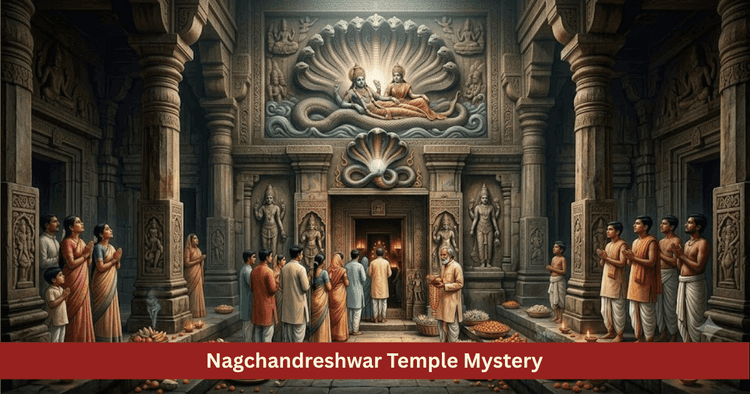
Table of Contents
The Special Nag Panchami Darshan
Nagchandreshwar Temple, located in the renowned Mahakaleshwar Temple complex of Ujjain, opens for darshan only once each year on Nag Panchami. This tradition makes the temple extraordinary because its doors remain closed throughout the rest of the year. On Nag Panchami, devotees may receive darshan of Lord Nagchandreshwar for 24 hours.
| Subject | Details |
|---|---|
| Temple | Shri Nagchandreshwar Temple |
| Location | Mahakaleshwar Temple complex, Ujjain |
| Position | On the upper level of Mahakaleshwar Temple |
| Day of darshan | Shravana Shukla Panchami, Nag Panchami |
| Darshan period | Usually 24 hours |
| Special worship | Trikala Puja and aarti |
| Main belief | Prayer for relief from Naga dosha, Kaal Sarp Yoga, fear and mental unrest |
This annual darshan of Nagchandreshwar Temple is not only a religious tradition. It reminds a person of time, faith and restraint. A door that remains closed through the year opens on Nag Panchami, as if life itself says that certain divine experiences are received only through patience, discipline and the right moment.
Nagchandreshwar in Mahakal's City
Ujjain is known as the city of Mahakal. The Mahakaleshwar Jyotirlinga located here is counted among India's most revered Shiva shrines. Above the sanctum of Mahakaleshwar Temple is the place of Omkareshwar and above it stands Nagchandreshwar Temple.
This architectural arrangement carries a deep spiritual meaning. Mahakal below signifies mastery over time. Omkareshwar in the middle represents the primordial sound of creation. Nagchandreshwar above reveals the balance of Shiva, serpent power and the lunar principle.
Thus, Nagchandreshwar Temple is not merely a separate shrine. It is an upward extension of Mahakal's great spiritual tradition. Here Shiva and the Naga together indicate an energy that can transform fear into peace, poison into restraint and restlessness into spiritual practice.
Why Does It Open Once a Year?
The belief behind Nagchandreshwar Temple opening only on Nag Panchami is connected with the austerity of Takshak Naga. It is said that Naga king Takshak performed severe tapas or spiritual austerity, to please Lord Shiva. Pleased by his devotion, Lord Shiva granted him immortality and blessed him to reside in Mahakal forest.
According to tradition, the temple doors are opened only on Nag Panchami so that Takshak Naga's solitary spiritual practice may remain undisturbed. A deep spiritual feeling is contained in this belief. Practice should not become only an outer display. Solitude, silence and regularity are essential parts of it.
The opening of the temple on Nag Panchami becomes an occasion to honor the tapas power of Takshak Naga. A devotee who receives darshan that day does not only see an image. One also remembers the ideals of austerity, patience and inward consciousness.
| Element of belief | Spiritual indication |
|---|---|
| Takshak Naga's austerity | Concentration and self restraint |
| Shiva's blessing | Divine protection gained through tapas |
| Solitary residence | Privacy of spiritual practice |
| Darshan for one day each year | The importance of patience and the right time |
| Nag Panchami | A festival honoring serpent power |
The Extraordinary 11th Century Image
The image installed in Nagchandreshwar Temple is considered to be about 11th century old. It is a subject of special devotion and curiosity because of its distinctive structure. Lord Shiva and Mother Parvati are seen seated upon a serpent couch.
Descriptions vary about the number of serpent hoods. therefore the central meaning of the image is more important. Lord Shiva, Mother Parvati and in some traditional descriptions Lord Ganesha as well are believed to be seated upon the serpent couch. The serpent spreads its hoods and becomes both a canopy and a seat for the divine family.
This image carries a very deep symbol. A serpent is commonly linked with fear, mystery and venom. Here the same serpent becomes the seat and protection of Shiva's family. Its message is that when fierce power comes under the guidance of Shiva, it does not remain destructive. It becomes a protective power.
The Spiritual Meaning of the Image
In the Nagchandreshwar image, Shiva and Parvati seated upon the serpent couch represent the balance of 2 great forces of nature. Shiva is the deity of detachment, consciousness and renewal after dissolution. Parvati is the form of creation, compassion and power. Nagas represent deep life force, mysteries of the earth and dormant inner energy.
Their presence together teaches that power alone is not enough. Power needs the foundation of consciousness and compassion. Knowledge alone is not enough. Knowledge needs to join with life force and sensitivity.
| Element of the image | Symbolic meaning |
|---|---|
| Lord Shiva | Consciousness, patience and inner control |
| Mother Parvati | Compassion, power and creation |
| Serpent couch | Life force and hidden potential |
| Spread hoods | Protection and awareness |
| Upper location of the temple | Rising of consciousness |
Darshan at Nagchandreshwar Temple is therefore not only outer worship. It is the feeling of offering fearful, unstable and poisonous tendencies within oneself into the peace of Shiva. When the poison of the mind becomes calm, the same energy can become a source of discernment and protection.
Importance of Trikala Puja
On Nag Panchami, the tradition of Trikala Puja at Nagchandreshwar Temple carries special importance. Trikala Puja means reverential worship and aarti at different sacred periods of the day. It indicates linking the 3 dimensions of time with dharma.
Morning worship symbolizes fresh consciousness. Midday worship reminds one of action, responsibility and awareness. The evening aarti gives the feeling of inwardness, rest and surrender to the Divine. In this way, Trikala Puja inspires one to see life not as a single moment but as practice through the entire day.
Points to Remember for Darshan
-
Maintain patience and discipline during darshan.
-
Follow the routes and rules set by temple authorities.
-
Carry the feeling of water, flowers and devotion but avoid all carelessness in crowds.
-
Resolve to practice non violence toward Nagas and all other living beings.
-
Regard worship as a means of self purification more than the removal of fear.
Rahu Ketu and Serpent Symbolism
In Vedic astrology, Rahu and Ketu are regarded as shadow grahas or celestial influences. In Puranic symbolism, they are also connected with serpent forms. therefore Naga worship, Nag Panchami and darshan at Nagchandreshwar Temple are viewed with the feeling of calming mental confusion, fear and karmic imbalance connected with Rahu and Ketu.
It is important not to understand the effects of Rahu and Ketu only through fear. Rahu may signify intense desire, confusion, unusual ambition and an unseen direction. Ketu is considered connected with detachment, mystery, inward search and subtle impressions of past karma.
The deep meaning of prayer before Nagchandreshwar is that a person accepts inner confusion and places it in the peace of Shiva. Such a feeling can help cultivate steadiness, discernment and self control in the mind.
| Astrological indication | Balanced spiritual feeling |
|---|---|
| Confusion arising from Rahu | Truth and clear thought |
| Restlessness linked with Ketu | Meditation and self examination |
| Belief in Naga dosha | Non violence and purification of karma |
| Fear of Kaal Sarp Yoga | Regular worship and restraint |
| Mental unrest | Remembrance of Shiva and disciplined routine |
Belief in Darshan and Relief
There is a popular belief that darshan at Nagchandreshwar Temple brings relief from Naga dosha, Kaal Sarp Yoga, obstacles connected with Rahu and Ketu, unexplained fear and mental unrest. These beliefs should be understood with devotion and self improvement.
Darshan should not be regarded as a guaranteed result. In the spiritual journey, truthful living, compassion, service, restraint and responsible action are also necessary along with worship. When a person makes efforts to purify habits and thoughts, the feeling of worship becomes more meaningful.
Worship of Nagchandreshwar can give a person inner strength that fear is not the final truth of life. Mental balance, humility in prayer and dharmic action can support a person through difficult planetary periods and the challenges of life.
Takshak's Solitary Practice
The belief connected with Takshak Naga deepens the mystery of this temple. The name Takshak brings to mind the story of Parikshit and Janamejaya, yet in the context of Nagchandreshwar he is also viewed as an ascetic and devotee of Shiva.
This perspective is important. Mythological figures cannot be defined by only one event. Serpent power may contain intensity but the same power also holds the possibility of austerity, protection and divine discipline.
The message of Takshak's solitary practice is highly useful for a person. In the noise of the outer world, it is difficult to keep the mind steady. Giving some time to silence, prayer and self reflection is the practical way to connect the inner serpent power with Shiva consciousness.
Make the Journey a Practice
A journey to Nagchandreshwar Temple should not be only a journey for darshan. It can become a journey of self restraint, respect for nature and humble reverence for the Naga deities. Large numbers of devotees arrive on Nag Panchami, so following order and patience is also a form of worship.
While visiting the temple or remembering Nagchandreshwar at home, hold the resolve not to cause harm to any living being. Capturing living serpents for worship is not appropriate. Serpent conservation, cleanliness of water sources and respect for natural habitats are connected with the true spirit of this festival.
The relationship between Shiva and the serpent conveys this message. A force that appears fearful can be transformed into protective power through understanding, compassion and restraint. This is the most beautiful meaning of darshan at Nagchandreshwar Temple.
The Quiet Light of Faith
Nagchandreshwar Temple remains silent for most of the year, yet when its doors open on Nag Panchami, a vast current of devotion rises in the land of Ujjain. This scene is not merely a religious celebration. It is the form of an ancient human longing for freedom from fear, peace of mind and divine protection in life.
This united form of Lord Shiva, Mother Parvati and serpent power teaches that energy hidden within life's depths should not be suppressed. It should be given a pure direction. Whether there is confusion from Rahu and Ketu, fear in the mind or uncertainty in circumstances, the answer is found in disciplined action and steady prayer.
The true fruit of Nagchandreshwar darshan on Nag Panchami appears when a person gives place to non violence, patience, truth and inner discipline in life. This is refuge in Shiva and this is the benevolent form of serpent power.
FAQ
When does Nagchandreshwar Temple open during the year?
Nagchandreshwar Temple opens for darshan only on Nag Panchami, the fifth lunar day of the bright fortnight in the Shravana month.
Where is Nagchandreshwar Temple located?
The temple is located on the upper level of the Mahakaleshwar Temple complex in Ujjain.
Which image is installed in Nagchandreshwar Temple?
An extraordinary image considered to be about 11th century old is installed there, in which Lord Shiva and Mother Parvati are seated upon a serpent couch.
What is the connection between Nagchandreshwar Temple and Takshak Naga?
It is believed that Naga king Takshak performed severe austerity for Lord Shiva and received a place for solitary spiritual practice in Mahakal forest through Shiva's blessing.
Do darshan at Nagchandreshwar Temple remove Rahu Ketu dosha?
Popular belief views darshan as a prayerful means for calming obstacles related to Rahu and Ketu, Naga dosha, Kaal Sarp Yoga, fear and mental unrest. Ethical conduct, restraint and dharmic action are also considered necessary with worship.
Get your accurate Kundali
Generate KundaliDid you like it?
Author

Aparna Patni (63)
Experience: 20
Consults About: Family Planning, Career
Clients In: Punjab, Haryana, Delhi
Share this article with friends and family
About ZODIAQ
ZODIAQ is an online Vedic Astrology platform. It connects clients seeking astrological advice to experienced astrologers with deep knowledge. Our users also generate kundali and perform kundali milan for free. ZODIAQ also offers services to the Astrologers. Astrologers utilize various offerings by ZODIAQ to serve their clients effectively.
If you are a User
Consult with experienced astrologers and seek their guidance. You can also order handwritten Janm Patrika report with life prediction prepared by experienced astrologers. Generate accurate Kundali, perform Kundali Matching and check horoscope and muhurat. Utilize our online library for all the necessary astrological and spiritual information.
If you are an Astrologer
Create accurate kundali for your clients and perform Kundali Matching for up to 5 people at a time. Write comprehensive Janm Patrika report for your clients with ZODIAQ. Check client details anytime by saving it in client directory. Become more productive by tracking how many clients you guide every day.
WELCOME TO
ZODIAQ
Right Decisions at the right time with ZODIAQ
