Parikshit and Takshak
By Pt. Amitabh Sharma
A profound story of time, karma and the mystery of Takshak Naga
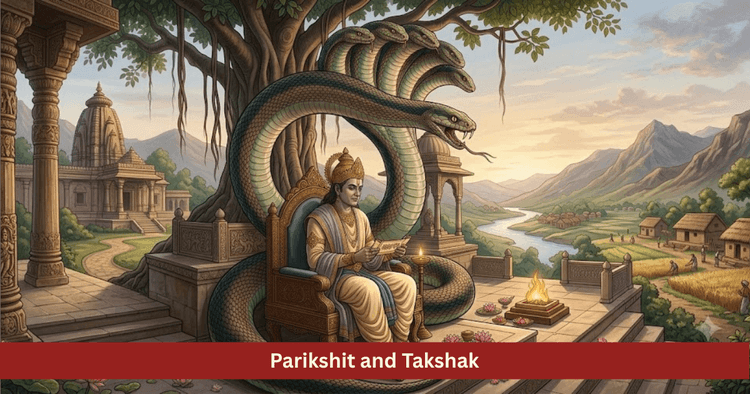
Table of Contents
The Lesson of Time and Karma
The story of King Parikshit is not only a story of death. It is a profound teaching about time, karma and restraint. As described in the Shrimad Bhagavat Purana, this episode shows that no matter how great a person's power, kingdom or courage may be, one cannot escape the law of karma and time.
| Subject | Details |
|---|---|
| Main characters | King Parikshit, Sage Shamika, Sage Shringi, Takshak Naga, Janamejaya |
| Main event | The curse of Sage Shringi and the bite of Takshak Naga |
| King's preparation | A safe palace built in the middle of water |
| Takshak's strategy | Taking a subtle form and entering a fruit |
| Spiritual message | Remain aware of karma, time and the results of ego |
| Meaning for Nag Panchami | Pacifying Takshak Naga and protection from untimely death |
This story is especially remembered on Nag Panchami because the episode of Takshak Naga reveals the mysterious, sharp and karmic power of the serpent principle. There is also a traditional belief that peace worship for Takshak Naga can help soften the yogas of untimely death.
How Did King Parikshit Receive the Curse?
After the Mahabharata era, King Parikshit is regarded as an important ruler from the early age of Kali. He was righteous, brave and the heir of the Pandava lineage. One day, while hunting, he went far away and entered the hermitage of Sage Shamika in a state of thirst.
The sage was then in silence and meditation. King Parikshit asked for water but the sage did not respond. At that moment, anger rose within the king. He picked up a dead serpent nearby and placed it around the sage's neck before leaving.
This act happened in a moment of impulse, yet from the perspective of dharma its effect was very deep. When the discipline of speech breaks, the balance of the mind also begins to break. That single act gave birth to a great and destructive curse.
When Sage Shringi, the son of Sage Shamika, heard of this event, he cursed King Parikshit in anger. He said that on the seventh day the king would die from the bite of Takshak Naga. Later, when Sage Shamika learned of this, he also accepted the seriousness of the curse. The sequence of events had now entered the wheel of karma.
Preparation for the Seventh Day
As soon as he heard the curse, King Parikshit felt fear. He made many efforts to keep himself away from serpents. A secure palace was built in the middle of water so that access from all sides would become difficult.
The king arranged strict security around him. Guards were posted. Routes were checked. Even food and gifts were examined. Yet the law of karma is far subtler than external security.
Takshak Naga also did not attack in an ordinary way. He took a subtle form and entered a fruit. Through that fruit he reached the king. This episode shows that when time nears, extraordinary paths can hide inside ordinary means.
| Security measure | Purpose |
|---|---|
| Palace in the middle of water | To make outside access difficult |
| Armed guards | Protection from unexpected danger |
| Food inspection | To avoid poison or hidden entry |
| Monitoring the place | Safety from serpents or secret enemies |
| Religious caution | Mental balance and refuge in dharma |
How Did Takshak Naga Bite?
Takshak Naga did not come like a common serpent to attack openly. He used subtlety, deception and opportunity. Hiding inside a fruit, he reached the king and bit him, causing King Parikshit's death.
This part of the story is very deep. Takshak is not only a symbol of physical force. He also signifies hidden, sharp, diplomatic and unexpected karmic energy. When a person carries fear, anger, revenge or ego within, such subtle forces can enter life.
With King Parikshit's death, the curse fully unfolded. His son Janamejaya became filled with grief and revenge. From there began the serpent sacrifice that later brought danger to the serpent lineage as well.
Takshak Naga in Astrological Thought
From an astrological perspective, Takshak Naga is seen as a symbol of highly cruel and diplomatic energy. This force may indicate sudden attack, hidden enemies, unexpected results, fear, delayed shocks and karmic repayment.
The symbol of Takshak teaches that inner balance matters more than outer strength. If the mind is filled with anger, even many protective measures remain incomplete. If the mind rests in dharma, clarity remains even in crisis.
| Astrological meaning | Significance |
|---|---|
| Hidden hostility | Unseen opposition or concealed obstruction |
| Sudden bite | Abrupt result or crisis |
| Diplomatic strategy | Subtle planning and cunning |
| Fear and insecurity | Mental unrest and need for caution |
| Karmic punishment | The unfolding of past karma |
In the context of Takshak Naga, it is also important to understand that serpent symbolism does not only mean fear. It also points to intense awareness, protection and strict discipline. Yet when this power becomes imbalanced, it turns destructive.
Fear of Untimely Death and Nag Panchami
On Nag Panchami, special importance is given to peace worship for Takshak Naga. This worship is not only a ritual. It is a symbol of calming the energy that may appear as sudden, hidden or untimely crisis.
Tradition holds that through peace for the Naga deities, yogas of untimely death may be softened. This idea is not meant to create fear. Its purpose is to encourage a person to keep karma, speech and conduct balanced.
During worship on Nag Panchami, respect is offered to Takshak Naga, the serpent lineage and serpent power. This remembrance teaches that safety in life does not come only from outer walls. It also comes from dharma, restraint and faith.
Common Worship Sentiments
-
After bathing in the morning, remember the Naga deities.
-
Maintain peaceful reverence toward Takshak Naga and the serpent lineage.
-
Offer water along with remembrance of Shiva.
-
Take a vow of compassion and non violence toward living beings.
-
Replace fear and revenge with restraint and faith.
Why Is Time Not Escapable?
The greatest lesson in King Parikshit's life is that a person can achieve much through courage, yet cannot fully stop the flow of time. He arranged many forms of security but the bite still came. This does not mean caution is useless. It means caution must be joined with humility.
When a person begins to think of himself as invincible, he forgets the severity of time. Parikshit's story reminds us that wealth, kingdom, security and power are all limited. The only lasting refuge is dharma.
Takshak and the Human Mind
Takshak Naga should not be seen only as an external serpent. His symbolism is also connected with fear, distrust, revenge and hidden anxiety within the human being. Just as Takshak entered through a fruit in secret, certain emotions also enter the mind and influence decisions.
If a person acts in anger, that anger can return as poison in life. If a person lives in fear, vision becomes narrow. If a person holds righteous wisdom, a path appears even inside crisis.
| Inner state | Possible result |
|---|---|
| Anger | Rash action and loss |
| Fear | Confusion and insecurity |
| Ego | Collapse of discernment |
| Restraint | Stable decision |
| Faith | Mental safety and patience |
What Does King Parikshit's Story Teach?
King Parikshit's story is not merely about death. It demands discipline at every level of life. On one side there was the king's mistake, on another side the severity of the curse and on a third side the unstoppable movement of time.
The story also teaches that disrespect to a sage, a harsh action in anger and a revenge driven decision can all become major crises later. therefore it is essential to keep speech restrained, respect elders and ascetics and avoid making decisions in impulse.
The peace worship for Takshak Naga on Nag Panchami is the outer expression of this balance. It reminds the mind that hidden powers also operate in life and that the finest way to deal with them is through faith, restraint and dharma.
FAQ
Why did Takshak Naga bite King Parikshit?
According to the Shrimad Bhagavat Purana, King Parikshit was bitten by Takshak Naga because of the curse given by Sage Shringi, the son of Sage Shamika.
What did King Parikshit do for protection?
He built a safe palace in the middle of water and kept strict guard around it so that he could be protected from danger.
How did Takshak Naga reach the king?
Takshak Naga took a subtle form and entered a fruit before biting King Parikshit.
How is Takshak Naga seen in astrology?
In astrology, Takshak Naga is regarded as a symbol of cruel, diplomatic and unexpected karmic energy.
Why is Takshak Naga worshipped on Nag Panchami?
It is believed that peace worship for Takshak Naga softens the yogas of untimely death and keeps serpent energy in balance.
Get your accurate Kundali
Generate KundaliDid you like it?
Author

Pt. Amitabh Sharma (56 Years)
Experience: 20
Consults About: Family Planning, Career
Clients In: Punjab, Haryana, Delhi
Share this article with friends and family
About ZODIAQ
ZODIAQ is an online Vedic Astrology platform. It connects clients seeking astrological advice to experienced astrologers with deep knowledge. Our users also generate kundali and perform kundali milan for free. ZODIAQ also offers services to the Astrologers. Astrologers utilize various offerings by ZODIAQ to serve their clients effectively.
If you are a User
Consult with experienced astrologers and seek their guidance. You can also order handwritten Janm Patrika report with life prediction prepared by experienced astrologers. Generate accurate Kundali, perform Kundali Matching and check horoscope and muhurat. Utilize our online library for all the necessary astrological and spiritual information.
If you are an Astrologer
Create accurate kundali for your clients and perform Kundali Matching for up to 5 people at a time. Write comprehensive Janm Patrika report for your clients with ZODIAQ. Check client details anytime by saving it in client directory. Become more productive by tracking how many clients you guide every day.
WELCOME TO
ZODIAQ
Right Decisions at the right time with ZODIAQ
