Divine Mystery of 51 Shakti Peethas
By Pt. Nilesh Sharma
Sati's legend, symbolic body parts and Navratri pilgrimage
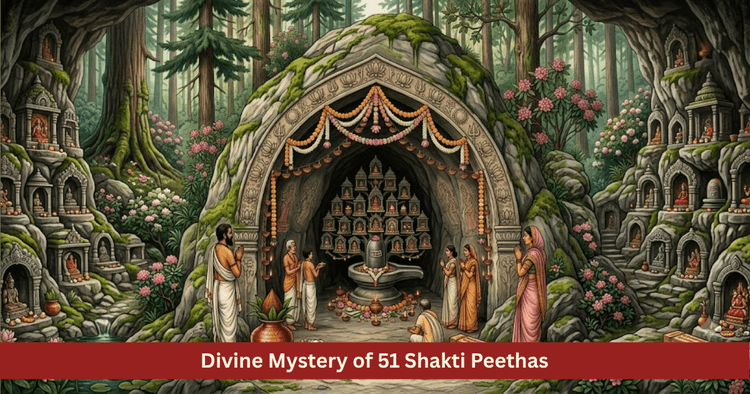
Table of Contents
Know the Main Details First
Shakti Peethas are sacred places where, according to Puranic tradition, the body parts, ornaments or garments of Mata Sati fell. These centres spread across India and neighbouring regions are regarded as self manifested seats of divine feminine power. During Navratri, pilgrimage, remembrance and worship connected with these Peethas hold special importance because this period is devoted to Shakti worship.
The number of Shakti Peethas, their locations and the details of the body parts differ across Puranas and folk traditions. Some accounts mention 51, some 52 and some a larger number. Therefore, it is not appropriate to treat any single list as the only final truth. Even so, the story of Sati, the grief of Shiva and the Sudarshan Chakra of Vishnu form the foundation of the Shakti Peetha tradition.
Primary Information About Shakti Peethas
- Central story: Daksha Yajna, Sati offering her body in yogic fire and the grief dance of Shiva
- Establishment of Peethas: where Sati's body parts, garments or ornaments fell, Shakti Peethas arose
- Common number: 51 principal Shakti Peethas
- Geographical spread: sites connected with India and regions linked with Nepal, Bangladesh, Pakistan and Sri Lanka
- Main forms of the Goddess: Sati, Durga, Kali, Kamakhya, Jwalamukhi and other regional forms
- Navratri connection: Shakti worship, Goddess pilgrimage and spiritual travel
- Suitable time: Chaitra and Sharad Navratri, Ashtami, Navami and auspicious Muhurat
- Feeling of darshan: not only travel but remembrance of courage, compassion and protection of Dharma
- Precautions: attention to crowds, safety, local rules and health
- Core message: Shakti is present in the temple outside and in spiritual practice within
| Major Shakti Peetha | Place | Traditional Body Part or Symbol | Principal Name of the Goddess |
|---|---|---|---|
| Kamakhya | Guwahati, Assam | Yoni or creative power | Kamakhya |
| Kalighat | Kolkata, West Bengal | Toe of the right foot | Kalika |
| Jwalamukhi | Kangra, Himachal Pradesh | Tongue | Jwalamukhi |
| Vaishno Devi | Jammu and Kashmir | Head or related symbol | Vaishnavi |
| Ambaji | Gujarat | Heart | Amba |
| Vindhyavasini | Vindhyachal, Uttar Pradesh | Right breast or regional belief | Vindhyavasini |
| Vishalakshi | Varanasi, Uttar Pradesh | Earring or eye related symbol | Vishalakshi |
| Lalita | Prayagraj, Uttar Pradesh | Fingers | Lalita |
| Harsiddhi | Ujjain, Madhya Pradesh | Elbow | Harsiddhi |
| Pushkar Manibandh | Rajasthan | Wrist | Related form of the Goddess |
| Tara Peeth | West Bengal | Eye related belief | Tara |
| Kanyakumari | Tamil Nadu | Back or related symbol | Kanyakumari |
The Story of Sati and the Origin of Shakti Peethas
The immortal story of the Shakti Peethas begins with the Yajna of Daksha Prajapati. Daksha organised a grand sacrifice but did not invite his son in law, Lord Shiva. Sati, the daughter of Daksha and the consort of Shiva, went to her father's sacrifice. There the insult of Shiva became unbearable for her.
Sati gave up her body in yogic fire. The grief of Shiva became boundless. Carrying the lifeless body of Sati on his shoulder, he wandered in sorrow. His Tandava shook creation. Then, for the protection of the worlds, Lord Vishnu used the Sudarshan Chakra and divided the body of Sati. Wherever a body part, garment or ornament fell, a seat of divine Shakti appeared.
This story is not only a narrative of grief. It holds the message of love, honour, the consequence of insult, the destructive form of sorrow and finally the protection of Dharma. The sacrifice of Sati is connected with self respect and the dignity of her consort. The grief of Shiva shows that love and power are not separate from each other. The intervention of Vishnu symbolises the restoration of cosmic balance.
Spiritual Meaning of a Shakti Peetha
The word Shakti Peetha means a seat or established centre of power. It is regarded not only as a geographical place but also as a centre of consciousness. A devotee goes there to experience a particular form of the Goddess. One Peetha represents creative power, another knowledge, another fierce protection and another compassion.
Shakti Peethas remind the devotee that divine power is not limited to one temple, one language or one region. It appears in many forms, many lands and many traditions. This is why Peethas such as Kamakhya, Jwalamukhi, Kalighat, Vaishno Devi and Vindhyavasini receive equal reverence in different regions.
Spiritual Benefits of Shakti Peetha Darshan
- Remembrance of the many forms of the Goddess
- Growth of courage and surrender in the mind
- Connection with family tradition and pilgrimage
- An opportunity to reduce ego
- Inspiration toward service, charity and restraint
- Patience during the difficulties of life
- Respect for feminine power and motherhood
- Gratitude toward nature and the land
Connection Between Navratri and Shakti Peethas
Navratri is the festival of Shakti worship. During these nine days, the different forms of Goddess Durga are worshipped. Shakti Peethas join Navratri practice with pilgrimage and sacred remembrance. Many devotees take a resolve to visit a Shakti Peetha during Navratri. Those who cannot travel may remember the Peethas at home, worship through images or undertake a mental pilgrimage.
The feeling of remembering Shakti Peethas during Navratri is that the devotee should not remain limited only to household worship. The devotee should understand that Shakti is vast. The creative energy of Kamakhya, the fiery power of Jwalamukhi, the fierce compassion of Kalighat and the protective strength of Vaishno Devi can deepen the practice of different days of Navratri.
How to Practise Shakti Peetha Remembrance During Navratri
- Remember one major Shakti Peetha each day.
- Chant the name of the Goddess of that Peetha.
- Light a lamp and offer flowers and Akshat.
- Recite Durga Saptashati or Durga Chalisa.
- If possible, visit a nearby temple of the Goddess.
- Join the practice with Kanya Puja or food donation.
- If travel is planned, arrange everything in advance.
- After darshan, take a resolve of gratitude and good conduct.
Major Shakti Peethas and Their Symbols
A brief introduction to some major Peethas is given below. Details of the body parts may differ according to tradition.
Kamakhya Shakti Peetha
The Kamakhya Peetha in Guwahati, Assam, is associated with creative power, the power of desire and the mystery of nature. The form of the Goddess here is ancient and unique. During Navratri, remembrance of Kamakhya may be joined with a prayer for creativity, balanced desire and spiritual energy.
Kalighat Shakti Peetha
Kalighat in Kolkata is a famous Peetha of Kalika. Tradition connects it with the toe of Sati. The form of Kali is not merely terrifying. She is the compassionate power that destroys Adharma and ignorance. During Navratri, remembrance of Kali inspires the devotee to become free from inner fear and ego.
Jwalamukhi Shakti Peetha
Jwalamukhi in Himachal Pradesh is known for its flame manifestations. It is connected with the tongue of Sati. Fire is a symbol of speech, radiance and the light of truth. Keeping speech pure by remaining away from falsehood, harshness and slander can become a practical form of Jwalamukhi practice.
Vaishno Devi Shakti Peetha
Vaishno Devi on Trikuta mountain is a centre of faith for millions of devotees. This Peetha is associated with protection, courage and the testing of devotion. The difficult climb is not only of the body but also of the mind. During Navratri, remembrance of Vaishno Devi is a practice of patience and fidelity.
Ambaji and Vindhyavasini
Ambaji in Gujarat is connected with the heart. The heart is the seat of love, compassion and resolve. Vindhyavasini in Uttar Pradesh is regarded as the Goddess of power and public protection. Both Peethas show that Shakti appears in both firmness and tenderness.
The Wider Message of the 51 Peethas
The number 51 may be understood as a sign of completeness and expansion. The presence of many Peethas of one Goddess shows that truth is one, yet its experiences are many. One devotee sees Shakti in a fierce form, another in a motherly form, another as knowledge and another as protection.
Shakti Peethas are also symbols of the cultural unity of India. Kamakhya in the east, Ambaji in the west, Jwalamukhi and Vaishno Devi in the north, Ujjain and Vindhyavasini in the centre and Kanyakumari in the south bind the land in one thread of devotion. Sites connected with neighbouring regions also remind devotees that sacred faith can be larger than borders.
Practical Rules for Shakti Peetha Travel
- Check health and weather before travel.
- Follow local tradition and temple rules.
- Give special attention to children and elders in crowds.
- Do not pollute the pilgrimage place with plastic and waste.
- Avoid improper pressure from priests or agents.
- Stay away from publicity that spreads fear or blind belief in the name of darshan.
- Give charity with discretion.
- Keep the journey a spiritual journey rather than a photograph journey.
- Respect women, workers and service staff.
- After returning home, continue good conduct and regular worship.
Astrological and Psychological Perspective
In Vedic astrology, Shakti worship is connected with the mind, courage, speech and power of action. The Moon represents emotions, Mars represents courage, the Sun represents self strength, Mercury represents speech and Jupiter represents righteous intelligence. Darshan of Shakti Peethas may inspire balance among these tendencies.
From a psychological view, pilgrimage takes a person out of a familiar environment. A new place, a new routine and collective devotion can lighten the mind. When a devotee completes a difficult path, awareness of patience, limitation and resolve becomes clearer. This experience later helps in worldly challenges.
Mental Benefits of Shakti Peetha Remembrance During Navratri
- Faith in place of fear
- Experience of reduced isolation
- A purposeful daily routine
- Reduction in anger and complaint
- Growth of the feeling of service
- Fresh reflection on the priorities of life
Difference Between Shakti Peetha and Siddha Peetha
A Shakti Peetha is generally regarded as a self manifested or Puranic centre connected with the story of the falling of Sati's body parts. A Siddha Peetha may be a place where power is believed to have been awakened through saints, practitioners or a special spiritual tradition. Both are centres of faith, but their origin stories may differ.
During Navratri, a devotee may visit any sacred centre of Shakti. The importance does not lie in competition between places but in devotion and inner change. For a devotee who cannot travel to a distant Peetha, a nearby temple of the Goddess may also be complete.
Method of Remembering Shakti Peethas at Home
Not every devotee can travel to all 51 Peethas. Remembrance at home is also possible.
- Keep a map or list during Navratri.
- Write the name and place of one Peetha each day.
- Light a lamp and meditate on the Goddess.
- Chant Om Durgayai Namah or the Navarna Mantra.
- Resolve to practise one virtue on that day.
- On Friday or Navami, offer food to girls.
- Support service or a cleanliness effort at a Shakti Peetha if possible.
- Keep a future resolve for travel but avoid display.
Symbolic Reading of the Body Part Narratives
The falling of the body parts of Sati is not only a physical description. Each part can become a symbol of some aspect of life force.
- Head: discernment and leadership
- Eyes: right vision and seeing the truth
- Tongue: pure speech
- Heart: compassion and love
- Hands: service and action
- Feet: path and progress
- Creative power: the stream of life and generation
- Ornaments: inner beauty rising above outer display
From this view, Shakti Peetha practice joins every part of the body with sacred responsibility. Not seeing with hatred, not speaking with violence, not acting with injustice and not becoming cruel at heart can also become the fruit of Shakti Peetha darshan.
Geography of Power and the Inner Self
The mystery of the 51 Shakti Peethas does not lie only in knowing which body part of Sati fell where. The deeper mystery is that divine power is believed to be present in every particle of the earth and also within the devotee. Navratri reminds the seeker that Goddess Durga protects in many forms and not only in one form.
A devotee who visits a Shakti Peetha should bring home the peace, service and self reflection of the place more than the grandeur of the temple. A devotee who remains at home may also touch the same power through the name of the Goddess, charity, restraint and courage. When faith becomes a journey and the journey becomes conduct, Shakti Peethas no longer remain mere points on a map. They become sacred foundations that support life.
FAQ
What are the 51 Shakti Peethas?
Shakti Peethas are sacred places where, according to Puranic tradition, the body parts, garments or ornaments of Mata Sati fell and centres of divine feminine power were established.
How did the body parts of Sati fall on the earth?
After Sati gave up her body in the Yajna of Daksha, Shiva performed the Tandava in grief. For the protection of the worlds, Vishnu divided the body with the Sudarshan Chakra and the parts fell at different places.
Do all scriptures mention only 51 Shakti Peethas?
No. Traditions mention 51, 52 or more Peethas. Details of places and body parts may also differ.
Why is Shakti Peetha darshan considered important during Navratri?
Navratri is the period of Shakti worship. During these days, remembrance or darshan of Shakti Peethas joins the devotee with the many forms of the Goddess, courage and surrender.
What should one do if travel to a Shakti Peetha is not possible?
Remembrance of the Peethas at home, chanting the name of the Goddess, offering a lamp, good conduct, charity and worship at a nearby temple of the Goddess can also become meaningful spiritual practice.
Get your accurate Kundali
Generate KundaliDid you like it?
Author

Pt. Nilesh Sharma (63)
Experience: 20
Consults About: Family Planning, Career
Clients In: Punjab, Haryana, Delhi
Share this article with friends and family
About ZODIAQ
ZODIAQ is an online Vedic Astrology platform. It connects clients seeking astrological advice to experienced astrologers with deep knowledge. Our users also generate kundali and perform kundali milan for free. ZODIAQ also offers services to the Astrologers. Astrologers utilize various offerings by ZODIAQ to serve their clients effectively.
If you are a User
Consult with experienced astrologers and seek their guidance. You can also order handwritten Janm Patrika report with life prediction prepared by experienced astrologers. Generate accurate Kundali, perform Kundali Matching and check horoscope and muhurat. Utilize our online library for all the necessary astrological and spiritual information.
If you are an Astrologer
Create accurate kundali for your clients and perform Kundali Matching for up to 5 people at a time. Write comprehensive Janm Patrika report for your clients with ZODIAQ. Check client details anytime by saving it in client directory. Become more productive by tracking how many clients you guide every day.
WELCOME TO
ZODIAQ
Right Decisions at the right time with ZODIAQ
