Divine Weapons of Goddess Durga
By Pt. Sanjeev Sharma
Who gave each weapon and what it represents spiritually
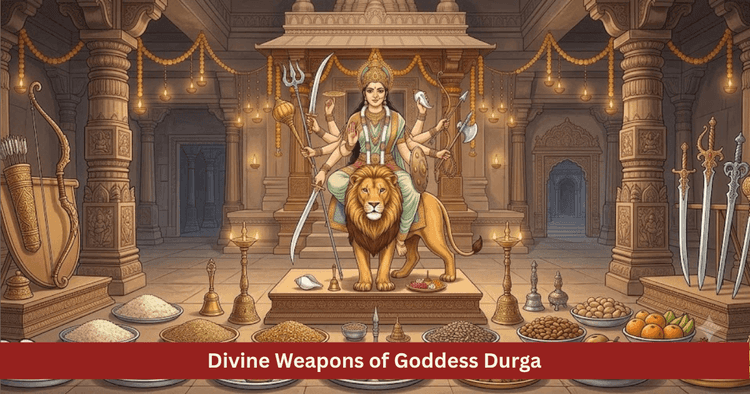
Table of Contents
Know the Main Details First
The weapons seen in the hands of Goddess Durga are not merely instruments of war. They represent the collective support of divine powers, the protection of Dharma and victory over inner weaknesses. When Mahishasura and other demonic forces threatened the order of the world, the Devas united their powers and gave the Goddess divine strength.
The names of the divine donors and the meanings of the weapons vary slightly across scriptures, Devi Mahatmya traditions and regional practices. therefore it is not appropriate to treat one popular list as the only final version. Even so, the Trishula, Sudarshan Chakra, Shankha, bow and arrows, Vajra, spear, sword, shield, noose and lotus are regarded as major symbols of Goddess Durga.
Primary List of the Goddess's Weapons
- Trishula: a symbol of the power received from Lord Shiva
- Sudarshan Chakra: a symbol of protection of Dharma received from Lord Vishnu
- Shankha: a symbol of awakened consciousness and sacred sound associated with Varuna
- Bow and arrows: the power of focus and direction associated with Vayu
- Shakti or spear: the radiance associated with Agni
- Vajra: unbreakable willpower received from Indra
- Khadga: knowledge, discernment and the end of illusion
- Shield and armour: protection, patience and healthy boundaries
- Pasha: control over attachment, ego and uncontrolled tendencies
- Lotus: purity, peace and spiritual awakening
- Bell: awakening of consciousness and removal of negativity
- Mace: strength, stability and the power of righteous action
| Weapon or Symbol | Traditional Donor | Spiritual Meaning |
|---|---|---|
| Trishula | Lord Shiva | Control over the three Gunas and ego |
| Sudarshan Chakra | Lord Vishnu | Movement of time, Dharma and discernment |
| Shankha | Varuna | Sacred sound and awakening of consciousness |
| Bow and arrows | Vayu | Aim, movement and concentration |
| Shakti or spear | Agni | Radiance, courage and piercing ignorance |
| Vajra | Indra | Firm resolve and inner strength |
| Khadga | Different traditions connect it with Ganesha, Kala or divine knowledge | Cutting through illusion and ignorance |
| Shield or armour | Associated with Yama, Vishvakarma or protecting powers | Security and self control |
| Pasha | Associated with Varuna or other protecting powers | Recognising and controlling bondage |
| Lotus | Associated with Brahma | Purity and spiritual development |
| Bell | Associated with the power of Indra's elephant Airavata | Awakening and removal of fear |
| Mace | Associated with Vishnu or divine power traditions | Stable strength and righteous action |
The Story of the Divine Weapons
In the Devi Mahatmya tradition, the Goddess appears as the collective form of the radiance of the Devas. The Devas became concerned because of the oppression caused by Mahishasura. From the combined radiance of Brahma, Vishnu, Shiva and other Devas, a magnificent divine power emerged. This power later became known as Durga.
After the Goddess appeared, the Devas presented their respective weapons to her. The deeper meaning of this scene is that when Dharma faces danger, different powers within society must unite in one direction. No single ability can face Adharma alone. Knowledge, courage, discipline, protection and compassion together create complete strength.
The presence of many weapons in the hands of the Goddess also teaches that the problems of life are not all of one kind. Sometimes discernment is needed, sometimes patience, sometimes a firm decision and sometimes compassion. The Goddess represents the balanced form of all these qualities.
The Trishula of Lord Shiva
The Trishula is the most well known weapon of Goddess Durga. According to tradition, Lord Shiva presented the Trishula to the Goddess. Its three points are regarded as symbols of Sattva, Rajas and Tamas. They are also connected with the three times, the three worlds and the balance of body, mind and spirit.
The Trishula does not mean only the destruction of evil beings. It also teaches the recognition of three major forms of inner imbalance. Laziness may be connected with Tamas, excessive desire with Rajas and ego can disturb even a Sattva dominated mind. The devotee is encouraged to become the master of these qualities instead of becoming their servant.
Inner Message of the Trishula
- Victory of awareness over laziness
- Control of uncontrolled desire through discipline
- Establishment of humility over ego
- Balance among body, mind and spirit
- A wise view of the past, present and future
From an astrological view, the Trishula reminds one of the balanced qualities of Mars, the Sun and Saturn. Mars gives courage, the Sun gives self strength and Saturn teaches discipline. Their imbalance creates conflict while their balance gives power to action.
The Sudarshan Chakra of Lord Vishnu
The Sudarshan Chakra is the divine weapon associated with Lord Vishnu. The Chakra given to the Goddess represents the protection of Dharma, the movement of time and the destruction of Adharma. It keeps moving continuously. therefore it also represents the unbroken flow of time and the results of action.
Sudarshan can also be understood as a beautiful or correct vision. Right vision takes a person beyond confusion. When the mind is covered by prejudice, fear or ego, judgment becomes unclear. The Chakra of the Goddess represents the clear vision that can distinguish truth from falsehood.
Inner Negativities Cut by the Chakra
- Confusion
- Injustice
- Ego
- Wrong viewpoint
- Old negative habits
- Unnecessary delay in decision making
The Chakra also teaches that time does not stop for anyone. A person who keeps postponing righteous action may lose an opportunity. therefore along with Goddess worship, respect for time and readiness in action are also necessary.
The Shankha of Varuna
The Shankha is regarded as a divine symbol received from Varuna. Its sound is associated with sacred vibration and the awakening of consciousness. Blowing the Shankha during worship creates concentration and marks the feeling of beginning and completion.
The Shankha symbolises the awakening of inner inactivity. When the mind becomes closed in fear, confusion or disappointment, its sound gives a message to awaken. Its spiral shape is also regarded as a symbol of life's journey and inward reflection.
Spiritual Meaning of the Shankha
- Sacred sound
- Beginning of a new resolve
- Victory of awareness over fear
- Purification of mind and surroundings
- Spread of the message of Dharma
While blowing the Shankha, the comfort and health of others should be considered. Excessively loud sound may disturb some people. The purpose of worship is peace and not noise.
Bow and Arrows of Vayu
The bow and arrows are regarded in several traditions as gifts associated with Vayu. The bow represents potential and the arrow represents active power moving toward a target. Energy is stored in the bow and the arrow is released at the right time.
Desire alone is not sufficient in life. Desire must be joined with a goal, preparation and action. The bow teaches preparation and patience. The arrow inspires the devotee to decide at the proper time and move forward.
Life Message of the Bow and Arrows
- Keep the goal clear.
- Do not make a decision without preparation.
- Do not scatter energy in unnecessary directions.
- Do not hesitate when an opportunity arrives.
- Focus on action before the result.
The bow and arrows are also connected with mental concentration. The strength of a person whose mind moves in every direction becomes scattered. The arrow of the Goddess represents focused effort and firm resolve.
The Shakti or Spear of Agni
The Shakti, spear or divine lance is associated with Agni. Fire represents light, heat, transformation and purification. A spear moves directly forward and has the ability to pierce its target.
This weapon teaches the need to pierce inner ignorance, confusion and dullness. Sometimes a devotee must face uncomfortable truths about life. When a person accepts a mistake, the path of improvement becomes open.
Inner Meaning of the Shakti
- Courage to face truth
- Knowledge that pierces ignorance
- Energy that burns laziness
- Direct movement toward a goal
- Radiance and clarity in resolve
Fire should be used carefully in worship. Respect for a spiritual symbol becomes complete only when fire safety is also observed.
The Vajra of Indra
The Vajra is regarded as a divine weapon received from Indra. It represents hardness, strength and unbreakable resolve. It shows the willpower that does not collapse during difficult circumstances.
Many obstacles in human life do not come from outside. They arise within as fear, self doubt, anxiety about failure and concern about the criticism of others. The Vajra teaches the power to break these mental barriers.
Message of the Vajra
- Remain patient during difficult times.
- Stay firm in a right decision.
- Face fear instead of running away from it.
- Join self confidence with action.
- Remain firm on the side of truth.
Vajra does not mean stubbornness. If a decision proves to be wrong, correcting it is also wisdom. It is important to understand the difference between firmness and rigidity.
The Secret of the Sword and Shield
The sword is regarded as a symbol of knowledge, discernment and the cutting of ignorance. Some traditions associate it with Ganesha, Kala or divine knowledge. The name of the donor differs in various accounts but the meaning remains clear. The sword is the intelligence that cuts through confusion.
The shield or armour represents protection. Dharma is not protected only through attack. Setting boundaries, staying away from harmful company and practising self control are also forms of protection.
Lessons from the Sword and Shield
- The sword gives clarity in decision making.
- The sword represents cutting falsehood and confusion.
- The shield teaches self protection and wise distance.
- Armour represents mental steadiness and discipline.
- Strength must remain balanced with protection.
A person who knows only how to attack is not balanced. The presence of both defensive and offensive symbols in the hands of the Goddess shows that Dharma may require both compassion and firmness.
Pasha, Bell and Lotus
The Pasha is regarded as a symbol of control over bondage. A person may become bound by desire, fear, anger, habit and unhealthy dependence in relationships. The Pasha represents the power to recognise and control these bonds.
The bell represents the awakening of consciousness. Its sound brings the mind into the present moment. The purpose of ringing the bell in worship is not only to frighten negative forces. It also creates awareness within the devotee.
The lotus is not a weapon, yet its importance is profound. The lotus grows in mud but the mud does not remain on its petals. It teaches the ability to live in the world while preserving purity.
Combined Meaning of These Symbols
- The Pasha recognises attachment.
- The bell awakens consciousness.
- The lotus teaches purity and balance.
- Together they purify mind, action and surroundings.
Weapons of the Goddess and Inner Practice
Connecting the weapons of the Goddess only with outer warfare limits their meaning. Each weapon is also a means of overcoming an inner weakness or fault.
| Inner Problem | Symbolic Weapon | Message of Practice |
|---|---|---|
| Ego | Trishula | Humility and self knowledge |
| Confusion | Sudarshan Chakra | Clear vision and discernment |
| Fear | Vajra | Courage and firmness |
| Laziness | Shakti or spear | Energy and action |
| Lack of direction | Bow and arrows | Focus and direction |
| Negative speech | Shankha | Sacred sound and restraint |
| Unhealthy attachment | Pasha | Boundaries and self control |
| Ignorance | Sword | Knowledge and judgment |
| Insecurity | Shield | Protection and patience |
| Impure tendency | Lotus | Purity and inner awakening |
This perspective encourages the devotee to improve within instead of searching only for an outer enemy. The greatest victory of the Goddess is the one in which a person aligns conduct, speech and thought with Dharma.
Weapons from an Astrological View
In Vedic astrology, planets are regarded as indicators of different powers and tendencies in life. The weapons of the Goddess help explain the balanced form of these planetary qualities.
- Surya, the Sun: self strength and leadership
- Chandra, the Moon: mind and emotional peace
- Mangala, Mars: courage and power of action
- Budha, Mercury: intelligence, logic and communication
- Guru, Jupiter: Dharma, knowledge and guidance
- Shukra, Venus: beauty, compassion and balance
- Shani, Saturn: discipline, patience and results of action
- Rahu: control over confusion and unusual desires
- Ketu: detachment and inner discernment
In Goddess worship, the balance of these planets appears more through improvement in conduct than through outer remedies alone. Merely reciting the names of weapons does not guarantee the removal of planetary difficulties. Charity, truthful action, service, restraint and qualified astrological guidance may also be necessary.
Life Messages from the Divine Weapons
- Strength should be used for protection.
- Courage without knowledge can become blind.
- Victory without compassion can become harshness.
- Talent without discipline can become scattered.
- Relationships without boundaries can become bondage.
- Worship without truth can remain an outer action.
- Inner strength should remain joined with humility.
- Protection of Dharma begins with personal conduct.
Balance of Strength and Compassion
The weapons of Goddess Durga are not meant to create fear. They show that compassion does not mean weakness and strength does not mean cruelty. The Mother holds a weapon in one hand and offers Abhaya, the gesture of fearlessness, with another. This form teaches that firmness may be needed to protect Dharma but its final purpose must be peace and welfare.
The presence of weapons from many Devas in the hands of the Goddess symbolises collective strength. In life as well, the different abilities within a family, society and workplace can face even a serious crisis when they work together. Every person carries some divine weapon within. One person has knowledge, another courage, another patience and another compassion.
Awakened Power Within the Weapons
The Trishula, Chakra, Shankha, bow and arrows, Vajra, Shakti, sword and other symbols of Goddess Durga show that victory of Dharma does not come only through outer battle. Victory over darkness of mind, mistakes in action and impurity of thought is equally important.
When a devotee looks at the Trishula, the balance of personal qualities should come to mind. The Chakra reminds one of time and discernment. The Shankha awakens consciousness. The bow and arrows inspire focus on the goal. The Vajra strengthens resolve. The sword cuts confusion and the lotus teaches purity while living in the world.
The real secret of the weapons of Goddess Durga is that they are outer symbols that must be awakened as inner powers. When a person brings these qualities into life, worship of the Goddess becomes more than visual reverence. It becomes a living spiritual practice filled with courage, wisdom, discipline and compassion.
Get your accurate Kundali
Generate KundaliDid you like it?
Author

Pt. Sanjeev Sharma (63)
Experience: 20
Consults About: Family Planning, Career
Clients In: Punjab, Haryana, Delhi
Share this article with friends and family
About ZODIAQ
ZODIAQ is an online Vedic Astrology platform. It connects clients seeking astrological advice to experienced astrologers with deep knowledge. Our users also generate kundali and perform kundali milan for free. ZODIAQ also offers services to the Astrologers. Astrologers utilize various offerings by ZODIAQ to serve their clients effectively.
If you are a User
Consult with experienced astrologers and seek their guidance. You can also order handwritten Janm Patrika report with life prediction prepared by experienced astrologers. Generate accurate Kundali, perform Kundali Matching and check horoscope and muhurat. Utilize our online library for all the necessary astrological and spiritual information.
If you are an Astrologer
Create accurate kundali for your clients and perform Kundali Matching for up to 5 people at a time. Write comprehensive Janm Patrika report for your clients with ZODIAQ. Check client details anytime by saving it in client directory. Become more productive by tracking how many clients you guide every day.
WELCOME TO
ZODIAQ
Right Decisions at the right time with ZODIAQ
