Mahishasura Mardini Story Meaning
By Pt. Amitabh Sharma
Spiritual meaning of eighteen armed Mahalakshmi
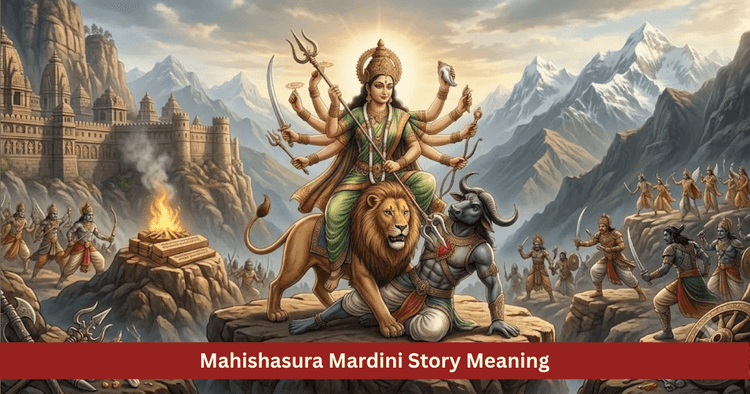
Table of Contents
Core Details of the Story
The Mahishasura Mardini story is one of the great spiritual narratives of the Indian tradition. It carries a deep message of truth, power, humility and the fall of adharma. When the terror of Mahishasura disturbed the gods, sages and the entire creation, Goddess Durga manifested from the radiance of Brahma, Vishnu and Mahesha.
In the tradition of Devi Bhagavata and Durga Saptashati the Mother is remembered as Mahalakshmi with eighteen arms or as Mahishasura Mardini. Each of her arms holds a weapon and each weapon represents a divine power.
Key Information
| Aspect | Details |
|---|---|
| Story | Mahishasura Mardini |
| Form of the Goddess | Eighteen armed Mahalakshmi |
| Origin | Radiance of Brahma, Vishnu and Mahesha |
| Enemy | Mahishasura |
| Main feeling | Victory of dharma over adharma |
| Spiritual meaning | Destruction of ego and awakening of Shakti |
Core Points of the Story
- Terror of Mahishasura
- Helplessness of the gods
- Radiance of the three deities
- Divine manifestation of the Goddess
- Weapons in eighteen arms
- Battle and victory
- Eternal message of Shakti
Who Was Mahishasura
Mahishasura was a powerful asura. According to the story he combined the form of a buffalo and human cunning. He could change his form at will. This ability made him an extremely difficult enemy in battle.
He performed severe austerity and received a boon that no man would be able to kill him. Because of this boon he became arrogant. He seized heaven and defeated the gods.
Symbol of Mahishasura
| Element | Meaning |
|---|---|
| Buffalo form | Inertia and ego |
| Shape shifting | Deception and confusion |
| Boon | Misused power |
| Terror | Expansion of adharma |
| Fall | End of ego |
Mahishasura is not only an outer demon. He also represents the human tendency in which a person loses humility after gaining power.
Why Did the Gods Become Helpless
When Mahishasura seized heaven Indra and the other gods became distressed. They went to Brahma, Vishnu and Shiva and presented their suffering.
This episode shows that position, force or outer strength alone is not enough. When adharma grows through boons and deception ordinary powers become insufficient. Then a united invocation of divine Shakti becomes necessary.
Condition of the Gods
- Displacement from heaven
- Obstruction in sacrifice and dharma
- Fear and instability
- Refuge in the three deities
- Collective prayer
Manifestation of the Goddess from Divine Radiance
According to the story radiance came forth from the faces of Brahma, Vishnu and Mahesha. The light of the other gods also joined that radiance. From that extraordinary mass of light the divine form of Maa Durga appeared.
This event is extremely important. The Goddess is not the power of one deity alone. She is the unified form of all divine radiance. Therefore she is called Adi Shakti, Mahamaya and Mahalakshmi.
Meaning of Radiance
| Source of radiance | Symbol |
|---|---|
| Brahma | Creation |
| Vishnu | Preservation |
| Mahesha | Dissolution and transformation |
| Other gods | Diverse powers |
| Combined radiance | Complete divinity |
Mahalakshmi with Eighteen Arms
Maa Mahishasura Mardini is described with eighteen arms. Each arm holds a weapon. These weapons are not only instruments of battle. They are symbols of different divine qualities and powers.
Main Weapons and Meanings
| Weapon | Spiritual meaning |
|---|---|
| Trident | Control over the three gunas |
| Discus | Cycle of time and dharma |
| Conch | Divine proclamation |
| Mace | Destruction of ego |
| Bow and arrow | Aim and concentration |
| Sword | Edge of discernment |
| Lotus | Purity |
| Thunderbolt | Unshakable truth |
| Noose | Breaking the bond of attachment |
| Goad | Control of the senses |
The eighteen arms show that the Goddess is not a limited power. She is complete Shakti working in many directions at once.
Why Was the Form of the Goddess Feminine
Mahishasura had received a boon that no man would be able to kill him. Therefore the feminine form of the Goddess was not only a narrative necessity. It also pointed to the truth that the original power of creation is not limited to masculine force. It is rooted in Adi Shakti.
The feminine form carries compassion, creation, protection and destruction together. The Goddess does not fight for the sake of battle alone. She fights for the protection of dharma.
Battle Between Mahishasura and the Goddess
The battle was extremely fierce. Mahishasura kept changing his form. At times he became a buffalo, at times a human, at times a lion and at times other forms. This shape shifting shows that ego does not remain in one form. It appears through many excuses and masks.
The Goddess faced him in every form. In the end she destroyed Mahishasura and established dharma.
Symbolic Stages of the Battle
- Rise of ego
- Crisis of dharma
- Divine invocation
- Manifestation of Shakti
- Struggle
- Victory
- Establishment of peace
Hidden Spiritual Meaning of the Story
The Mahishasura Mardini story is not only a story of outer battle. It is also the story of the struggle that takes place within the seeker.
Inner Symbols
| Outer story | Inner meaning |
|---|---|
| Mahishasura | Ego and tamas |
| Boon | Misused power |
| Defeat of the gods | Limit of ordinary intellect |
| Manifestation of the Goddess | Awakening of the inner self |
| Weapons | Discernment and restraint |
| Victory | Self purification |
When a person seeks only outer success and does not observe inner faults an ego like Mahishasura grows. Goddess sadhana is the path of cutting that ego.
Why Was the Radiance of the Three Deities Necessary
Brahma creates, Vishnu preserves and Shiva transforms. When adharma increases preservation alone is not enough. The powers of creation and transformation also become necessary.
The manifestation of the Goddess is the coordination of these three powers. It shows that building, protecting and ending wrong tendencies are all necessary in life.
Social Message of the Goddess Victory
This story teaches society that oppression, however powerful, is not eternal. When collective consciousness unites for truth and dharma change becomes possible.
The gods left personal ego and collectively invoked the Goddess. That collective spirit became the foundation of power.
Importance of This Story During Navratri
During Navratri the Mahishasura Mardini Stotra is specially recited. This hymn praises the victory, compassion and protective form of the Goddess.
During Navratri the seeker also fights the Mahishasura within. Victory over anger, greed, laziness, ego, fear and deception is the real destruction of Mahishasura.
Inner Asuras
- Ego
- Anger
- Greed
- Attachment
- Laziness
- Deception
- Fear
- Jealousy
Psychological Aspect of the Story
A human being often changes form to hide weaknesses. At times the person becomes angry, at times makes excuses and at times blames others. The shape shifting of Mahishasura is a symbol of this tendency.
The steady and concentrated form of the Goddess shows that truth cannot be defeated by many masks. Discernment, patience and right purpose finally win.
Mental Benefits
- Control over fear
- Self confidence
- Clear decisions
- Reduction of ego
- Inner courage
Feeling of the Mahishasura Mardini Stotra
In the Mahishasura Mardini Stotra the Goddess is called the mother of the world, the remover of misfortune and the destroyer of asuras. This hymn is not only a battle song. It is a stotra that awakens power and faith in the heart of the devotee.
Essence of the Stotra
| Feeling | Meaning |
|---|---|
| Victory | Proclamation of triumph |
| Mother | Compassion and protection |
| Weapons | Defence of dharma |
| Radiance | Divine light |
| Refuge | Complete surrender |
How to Remember the Story at Home
- Install an image of the Goddess during Navratri
- Light a lamp
- Listen to or recite the Mahishasura Mardini Stotra
- Offer red flowers
- Make a list of personal faults
- Take a resolve to conquer one fault
- Perform aarti and pray for forgiveness
Relevance of the Story in Modern Life
The Mahishasura of today is not only a figure of Puranic story. He may appear in society as corruption, injustice, ego, violence and falsehood. In personal life he may appear as laziness, anger, addiction and selfishness.
The invocation of the Goddess becomes meaningful when a person resolves to fight not only outer enemies but also inner faults.
Calm Closing Note
The Mahishasura Mardini story shows that when adharma reaches its peak divine power appears in a new form. The eighteen armed Mahalakshmi born from the radiance of Brahma, Vishnu and Mahesha is not only a Goddess of battle. She is the complete expression of dharma, compassion, discernment and courage.
This story teaches the seeker that true power is not ego. It is the protection of dharma. The person who recognises the Mahishasura within and faces it with Goddess given discernment attains real victory.
FAQ
Who is Mahishasura Mardini
She is the divine form of Maa Durga who destroyed Mahishasura and established dharma.
How was the Goddess born
The divine form of Maa Durga appeared from the radiance of Brahma, Vishnu, Mahesha and the other gods.
What do the eighteen arms of the Mother mean
The weapons in each arm symbolise different divine powers, qualities and means of protecting dharma.
What does Mahishasura represent
He is regarded as a symbol of ego, deception, tamas and misused power.
What lesson does this story give for life
It inspires protection of dharma, release of ego, the importance of collective strength and victory over inner faults.
Get your accurate Kundali
Generate KundaliDid you like it?
Author
Pt. Amitabh Sharma (56 Years)
Experience: 20
Consults About: Family Planning, Career
Clients In: Punjab, Haryana, Delhi
Share this article with friends and family
About ZODIAQ
ZODIAQ is an online Vedic Astrology platform. It connects clients seeking astrological advice to experienced astrologers with deep knowledge. Our users also generate kundali and perform kundali milan for free. ZODIAQ also offers services to the Astrologers. Astrologers utilize various offerings by ZODIAQ to serve their clients effectively.
If you are a User
Consult with experienced astrologers and seek their guidance. You can also order handwritten Janm Patrika report with life prediction prepared by experienced astrologers. Generate accurate Kundali, perform Kundali Matching and check horoscope and muhurat. Utilize our online library for all the necessary astrological and spiritual information.
If you are an Astrologer
Create accurate kundali for your clients and perform Kundali Matching for up to 5 people at a time. Write comprehensive Janm Patrika report for your clients with ZODIAQ. Check client details anytime by saving it in client directory. Become more productive by tracking how many clients you guide every day.
WELCOME TO
ZODIAQ
Right Decisions at the right time with ZODIAQ
