Home Navratri Havan Method Guide
By Pt. Narendra Sharma
Simple home method for Navami kund, wood, mantras and Swaha
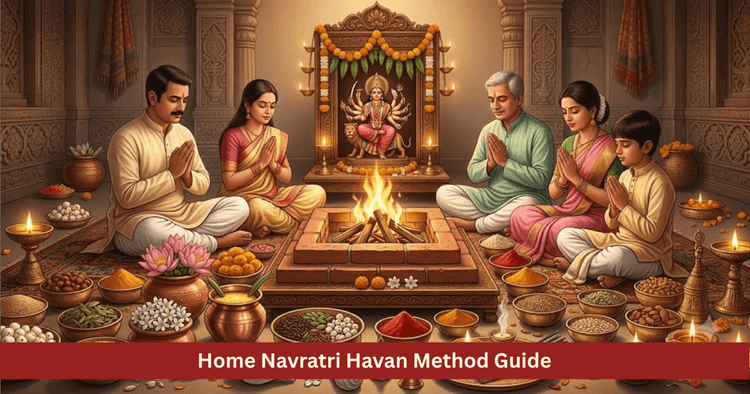
Table of Contents
Know the Materials and Rules First
Performing Havan on the Navami of Navratri is regarded as an important part of Goddess worship. Many families perform Havan with a priest and many devotees also complete a simple form of Havan at home with devotion. Havan at home should be done only when cleanliness, fire safety, proper materials and a calm mind are available.
Havan is not merely the act of placing materials into fire. It is a ritual of resolve, gratitude and inner purification. Instead of attempting a complex sacrifice without experience, it is more appropriate to follow a simple, safe and devotion filled method.
Primary Information for Navami Havan
- Suitable day: Navami of Navratri or Ashtami according to family tradition
- Suitable time: after the morning bath or an auspicious period before evening
- Place: a safe open balcony like space, courtyard or ventilated worship area
- Direction: sitting facing east or north is considered auspicious
- Main Mantras: Gayatri Mantra, Durga Mantras and the utterance of Swaha
- Fire base: Havan Kund, an earthen vessel or a safe metal kund
- Samidha: dry mango wood or another pure sacred wood if mango is unavailable
- Offerings: ghee, Havan mixture, barley, sesame, rice and Purnahuti materials
- Compulsory caution: distance from children, curtains and flammable objects
- Feeling: a quiet, restrained and grateful mind without display
| Material | Purpose | Point to Remember |
|---|---|---|
| Havan Kund or earthen vessel | To establish the sacred fire | Place it on a firm surface |
| Mango Samidha | Base for fire and offerings | Must be completely dry |
| Pure ghee | To kindle the fire and offer Ahuti | Do not pour too much at once |
| Havan mixture | For fragrant offerings | Must be free from plastic or chemicals |
| Barley, sesame, rice | For traditional Ahuti | Keep them clean and fresh |
| Camphor | For lighting the fire | Use only a limited quantity |
| Water vessel and Achamani | For purification and Achamana | Keep them nearby |
| Red cloth, Akshat, flowers | For resolve and worship | Choose clean materials |
| Bell, lamp, incense | For the opening worship | Keep them at a safe distance from fire |
| Purnahuti materials | For the closing of Havan | Coconut, jaggery and ghee as per tradition |
When and Why Havan Should Be Done at Home
On Navami, the worship of Goddess Durga moves toward completion. After nine days of prayer, fasting, chanting and service, Havan is regarded as the offering of the sacred resolve. Taking fire as witness, the devotee symbolically surrenders ego, fear, laziness and impure thoughts.
The purpose of performing Havan at home is not to reduce the importance of a priest. In complex rituals, special resolves or strong family traditions, the guidance of a priest remains superior. If the family is small, materials are limited and the devotee wishes to perform Havan through a calm method, a simple household Havan may be done with faith.
In the Vedic tradition, fire is regarded as a purifier. Its heat makes the outer atmosphere fragrant and brings the mind of the devotee into concentration. When Swaha is spoken with the Mantra, the feeling is that both the offered material and the connected intention are surrendered to the Divine.
How to Prepare the Havan Kund
The Havan Kund is the seat of the sacred fire. A large sacrificial construction is not necessary at home. A small and safe arrangement is enough.
Steps for Preparing the Kund
- Choose a firm and level place where strong wind does not blow.
- Place heat resistant bricks, an iron plate or a layer of earth on the floor.
- Keep the Havan Kund or deep earthen vessel in the center.
- A thin layer of ash or sand may be placed below the kund.
- Keep safe empty space on all sides.
- Keep a large vessel of water nearby.
- Ensure that no ceiling cloth, fan cover or hanging decoration is above the fire.
- Do not allow the kund to shake. A stable base is essential.
If a metal kund may become too hot, place bricks beneath it. Never perform Havan on a wooden floor, table or plastic surface. When performing Havan in an apartment, ventilation and society rules must be respected.
How to Arrange Mango Wood and Samidha
Mango Samidha is considered special in Havan. Its fragrance is Sattvic and traditional. The wood must be completely dry. Wet wood creates excess smoke and makes the fire unstable.
Simple Method of Arranging Samidha
- Choose small dry pieces of mango wood.
- Do not place very thick wood at the beginning.
- Keep a little cotton or camphor in the center of the kund.
- Arrange thin Samidha around it in a slanted manner.
- Leave some open space above so that oxygen can reach the fire.
- Apply a few drops of ghee on the Samidha.
- After the fire becomes stable, add more Samidha gradually.
- Do not cover the fire by placing too much wood at once.
Arranging Samidha is not only a technical act. Just as the wood is placed in order, the thoughts of the devotee should also become orderly. An unsteady fire and an unsteady mind both disturb the peace of Havan.
Pure List of Havan Materials
In a home Havan, fewer materials of pure quality are enough. Expensive and excessively mixed materials are not necessary.
- Pure cow ghee
- Mango Samidha
- A Sattvic Havan mixture
- Barley
- Sesame seeds
- Rice
- Lotus seeds or Guggul, if available
- Loban in a small quantity
- A piece of dry coconut
- A small quantity of jaggery
- Camphor
- Akshat
- Flowers
- Red cloth
- Water and Panchapatra
The Havan mixture should not contain plastic, artificial fragrance, chemical incense or unknown powders. Materials that create heavy smoke may cause discomfort in a closed room. Keep smoke limited near family members with breathing difficulty.
How to Perform Havan at Home Without a Priest
While performing Havan personally, the method does not need to become complicated. Order is the most important quality.
Step by Step Method of Havan
- Bathe and wear clean clothes.
- Purify the worship area and the Havan space.
- Meditate on Goddess Durga and light a lamp and incense.
- Calm the mind through Achamana and gentle breathing.
- Take a resolve that this Havan is for the pleasure of Goddess Durga and the welfare of the family.
- Light the fire in the kund with safety.
- After the fire becomes stable, offer a small Ahuti of ghee.
- Offer Samidha.
- With every offering, recite the Mantra and speak Swaha at the end.
- Offer barley, sesame, rice and Havan mixture in order.
- Give special offerings with Durga Mantras.
- In Purnahuti, offer coconut, jaggery, ghee and the remaining materials.
- Remain seated in prayer until the fire becomes calm.
- After the ash cools, immerse or store it respectfully.
- Distribute Prasad and conclude the Havan.
The resolve may also be spoken in simple language. A long Sanskrit recitation is not compulsory. Clear pronunciation and pure feeling are superior.
Gayatri and Durga Mantras with Swaha
In Havan, Mantras give a divine feeling to the offering while addressing the sacred fire. At home, fewer and pure Mantras are enough.
Simple Mantra Sequence
- Om Ganeshaya Namah Swaha
- Om Durgayai Namah Swaha
- Om Aim Hreem Kleem Chamundayai Vicche Swaha
- Gayatri Mantra followed by Swaha
- Om Jayanti Mangala Kali Bhadrakali Kapalini. Durga Kshama Shiva Dhatri Swaha
- Any short Durga Stotra from family tradition
- At the end, gratitude with the feeling of fullness and completion
The feeling of the Gayatri Mantra is to bring light to the intellect. The feeling of Durga Mantras is strength, protection and the removal of fear. Swaha means surrender. With every Swaha, place a small amount of material into the fire. There is no need to shout loudly. A steady voice and a calm rhythm are enough.
Points to Remember While Offering Ahuti
- Offer a small Ahuti with the right hand.
- Place the material in the center of the fire.
- Do not suddenly increase the flow of ghee.
- Speak Swaha only after the Mantra is complete.
- If smoke reaches the eyes, sit a little away and remain calm.
- Do not allow clothes to come near the flame.
- Do not place too many sweets or large coconut pieces at once.
- If the fire begins to weaken, support it with ghee and thin Samidha.
How to Perform Purnahuti
Purnahuti is the completion of Havan. Its feeling is that the fruit of spiritual practice is offered to the Divine and the devotee reduces attachment to results while accepting gratitude.
Simple Process of Purnahuti
- Keep the fire stable and bright.
- Prepare a little ghee, jaggery, coconut and remaining Havan mixture together.
- Pray to Goddess Durga for forgiveness and grace.
- Offer the Purnahuti materials and speak Swaha.
- Sit in silence for a few moments.
- Ring the bell and perform Aarti.
- Offer Akshat and flowers over all family members.
- Distribute Prasad.
After Purnahuti, the fire should not be extinguished forcefully with water unless safety makes it necessary. Allowing the fire to become calm by itself is considered more appropriate. If immediate extinguishing is required, use water slowly and carefully.
Compulsory Fire Safety Rules
In a home Havan, safety stands above everything along with devotion. A small act of carelessness can become a major accident.
- Keep full attention on the fire during Havan.
- Keep children and pets away.
- Do not bend forward with open hair.
- Avoid loose synthetic clothes.
- Keep strong fan air switched off.
- Do not use the phone or engage in useless talk near the fire.
- Do not put hot ash immediately into plastic.
- Do not allow thick smoke to collect under the ceiling.
- Keep water and sand ready to control fire.
- If coughing increases or smoke becomes unbearable, shorten the Havan.
Spiritual and Astrological Feeling of Havan
In the Vedic view, Havan is not only an outer ritual act. Fire is a symbol of radiance, light and transformation. By offering Ahuti into the fire, the devotee resolves that the impure portion of life may burn and purity may remain.
Related Feelings and Planetary Indications
- Surya, the Sun: light, inner strength and clarity
- Fire element: purification, vitality and resolve
- Guru, Jupiter: Mantra, dharma and auspicious intelligence
- Mangala, Mars: energy, courage and power of action
- Chandra, the Moon: peace of mind and emotional purity
- Shukra, Venus: sweetness of the home and family harmony
- Shani, Saturn: purification of karma and discipline
The Havan of Navami binds the nine days of worship into one thread. For a devotee who has remained disciplined through all of Navratri, this Havan becomes a celebration of gratitude. For a devotee who wishes to perform the ritual only on the final day, it is still wise to begin with a simple method and take a resolve for regular spiritual practice afterward.
What Should Be Done After Havan
After Havan ends, the ritual is considered complete only when peace appears in conduct as well.
- Allow the kund to cool completely.
- Immerse the ash below a plant or in a river or clean place according to tradition.
- Clean the worship area.
- Take Sattvic food.
- Avoid anger, arguments and heavy food on that day.
- If a fast was observed, do Parana according to the proper method.
- Offer food, clothing or Dakshina to a person in need.
- Keep gentle speech within the family.
Do not throw the ash under the feet. Some traditions respect Havan ash like sacred residue. Storing it in a clean cloth or earthen vessel before immersion is superior.
Completeness Hidden in Simplicity
A Navratri Havan at home becomes successful when it remains free from fear, display and haste. Mango Samidha, pure ghee, Gayatri and Durga Mantras and the Swaha spoken with every offering remind the devotee that every action of life can be performed with a feeling of surrender.
Havan without a priest is possible, yet Havan without humility remains incomplete. Sitting before the fire teaches the devotee to become small. In that smallness, strength awakens. The Havan of Navami does not give only outer fragrance to the family. It also offers a chance to bring inner disorder into order. When the Mantras are calm, the fire is controlled and the mind is grateful, even a small Havan at home becomes a divine ritual.
FAQ
Can Navami Havan be performed at home without a priest?
Yes. Navami Havan may be performed at home with simple materials, fire safety and devotion. In complex resolves or special sacrifices, the guidance of a priest remains better.
Which wood is best for Havan at home?
Dry mango Samidha is considered most suitable. Wet, painted or chemically treated wood should not be used.
When should Swaha be spoken in Havan?
Swaha should be spoken while offering Ahuti after the Mantra recitation is complete. Swaha is the sign of surrender.
What is placed in Purnahuti?
In Purnahuti, ghee, jaggery, a piece of coconut and the remaining Havan materials are offered according to tradition. This symbolises the completion of Havan.
What precautions should be taken while doing Havan in an apartment?
Choose a ventilated place, use low smoke materials, keep water ready, place the fire on a stable base and fully respect neighbourhood and safety rules.
Get your accurate Kundali
Generate KundaliDid you like it?
Author

Pt. Narendra Sharma (63)
Experience: 20
Consults About: Family Planning, Career
Clients In: Punjab, Haryana, Delhi
Share this article with friends and family
About ZODIAQ
ZODIAQ is an online Vedic Astrology platform. It connects clients seeking astrological advice to experienced astrologers with deep knowledge. Our users also generate kundali and perform kundali milan for free. ZODIAQ also offers services to the Astrologers. Astrologers utilize various offerings by ZODIAQ to serve their clients effectively.
If you are a User
Consult with experienced astrologers and seek their guidance. You can also order handwritten Janm Patrika report with life prediction prepared by experienced astrologers. Generate accurate Kundali, perform Kundali Matching and check horoscope and muhurat. Utilize our online library for all the necessary astrological and spiritual information.
If you are an Astrologer
Create accurate kundali for your clients and perform Kundali Matching for up to 5 people at a time. Write comprehensive Janm Patrika report for your clients with ZODIAQ. Check client details anytime by saving it in client directory. Become more productive by tracking how many clients you guide every day.
WELCOME TO
ZODIAQ
Right Decisions at the right time with ZODIAQ
